Software
Houzz Logo Print
natalietobin

Undermount sink lip incorrect?

12 years ago
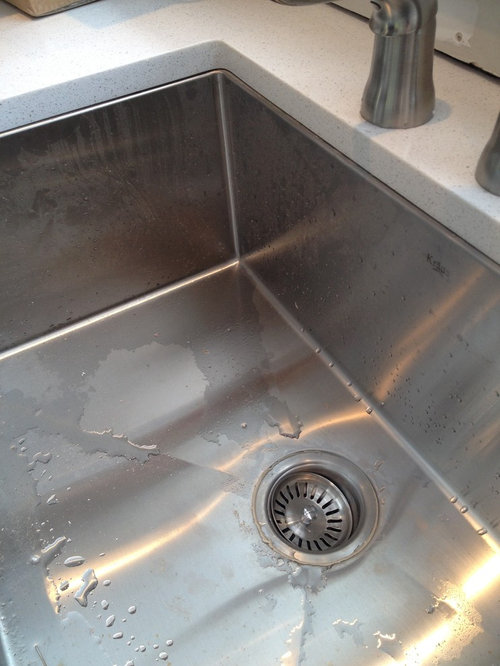
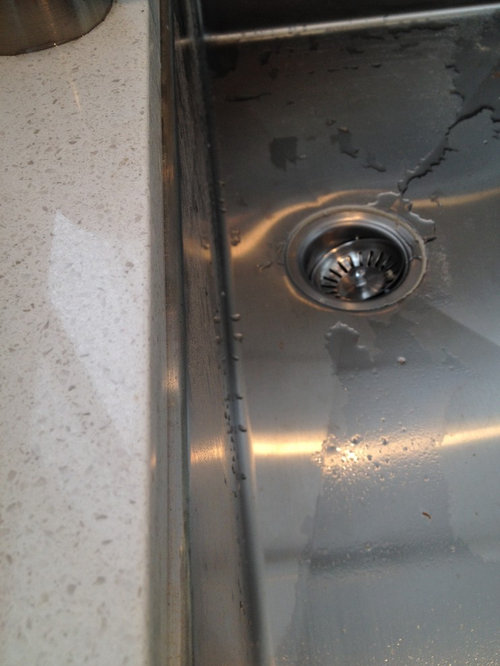
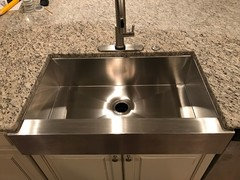
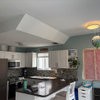
We just had an undermount sink and new countertops installed in our kitchen and were surprised to see that there was a 1/16 inch underhang... Meaning the sink sticks out further than the counter edge. Little beads of water are resting there.

I thought undermount sinks were supposed to have a countertop lip that sticks out further than the sink?

Were our counters cut incorrectly?
Thanks!

Comments (16)

  • 12 years ago
    "An undermount sink's "reveal" refers to the degree that the countertop extends over the edge of the sink. A positive reveal means the lip of the sink juts out slightly from the edge of the countertop. A negative reveal means the countertop surface overlaps the edge of the sink." --from home-style-choices.com

    I think that your fabricator was supposed to ask you what kind of "reveal" you wanted. They may have just made an assumption. But what you have isn't necessarily wrong, just one of a few possible choices. What may be wrong is that they didn't ask you when they did the template.
  • 12 years ago
    Looks good from here..
  • PRO
    12 years ago
    It looks pretty standard to me. I don't see a thin clear caulk line or something between the sink and countertop to prevent water seeping through, however. Nice sink.
  • 12 years ago
    The positive reveal looks right. This way, where the sink and counter meet is cleanable. You never know what's beneath a negative reveal.
  • 12 years ago
    Didn't know about this. Mine is just barely negative and I think I might have opted for positive had I known. It is well sealed, though.
  • 12 years ago
    last modified: 12 years ago
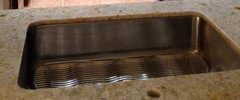
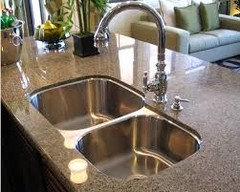
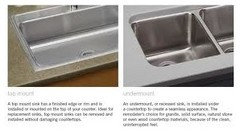
    From what I have know is an undermount sink is that there is a counter top overhang. I am in Australia so don't know if things are different here but top mount and undermount is what we have. If this is wrong and in the contract it says undermount, I would be going back to your contract hand having a good read or contacting the builder. Have got a couple of pics for you.
  • 12 years ago
    I haven't a clue in sinks, but i'm thinking in roofs in where they overhang the house and have a drip edge so water running down the roof shall not curl under and run down the siding of the house
  • PRO
    12 years ago
    There are actually 3 choices for the reveal for an undermount: positive, negative and zero. Some sinks are specifically manufactured for a positive reveal...it is possible your fabricator simply followed the template instructions included with your sink. Also possible they just assumed you wanted a positive reveal. Either way, it would have been good for them to check with you first.

    Positive reveals are actually harder to execute well than negative, as any imbalance front to back or side to side is very obvious. This means they picked the harder way to go - so you can rest easy that they weren't trying to cut corners on you (pardon the pun). From the one photo it looks like they did a nice job of it.
  • PRO
    12 years ago
    They look correctly installed to me...the "undermount" term refers to the reveal from where the counter and sink meet, meaning the sink is under the counter, instead of the lip of the perimeter of the top part of the sink that sits above the counter top.
  • 12 years ago
    Thanks everyone! Glad to hear it isn't incorrect, and you're certainly right - they should have asked.
  • 10 years ago

    Granite counter tops recently installed. We've observed
    inconsistencies in lip from one area of kitchen to next. Three
    areas=standard 1-1/2". Two areas=1-1/4". Not much, but disparity
    noticeable on entering room. Peninsula lip barely extends out over
    drawer beneath. Also... 1-1/2' lip to left of range, versus 1-1/4" on
    right. Two remaining areas=1-1/2".
    Bottom line question... what is acceptable margin of variance and/or
    what is
    reasonable expectation of correction for us to have of vendor, at this
    point?

  • PRO
    9 years ago

    As others have mentioned, there are three typical configurations for the counter top overhang and the sink. Most sink manufacturers provide templates and many counter top fabricators use this to determine the cut-out. Regardless, the exposure of the sink should be equal, within 1/16", all around. My fabricator always takes the actual sink back to the shop after templating so they can test the actual sink to the opening just to make sure it is exact.

    Graham


  • 8 years ago
    last modified: 8 years ago

    I just had my island installed by a reputable local company. Prior to installing my quartz countertop, my high quality stainless undermount sink was already held in place by support boards and the cabinet edge itself. Installing the countertop, the contractor put no adhesive or silicone along the top rim of before setting the quartz island top (with sink cut out) into place. Once the quartz top was already in place, a bead of silicone was then put around the inside rim where the quartz meets the stainless steel. So, with no adhesive or silicone applied to the sink rim before placing the quartz surface on top, should I be concerned about water seeping under? If so, is it possible to have the quartz lifted up and sealed properly underneath? The only thing holding the large slab of quartz in place is silicone along the cabinet edges as well as 4 metal braces/brackets extending from the island cabinet edges. Thank you.

  • PRO
    8 years ago
    last modified: 8 years ago

    "So, with no adhesive or silicone applied to the sink rim before placing the granite surface on top, should I be concerned about water seeping under?"

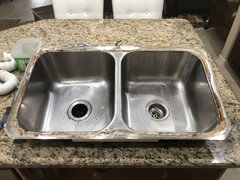
    Absolutely. Your sink is already leaking. Here is what your sink flange will look like, only yours will be much worse more quickly. At least this sink had (4) mechanical fasteners and silicone on the flange. This sink was three years old when I pulled it:

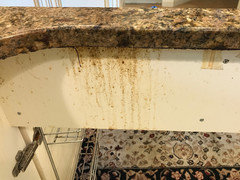
    As if the first picture isn't gross enough, here's what the inside of a cabinet with a leaking sink flange looks like. Note the rusting hinge.

    "If so, is it possible to have it removed and sealed properly?"

    Yes. Undermount sinks should not be installed with wood blocking. It shrinks, stresses the silicone, and can cause leaking. The sink should be strapped in place with a Hercules Universal Sink Harness (Braxton Bragg) or a Sink Strap or two from Regent Stone Products. The cabinet front may have to be removed to remove the blocking to remove the sink, but that's not a big deal.

    Topical silicone at the flange as you have is useless. He's created a germ factory right where you prep your food.

    Leaking sinks can put granite tops in mortal danger.

    If you can push on the divider of your sink and pump water from between the sink and stone bottom, or if you just have constant brown gunk at your sink no matter how much you clean, your sink is leaking and needs to be rehung properly.

    My strapped sinks don't gunk. Ever.

    To the OP's point, if I replace your sink, you're getting a slight (1/8"+-) positive reveal. A negative reveal creates a difficult-to-see-and-clean "crud lip" and a flush reveal makes an elongated and difficult to maintain silicone joint. A positive reveal makes a crisp change of plane with virtually no exposed silicone to maintain.

  • PRO
    8 years ago
    last modified: 8 years ago

    There is two ways of doing an undermount sink and most the time the templates that are supplied from the sink manufacturers will give you the lip you have.

    The other way is to project the stone 3-6mm past the edge of the undermounted sink. Unless you specify the stone fabricators will do the first option as these templates are in there CNC bridge saws

    Like The Big Small has said there is a few choices though the stone being flush with the undermount leaves two issues you have generally a pencil round roll to the top of the undermount sink or an arris which will leave a visual gap of about 3 mm which looks horrible and will collect grim, germs etc as you can not really make this visually appealing filling the void with silicone. hence the two options that are normally used.