Software
Houzz Logo Print
ginnyrae222

bath vanity finish

11 years ago
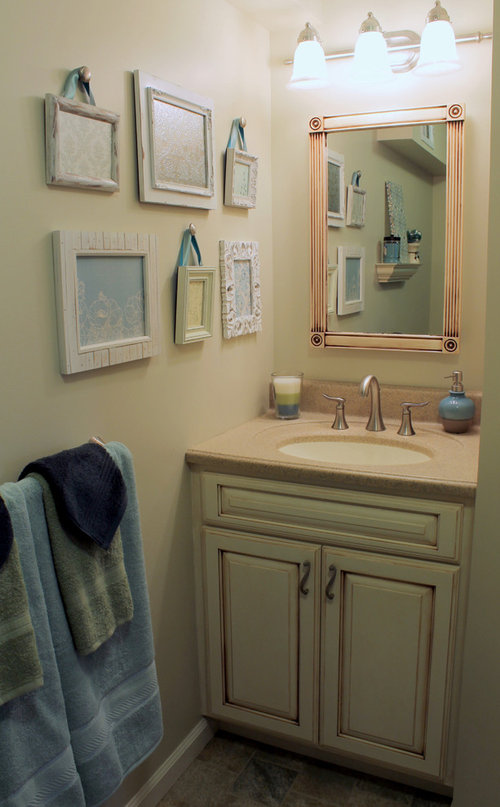
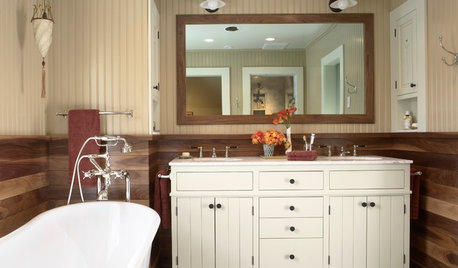
Can you tell me what you used to finish the vanity? Perhaps a little about the process would be helpful, too, if you would be so kind. Thank you!
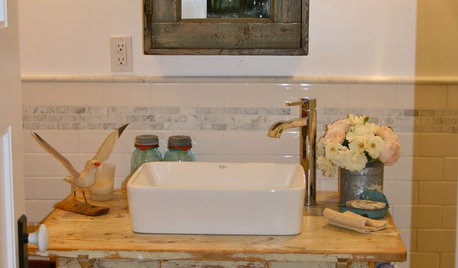
Chesley Knoll - Apartment Bathroom · More Info

Comments (5)

  • PRO
    11 years ago
    Sorry for the delayed response.

    We bought the doors unfinished from rawdoors.net. The doors and the frame are primed and painted with regular latex paint (Behr Parchment Paper (710C-1) in Semi-gloss). I used the Wagner 0518080 Control Spray Max HVLP Sprayer ($118 on Amazon) to get an extremely smooth finish. The dark glaze is Rust-Oleum Ultimate Oil Wood Stain (Early American). Since it is an oil stain over latex, it is important to let the paint dry completely. I think a gel glaze would have worked better though. The thicker it is the easier it is to not wipe it right off again. The technique is to spread the glaze on the detail and into the corners and then wipe it off. Depending on how well you wipe it off, you can get a lighter or more dramatic glaze. We let the stain dry, lightly roughed up the whole surface with sandpaper, and sealed it with Rust-Oleum Ultimate Polyurethane (Gloss). I believe the poly was water based, but that was what Rust-Oleum suggested when I called their technical department.

    Overall it is a very easy process and the cabinets seem to be holding up well. Just be sure to try it on a scrap first. It does take a little time to get used to how the glaze behaves.

    Best of luck!

    Jack
    ginnyrae222 thanked Jack Calderone
  • 11 years ago
    Jack,
    Thank you so much for the information and the very detailed notes! We love the look, but are a bit hesitant to tackle it. Did you find the sprayer easy to work with? I keep hearing different suggestions (small roller, sponge brush, etc), and want it to look as professional as possible. Your work looks great and I definitely will do a practice run!
  • PRO
    11 years ago
    The sprayer is actually remarkably easy to use. It takes a little practice to get the thickness of the paint right. But it's easy to tell if it is correct because if it is too thick it doesn't come out, and if it is too thin, it runs easily. The sprayer I mentioned comes with a little spoon with a hole in it that is supposed to help measure the thickness of the paint. I found it completely useless. If you just experiment for a few minutes, you'll be better off.

    As far as a brush or a roller, both are a lot slower than a sprayer and it is very difficult to not leave brush/roller marks. When I spray doors like the ones on the vanity above, it takes about 30 seconds per side max. It also dries much faster so you can recoat sooner. The one time I would use a small foam roller is if I need to touch up a sprayed piece once it is installed or if I am painting cabinets that I don't want to remove. But the doors can always be done outside (just bring them inside while they are drying). A sprayer is especially critical for the polyurethane where any sort of texture on the surface will reflect the light.

    If you decide to try the sprayer, the trick to spraying is to put on enough paint so that it stops looking like droplets on the surface and starts to run together. If you look at it with the light reflecting off the surface, this is very easy to see. If you keep spraying after the paint droplets/mist begin to blend together, that is when it can run. And of course it is always easiest (but not required) if you can position the piece so the painted surface is horizontal. And don't be discouraged if you are starting with primer. Primer never looks like it covered well because it is not designed to have a lot of pigment. Just make sure you sand lightly after the primer (drywall sanding sponges work great) so that the topcoat is smooth.

    Also, if you are painting something like a cabinet door, spray the difficult areas (like the routed edges around the central panel and the outer edges) before you spray the big easy surfaces. By the time you finish the difficult sections, you will have already sprayed a lot of paint on the easy parts. Then you just touch them up. If you do it the other way around (easy parts, then hard parts) the paint almost always runs when you have to slow down for the detail areas.

    At the end of the day, if your practice piece doesn't turn out like you want, keep experimenting. I'm sure you can find a lot more detailed tutorials on YouTube as well. And I'm happy to keep answering questions too.

    Good luck!

    Jack
    ginnyrae222 thanked Jack Calderone
  • 11 years ago
    Jack,

    Sorry I didn't see this until now-- and you have been most kind to give such a detailed response! I can't thank you enough! We are painting 1980s kitchen cabinets that have wood doors, but the sides are a veneer, so I know I have to make sure I prep those correctly. I will check out YouTube as you suggested. I sincerely appreciate your offer to continue to answer questions, but hopefully I won't need to keep bothering you!

    We are planning on starting next weekend and we will have to take our time with it. I will try to let you know how it all comes out--but it may be a while :-)
  • PRO
    11 years ago
    If you think of it, I'd love to see pictures when you're all finished.
    ginnyrae222 thanked Jack Calderone
Sponsored
Peabody Landscape Group
Average rating: 3.5 out of 5 stars8 Reviews
Franklin County's Reliable Landscape Design & Contracting