Software
Houzz Logo Print
californian_in_dc

Boy, do we need landscape architect recommendations

20 years ago

Hello,

I would very much appreciate recommendations for a good landscape architect who works in the northern virginia/d.c. metro area.

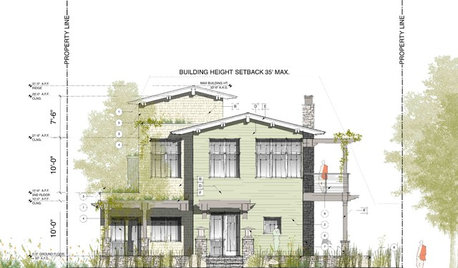
Ever get that quesy feeling that something horrible is happening and you can't stop it? Well, my husband and I just spent our life savings and are building a new addition to our house. Unfortunately, the front yard is on a steep slope, which didn't feel so steep because our house is about 90 feet away from the street level and the old front yard had these three "levels", essentially the lawn dipped into three flat levels. Now, the front addition is only 35 feet away from the street and seems to tower above the street level. (The addition is a two car side loading garage over which we have built a porch and office on the first floor and the kids' new bedroom on the second floor.) We were almost in tears yesterday as we watched the basement walls being poured. I guess we didn't realize how close our addition would feel to the street. But, we couldn't add to the back, because we wanted to save our mature trees growing there. The floor of our porch will be 10-12 feet above street level. It feels just terrible. Our only hope is a talented landscape architect.

TIA.

Comments (19)

  • 20 years ago

    You added 55 feet of garage and living space to the front of your house? That's a lot. But you have mature trees in back to enjoy. Does the house "live" toward the back? That is often done here on busy streets, the most used areas of the house looking out on the back garden rather than the front.

    When I first read your post, it made me think you didn't plan this very well, but pouring basement walls suggests this was not a do-it-yourself, impulsive, seat-of-the-pants project. You probably have a set of blueprints and drawings showing elevations from the street, right? Are there really any surprises, or are you reacting to the sudden change?

    "Our only hope is a talented landscape architect." Ouch. That's a terrible thought. What about your architect and contractor? Is the front of the house a solid two-story front? Can the design be stepped back on the second story to make it less of an imposing mass? Or stepped down the lot with grading?

    My last thought is that it's all so sudden, and so expensive, and so scary, that it's freaking you out today, but in a few weeks you will adjust to the idea and the look, and it's maybe not nearly as horrible as you feel today.

  • 20 years ago

    Have you ever gone through a building project before? We had our house built 11 years ago and I still remember the roller coaster of emotions through the various stages. The hole in the ground looked impossibly small, but when the foundation walls went in, they looked enormous. And so on, and so on, all through the various stages. When all was done, the size turned out to be just right.

    So my advice is to be patient and wait until the walls of the addition are finished with the final brick or siding or whatever will be on the outside. Then decide what you think needs to be done.

    It will look very different, and hopefully better, when it's finished.

    And a final word of advice is to be sure that you know the difference between a landscape architect and a landscape designer and which is best suited to your project before you call someone in. You may have issues that will require the expertise of an LA, but you may just need a good landscape designer. Know the difference!

    Good luck!

    V.

  • 20 years ago

    What is the difference between the 2? I searched and what I found is that LA's designs and performs the work, while the designer only designs the layout?

    Is that correct, or did I misunderstand?

  • 20 years ago

    I searched this forum for "architect designer" and got the hits in the link below. There have been a lot of discussions over the years about all of the different kinds of professionals who work with outdoor spaces.

    Here is a link that might be useful: link

  • 20 years ago

    I would suggest the VSLD (Va. Society of Landscape Designers) website: vsld.org Please email me for particular references. I am a VSLD member in Williamsburg and will be happy to recommend some of the best in Northern Va!

  • 20 years ago

    I am with the OP on this one. A landscape architect has been trained in site engineering as well as garden design. Your project sounds like it bridges between engineering and landscaping which makes it a little more technical than what most landscape designers have been trained to do. Civil Engineers tend to be more functional without too much of an eye for aesthetics.

    Why would anyone think that hiring a landscape architect is a terrible thought?

    It takes a certain amount of training and experience to resolve problems of this nature on paper before the ground is broken, or before the rough grade is complete, as in this project. Just garden designer is not going to be much help until that is all resolved.

    I don't usually push the profession, but this is a prime example of when you need an LA.

    Here is a link that might be useful: Virginia

  • 20 years ago

    laag-- what I meant by saying it was a terrible thought was that the house was evidently planned without consulting a landscape architect in the first place. My initial impression of the post was the house addition was poorly sited and it would be up to a landscape architect to fix the whole mess, as in "here, we created this mess, can you fix it?" I suspect it is really not so terrible, just a huge adjustment of perception for the owner, and probably nothing a good LA couldn't handle.

  • 20 years ago

    Well you designed around mature trees and it may be mature trees that you need to save the day. 35 feet is a good bit of space to grow a nice tree or two, either evergreen or deciduous. Maybe you do need professional advice, but trees seems to me to be one of the things a professional is most likely to recommend.

    You could plant a couple of fast growing/short-lived ones and a couple of slower growing ones, so you have coverage quickly but can sacrifice those trees (usually weedy species) when the slower ones get big enough to do the job.

    I'd also agree to not panic until the siding is on, and I hope you have such things as windows or embellishments or even a receding colour to help visually reduce the mass. (Clematis people probably look specifically for houses with walls like this :-))

  • 20 years ago

    Thank you all very much for your commiseration and advice. We did not consult a landscape designer before the drawings were made - our mistake. We hired a very well-known local architect who did the plans and elevations for us, but those elevations did not show the street level (just a hypothetical ground level). He assured us it would look fine. We couldn't build in the back for fear of killing our 100 year old holly, and 50-80 year old oaks and tulip poplars which grow close to the back of the house. Anyway, I certainly hope it is just the roller coaster of emotions people have alluded to in their messages. We did feel the same thing - that the hole was too small, the foundation walls are too huge, etc. I appreciate laag's insight as to why we would need a landscape architect as opposed to a designer. My husband confirmed we are further away from the street than I thought. He said we are 60 feet away (!) and the porch floor will be about 16 feet above street level. I apologize - I can't measure things - but I can tell if something doesn't look right. And this doesn't, at least, not right now. I hope to be able to report back in a few months that it looks better than we thought.

  • 20 years ago

    Landform.

    If you wait 'til it is backfilled and the siding is on, you've ignored the exploration of using landform to mitigate the problem. Possibly retaining walls, some creative grading, and/or incorporating steps should be looked at ahead of all of that. If the framing has not started, added masonry could allow more fill up on the building, if that helps. The point is to review the options with someone who has creativity and experience with them before they are taken away.

    Waiting to see what you wind up with limits your options of what measures you can take to mitigate things that you don't like about it. Certainly plants are part of the mix, but only part of the mix.

    Plan is not only a noun, it is a verb as well.

  • 20 years ago

    I'm with laag on this one. Get help now, before too much is 'set in stone.' It may be that just a consult will do, but if not, it would be better to get the input now.

    I'm sure that some designers will tackle grading issues, but I'd vote for the LA, as well.

  • 20 years ago

    Obviously there are major grading and design issues to tackle. We have already established the fact that this is why it is important to consult a landscape arch/designer prior to such a project. You need a landscape arch or designer who has extensive work in grading and dealing with earthwork/hardscape/wall design. Where do you find such? Friends, neighbors, ASLA, interviews, etc, be prepared to meet with several before finding a good match. Look at similar projects they have done and WHO built them. Be prepared for a significant design fee. If you are spending a significant number on your addition, do not expect to find a lesser expensive solution. All in all, LA's, designers, design build firms who work on the project level I suspect you are in need of are usually a close group and pricing is usually fairly even almongst them. It is not too late to research and make an educated decision.

  • 20 years ago

    Thank you, laag, creatrix, gardenlifer, and to all the others who have responded to my request. I have been reading and re-reading your posts. We are meeting with two landscape architects this week, possible one or two more. I understand, I think, the substantial work that must be done. Could I ask your opinion on one more thing? Would you strongly recommend against hiring one company to do the design and having another company implement the design?

    We think the work of one of the landscape architects we are interviewing is very artistic and just beautiful. However, I have heard from neighbors that he is extraordinarily expensive. The work of the other landscape designer (she has a landscape architect on staff) we are interviewing doesn't seem to have the punch or creativity of the first, though it looks just fine, just a little more run of the mill (it may be that most of her work has been in an area that is less "exclusive" than ours and therefore clients' budgets were more modest.) However, her references glow about how wonderful she is to work with, honest and she could be much more reasonably priced in terms of installation. Could a professional take someone else's landscape master plan and implement it? Is that really unusual? We were hoping to pay for a master plan and then bid it out to a small group of landscape design/build firms or even try to act as the general contractor ourselves and hire the stone mason, the concrete company, the local Merrifelds Garden Center, etc. to do the specific parts of the plan.

  • 20 years ago

    Gardenlifer capitalized "WHO" built it for a reason.

    If the design is technical in nature or has specialty work such as masonry involved, you have to know if the contractore is able to follow the plan exactly or if he is more or less winging it. The LA is going to make sure that the plan is followed exactly if he is hired to do so.

    If you act as a general contractor, what does that mean? It means that you are in charge of implementing the plans through your subcontractors. You are in charge of knowing whether or not the plan is being followed, the craftsmanship is sufficient, that the contract is not leaving loopholes for extras (don't under estimate that part), and basically makes you totally responsible. If you think it only means cutting out an extra expense and that the subs will take charge of it, I think that you will be very disappointed unless you have experience as a general contractor. I suspect that if the latter were true, you would not be needing a design after the concrete was poured (no offense).

    If the project is pretty straight forward, you could hire a contractor without having the LA manage the project.

  • 19 years ago

    There is one main difference between a landscape designer and a landscape architect.

    They both have a degree in landscape architecture
    They both have a full time work experience working with/for a landscape firm.
    They can both not only do the plans but also instalation etc.

    However A landscape architect has a liscence in landscape architecture and an la designer does not.

    A landscape designer is CHEAPER because he or she is not liscenced. If I were you I would hire an la designer and ask for a resume/portfolio. Ask to see completed work that they have done wether at a firm or for themselves.

    Hope this helps

    rama
    crea-tions.com

  • 19 years ago

    go onto the site asla.org (american society of la).
    under producs and services click on firm finder this tool allows you to find any la firm based on state and county etc.

  • 19 years ago

    ramidio--one does not have to have a degree in landscape architecture to be a landscape designer. At least, not in NC. In fact, if one keeps one's projects at $30,000 and below (per project) one doesn't even need to be licensed. At least, not as a contractor. I'm certain one needs a business license. I don't know the rules in DC.

    californian in DC--Do a cost/benefit analysis. And look at the amount you've spent up to now. It may be worth it to spend more to get the inspired design the more expensive LA will give you. Additionally--I properly managed/designed project can be LESS expensive in the long run, once one figures in the amount spent re-doing work that one is less than satisfied with.

    Just a thought.

    melanie/neither an LD nor an LA/merely a lowly garden center retail rat and enthusiastic gardener

  • 19 years ago

    What this person needs, or needed, is a person who is experienced and adept at doing the kind of work, the kind of style, and the kind of budget for this particular project.

    By the description of the project, I would agree that there is more liklihood of finding a landscape architect with the experience necessary to handle this. Grade changes like that have to be handled by calculations along with design. There are not a lot of landscape designers out there who routinely do precise grading and drainage plans as part of their work.

    The problem was not noticed until construction because no one had done such a plan, or if they had, it was not presented to the homeowner in a clearly understandable form. Complete site plans prior to construction would have revealed this and should have addressed it.

    I don't know too many landscape designers who do technical site plans because most have not had the training or experience working grading and elevation problems out on paper prior to construction.

    I'm not saying they need a landscape architect. I'm saying that not many landscape designers who have not gone through the education and internship in an office that does site planning can do much more than dealing with it on site and seeing how it comes out.

    Moral of the story: Have a complete site plan, including grading and elevation plans, done of the area being disturbed prior to building.

  • 19 years ago

    This particular situation also sounds like a case where it can be hugely beneficial to work with a really good design-build firm.