Software
Houzz Logo Print
shadowgarden

Hanging plants for highwall

19 years ago

It is finally happening. We are getting ready to build a retirement home on some old family property in Southeastern Ohio. This land was strip mined about 75 years ago. behind where the house will be is a highwall. This is a vertical rock face about thirty feet high. The rocks are sandstone and shale. I plan to transplant some ferns onto the rocks. I would also like to plant some colorful flowering plants above that would grow hanging down over the rock face. The wall faces East. Because of the deciduous trees it would be a light shade to full shade area. Also the top where I would like to plant the plants would get more sun than the hanging down part. What should I plant? A Clinbing rose? Which one? Is there one that blooms in shade? Wisteria? Something else? This is in USDA zone 5-6 for hardiness. I want a perrenial. Thanks.

Comments (12)

  • 19 years ago

    How long is the rock wall where you intend to plant? This would help with plant selection.

  • 19 years ago

    The highwall is about 60 feet long at that point. I know I will need several plants. Perhaps I should mention there is a pond or sink at the bottom of the highwall. But that is another project. If I can find a picture that shows this I will post it on the gallery.

  • 19 years ago

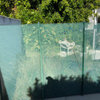
    I posted a picture in the gallery. Sorry it is not a very good picture but you can see the wall somewhat.

  • 19 years ago

    Next question...Do I detect a descending path running across the face of the rock wall about halfway down?

  • 19 years ago

    A path, no. This is very steep. However a good rock climber could probablty traverse it. (I tried to convince my son who with his friends who climbs a fake rock wall that it would be great fun to climb this and I could tie the ferns onto a rope and lower them down for the guys to plant, so far no takers!) The bottom part of the the highwall is crumbly shale partly covereed by a shallow layer of leaf litter. It might be interesting or possible to make a path but because the rock is so crumbly I think stability would be a problem. I also thought about making a waterfall but there is not enough flat space up above to create a feeding pond, the lay of the the land does not seem to lend itself to creating a stream easily. In addition I am reluctant to create any sizable body of water directly up hill from our house, hence flowers.

  • 19 years ago

    It is nice to have a question distinct from the usual "what should I plant along the house foundation?" Yes, this old rockhound/fossil hunter is familiar with the area you describe. I will attempt to point you in the right direction, leaving you with some homework to do.

    1. Two plants of deciduous Sweet Autumn Clematis (Clematis paniculata) planted at the top will quickly cover the entire rock face. An easy solution.

    2. You mention climbing roses. Google "shade climbing roses" and you will note a number of useful varieties. My thought would be to plant them at the base of the slope and peg each branch into the shale where they would take root and continue up the slope. Or, you could use the same approach planting from the top. As you study rose varieties be aware of which ones are very disease resistant. This will lead you to some of the newer varieties of which Peter Mayle is my favorite. A clean, green climber. You also have to consider that most roses, excluding some of the the old fashioned ramblers need some pruning. Turn to the Rose Forum people for varieties to select that will not require you to be a mountain goat.

    3. Before planting Clematis is is important to understand that the family is organized into 'groups'. Check the A-Z ENCYCLOPEDIA OF GARDEN PLANTS for a better understanding of this. Basically you want the Clematis groups that bloom on old wood and never need pruning. The expert posters on the Clematis Forum will guide you to the right varieties if you explain to them what you are trying to accomplish. Again, Clematis could be started at the slope base and pegged upward or also from the top.

    4. Climbing hydrangea (Hydrangea anomala peteolaris) is often mentioned as a shade vine. I would not plant it on the rock face. Rather suggest that it be planted at the base of trees on the slope (one plant to a tree)
    where in will climb up into the branch canopy and in time blooms will cascade from the branches. A stunning effect in garden design which ought be used more often. It should only be planted on trees with smooth bark.

    5. Grape vines cascading over the slope is another thought.

    Do not plant the very invasive Trumpet Vine.
    Do not plant Dutchman's Pipe (Aresalchia littoralis) if grandchildren will be visiting. A beautiful vine which could work well for your situation. However, the seeds are poisonous to little ones.

  • 19 years ago

    Looks like it will be a dramatic site. I'm not certain I would "cover" the entire wall..it's much prettier than I was expecting when I saw the phrase "strip mine". Pockets of ferns would be great. Nandina, I like your suggestions. Clematis panniculata is lovely, and smells beautiful when it blooms--but in my area it can be invasive. (It seeds out like no-one's business--I pull babies up every spring!) Maybe not in zone 5 SE Ohio. If invasiveness isn't an issue...it's a great plant.

    melanie

  • 19 years ago

    I like the idea too of clematis hanging down, and it would be interesting to contemplate varieties and how the different types would require maintenance. For example, for Type Cs planted at the top, you would just guillotine the whole mess once it was frost-killed and jettison it down the slope. I do wonder whether top planting would be asking too much of the roots, as they would be holding the whole weight of the plants. I honestly can't make head or tail of that picture in terms of seeing whether the plants would have anything to hold onto.

    But I am also entranced by the idea of the climbing hydrangea or the related Schizophragma perhaps.

    Finally, I wonder if you meant Aristolochia for Dutchman's Pipe, Nandina?

    KarinL

  • 19 years ago

    Karen, thanks for catching my error re Dutchman's pipe. Our household is a bit crazy right now and what I wrote above was written in haste. And I agree with mjsee that Clematis panniculata can be invasive. However, this looked like a fairly wild area to me where it might not be a problem. Although I answered Shadowgarden's direct question I actually see a different approach to working with this rockface. The upper part appears to be attractive with mosses and should perhaps be left as is. Hopefully she will post some better pictures. Also the idea hangs in the back of my mind to build a grotto using the larger pieces of shale set in concrete with an inside seating area placed next to whatever the water feature is that was mentioned. I don't have time to search but a structure similar to the grottos in the beautiful Viscaya gardens in Miami. Sorry, that's what happens when you ask a designer who thinks 'out of the box' a question.

  • 19 years ago

    I posted two more pictures. This highwall is basically where they stopped strip mining. They cut off half of the the hill. So at the the top there is a layer of dirt then a fairly thick layer of sandstone. This is the rock you can see. Next there is a layer of shale. This is mostly covered by leaves in the picture. The shale is broken in little chunks and is pretty unstable. The sandstone is pretty much vertical but the shale more mounded. At the bottom of the rock face is a little pond that basically collects runoff from the hill. The water is black but I think that is probably from the decaying leaves I have not seen any oily scum. I know the water will have to be tested. There are deciduous trees all about. The top of the hill has a rather nasty bunch of multiflora roses which is one reason I though of climbing roses. Our house will be on the other side of the little pond back a bit. I would like to have an arching bridge and a little trail under the cliff but I do not know it that is really feasible. We are talking of a lot of enthusiasm, some slight gardening ability and not too much funds here.

  • 19 years ago

    It reminds me a lot of a devil's den. They are fairly common in western Pennsylvania, so you may be able to find one or two locally to look at. Ferns and mosses are the usual plant life, with the occassional tree or shrub in a crack. There isn't much else because the trees growing in the decent soil at the base of the rocks shade everything out. Small spring ephemerals and wildflowers like columbine might work.

    BTW, something interesting about climbing hydrangea. While it is usually listed as very shade tolerant, I have yet to see one locally growing in shade. The decent sized ones all seem to be on the south side of limbed up, open grown trees. It may simply be a trick to get them started sooner, but I've found it interesting.

  • 19 years ago

    I just took a look at the Alpines and Rock Gardens forum; that site might give you some ideas.