Software
Houzz Logo Print
duluthinbloomz4

Hardscaping the Landscape

19 years ago

Been mulling this over ever since it appeared on another forum complete with the predictable emotional responses.

In a nutshell: a WSJ article profiled a professional who, tired of spending what free time he had being a slave to his lawn and shrubbery, established a budget of 90k to hardcape his quarter acre Falls Church, VA., backyard. And the article went on to hint that this is a growing trend.

I'd like to think that if Mr. Professional performed his due diligence when contracting for this project and worked with the chosen designer, etc. his 90k was likely to get him a design that took potential water runoff into consideration, included a compromise on installing minimal plant material for radiant heat and sun glare mitigation, as well as some pretty good looking stone work.

Instead of being dismissed as someone who should live in an apartment; as someone who has diminished the natural habitat for birds, butterflies, and bunnies; or as someone who is a poor steward of the earth, isn't he really someone who took appropriate steps to find a solution for his particular landscaping problem?

Comments (8)

  • 19 years ago

    Was their yard comprised of perfect grass and meatball shrubs? I can see how a compulsive Type A person would go nuts trying to get everything perfect, so this is a possible design solution to be considered among many other alternatives.

    Equally as feasible would be an unraked/unmulched (no imported dyed products) native woodlands garden with natural leaf mulch or even a native meadow garden.

    Or why not set up an account with a landscape maintenace company to come out weed,seed, and trim the landscape. 90K should cover quite a lot of mowing and blowing.

  • 19 years ago

    My guess is that Mr. Type-A could not find a landscape maintenance company who lived up to his expectations.

    Another thing that I wonder about is whether local zoning regulations allow this kind of lot coverage. There is no standard of what every community does in this regard, but most communities have some kind of limitations on "lot coverage". Sometimes that is limited to building structure, but a lot of the time it is buildings and paving. Sometimes it is defined as being limited to x% of coverage.Other times there is a requirement for x% green space.

    I wonder if the city knew of this and whether or not it met their zoning requirements.

    I once ran into this in Pullman, WA when I was working for a landscaper while in college. The homeowner had us build Keystone wall around the entire property and levelt it off. They had the builder pour concrete wall to wall. I never went back there to see what the consequences were, but I do not think drainage was being addressed in a professional manner. .... now who says design is about making things pretty?

  • 19 years ago

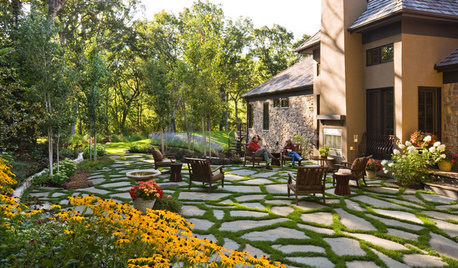
    While it might sound like the guy had the equivalent of a parking lot installed in his back yard, for 90k there must be more. Here is a good example of a yard that is mostly hardscaped, and I can see why a mostly hardscaped back yard is getting trendy. It's a nice solution to lawn. If I could afford to do something like this, I'd do it in a heartbeat.

    http://www.lowescreativeideas.com/0907/ol_accessible_design.asp

  • 19 years ago

    I learned after installing a patio, terraced back entrance, and additional walks, that they actually require more frequent maintenance, in the form of sweeping or blowing-off, than either grass, other groundcovers, or mulched plantings did.

    Leaf litter, seeds, bird droppings, the hardscape is constantly covered with stuff. If I want it to look like the hardscape in magazine photographs, I would have to clear it a couple of times a day.

  • 19 years ago

    Coincidentally, I am presenting a class today on "lawn alternatives", which does include hardscaping as a viable lawn substitute. Replacing environmentally challenging and maintenance demanding turf grasses with alternate landscape solutions is a rapidly growing trend and one that is becoming extremely popular in my area. One of the biggest motivations behind this trend is our area's focus on organics and the movement away from chemical fertilizers and pesticides. While it is entirely possible to have a 'natural' or organic lawn care regime, to many homeowners the effort is just not worth the return. And lawns are very water demanding in our warm and dry summers and few opt to let them go dormant as they are naturally want to do during this period.

    But as with all issues concerning landscape design, how one handles each specific garden situation will be different. And I doubt many will agree that hardscaping over the entire property is any kind of a viable solution. But the practical and moderate use of hardscaping is most definitely an option. For one, it extends the ability to use more of the landscape for entertaining or other purposes. And it can be an extremely attractive element. But it needs to be combined with typical planting areas and it needs to take in acccount water permeability, runoff and drainage.

    FWIW, I do a good number of designs that are specifically requested to include NO lawn. With a small lot, that's not the slightest bit hard to achieve but it gets to be a bit more of a creative challenge with larger areas. And $90K here does not necessarily consititute a lot of hardscaping - I've seen several times that amount involved in the construction of rock walls, outcroppings or water features and the placement of large boulders, not to mention what a well-designed and constructed natural cut stone patio or terrace of any size will cost.

  • 19 years ago

    It's likely that the homeowner in question was subject to the same restrictions we face all across northern VA, where to get that kind of lot coverage we need to have an engineer certify the paving as pervious, and/or install rain gardens/ infiltration trenches. You can't just dig a basic raingarden and call it good, because you're required to spell out how much rainwater you can handle, what percentage of pollutants you'll capture, etc. We just worked with a client in the town next to Falls Church and they had to tear out their asphalt driveway and replace it with pervious asphalt, just to put a small sport court in the backyard.

    I'd like to think that the homeowner in question did it right, but I wouldn't bet the farm, know what I mean?

    Duluth, would you be so kind as to post the date and page # for the article, if you still have it? I'm curious, especially since I wouldn't be surprised if it comes up in a future sales call.

    Dave

  • 19 years ago

    I can relate to part of this guy's issue. I think that our cultural attachment to a perfect lawn can drive people to extremes. I gave up the attempt in my too shady front yard for the same reason, but went the other way--all perennials and shrubs, and many of my neighbors commented (at first) that it looks "messy", although I prefer the term "romantic". After 5 years, more lawns on my block and in my neighborhood are being replaced with similar looks and I have now been told that I am an inspiration (messy must be "in").

    On the other hand, I still see that same lawn obsession at work around me--my neighbor who gets out the edger every weekend, working furiously for that perfect line, and another who doesn't rake or blow the leaves off his lawn, but vacuums them off for a "perfect" lawn.

    If a totally hardscaped yard helps to bring some order into this guy's life where he needs it, ok. I suspect that anyone who buys this house from him will have the 90K to have the hardscape removed, if they so desire.

  • 19 years ago

    marcinde - this is a cut and paste from the Cottage Garden forum where it appeared on Aug. 19, 2007. Orig. poster lifted it off MSN

    By June Fletcher, The Wall Street Journal

    Michael Kulik recently invited the bulldozers in to tear up his quarter-acre Falls Church, Va., backyard. The $90,000 redo he has planned will include a hot tub and gazebo, an outdoor fireplace and grill, a multilevel paved terrace -- and very few plants.

    Kulik, a professional photographer, says he was tired of spending hours every week trimming the azaleas and hollies and trying to get grass to grow under the oak trees. "For me, the backyard had become a war zone."

    Here's what's on the way out in landscaping: grass, flowers and trees. Frustrated by extreme changes in the weather -- floods this year, droughts last year -- some homeowners are simply giving up. They're replacing ferns and palms with lifelike fakes, pulling up the sod and putting down stone, concrete and other types of paving, and drastically shrinking planting beds.

    "It's garden fatigue," says Bruce Butterfield, the director of research for the National Gardening Association in Burlington, Vt.

    Lawn and garden sales have been declining for the past three years, according to the group. Sales totaled $35.2 billion in 2005, down 4% from the year before. And it's not just the wiggy weather: Many homeowners are aging, says Butterfield, or are simply wearying of maintaining elaborate plantings or competing with the neighbors for the showiest roses.