Software
Houzz Logo Print
jackieras2

Disaster Area, How about Mulch?

19 years ago

I have an area 25'X 25' that is in complete shade, because of a 100 year old oak tree. Right in the middle of the area, is a 6' round pave stone flower container 3' high, that will grow spindly plumbago. I am going to replace the plumbago with hosta.

I have tried to grow grass, which of course because of the shade did not grow, ground cover that will grow somewhat but because of foot traffic does not do well and I am tired of pouring $$$$ into an area that will not grow anything well. My thought is to bring in a few yards of good mulch and stone walking stones for a path, and just call it a day.

The problem I forsee are the leaves from the oak tree, but they can be blown away. Anyone have any other ideas, I will be forever gratefull for any help I can get.

Comments (9)

  • 19 years ago

    There are several solutions. First, explain the 'foot traffic', please. Is the entire understory of the tree constantly walked on and around?

  • 19 years ago

    Nandina, thanks for the response.
    Hard to describe, picture a square, north is the right side of the square and the back side of the garage, the tree is to the south of the square, a privacy fence is to the west (top of the square) with Azalea bushes, and a deck is on the east side. The understory of the tree, which is not walked on, is landscaped with Wandering Jew, and Monkey Grass. The foot traffic is from the lower deck steps to the area I am concerned about. Clear as mud?

  • 19 years ago

    I have same questions as nandina, as in, what do you do in that area and why? Could stepstones allow you to avoid smooshing a groundcover?

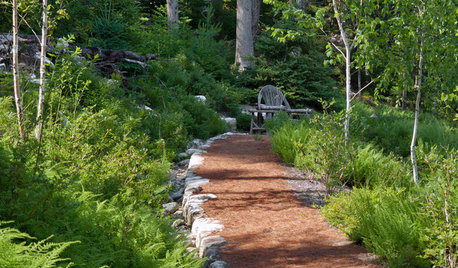
    Mulching can make it look nicer and more orderly, and has benefits + drawbacks. If you add thin layers over time, the soil will improve and you will start to grow stuff. The heavier the shade, the less concern because weeds don't like that as much, but if you mulch a large area, then over time it will grow oak seedlings and other things that may not have germinated previously in the disaster zone. Of course, with improved soil over time you might then also be able to establish a nice groundcover and pockets of hostas under the tree (if you control traffic). Same for leaf removal--you'll need to think about how your leaves and mulch will intertwine, or not, so choice of mulch may be different for someone who has to blow leaves off vs. not.

    So you will get to see over time if the area is improved and less maintenence, improved with manageable ongoing maintenance, or is a maintenance disaster.

    This is not to deter you, but just points out that there are often action-reaction things that occur when you change the growing conditions. Hey, that's gardening!

  • 19 years ago

    Frankie, thanks for your input. What do we do in that area is your question.

    From the lower deck steps it leads across the area (on a diaginal) to the gate leading to the side yard and front lawn. I have tried stepping stones and ground cover (does not grow well) and it works fine for adults...for Grandkids, not so good....I have given much thought to the mulch idea and as you suggested over time it will improve the soil, but, could prove to be a bigger problem than I already have. I have also thought of paving over the area, but, that would be a last resort kind of thing.

    Oh, well, it's not an earth shaking problem is it? ;>D

  • 19 years ago

    With a little more understanding of the situation plus the fact that you have already tried stepping stones and mulch with little success...there are not too many inexpensive options left. Here in my part of the south a path mulched twice yearly with pine straw holds up well and is much cleaner than bark-type mulches. Is that option available to you? You could, of course, install a brick path.

    Think about putting a mulched path with or without stepping stones in place and then using Holly fern as a taller groundcover around it. It is attractive, especially the variegated variety, plus it is tough enough to grow in your situation. Also is tall enough to keep foot traffic on the path. Work in some clumps of Lycoris for fall color.

    Live oaks are always dropping 'something' 24/7. Such magnificent, but messy trees! It is best to plan groundcovers beneath them into which you can blow the accumulating debris. Holly fern thrives in this type of situation.

  • 19 years ago

    Nandina--do you think epimedium would be a suitable taller ground cover? Or hellebores? Those are among the first plants that come to MY mind when I hear "dry shade." Epimedium can be a little...aggressive...but perhaps that would be a GOOD thing in this case?

    I've got lots of experience with dry shade this year...here is a list of what's still alive in MY yard, in the dry shade, with little supplemental water:

    Polygonatum biflorum (Solomon's Seal)
    Epimedium
    Hellebores (Lenten Rose)
    Sarcococca hookeriana var. humilis (Sweetbox--a little burned where the sun hits it, but still alive!)
    Rubus calycinoides (Creeping Raspberry)

    Would any of the above suit, do you think?

  • 19 years ago

    Nandina, I have not tried stepping stones and mulch...I have tried ground cover and stepping stones. And, yes live oaks are marvelous for shade but can drive one bonkers when trying to keep up with the mess they make.

    I thank all of you for you suggestions, and will research all of the suggested plants.

    Thanks again.

  • 19 years ago

    How about Aspidistra elatior (cast iron plant)? It grows in dry shade. It is evergreen. It's hard to kill. It does grow slowly, however. You can lay a path, then plant this around it.

  • 19 years ago

    Totally different climate, but I saw a vast planting of sweet box in a naturalized area beneath deciduous trees at a botanical garden here in New Jersey ... beautiful!

    Leucothoe is a good stand-by here, too; likes a moist, acidic soil, but seems to adapt well to drier conditions as long as it is in at leat partial shade/dappled sun. You'd have to check to see if it would be suitable for your climate, though.

    Whatever you do, pleasepleaseplease don't pave! I'm sure your were only kidding anyway ... weren't you? I envy your having a live oak - such beautiful trees. I've been blessedly ignorant of their drawbacks, though our various oaks here in the northeast also seem to be always dropping something: pollen, catkins, acorns (ouch), leaves, small branches girdled by oak gall wasps or nipped by nest-building squirrels ... occasionally even a squirrel itself.

    With a little research and planning - looks like you're getting some good advice here - I expect you can develop a lovely area beneath that live oak that will also accommodate the necessary foot traffic. I'd love to see a photo when you're finished.

    Diane