Software
Houzz Logo Print
rgreener_gw

Hillside Ivy Challenges

12 years ago

We have a two sloped sides of our house that have ivy (I think English although not certain). And we'd like to remove it safely as it is invasive and just not the landscape sensibility we like. We first started by cutting it down to the root to see what we truly have. Our next step would be to remove the roots in order to replace the ivy with an acacia or something similar to acacia with a few smaller trees.

The roots of this old growth ivy are very large and weaved into the slope like a lattice. And since we are on a slope/ hillside, I'm afraid that if we remove the roots, we will have the hillside coming down. Terracing would be an enormous job. In your experience of old growth ivy, do the roots serve to hold up the hill on hillsides?

Would love advice. I've attached a picture. Thank you very, very much!

Comments (25)

  • PRO
    12 years ago

    It's true that English ivy doesn't stop a landslide, but it holds surface soil in place very well. If you dig the ivy out that will destabilize the surface soil and it will erode easily. BTW, it doesn't look like English ivy and since you are in zone 10, I doubt it is. Suspect it is probably Algerian ivy, its ruffian cousin.

    Since you've already cut the top, you won't be able to use Round-Up now, But it would be best to kill the ivy first and leave it and the soil in place. It will take at least two applications of R-U over time in order for the ivy to die. The dead ivy roots will keep the soil stabilized until the new plants can take hold.

  • 12 years ago

    Agree with gardengal...not 100% convinced that you have English Ivy there. Any chance of a close-up pic of the leaves?

    And it's been disproved many times that ivy has any use in erosion control. In fact, it's the opposite. It can be drastically detrimental.
    "English ivy was once thought to be useful for erosion control. However, because landslides occur in ivy-covered settings, it is now recognized that its foliage overwhelms and prevents the growth of other plants that would hold the soil, and its shallow roots leave slopes vulnerable to erosion."

    (See link below).

    Here is a link that might be useful: EPA: Ivy Erosion Control? Hah!

  • 12 years ago

    Thanks for the feedback. I spoke to one of the men yesterday that helped cut the tops off and he was convinced that if we remove the roots we wold have a problem with the soil coming down. We are located in the Los Angeles area.

    Here are more photos and a closeup of the leaf. There are two sides to the house.

    I feel that by starting to clear we opened this "can of worms" and now have this chronic disease that we will need to maintain for many, many years by having to control and cut back the new growth every few months... Oh no!!

    thanks

    Here is a link that might be useful: ivy photos

  • PRO
    12 years ago

    "... it's been disproved many times that ivy has any use in erosion control." Shaxhome, this is misleading. English ivy is used successfully in many places to control erosion ... the surface washing of soil. But landslides? Even trees or anything else is incapable of holding soil if the land mass wants to move. (See link.) You're alluding to a situation in which ivy smothers all other plants, but that's not the case in a managed yard.

    Rgreener, I think you have opened a can of worms by removing ivy top growth before determining how a final solution will be implemented. I don't doubt that you can change from ivy to another plant, but I'm certain it won't be by digging it out .... unless you want to spend major money and treat this as if it was an industrial project. Otherwise, it would be better to do some testing/experimentation first. And I think you'll need to use herbicides in order to make this do-able. If you're opposed to using herbicides, it seems to me that you'll be living with ivy for a long time.

    Here is a link that might be useful: No plant could prevent this.

  • 12 years ago

    One aspect I inadvertently left out is we have a fantastic 250+ year oak tree as a centerpiece in our courtyard and one side of the ivy is less than 50 feet away from the tree. Would want to avoid a herbicide solution anywhere close to this tree if possible. We would consult an Arborist if we went down that direction.

  • 12 years ago

    While that may be the common belief, it is generally accepted NOT to be valid:

    When used as a solution for soil erosion, English ivy is a particularly poor choice. It does not form an extensive underground root system as it covers areas to the exclusion of other plants. As a result, surface flow easily undermines the soil on steep slopes. - SEPPC

    English ivy was once thought to be useful for erosion control. However, because landslides occur in ivy-covered settings, it is now recognized that its foliage overwhelms and prevents the growth of other plants that would hold the soil, and its shallow roots leave slopes vulnerable to erosion. - EPA

    It should be noted that ivy, that all-too-common erosion remedy, turns out to be no remedy at all - erosion control website

    The shallow mat-like root system make it a poor choice for erosion control, and contributes to erosion in some cases. - King Co WA Info sheet

    English ivy does not control erosion. Its shallow, mat-like root system does not have the
    diversity of configurations and depths to bring water down through the soil to form an
    interconnecting water dispersal system. Instead, it tends to pond the water on the surface. - BC Invasive Plant Profile

    Since English ivy is considered a seriously invasive species all along the west coast (as is also Algerian ivy in CA), removal is typically suggested and highly encouraged, even from so-called 'managed' plantings. Many times these are plantings on sloped areas. Digging it out IS the recommended manner of removal as it is really the only way to ensure the least amount of regrowth. The only time I would caution about using this method would be in a riparian or coastal setting or on a very large or steep bluff, as yes, there is bound to be significant soil disruption. In an inland garden setting with the slopes apparent in the OP's photos, I wouldn't hesitate. This is the type of ivy removal project I get involved with all the time.

    btw, after cutting back the foliage, cut stems can be treated with triclopyr (paint directly on the cuts) but it will take multiple applications for complete control. Few herbicides have any impact when sprayed directly on ivy foliage as the waxy leaf cuticle prevents absorption and uptake of the chemicals.

    As an additional motivation for removal beyond an undesired aesthetic and a large planting of an invasive species, ivy - both English and Algerian - is a prime and highly sought after habitat for vermin.........rats.

  • PRO
    12 years ago

    All herbicides are not alike. They have different purposes, methods of application and results. Some are meant to "sterilize" ground from all plant life and, obviously, this is not the type one would use in the vicinity of a desirable tree. Other herbicides must be applied to foliage and make take several applications over time in order to eradicate the pest plant. Round-Up, the most commonly used herbicide, is not effective or intended as a soil application (there would be some minor exceptions for accidental damage such as small seedlings) nor when applied to bark covered tissue. Where there is lack of familiarity there is a tendency to substitute fear, but this is not a reasonable exchange. FYI, Round-up is used around desirable trees every day, however, it is never sprayed on the foliage of them.

  • 12 years ago

    Yardvaark...I've spent the past 4 years working in the Himalayan Kingdom of Bhutan, the indisputably steepest terrain on the planet. Landslides, mud-slips and even avalanches are a daily occurrence here especially during the monsoon season. I'll post some pics to give you an idea...

    My qualifications and experience are in horticulture, landscape design, soil science and turf management.
    On this 1st project, I had to landscape a 5 acre construction site, and all around us, roads and houses were constantly collapsing, even those covered in the ubiquitous English and local Nepalese ivies.
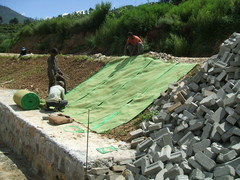
    I acquired a (biodegradable) cloth from India (coconut fibre) and under-planted it with the local tall fescue. This has a deep and tenacious root structure. At the top of the slope, we planted a row of the local blue pines. Further down, dozens of rhododendrons, and at the bottom of the slope, above the retaining wall, the local honeysuckle, Lonicera acuminata. To this day, ours is the only area with negligible erosion and slip, and I now spend a lot of time advising and supervising other projects, here and also in nearby Nepal and Indian Kashmir.

    {{gwi:51430}}

    {{gwi:51431}}

    {{gwi:51432}}

    {{gwi:51433}}

    {{gwi:51434}}

  • PRO
    12 years ago

    Shax, I'm pointing out that you're lumping two different phenomena together as if they are the same. Erosion begins at the soil surface and works its way down. Ivy is very effective for protecting the soil surface from common rain and keeping soil in place. Of course, it's not going to protect against separation of a layer of soil that occurs below the extent of the ivy's root system. But it can be used in combination with other plants for deeper stabilization of the soil. In this thread the ivy already exists and the question is whether removing the ivy roots will destabilize the slope surface. Surely it would. Would the OP's proposed replacement, cassia, will do a better job of protecting the slope against erosion? That one's up for grabs.

  • 12 years ago

    Would the OP's proposed replacement, cassia, will do a better job of protecting the slope against erosion?

    Yes......anything with a deeper penetrating root system is a better choice for erosion control or slope stabilization.

    And I think the OP referred to acacia rather than cassia, but either would be a better choice than the ivy, provided it is not one of the invasive acacia species. An even better choice would be a low growing broadleaf evergreen shrub, like Baccharis, a dwarf ceanothus or manzanita. All very drought tolerant as well.

  • PRO
    12 years ago

    Sorry, acacia is what I meant to type.

  • 12 years ago

    Yes, Acacia would be a good choice...extremely hardy, very fast growing (and thus fast dying...10 years sees most of them finished), deep root system and many species give glorious winter flower displays. They're often used as a pioneer plant on slopes/river banks.

    Not sure on your local invasive ones, but there are almost 1000 species in Oz, so plenty to select from.

    And that YouTube video that Yardvaark linked...Yikes! Nothing smaller than an aircraft-carrier would halt that!

  • PRO
    12 years ago

    If in that spot when the landslide happened, time to run away really fast ... not stand there and film a video!

  • 12 years ago

    rgreener -- I am in agreement the ivy should be removed, HOWEVER, I wonder if you should delay until after the rainy season? To remove the ivy right now, not long before the possibility of rains, might not be the best timing, even using erosion-control fabric. Yes, California is in a drought, maybe it won't rain at all, and fall is the best time for planting, but what if the El Nino unexpectedly develops and we get a lot of rain? Could be messy for you. I'm just raising the question, I don't really know the answer.

  • 12 years ago

    I would suggest waiting until after the rainy season, too, because then you can allow the area to remain dry for a long period of time, killing the ivy roots, making re-sprouts and attempted (because they often don't work all that well on rhizomatous plants with glossy leaves -- cut stem painting as suggested above more likely to be effective) use of herbicide less necessary.

    A few years ago, I personally removed more than 2500 sq. ft. of ivy (English and Canary/Algerian) from slopes in my garden soon after moving in, in late spring. I did it by hand with a little mattock, chopping roots and rolling the ivy up like a rug as I went along.

    I did not use herbicide and got very little re-sprouting, no doubt because the slopes were left totally dry all summer/fall after removal. I then planted with native shrubs just ahead of the following wet season. Erosion control fabric or netting can be used to reduce surface runoff. I also planted a native annual grass, Vulpia (now Festuca) microstachys and perennial grass Nassella (now Stipa) pulchra, to serve as groundcover while waiting for shrubs to grow in, though be warned that native grasses can and will happily reseed and make pests of themselves in other parts of the garden...but, hey, they're native!

    I don't have any experience with Acacia groundcover (only the nasty, invasive trees and shrubs we have in the Bay Area - A. dealbata, decurrens, and melanoxylon), but prostrate forms of ceanothus do okay up here in Livermore.

  • 12 years ago

    Glyphosate (RoundUp) kills by disrupting plant enzymes. It is applied to foliage and kills to the root. It can be sprayed on tree bark and will not penetrate to the cambium layer unless the trunk or branch is green. It is the safest herbicide available and starts decompose as soon as it hits the soil.

    There are several different strengths available and a strong strength could be used. Concentrates are readily available and can mixed for high strength. The cautions are it should never be used near water as it affects fish and other water life. It should always be used according to the directions, of course. Once dry it is harmless to humans or pets. Digging up a large area would be a task and some people are sensitive to English Ivy. When the plants are dead the dead roots and foliage will stay for a while until whatever replacement grows in giving whatever erosion control they have in place.

    I have large areas covered with Variegated Vinca Minor which is invasive as well, but looks a lot nicer. I imagine it's effectiveness against is no better than English Ivy, although I don't know how deep the roots go; it seems to be shallow rooted as well though.

    This post was edited by jonnyb023 on Thu, Oct 23, 14 at 11:10

  • 11 years ago

    Hi All,
    Wanted to give an update. We ended up removing all the Ivy and removed as much of the roots as we could (25 yard dumpster packed full o roots). Planting is scheduled for one week.

    With the Ivy removed It feels truly like a "black cloud" lifted from the house. We now have this great blank palette to work with.

    A friend has suggested that we lay down Jute netting to hold the soil. Based on my internet research, while I see many people selling the product not many people "championing" the idea. And the argument that Caltrans uses it does do much to sway me... I'm thinking really good mulch.

    Jute netting opinions??

    Thanks for all the input!
    rg

    Here is a link that might be useful: california natives on slope

  • 11 years ago

    I would recommend the jute netting.
    Please know that all jute netting is not created equal.

    Without seeing the property it is difficult to say what would be the best solution but at the very least the open woven type might be the best option.

    If the site is really steep the fiberous woven jute netting will provide a small amount of nap for the mulch to bind to.
    A shredded mulch should be chosen over a chipped mulch.

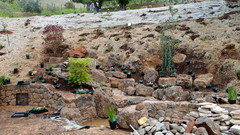
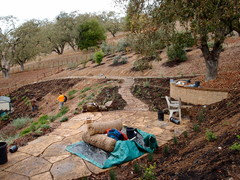
    Attached is a photo of a 2:1 slope with woven jute going down before the shredded mulch.
    There is also some sterile straw on the slope that we spread while planting ( lower half)

  • 11 years ago

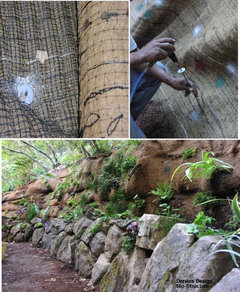
    Another image showing the open weave jute netting as opposed the the jute netting that has plastic woven into the weave.

    BTW, the link to the Las Pilitas nursery site that you linked us to is great. I often use this website in doing research on California natives. Another great website is Cal Flora nursery and if you are interested in California natives I highly recommend the book California Native Plants for the Garden by Bornstein, Fross and O'Brien.

    For the steep hillside garden in the two photos that I attached we used 85% Cal natives with a smattering of Australian natives and a few tough hardy ornamentals such as rosemary, lavender and yarrow.

  • 11 years ago

    d-d...that's some really nice work! I agree that the jute without plastic is preferable. Unfortunately, in the remote regions where I work, it's not available. My truckloads of coconut fibre rolls take a couple of months to arrive in the Himalayas from South India, so I'm grateful for even that. It does seem to do the trick with judicious plantings, though. I've found that allowing the ubiquitous local Artemisia absinthium to reseed helps greatly, too. And I do envy your access to irrigation materials, as well as shredded mulch. None of that available here.

    I've seen that Las Pilitas site a few times before, and while they seem to be experts in Californian native plants (and strongly promote their own sales of such above any other options), I have serious doubts about some of their seemingly home-spun soil "science" information.
    JHMO.

  • 11 years ago

    Shax,
    Thanks for the kind comments.
    I find it incredibly inspiring to see what you are doing in Bhutan.
    It must be very challenging to attain proper resources so big kudo's to you for doing what you do and doing it so well.
    Attached is a photo montage of some coconut coir embedded in between plastic. - another type of erosion control netting.
    These two types are used for very steep vertical wall erosion and or for making bio-walls.
    Pneumatic pins are used to secure the netting to the steep hillside.

  • 11 years ago

    Who did you use in Los Angeles for ivy removal on a hillside? I need to do the same. How is your hillside replanting going?

  • 11 years ago

    for those in Los Angeles, this variety of ivy removal sounds much better than the roundup method! http://www.countryliving.com/gardening/garden-ideas/a5964/jennifer-garner-goats/

  • 11 years ago

    Loved the goat idea -- except that the ivy grows back! I want the ivy gone... forever!

Sponsored
Daniel Home
Average rating: 4.8 out of 5 stars20 Reviews
Premier Interior Design Team Transforming Spaces in Franklin Co, Ohio