

have: true potato seed (tps)
I am currently in the process of cleaning my harvest of true potato seed (TPS). I have approximately 7,000 seeds right now and the project is at most only 20% completed. I am seeking TPS for TPS trades ONLY. Any size trade is welcome, I will definitely consider bulk trades of 1000 count or more.
FYI one potato berry will contain hundreds of seeds, so acquiring TPS does not have to be a laborious task. Collecting seed from multiple berries increases viability and genetic diversity, though. If at all possible, I would suggest harvesting seed from at least five berries from five different plants. Seeds are similar in appearance to tomatillo seeds or perhaps sesame seeds, only much smaller - 1/8 teaspoon equals approximately 500 seeds.
I am not ready to trade until seed cleaning and germination testing is completed - I thought I should bring the offer up now since the potato harvest is starting and that is generally the time for folks to be collecting the potato berries and cleaning the seed.
I am hoping to set up a few October trades. Please post here if you have or will have TPS available and are interested in a fall trade. I will then contact you at the appropriate time. I will not be responding to emails at this time.
Trades only please, I will not be responding to SASE inquiries.
Thanks much,
-Tom
This post was edited by soilent_green on Sat, Aug 23, 14 at 10:40
Comments (45)
 12 years agolast modified: 11 years ago
Hi Tom! I've never grown potatoes from seed before. Never even thought about it. How interesting!
I have some Apios americana blooming right now and hope my vines get pollinated and produce seed. I assume that is what you are seeking (Apios tuberosa). I think seeds might be ready in October. That's when they ripened last year. Check back with me then!
Katie
soilent_green
Original Author12 years agolast modified: 11 years agoKatie, to be more specific I am speaking of solanum tuberosum, the common cultivated potato or Irish potato, in all of its splendid shapes, sizes, and colors. My apologies, I should have been more informative for everyone in my initial post.
My true potato seeds are possible crosses, due to wild pollination, of the 12 potato varieties that I planted - I cannot narrow it down any further with any accuracy. Trading seeds would explode the genetic diversity of my seed collection very quickly, which is what I am after. :-)
That all being said, I am very interested in acquiring seed of Apios americana American Groundnut from you, and would love to work out a trade at the appropriate time. I have lots of other stuff that might interest you if you do not want TPS.
I currently have my seed list removed for complete revamping. Per your suggestion, I will contact you in October regarding a trade.
Thanks for posting!
-TomRelated Professionals
Huntsville Landscape Architects & Landscape Designers · Aberdeen Landscape Architects & Landscape Designers · Vicksburg Landscape Architects & Landscape Designers · Des Moines Landscape Architects & Landscape Designers · Saint Marys Landscape Architects & Landscape Designers · Tallahassee Landscape Contractors · Rome Landscape Contractors · Terre Haute Landscape Contractors · Meridian Landscape Contractors · Corpus Christi Landscape Contractors · Omaha Decks, Patios & Outdoor Enclosures · Lebanon Decks, Patios & Outdoor Enclosures · San Francisco Decks, Patios & Outdoor Enclosures · Longview Decks, Patios & Outdoor Enclosures · Ottawa Decks, Patios & Outdoor Enclosures- 12 years agolast modified: 11 years ago
Tom, thanks for additional info on the true potato seed. I went and read an article on Mother Earth News to further educate myself, too. I've never grown 'taters from seed before. Only ever grown them from seed potatoes 1x before. Crosses sound interesting!
A trade sounds great. I will be saving all of my Apios americana seeds this year. I found some wild tubers last year and transplanted them to my flowerbed. It's a beautiful vine.
 12 years agolast modified: 11 years ago
I haven't saved these before, but you have me interested. I know several of my drying potato vines have round berries on them now. When do you harvest the berries...from still green plant, dying vines, dried vines? How do you clean the seeds? I have several varieties growing close together so there is likely some crossing in my garden, too. We grew several colors and included a fingerling variety, also, so it could be an interesting mix.
soilent_green
Original Author12 years agolast modified: 11 years agonaturegirl_2007 - Thanks for posting! You are exactly the kind of person I was hoping to reach with this thread. Possible crossing of several varieties is great - increases potential for success and increases diversity of offspring. By growing out from seed a person can create varieties that are acclimated to local growing conditions and thus be more productive, more disease resistant, etc. There are some great stories, info, and photos online of what people have been getting from their TPS. Just do a search using keywords "true potato seed". Really neat stuff.
Harvest the berries when the vines are yellowing and leaves are browning and starting to dry down - the berries will be much more visible at this point making it easier to find them. The berries will practically fall off the vine as you pick them. Be sure to look for loose ones that may have fallen to the ground already.
Keep the berries in an open container out of direct sunlight and out of the reach of children and pets (explanation further down). Check berries daily. Hard and green = not ripe. Soft and discoloring to light green or greenish yellow, maybe even purplish on blossom end = ripe. Berries will ripen unevenly. Some may take weeks to ripen, some may be ripe when you harvest them. Clean them as they ripen, or if you only have a few then just find an average ripeness and clean them all at one time.
Cleaning seed is easy. Yesterday I just cleaned another 5000 seeds or so and they are drying as I write this. My following instructions for seed cleaning are a tad long winded, but I want to be as clear as possible.
Do not be afraid to just cut one open to see what it is all about and to get the feel for what I am talking about. If it is not ripe no big deal, just toss it. Got to learn somehow, right?
Mature seeds will be off-white or light tan in color - the color of tomato or maybe sesame seeds. Mature seeds will easily separate from the flesh.
First thing I must note is that there may be toxins in the berries called glycoalkaloids. They are the same toxins that are in the leaves and in the potatoes that have green on them (the ones that we have always been told not to eat). Such toxins are typical of most if not all plants in the Solanaceae nightshade family. I personally am not overly concerned as long as I am careful. Use basic precautions. Do not clean seeds in food preparation areas. Be sure to wear gloves or wash hands thoroughly after the project and wash all utensils. If you are concerned and want more info then do some research starting with the "Toxicity" section of the potato wiki. http://en.wikipedia.org/wiki/Potato
If you have serious reservations then simply drop this project.
Seed Cleaning:
Several ways to remove and clean seed - lots of online instructions speak of putting berry chunks in blender and then fermenting the resulting mash for several days. I will tell you my way because I feel it is quicker, simpler, and not as messy.
I use a small plastic cutting board, cutting knife, and a grapefruit spoon which I rinse lightly after each cleaning session and set aside so I can reuse the same equipment next time. Get a small jar with a sealing lid and fill it half full with water (recommend avoiding chlorinated water). I use a plastic peanut butter jar. Cut berry in half in the direction of the visible seam on the berry. Gently dig seeds out of each half with a spoon and/or squeeze the berry half slowly, with increasing pressure, to get remaining seeds out. Be careful, aim the cut side towards the spoon to avoid seeds shooting out into your face. Wear eye protection if you feel it is needed (always a good idea anyway). Put spoonfuls of seed with berry juice into jar (the berry juice will help the process). Try to minimize getting big chunks of berry flesh in the jar, but do not worry if it happens.
Seal jar. Strongly agitate by shaking or spinning. Notice good seeds settle to bottom first and any junk will settle out after the seeds. Set sealed jar on counter or table and every time you walk past the jar agitate it some more. After 24 hours agitate/spin the jar by the sink, let the seeds settle but not the junk. Remove lid and gently pour off the water with the floating junk, being careful not to let seeds spill out. Rinse seeds with water and repeat until the water in jar looks clean. Drain as much water off as possible, pour seeds onto paper towel to soak up remaining water, and gently scrape wet seeds off onto a plate using a table knife. Spread wet seeds thinly around plate. Next step is I use a fan on low setting for about an hour or so to dry the seeds on the plate - this step is up to you whether you want to do or not, I just like to dry the seeds as rapidly as possible. Scrape seeds into an open container (I use a cool whip or sour cream container) and leave the container open for several days to make sure seed is dry. Gently break up any seed clumps. Label and store.
To summarize:
1.) Cut berry in half.
2.) Gently remove seeds from berry halves by using spoon and squeezing berry half.
3.) Place seeds in sealable jar that is half full of nonchlorinated water.
4.) Seal jar and agitate contents occasionally.
5.) Rinse seed after 24 hours and spread wet seeds on a plate.
6.) Dry wet seeds using a fan for an hour or so on low setting.
7.) Scrape seeds into an open container and let sit for several days to ensure seeds are completely dry.
8.) Break up any seed clumps, place seeds in labeled container for storage.
9.) Trade seeds with me in late September or October. :-)To you and any other potential trade partners: Do not worry about germination testing if you do not want to deal with it. Just do the best you can with the seed cleaning, I will take the risk in a trade. I always germination test any seeds I trade as a habit, just something I do to add to my comfort level.
Please let me know if any questions.
Thanks again for your interest,
-TomThis post was edited by soilent_green on Mon, Aug 25, 14 at 13:04
- 12 years agolast modified: 11 years ago
Sounds a lot like cleaning tomato seeds which I've done quite often. Cleaning potato seed should not be a problem.
Hopefully, I can find enough berries to get seeds from. I know I threw some out when I dug some of the potatoes a few weeks ago. I just went out to the small potato patch here at home and tried to find more in the last bit of daylight....not too successful. I even dug in the compost pile looking for ones from the recent harvest! I'll look more tomorrow with better light. I also have a couple small beds at another location I can check. I know they had some berries earlier, but since then some of the potatoes were harvested and vines were removed. I'll hope for the best when visiting there later this week. For now I have 2 berries... not much, but a small start.
I have seeds for some other things you have listed on your trade list, too We can email later in the season and see what potato seed I've found to process by then and work out a trade.
soilent_green
Original Author12 years agolast modified: 11 years ago"Sounds a lot like cleaning tomato seeds..." - Yes, main difference is the potato berry seeds do not have gel capsules surrounding them like tomato seeds, which necessitates the fermentation method of seed cleaning. To me they are very similar to tomatillos, the seeds are just sticky and slimy when removed. Obviously if you have experience cleaning tomato seeds then you have the skill set required for this project. :-)
Critters took quite a few of my potato berries. The berries would just disappear off the stems never to be found again. Never figured out who the guilty party was. I even spent some time on my hands and knees in the potato patch looking for critter tracks, paw prints, or scat (until I realized I was obsessing again). Ultimately no big deal, at least they did not mess with the tubers...
As a suggestion, if you continue to have an interest in this project then next season as you find plants developing berries gently tie a piece of orange plastic flag tape or some other visible material around the stems with the berries - easy to keep track of the berries as plants intertwine and branches all collapse on top of each other at dry down.
I will contact you in a month or so regarding working out a possible trade.
Thanks again for your interest,
-Tom 12 years agolast modified: 11 years ago
Tom,
I've been keeping an eye on your post. I love all the information you provide. I tried to grow a couple potatoes and one did end up with a few berries, which I was excited about and planned to save. However, they disappeared when they were still fairly small. I had assumed that the bugs got to them, but hearing that "critters" took some of yours, I'm inclined to think that that's where mine might have disappeared to, as well. Squirrels live in the trees here and there are also possums and racoons in the neighborhood. I hadn't considered that animals might actually like potato berries!
- 12 years agolast modified: 11 years ago
I visited the away from home site and I'll have seed for you in October! I found several drying vines in the ground with lots of berries and several dried vines on the top of the compost bin with berries still attached along with a few loose ones. A few small potatoes attached to the compost bin vines show that those plants were Adirondack Reds which I know were harvested just a few days ago from a 4'x7' bed that also had 3 other varieties: might make for interesting offspring with that close spacing....I'll keep notes with the seeds.
Tom, I'm glad to save seed and get them to you and would likely do it again next year if you have an ongoing project. However, I doubt I'll want to grow many potato seeds myself....not much room to trial and cull, and I'm mostly just curious to see how they grow and how long it takes to get anything of significant size. Perhaps I can try some other veggie seeds from you.
Every year I usually grow several varieties close to one another. There are often only 4 or 6 plants of any one variety. People sometimes look at me kinda weird at the farm store where I buy only a few of each variety they offer and write the names on the seed potatoes with a Sharpie marker :) But it sounds like this may be a good way to get some interesting DNA into the seeds. I hadn't thought about my tiny potato patch being useful in that way.
soilent_green
Original Author12 years agolast modified: 11 years agonaturegirl_2007 - Wonderful! I am glad your search was successful. If you want to trade some of your TPS to me for other vegetable seeds that is fine with me, as long as it does not bother you to have to spend time cleaning seed. I feel bad that I created another project for you, goodness knows we are all busy this time of year. I have wondered about the possibility of having folks just ship the berries but I can not see my way around the likelihood of receiving a dripping box of oozing moldballs.
If you want to keep track of what seed came from what variety, that is great. What would also be nice is the complete list of the varieties that you grew together just for the sake of my record keeping. Ultimately none of it matters much, though, as my goal is to grow out a bunch of "mutts" to make what amounts to a localized, acclimated landrace. I consider mutts to be the best bet because they come from a large, diverse gene pool. Nature always shows us the way if we give her a chance.
My main reason for stating "TPS for TPS trades only" in the initial post was simply to keep things focused - to try to acquire TPS from others and to reduce the amount of general trade requests. Next winter I will offer some of my TPS to folks for general trades, just did not want to deal with it at this time.
"People sometimes look at me kinda weird at the farm store where I buy only a few of each variety..." - Pretty funny. Every gardener works at a different scale. I had an experience at my local fleet/farm store where I was trying to pick out the best five pound sack of each seed potato variety for purchase when a guy actually pushed me out of the way so he could load up a bunch of 50 pound sacks of seed potatoes onto his flat cart. Never get in the way of people and their taters I guess. LOL
"I hadn't thought about my tiny potato patch being useful in that way." - That is what keeps gardening so interesting to me: learning new things, thinking different ways and coming from different angles, trying different methods, and the ability to experiment and maybe make something better or "create" something special that nobody else in the world has. Fun stuff. :-)
I will contact you in a month or so via email so we can work out the trade details. Feel free to post an update here or ask any questions, I will continue to keep an eye on this thread.
-Tom
This post was edited by soilent_green on Wed, Sep 3, 14 at 10:20
- 12 years agolast modified: 11 years ago
Tom I have some tps of some red norland you can have some for sase if you like in about a month when the seed is ready.
soilent_green
Original Author12 years agolast modified: 11 years agoMrsDlight - I appreciate your offer and would like to take you up on it. I will contact you beginning of October.
Thanks much!
-Tomsoilent_green
Original Author12 years agolast modified: 11 years agoStill looking for a few more nice folks who might have an interest in participating in this project. Might be too late by now as most people have harvested their potato crops...
I have approximately 17,000 TPS cleaned at this time, project is around 50% completed. :-)
One little issue: I was unaware that the TPS natural dormancy period can last 4 to 6 months. I plan on doing a germination test late September/early October using gibberellic acid to try to break dormancy. Time will tell how this all works out, but the point is that trades may have to occur without an accurate reading on germination rate of seeds. I do not see the point in delaying planned October trades, but this matter will be discussed with all interested trading partners beforehand.
-Tom
 12 years agolast modified: 11 years ago
I really like this idea as crossbreeding plants is a hobby that I want to get into. Just out of curiosity though, would it not be possible for the plant to produce a toxic variety considering its lineage?
soilent_green
Original Author12 years agolast modified: 11 years ago"..would it not be possible for the plant to produce a toxic variety considering its lineage?" - You are bringing up a valid concern, albeit a relatively minor one in my humble opinion. It should not be ignored, this is the Solanaceae nightshade family we are talking about after all so of course care must be exercised when experimenting. Yes it is quite possible to grow out a toxic variety (almost assured on large grow-outs of wild pollinated seed), but one must note that there are differing levels of toxicity out there in the plant world. To make an extreme example, the adverse effects of eating a "toxic" potato should never be as bad as the adverse effects of ingesting a castor bean. (I wonder how many people are aware that raw/undercooked snap beans and raw/undercooked kidney beans are considered to be potentially "toxic".) Now, that does not mean that susceptible people might not get very ill if ingesting a bitter tuber, it just means that most people might simply experience gastric distress or some other negative reaction (certainly unpleasant but not life threatening). This is my informed opinion. I yield to any accredited medical or toxicology expert who may claim otherwise, but understand that this is a seed trade thread. I request that my thread not morph into a large discussion about plant toxicities - it is a good topic, and an important one, but the wrong thread and the wrong GW forum in which to do so.
I do NOT recommend that anyone try tasting or eating foods that they do not know for a fact are 100% safe. Bitterness in a tuber is proof that glycoalkaloids (toxins) are present. I consider myself a fairly experienced amateur gardener/plant breeding hobbyist. After engaging in much personal research and barring multiple professional chemical analyses due to impracticality and unaffordability, I personally feel quite comfortable in taking a tuber from a new grow-out, slicing it in half, and licking the cut side to taste it. If I taste no bitterness I feel comfortable in assuming the plant has produced edible tubers. If I taste bitterness, or if I have so much as a whisper of a doubt, the tubers will be destroyed and I will cull that plant from my breeding lines.
New potato plants grown from true seed, or the tubers they produce, that have undesirable traits regarding bitterness, poor insect or disease resistance, poor flavor, poor texture, poor production, poor storage abilities, etc. must be culled out. I rate all these undesirable traits equally - to me poor disease resistance or poor yields rate just as negatively as bitterness/toxicity. For all this effort what eventually should remain are some unique gems that are acclimated to one's local growing conditions that will outproduce commercially available seed potato tubers, and are perfectly safe and enjoyable to eat. This is the whole point of the exercise, to me anyway, and it is a rather long term proposition (which is why I want to speed up the process by acquiring wild pollinated TPS from other people). Most folks out there will just want to try growing TPS simply out of curiosity, just for the fun of experimentation. That is wonderful and what gardening is all about. There is absolutely nothing wrong with that but they should know what they are doing if they intend to take the next step which is harvesting for food.
This issue is a perfect example of personal responsibility and how folks must educate themselves regarding what they are growing in their yards, flower gardens, and vegetable gardens, regarding toxicity and levels of toxicity of various plants or parts of plants. Being informed means one is coming from a position of knowledge, strength, comfort, and safety. An informed gardener is a happy, healthy, successful gardener. :-)
-Tom
soilent_green
Original Author11 years agolast modified: 11 years agoUPDATE: I started germination testing of my TPS on October 01. Today (October 07) I noticed the first seeds are sprouting. So although I do not have an actual germination percentage yet I can at least make an honest claim that the seeds are viable.
I plan on seeing this germination test through and I will post a photo at some point in the near future. I will then pursue trades with all the GW members who have expressed an interest by posting previously in this thread.
Thanks,
-Tom- 11 years agolast modified: 11 years ago
Hi Tom,
I'm late to the party but I am hoping that you are still interested in trading TPS. I have seed from Yukon Gold, Adirondack Blue and Carola available. Let me know if you are interested and I can give you more info.
~Dawn soilent_green
Original Author11 years agolast modified: 11 years agoHi Dawn! I am very interested in your offer to trade TPS, and I am still hoping to be working with everyone else who expressed an interest. I am still planning on TPS being my main gardening experiment for 2015 and beyond - I am more excited about it than ever, and very much looking forward to the results.
My humble apologies for the delay. Fall was very busy here, I simply did not have the time to work on seed trades. Now the holiday season is in full swing and will be a major distraction through December. I have scheduled January 1 to install my new computer and finally get my email back up and running. The new computer has been sitting in its box on the floor for two months now, have had too many other more important things to do and it keeps getting bumped down the list.
A major achievement is that I have completed the cleaning, sorting, packaging, and labeling of all of my seed acquisitions from 2014 - tens of thousands of seeds of many varieties of flowers, vegetables, etc. I am currently in the process of reorganizing and updating my seed collection and rotating out the outdated inventory (birds and squirrels are going to have a Christmas feast of the old seed). I am working on my new GW seed list whenever I have some spare time, goal is to have that up this month.
Back to the subject, I ended up with approximately 30,000 true potato seeds, all nice and clean and good quality. Back in October germination tested out around 80 percent and I expect it to be even better now as time passes and natural dormancy is breaking.
Following is a photo of the TP seedlings from my germination test, was taken back in October when they were babies. More seeds continued to germinate after photo was taken. I let the plants grow until they were around two to three inches tall and then tossed them out.
My Observations: Small potato seedlings are very fragile, need lots of light and stable warm temps, and are rather susceptible to damping off. I was advised of these issues so I was not surprised. I rate them a bit more finicky and difficult to start than impatiens, as an example, so if you have successfully started impatiens you should be successful with these. Bottom line is that anyone with seed starting experience should have success with TPS, just be sure to use a soilless seed starting mix or a soil mix recommended by experienced TPS growers.
Happy Holidays!
-Tom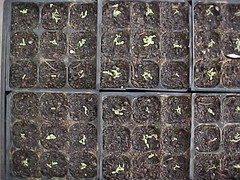
- 11 years agolast modified: 11 years ago
This year I grew 5 potato varieties from tubers: Yukon Gold, Adirondack Blue, Carola, Adirondack Red and Red Gold. Yukon Gold was the most prolific berry setter, then Ad. Blue and Carola. Only one of my Ad. Red plants set seed; just two berries with a paltry amount of seed. Red Gold set no berries at all.
I started growing some of the TPS in October to check germination and to get an idea of how TPS grow (this is my first year being interested in growing from TPS). Germination was excellent; I sowed about 5 seeds per pot and had to cull several seedlings from each. The seedlings have allowed me to make some very interesting observations. The Yukon Gold TPS appears to have been self pollinated. The plants have green leaves and green stems. The Carola TPS appears to have been crossed with Ad. Blue. Carola is a yellow skin, yellow flesh variety like Yukon Gold. However, the stems of the Carola seedlings are a bluish purple color just like the stems of the Ad. Blue seedlings. The Ad. Blue TPS is probably self pollinated.
I don’t have thousands of TPS but I have at least 50 of each (Yukon Gold, Adirondack Blue and Carola) that I would be happy to trade.
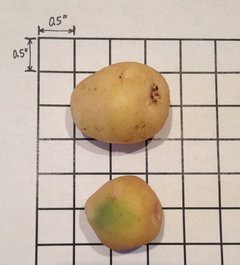
Pictured are minitubers from a Yukon Gold seedling that was started this October. I will save these minitubers to plant in spring. I want to experiment with yields from minitubers vs TPS seedlings started in spring.
January will be fine for seed swapping as I am about to go on vacation for the holidays.
Merry Christmas!
soilent_green
Original Author11 years agolast modified: 11 years agoThanks for writing about your germination experiment and observations, I always enjoy reading about the experiences of others. Those are some impressive minitubers, I hope they keep for you until planting time (please let us know how it works out). The few plants of mine that I inspected had some pea-size minitubers. Getting minitubers was not my focus at the time but they were interesting and fun to see nonetheless.
My seed was also harvested mostly from Yukon Gold. Berries were also harvested from German Butterball, Carola, Russet Burbank, Red Cloud, and either Red Gold or Irish Cobbler (some confusion in my notes), in order of quantity harvested. I also grew varieties that did not flower, and had some varieties that flowered but did not set fruit. Pollination was wild, different potato varieties were grown in three separate gardens, so I have no idea what might have crossed with what. I am not really into selective breeding anyway, I am more into acclimatization and landracing and letting Mother Nature take her course to see what she comes up with. That does not mean I might not try some selective breeding projects some time in the future, and if I do I will follow isolation procedures and keep better records.
I am willing to do any trade quantity you or anyone else may want to do. Reason I went overboard and saved so much seed was because in my excitement I harvested and cleaned every last berry I could find. I also figured that berry production varies from year to year based on growing conditions so I wanted to save as much seed as I could as a hedge against a bad production year. For all I know 2014 might have been a banner year for berry/seed production here and it might be years before such a thing happens again. Also, apparently properly cleaned and stored TPS stays viable for many years so I stashed a large quantity of them in my personal emergency seed vault. :-)
- 11 years agolast modified: 11 years ago
Tom,
I went through my TPS and this is what I have to trade:
50+ seeds each of Yukon Gold, Adirondack Blue and Carola
~10 seeds of Adirondack RedI also have TPS varieties that were purchased from Tom Wagner: Magic Dragons and Skagit Blast. I am willing to trade ~10 seeds each of these varieties. I believe that these are both diploids. I have not grown either of them yet.
I would like to trade for seeds from all of your varieties in whatever quantity that you think is fair.
I know we both have Yukon Gold but figured that as long as we are swapping seeds we might as well include those. Although we both grew Carola, I am guessing that my TPS and yours will produce quite different results. See the picture below. The minitubers with dark pink skin are from two separate Carola TPS seedlings. The other ones are the Yukon Gold pictured above and one from an Adirondack Blue seedling.
Happy New Year!
Dawn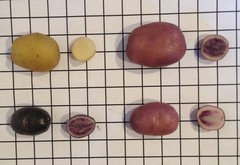
soilent_green
Original Author11 years agolast modified: 11 years agoHi Dawn. Happy New Year back!
You sound like you are on a higher level than I am regarding TPS, especially if you are now working with some Tom Wagner seed varieties. I am afraid all of my TPS is mixed together in one bag, so I do not know what came from where. I did not think it mattered being that I only knew one parent.
My strategy is the landrace concept using wild pollination to see what Ma Nature can come up with by herself, and selecting and saving the best of what she creates for me. Most of the TPS people I know are doing intentional controlled crosses of two varieties and are keeping track of the heritage. That is probably the correct way of doing things, and I may have to switch to those methods. For now I am just doing it out of curiosity and to learn new things.
If what I have no longer interests you I certainly understand, and I have no problem if you change your mind regarding a trade. :-) LMK
I would suggest you keep your Wagner seeds to make sure you have successful grow-outs. Maybe we can trade for those some time in the future when I can offer seed that I have kept variety-specific. I am happy just getting a random sampling of the seed you harvested, and it can all be mixed together into one bag. I plan on starting a random sample of seeds that I get from each trader, and then mixing the remaining seed into the bag of seed that I harvested.
I would also appreciate hearing some info from you regarding how you were so successful in getting such nice mini tubers. I think this would be helpful info for lots of folks, not just me. Of course Mr. Wagner's discussion board is a very useful resource as well.
Next week, first week in January, I plan on contacting everyone who expressed an interest in trading in this thread. If anyone is no longer interested that is not a problem.
-Tom
- 11 years agolast modified: 11 years ago
This is just my first year experimenting with TPS. I keep records mostly because I want any (potential) excellent results to be repeatable.
I would still be happy to trade seeds next week. I will keep the Tom Wagner varieties for now but everything else I have plenty of.
Making a post about minitubers on Mr. Wagner's discussion board is a good idea! I have a few questions that he might be able to answer.
- 11 years agolast modified: 11 years ago
Tom I sent you an email but I don't think you got it. We could do a MN trade.
soilent_green
Original Author11 years agolast modified: 11 years agoHi minnie!
Good to hear from you, hope you had a good holiday season. Hope the horseradish grew that I sent last year. Sunchokes and fingerlings you sent me did great. Yes I am open to another MN trade.
Update: Got my new computer set up, just having a problem setting up my private email through the service provider as I expected would happen. My yahoo email account works of course but I have around 1800 emails to sort through there. LOL Not as bad as it sounds, mostly outdated stuff and spam but I want to get that housecleaning done. I figure no big rush, I am almost ready and the trading season is just beginning to go into full swing. Time to start thinking about gardening!
Will get back to you very soon, along with all the TPS folks I promised to contact in January. :-)
Stay warm...
-Tomsoilent_green
Original Author11 years agolast modified: 11 years agoAs of January 10 I believe I have contacted everyone who posted on this thread and has expressed an interest in doing a trade. Two people were messaged via GW message service, so if you did not get a message from me then please contact me so we can converse via private email.
Thanks,
-Tom 11 years ago
Hello I am brand new here, and have seed from Carola potatoes , fall 2014 crop. Had a fantastic harvest, and tons of seed balls. These are the only variety I grow here in upstate NY. They store till late spring every year. Would love to trade some seed if you are still interested. Thanks, Norm
- 11 years ago
Project Update: This spring I started 30+ TPS seedlings. I had a lot of different varieties so I planted two of each kind. I did have some losses, it seems that TPS seedlings are pretty fragile at first. (Tom, I grew two plants from your seeds but they were two of several plants that did not make it once they were out in the garden. One got stepped on by a Canadian goose. I was so mad!) By now, most of the plants have grown huge and are flowering/have flowered. I have berries on at least three varieties which is so cool!
Some of the plants have not flowered and some are just way smaller than the others. Since I have limited space to experiment with, I may be culling these. I did notice that some TPS seedlings grow faster than others right from the beginning. In general, the seedlings that were the largest when I planted them out, grew into the largest plants. (I was expecting them to be more like tomato plants where all of the plants tend to "catch up" by the middle of the season no matter what they look like when planted.)
I have a bunch of regular (named) varieties planted from tubers this year. About half of them are fair to excellent at producing berries. By harvest time I should be positively swimming in berries!
I would definitely be interested in trading seeds again. I will have many more varieties this year.
And for those of you who are on Facebook, there is a whole group dedicated to discussing growing potatoes from TPS. Search for "Kenosha Potato Group."
soilent_green
Original Author11 years agoHi Dawn,
Nice to hear from you, thanks for your update! I too am impressed at how large some of the TPS plants have grown, I did not expect that to happen. Makes me wonder how large the tubers are going to be underneath. Quite a few of my assumptions regarding this project have been proven incorrect, which is what makes gardening experimentation so fun.
One assumption that I am happy to see somewhat disproven is difficulty. I did not find starting potato plants from seed to be any more difficult than other seed starting endeavors, but I would not rate them as "easy" or "for beginners" as the small seedlings do need to be coddled somewhat - kind of like impatiens and alpine strawberries. One thing is for certain - they crave light and need a lot of it, and the sooner they start getting full natural light the better. Plants were rather fragile at time of transplanting, and I quickly learned to put up wind protection for each plant to protect from the gawd-awful spring prairie winds we have around here. After two weeks or so of acclimation and growth I watered the little plants with rainwater and fert and then gently hilled them by hand, and then I hilled them again when they got taller.
I do not remember exactly what I got from you so my general update is as follows:
Plants from general TPS received from others are pretty much doing the same as plants from my TPS - some good, some poor, a few excellent gems here and there. I am quite satisfied with the progress.
Adirondack Blue TPS plants are doing well, Adirondack Red TPS are doing o.k. (I lost most of these plants in a wind storm soon after planting, wasn't their fault).
Rosalina TPS plants are doing fantastic and seem to have some decent CPB resistance. These are some of my best plants from TPS, and are very pretty as well.
One variety of named TPS I received from someone did not germinate. This happens, was not a problem in the least as I had plenty of other plants to work with.
I did expect TPS plants to be all over the map regarding health and vigor. Out of a hundred plants I expected a few failures, many to be weak, most to be average, a few excellent, and (hopefully) end up with two or three gems. This is pretty much what has occurred so far. As you stated, some plants looked strong right out of the gate, others looked weak, most looked average. I figure this is where human selecting comes into play. I selected for health/vigor when I thinned and potted-up. I selected for health/vigor when I transplanted out. Mother Nature then selects for health/vigor throughout the growing season. Finally, I am selecting for health/vigor by taking notes regarding which plants will have their tubers harvested for seed and which will be tossed aside as curiosities. Then comes the selecting for season length, disease/insect/drought resistance, edibility/flavor, storage characteristics, etc. It is a winnowing process, and I expect very few will ever make the final cut. And even then, if I continue to plant from TPS an old qualifier might get bumped by a new and better one.
My goal is to slowly replace my standby retail varieties with my own varieties I have developed by growing out TPS. For years I have been following this "local landrace" strategy fairly successfully with dry beans, snap beans, peas, tomatoes, peppers, wheat, corn, and a few others, but it is a long, continuing process. I have many "varieties" of stuff now that nobody else on the planet has (to my knowledge anyway LOL). As I get older and creakier I admit I am kinda wondering what the point is because it can take a human lifetime (or more) to accomplish these goals - great for the next generation, but only if they find value in such things. Mainly I do it for the fun. :-)
I too look forward to a trade with you this fall. There are far fewer berries on my plants this year, but there are berries on more (some newly acquired) varieties than last year. This year I am going to keep some seed separated out, and keep track of the name of the parent variety that the berry came from in case that matters to some folks. Obviously the other parent will not be known because I am continuing to allow wild pollination.
Take care,
-Tomsoilent_green
Original Author11 years agoBump/Reminder: If you are growing potatoes and want to participate in fall 2015 TPS trades then now is the time to be flagging any of your potato plants that
are producing berries, to make locating and harvesting those berries
easier when the time comes to do so.I am in zone 4. My berry-producing potato plants were all flagged a couple weeks ago. Most of the plants have matured and are starting to dry down. I will be harvesting the seed berries soon, probably next week. Once harvested it is very likely that the berries will need several weeks to ripen before seed cleaning can be done.
-Tom
soilent_green
Original Author11 years agolast modified: 11 years agoUpdate: I have harvested the potato berries. Now most of them need to sit and ripen a bit before I can harvest the seeds from them. I found a couple hundred berries, many more than I was expecting to find. Some are quite large - almost the size of cherry tomatoes. I also found quite a few berries on plants that were started from last year's TPS, so that seed is now the second wild-pollinated generation removed from the original variety. I will be keeping some of that seed separate from my main inventory in case of trade interest.
I also harvested berries from a grocery store-acquired NoID dark purple/almost black potato with mostly purple flesh that I grew this year (it is actually somewhat difficult to find the tubers in my black soil!). I strongly suspect the variety is "Salad Blue" which is a common maincrop variety. The plants had purplish stems, dark green leaves, bluish purple flowers, and the berries produced were mostly purple - I believe all are indicators of high levels of anthocyanins (antioxidants). I will keep some of this seed separate as well for trading.
The colors of the berries harvested from the different plants are quite varied - some are completely green while many are green shouldered with the remainder of the berry showing white, yellow, pink, or purple hues or streaks. Very interesting compared to last year, and I think such variation shows the results of the cross pollination that is occurring.
Harvest those berries, clean those seeds! I hope to be doing some TPS trades through here in the second half of September.
Have a great day!
-Tom
- 11 years ago
Hi Tom! I was perusing your very informative posts on potato seeds, as I've gotten some myself this year (finally). Mine are just from some russets I grew in a very large tub. Anyway, you sound like a committed plant breeder! If you haven't read the book yet, you may find the book "The Secret Life of Plants" interesting. It's one of my favorite books of all time, and I have read a lot of books in my life. Plants really do grow to please you. It's almost scary how this is true. I've had it happen to me as well (with ginger, my dawn redwood and one of my san pedro seedlings), though I have noticed a few 'stubborn' plants that refuse to cooperate. Just FYI. Seeds seem to be more 'malleable' than regular plants.
- 11 years ago
Tom, I noticed the potatoes this year had a much higher number of fruits. Even old standard varieties were loaded with them. Unfortunately all of Sherburne county seems to have terrible bacterial spot on tomatoes and potatoes. The fields are all turning brown without Roundup. I am not saving potatoes or tomato seed or potatoes whole for seed. Next year I will buy all fresh potatoes for seed and start again. We are buying our own land and moving next month. Anyway, I just thought I would mention what is going on here in central MN and why I did not save TPS this year. It is the worst disease and weed season I have ever experienced by about 10x!
soilent_green
Original Author11 years agolast modified: 11 years agoThanks for posting, mersiepoo. I have not grown russets in years so I do not have any russet in my TPS gene pool - would you be interested in trading this fall? Interesting book suggestion, will look into it further when time permits. I have no time for reading during the busy growing season but I try to read a few books during the winter break.
"Anyway, you sound like a committed plant breeder!" - No, just a person whose hobby has gotten way out of control. :-)
Hi minnie. Thanks for reconnecting, it has been a while. I have been following your posts on another gardening site regarding your land acquisition. Congratulations! I wish you all the best on your new "digs".
Sorry to hear of disease problems happening in your area. Things are going fine here in southwest MN, but a bit on the strange side. I am convinced the reduced solar output last couple years is having an effect as well. Weeds have been absolutely horrible this year in my area. Field corn plants around here are maxing out at 10-11 feet in height but plants are producing only 1 smallish/average ear each. Onions are doing very poorly, will be my worst crop in many years. Will not be any of my traditional fresh batter fried onion rings this year and that is a REAL bummer. May have to go shop my local farmers market to get my onion ring "fix".
Garlic harvest was generally mediocre once again but I finally have
around 150 very large, healthy German Browns of the quality I had before
AY wiped me out. Took three years, almost lost hope and quit - this was going to be my last year attempting to reestablish my crop of market garlic. Have a few other varieties that are now showing promise as well. No way around it, it just takes time to properly acclimate garlic.Pepper plants doing average. I have a hundred ghost pepper plants that are doing very well because I am babying them and spoiling them rotten. I have a contract to sell the peppers. Project has been more labor intensive than I estimated it would be, oh well. First picking of ripe ghost peppers will be tomorrow for Monday delivery.
Potato growing went well this year, but CPB was a serious problem. Potato plants were huge but hills yielded average weights and sizes. Very good quality tubers, though, and they are coming out clean with no scab whatsoever. No hollows, no internal brown spots, no insect/wireworm damage. I have harvested 475 pounds of potatoes so far and am a little over halfway done. Carola is my best producer this year, averaging 4.25 lbs. per hill. Most varieties are in the 3 lbs. per hill range. The poorest standard variety is Irish Cobbler at 1.89 lbs. per hill. Cobbler was one of my best producers last year. Strange how that works...
Tomato plants here are doing well. This year I waited until April 16 to start my seedlings and I planted them out second week of June. Worked great but next year I am going to push tomato seed starting back even further, to April 23. Planted 80 plants and lost only one. Lots of healthy growth and time now to do a little trimming in order to be able to get in for harvesting. I spaced tomato plant rows six feet apart and I cannot walk through some areas. Guess I have to change the spacing to 8 feet in future. Barring a hail event I will finally be getting a decent tomato crop, probably my best in the last 10 years. Disease issues under control, but I do have some septoria and late blight issues which is typical for this time of year. Problem I have been having is squirrels and raccoons eating into the tomatoes but I have been working on this issue with some success. From one plant, variety "Bull's Heart" oxheart, I have already harvested five tomatoes with a combined weight of 6.25 lbs. and there are still more ripening on the plant. In total I have harvested around 3 dozen tomatoes so far, bulk harvest will be starting probably end of next week based on how many are finally starting to turn. The big processing push is coming very soon and I am looking forward to it. The larder is quite bare of canned tomato goods and I need to restock.
I understand your decision to not save seeds and wanting to start with new commercial tuber stock, probably a wise move. As time passes I find myself becoming more and more protective of my soil and less inclined to acquiring outside seed/planting stock from non-commercial sources. Even the commercial sources are starting to concern me. In one of his threads, though, Tom Wagner spoke of how he treats his TPS to kill off anything nasty.
My TPS plants are now starting to wind down. Cannot wait to dig them up and see what is there. I hope to post a couple of pics at the appropriate time, but I have had camera issues and have no time or interest to shop for a new one right now.
BTW, last winter someone gave me TPS labeled "Rosalina" in trade but I cannot find any information on a potato variety by that name. Likely I misread the packet label, or perhaps that person just came up with their own variety name. Anyway, if anyone knows what it might be I would appreciate a quick comment. Blue flowers, stocky healthy plants with beautiful dark green leaves, somewhat CPB resistant, good seed berry producer, so I really want to correctly ID them if possible for my records. I want to isolate some of those plants next year for growout.
Well, gotta go dig taters before it gets too hot outside to work...
-Tom
soilent_green
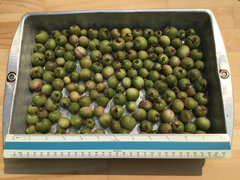
Original Author11 years agolast modified: 11 years agoA pan of potato seed berries, all I had left at time of photo that remained to be processed for seed harvest.
 Images · More Info
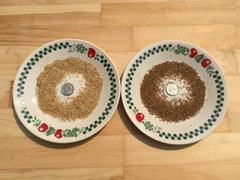
Freshly cleaned TPS. Plate on left contains seed acquired from plants grown from seed tubers of established commercial potato varieties. Plate on right contains seed acquired from plants grown from first generation TPS. In other words, these seeds are second generation wild cross-pollinated TPS. Note the difference in seed colors between the two plates indicating that far more genetic variation is occurring due to cross pollination, which is a very good thing.
 Images · More Info
I have three categories of TPS:
1.) First Generation Wild Pollinated TPS (seed obtained from plants grown using seed tubers of established commercial potato varieties)
2.) Second Generation Wild Pollinated TPS (seed obtained from plants that were grown from first generation TPS)
3.) First Generation "Salad Blue" TPS (wild pollinated seed obtained from commercial variety "Salad Blue" plants grown from seed tubers)
Including seed I still have from 2014, I have an inventory of approximately 60,000 - 75,000 TPS. :-)
I am still very busy with the harvest season but at this point I do have fresh 2015 TPS available for trade, so anyone who has their TPS ready as well and wants to initiate a trade with me is welcome to post here or contact me privately.
Note that my TPS has not been germination tested, and at this point I am not intending on doing any germination testing (but I may reconsider if enough people take issue). Because of seed dormancy issues, the seeds would have to sit for a minimum of 4-6 weeks before germination testing can even occur. Then, due to the erratic nature of TPS germination, it would be another 2-4 weeks before germination testing would be completed. This schedule is assuming that I would have the time available to do said germination testing promptly. Last year I did do germination testing and results came in at almost 100% germination, so quite frankly I do not see the need to test this year's seed harvest. I stand by any seeds I trade, but if this is beyond your comfort level then please do not initiate a request for trade.
Trades only. Requests for free seeds or SASE will be ignored.
Thanks,
-Tom
 11 years agolast modified: 11 years ago
hey tom
i hope you dont mind if i say hi here, i dont have any potato seeds.
but i thought it was cool that those bull's heart tomatoes i sent did well =) if i am correct and it was me who sent them in our last trade. i know i sent you some at some point anyway. such gorgeous tomatoes! mine are growing really slowly this year, i have yet to get one, while the rest of the maters are doing great. actually they did that to me last year too, take forever to ripen, and i can get a little slack at getting them in early, cause we have an extra long season. so its just odd that with your more challenging climate, that tomato is doing way better for you than me. maybe they dont like the heat, or maybe they need more water, i get stingy with it for the maters. the other maters are doing fine though.
if i just get a couple of those beauties though, i will think it was worth it. and i will eventually get at least a few i hope =).
also in some bad news, my elephant garlic, darn...i dont know whats going on with it. i will probably not be able to trade with you.
its like - disappeared! maybe it like...sunk down deeper, or got too dry and went dormant or something...either that or it got eaten. there was something in there eating my root crops!!! there may actually be more garlic in there, but i ran out of steam digging it up again and again trying to find them. once it starts raining, whatever garlic bits, or whole bulbs are still in there will pop up with green. so there may still be some around. its kinda weird though.
i got an extremely small harvest, and kept on digging and digging trying to find more. i didnt really even have enough for eating any, but i had to have at least one for eating. the rest got replanted (different location!), and i wish i had more.
i did finally figure out what you were talking about. i had noticed those garlic bulbils (?) in the ground, but i had actually mistaken them for some other kind of tree seed or something. they look completely unlike garlic, well now that i know, its more obvious, but when i encountered them digging i thought they were something from the wild trees. anywho thanks for clearing that up for me.
theres some chance theres maybe some garlic hiding under there, and i am thinking now ish, would be when they make those underground bulbits? so if i ever do find a stash of them, i will let you know, but for now i probably wont have any to trade.
i hope its ok that i am posting here, just figured i would give you that info...
btw, i enjoy reading about your gardening adventures, and landrace seed projects. =)- 11 years ago
Hi Tom,
I've got quite a few potato berries and I'm slowly working my way through processing them. I will be happy to do another trade this year. I don't have an up-to-date seed list but I can send you a short list of seeds I have that you might be interested in.
soilent_green
Original Author11 years agolast modified: 11 years agoHi Leila, thanks for posting. Nice to hear from you. No problem posting here, TPS is not in high demand so things are pretty quiet.
Yeah, the Bull's Heart Ox is a great tomato, a new favorite for me. Was one of my earliest producers for me this year and high yielding for an oxheart. Late blight has decimated the plants, though, so they are done now. Yes, the flavor is very good, have made quite a few BLT sandwiches using slices from them. Other OP varieties I got in trade last winter that I am impressed with are Thessaloniki, Bread and Salt, Legend, Terhune, and Old German. Old German is very interesting, to me it has a "peachy" flavor and texture. The Christopher Columbus tomato variety I tried this year intrigues me. Not that great of a tomato but it seems to be quite an old variety based on the traits - I want to introduce the genes into my landrace gene pool and see what happens. Big Boy has been by far the best of the hybrid varieties I trialed. Many of my landrace varieties are performing beautifully as well though some of them failed. No big deal, that is how the landrace concept works.
Finally got a good tomato crop after three very bad years in a row. I have harvested around 300 pounds (!) of tomatoes at this point, far more than I can use for processing so I am passing them on to others.
Sorry to hear about your elephant garlic. Probably best to reacquire seed stock and plant in a new location. No big deal that a trade won't work, I have plenty of other stuff to occupy me.
Dawn - nice to hear from you as well, thanks for posting. I would love to do a TPS trade or a larger trade including other stuff with you when you are ready. I do not have an updated seed list either, and likely will not have time to update until some time in November. But if maybe in late September/early October we can do just a simple TPS for TPS trade, I would be game for that, and maybe we could do a larger trade of other stuff after the winter holiday season.
I am still processing potato berries as well. I have much more genetically diverse TPS this year, the project is progressing nicely. My TPS plants are around 1/2 harvested, some of my best plants are still winding down. To date I have harvested around 30 pounds of tubers from TPS plants, some of them rival my main crop in tuber size. Was not expecting anything like that.
-Tom
- 11 years ago
well hey thats cool, we can chat a little.
i will be more on top of things next year with the bull's heart. its definitely in my keeper pile still, despite not doing very well this year. so thats saying something for it, that i like it so much despite the fail, i will keep trying. its really that good =).
of course partly...its me and the luck of the draw. they got shaded out a lot, because they didnt keep up with the growth of everything around them. it may also be that it is a better tomato for a cool climate, i would be curious to know for sure if thats so.
and well no complaining, i am swimming in tomatoes ! so its all good. this year the biggest producer was a volunteer large cherry, that happen to land in just the right spot from where i stored last years tomatoes at end of year. it managed to find just the right spot really early in the hoophouse, and turned into a gigantic monster. if i had only grown that one tomato this year, or it had grown itself (!) i would still be swimming in tomatoes.
also a variety called rapunzel has been good for the tiny ones i like, the jelly bean is coming out good, though slower than last year, and i picked up some sungold tomatoes i found somewhere, they looked so sad at the store and they were way marked down last minute price, so i had to get them. they are really good, i totally get why its such a great variety. black cherry is always one of the best and easiest for me, and homestead is also very reliable and productive. tried some new varieties that are close, but havent produced yet, the indigo rose, the rainbow, some others i cant think of right now...that havent produced yet. i had a lot going on in spring, and didnt get the earliest start i could.
we have oodles of yellow pear and also amish paste. i hadnt ever grown this one before now, but this has been the best in this years garden, and i do enjoy the tomatoes a lot. yeah if i absolutely had to pick the winner in this years garden - it would be amish paste. probably have harvested the most from it (except for monster volunteer) and started early and has just kept on producing a lot. still going strong...
ah anywho...enough rambling. =) time to get to it... soilent_green
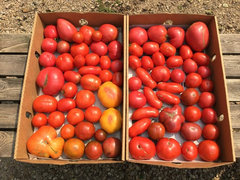
Original Author11 years agolast modified: 11 years agoSample of tomato harvest, taken a week ago. I believe that is a Bull's Heart ox in upper right corner of right box. :-)
 Images · More Info
 10 years ago
Hi Tom, at last I found someone trading TPS, the potatoes I´m growing are from seeds purchased from TaterMater seeds, "Pig nucles" is the name. The potatoes are red skin and flesh. Only one plant produced five berries, (I live in Iceland), it is not ripe yet. I´m very interested in getting seeds from "Mountain Rose", "Bintje" and "Purple Viking" are you growing any of of it? Please let me know if you have something similar.
soilent_green
Original Author10 years agolast modified: 10 years agoIn 2015 the potato varieties I grew were:
Adirondack Blue
Adirondack Red
Carola
French/Nosebag Fingerling
German Butterball
Irish Cobbler
Magic Molly Fingerling
Norland Red
Red Gold
Red Cloud
Rose Finn Apple Fingerling
Russian Banana Fingerling
"Rosalina" (Not sure about name.)
Salad Blue
Yukon Gold
NoIDs/Crosses grown from TPS
Not all of those varieties bloom, some of those varieties bloom but do not have viable pollen (cytoplasmic male sterility), some of those varieties produce only a few seed berries, some varieties are heavy berry producers.
At this time I am personally not interested in controlling pollination in order to maintain or develop lines, so I have been planting the potato varieties together and allowing for wild cross-pollination. As a result I would only ever know one parent, the parent from which I harvested the seed berry. If you want to keep lines pure then you do not want any of my TPS.
I have kept three types of TPS separate for trading, for now: The first type of seed is a first generation TPS mix harvested from plants grown using seed tubers. The second type of seed is a second generation TPS mix harvested from plants grown from first generation TPS. The third type is first generation TPS harvested from variety "Salad Blue", which was grown using seed tubers.
Birna Gunnarsdottir - Thanks for your interest, thanks for posting. I do not grow any of the three varieties you mentioned. If I did it is likely that the seed would not be pure anyway, because of what I discussed previously. I can not speak as to whether I would have something similar for the same reasons.
Either way, I am sorry but I do not trade seeds internationally. I find it to be too much trouble. Doing so through this forum is also against Houzz policy as stated at the top of the Seed Exchange page: ""Additionally, it is Houzz’s policy that: 1) you may only use this forum for exchanges within your country..."
I wish you the best of luck in your search, though.
-Tom







soilent_greenOriginal Author