Software
Houzz Logo Print
nova12_gw

Is this Scale?

18 years ago

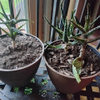
My red philo looks GROSS. Under the leaves are these red dots and yes they have that stickiness, the honeydew. My hubby says not to worry, they are just marks on the plant. I know with mealy bugs, I was able to look at it and see a living organism, is it the same for scale? All I see are red dots, not any bigger than a period on the screen. Here are some pics, they can be enlarged further but no matter how much I zoom in, I still dont' see insects, just red dots.

{{gwi:74344}}

{{gwi:74345}}

Here is a different pic of my passion vine.....I don't know what this is, but when I zoom in, it doesn't look good. It looks like something is on it, surrounded by little white specs (eggs?) You will definetely have to zoom in on this one to see what I am seeing.

{{gwi:74346}}

Thank you everyone

Comments (16)

  • 18 years ago

    I should also mention that I have tried to remove these spots, but they do not come off. The sticky sap stuff wipes off, but the red is almost in the leaf, rather than on it, this is why I am not sure if they are scales or not. I noticed the stem seems to excrete this sticky sappy stuff too, but no red spots.

    I just tried the q-tip and alcohol, and again, the sticky stuff comes off, but I am left with red scars? And other than the raised sticky stuff, the red spots are not raised at all.

    Thanks everyone

  • 18 years ago

    Scale isn't clear like that. Scale is usually a hard shell. The liquid you see looks like plant sap leaking out where something is actively sucking sap. Whatever it is, it looks too small to see, which makes me think spidermite. The spots that you can't wipe off are old damage where a sapsucker juiced your plant.

  • 18 years ago

    That is quite possible, we had a small bout of mites here, so they may not be under control yet. The sap does taste sweet (Ya ya I know, gross, but we all do crazy things....lol) I have a couple other plants that I suspect have spider mites, but I can't see anything other than the typical yellowing and spotting of the leaves. I can't find webs. Last night my hubby and I saw something moving, but it was near impossible to see, just a spec that moved. Since we both can't find any webs, we are unsure of what they are. Are there any other pests that small, he mentioned thrips, but I have no idea what these are, and I am quite sqeamish so I would rather let him do the research....lol.

    Thanks so much, I am so glad it is not scale. Mites on the other hand are just a pain in my a$$.

  • 18 years ago

    Every time I've seen scale, you could scrape it off with a thumbnail. And I've never seen mites leave holes big enough to drip like that. Thrips are long and skinny, not round.

    I have seen red leaf philos with brown spots like that, only larger, but without the sap, and I assumed it was some sort of fungal disease.

    If it's only on a few leaves, I would cut them off and make a point of not splashing water on the leaves in the future, in case it is a fungus. If it's all over the plant, I'm not sure what to tell you.

    The second photo could be an aphid. The black dot, if it's pear shaped, would be an aphid, and the white things could be shed skins.

  • 18 years ago

    Hubby has said that he had another philo like this years ago, and it did the same thing (small brown marks), and it had no pests either. So maybe it is nothing.....Only a couple leaves are affected, not the whole plant, and the plant is not in decline. Could it be damage from maybe rubbing the wall, or floor, or something, and because of that secrete the sap. I thought the sap was produced by the pests, not the plant itself.

    The second pic, if you were able to zoom in, has enough detail that i see something that is brown and white, but again, i can only get so close, and then the white looks like eggs....i guess. Maybe we are worrying too much....lol.

    Thanks for the help

  • 18 years ago

    I would treat it, just to be certain, maybe with some Bayer Systemic granules that you water in? If its mites and you can't see them, that will stop them. You don;t always see webs with spider mites until the population gets out of control.

  • 18 years ago

    If you do treat with a systemic, STOP TASTING IT!!!!!

  • 18 years ago

    LOL, I will, I told my kids today that I was planning on putting "poison" in the plants, so they need to vigilantly wash there hands when they touch the plants. We are pretty sure we are seeing mites, and we are going to treat them tomorrow. I will keep everyone posted. I just hope we don't kill everything....lol.

  • 18 years ago

    I know you probably know this, I don't want you to think I am talking down to you in any way, LOL, but some people are surprised by this....

    The pesticide in the Bayer granules (and the Bayer Flower care and Bayer Tree and Shrub) is the same pesticide in the topical treatments that they use on dogs for ticks and fleas in Advantage and Frontline.

    Its Imidicloprid. Its also in an outdoor insecticide called Marathon, and another called Merit.

    Its considered safe (of course I don't lick my dog, so I wouldn't taste the plant secretions either after treating it). I mean, of course you wash your hands after touching your pet before you eat, but just in general, its probably okay to touch the plant and not wash if you are using the Bayer.

    Imidicloprid is one of the better systemics to use against mites in particular because it works by paralyzing the mouth parts of the insects so they can't bite, chew or suck sap. (I have had better results with using it in some instances than I have had with a dedicated miticide like Kelthane) That's why all fleas and ticks fall off your dog after 24 hours and new ones are killed quickly. Same principle with scale, mealies, mites and thrips. The existing ones die, and can't reproduce a new generation, and new comers who may pop in from elsewhere die as well after they bite the plant.

    The theory is that they can't develop resistance to this product, but I guess time will tell.

    Many people think it doesn't work because the bugs don't immediately drop dead when you water it in. Takes a day. But it does work.

    There is also a ready premixed spray that does kill almost immediately on contact for a quick knock down. I have used this with excellent results on orchids like Cattleyas that for me are scale and mealy magnets down in the sheaths around the bulbs. A spritz with the ready mix followed with a watering in of either granules or the diluted Flower Care has solved many problems for me in the greenhouse, where pests can spread very rapidly from plant to plant.

  • 18 years ago

    I like imidacloprid very much (it's delicious on ice cream!!!!), but I thought it wasn't approved for mites. In fact, I'd seen rumors to the effect of it making mite problems worse. The Wikipedia entry for imidacloprid doesn't mention mites one way or the other, which makes me think it at least doesn't work, even if it doesn't exacerbate mite problems.

    In any case -- if it's not listed on the label for the pest you have, assume that it doesn't work. There are pesticides specifically for mites, that do work; Avid (abamectin) is the one we seem to use most where I work, and it seems to keep the mites under control, though since we're always bringing in new plants we never win the battle completely. I don't know whether it's available to buy over the counter, but I'll look into it and get back to you.

    Imidacloprid, besides being a luscious dessert topping, does a nice job on mealybugs and whiteflies, in my personal experience. Just so you know.

  • 18 years ago

    The big blue bottle of Bayer granules specifically says "Kills Spider Mites" and I have personally found it to be true

  • 18 years ago

    (Turns out Avid is a restricted-use pesticide, so never mind.)

    Does the Bayer forumlation have multiple active ingredients? There's a 3-in-1 formula (a spray, though) that I know one of the guys at work is very fond of, which is tau-fluvalinate, imidacloprid, and something else. It works fine, but I used it inside, in a not-so-well-ventilated area, and it made me kind of sick for a while. Granules sound a lot less dangerous.

  • 18 years ago

    I recycled my last container, let me buy another (I always like to keep one) and I will let you know.

  • 18 years ago

    Definitely found mites.....I'll be treating this weekend. A weekend of showering and washing plants. Thanks so much for the advice.....I am glad I found this early, I still can't see webs, I can only see what my cam sees for me.....they are small little buggers.

    {{gwi:74347}}

  • 18 years ago

    I think Bayer very recently introduced an imidacloprid product that also includes a miticide. I'm pretty sure that straight imidacloprid does not work on mites.

    The new product sounds like a great idea, but I haven't needed to try it yet (knock on wood).

  • 18 years ago

    The reason mites are so hard to kill and that so many things don't work on them is that they are not "insects" per se, they are actually related more closely to spiders. I believe that they are classified as arachnids (hence the name, spider mites).

    There are also several different kinds of them, and I have noticed that some things will list the exact type of mite it either kills or "controls". I think the most common Florida mite is the red spotted spider mite.

    I know Avid is a popular product, but I simply can't find it locally. No one carries it. The only dedicated miticide I can get is Kelthane, which is definitely good for a quick knockdown, but I always follow it up with a few weeks of serial Neem Oil spray to make certain everything is completely eradicated. I don't like to use pesticides, I stopped using Orthene, Funginex and Cygon a couple of years ago. I really like the Bayer products because they don't "travel". It kinda stays where you put it. But if I have a choice I usually go with Neem Oil.