Software
Houzz Logo Print
linnea2

Winged ball coming along

20 years ago
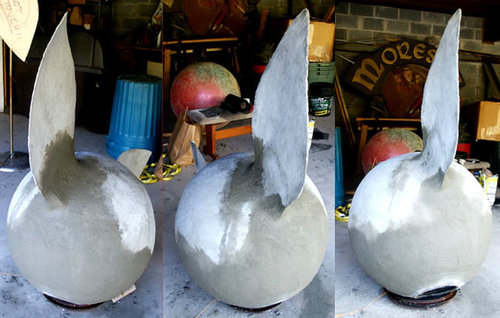
Weekend work over I'm happily getting back to concrete.

Is there any way to post pictures directly into a thread

without having them on a web site?

I'm getting tired of having so many posts in the gallery

(and a new one for every picture, breaks up the continuity

and hogs the whole gallery!)

The ball is starting to look more like a whale than Piglet

and, yes BB, I believe it will spin, getting it up on the rod

will be an adventure.

Here is a link that might be useful:

Comments (15)

  • 20 years ago

    Very elegant looking wings!
    In one of the forums I recently read how to post pictures directly into a thread. I didn't exactly understand the directions so I saved the message! Since I don't know if it is okay here to reprint someone's post, I sent it to your email address.
    Laura

  • 20 years ago

    Thanks Laura.
    I guess I'll have to decide wether to start an online album,
    it would simplify posting pictures. A picture DOES say more than
    a thousand words. I love when other people post pictures in a thread.
    I'll save your instructions just in case.

    I'm having an impasse with the edges of the wings, thinking about
    some kind of web-like coping, if there is such a thing?
    I have some time, this side needs to cure before I do the other side
    and then the edges.
    Then I'll have to dig out my stains.

    The hole is dug and the pipe is cut, the spike it will hang on
    will be at about 6.5'.

  • 20 years ago

    Great job on the wings/ears! They look almost paper thin. How thick are they and how in the world did you build them up ? And definitely do the album thing...we all want to follow this one. Looking fantastic!

  • 20 years ago

    Thank you Tango!
    The wings are about 3/16" thick except where they attach.
    I made a pattern and cut them out of standard expanded lath,
    with long extended tabs to wrap in opposite directions around the ball.

    While flat I shaped them slightly to final shape and did a coat of POP gauze
    on one side. When that was stiff I did a thin coat of vinyl patching cement
    on each side, lapping on sheets of fiberglass bug screen.
    The concrete/POP joint seems ok, no peeling except tiny chips 1/8" in from edge.

    After they were strapped on, I cut circles of lath and sewed them
    into all 4 angles with wire, until they curved like brackets
    feathering close to ball and wing, this stiffened the wings considerably.

    Now I'm stuffing the resulting hollows with rather stiff mix,
    stroking everything out with wet rubber gloves after about 1/2 hr of cure.

    I'm looking for some kind of coping to edge the wings, then cover with concrete,
    possibly with a wire inside it to help stiffen them more.
    Have you any ideas? This is really your domain I think.

    I may be asking concrete to act more like fiberglass than it may prove willing to.

  • 20 years ago

    Hi Linnea
    My grandfather worked as a mostly wing repairman at a small airport. He fixed damage caused by bad landings mostly. I used to hang out there as often as I could as a kid.
    My biggest worry is if your ball isn't perfectly balanced the vibrations could break the wings right off the ball.
    But I've never seen this done in concrete so it's just my opinion.

  • 20 years ago

    Hi T.E, I'm hoping there won't be any bad landings.

    If it doesn't balance well enough it should be an easy fix
    but when I first hung it, the weight was so far below the fulcrum
    it really just wanted "down".

    Structurally, the wings are hanging by a strap of lath draped over the top
    centered over the socket that holds the spike, so up-down is secure,
    sideways I'm trusting to the beefy "brackets" I'm doing now.

    One wing might, in retrospect, have been better in terms of aerodynamics,
    no conflict of forces.
    I can always add weight to the bottom, inside, after it's hung.
    It's an experiment, some things don't work. Happily I'm very pig-headed.

    Your grandfather would have been good to have around, I bet he
    would have known how to reinforce the edges.

  • 20 years ago

    Linnea --- You might take a look at the link below. It shows some Drywall Outside Corner Bead for Arches. It is a metal lath type product and is excellent for forming to curves. If you think it might work for you, just check with some local suppliers...Home Depot might have it, but the "arch" variety that can be bent around shapes is not the most common. Hope this helps.

    Here is a link that might be useful: Drywall Corner Bead for Arches

  • 20 years ago

    Tango, I think those would be too heavy for this job.

    Today i got some metal (nickel-covered copper) tubular webbing
    at my favorite surplus store. They can be cut open without disintegrating
    and the texture should let the 'crete adhere. If the metals react
    with the lime later (not sure how) at least I'll get a smooth edge.
    Also got some fine (1/8") threaded steel rod, I'll try that too.

    It's going to rain cats and dogs all weekend, good time for being
    in the garage!

  • 20 years ago

    For very fine forms it's useful to have alkali-resistant fibre-glass. I'm not quite sure what you're trying to do, but I'd make a cement/sand slurry, with SBR instead of water, then mix in fibre-glass strands. That can be spread thinly, and painted over afterwards with a slurry of cement/sand/SBR. Or you can paint on a slurry, sprinkle on a very fine layer of fibre-glass strands, pat down into the slurry, and build up that way.

    (If the cement-content is too high the surface will craze in time - sometimes that looks quite good, but you don't always want it)

  • 20 years ago

    linnea2 --- My only concern with the material you found would be discoloration, especially with it that close to the surface. Below is an excerpt from a document dealing with metallic reactions in concrete...

    "Copper (Cu)
    Copper embedded in concrete and/or mortar is usually roof flashing. Embedded copper is practically immune to reaction with corrosive alkalis, even if exposed to constant moisture. Copper will not react with dry, hardened concrete and/or mortar. Rainwater leaching, however, may bring chlorides in contact with the metal. Corrosion may occur and result in a green discoloration or runoff. Consequently, chloride admixtures should not be used in concrete if contact with copper is expected."

  • 20 years ago

    linnea,
    If your goal is to give a very smooth finished look to the edges, why not use a similar technique to what you began with using the plaster bandage pieces, but instead of POP (which by the way is not weather resistant), use cement mache' strips. Be sure to wet the already done wing portion first, and even apply a little bonding agent if you like. Using a very thin mix of 1 cement to 2or3sand, or a slurried mortar mix, or the vinyl patching stuff thinned, dip strips of fabric into the mix then smooth them onto the wings feathering in.
    Dena

  • 20 years ago

    Dena, I think you hit the nail on the head.
    The threaded rod works, shaped to fit and held on temporarily
    with duct tape strips. The metal braid is awkward.

    I have lots of bias edging, some fairly loose weave that will work.
    What would you use for a bonding agent?

  • 20 years ago

    Oh, and Tango, thanks for the copper report. If I can get the
    already applied strip off today, I will.

    Dog, painting on layers of slurry I'll also try today.
    After this, I'm done, just stain and then, up^

  • 20 years ago

    linnea,
    I would use a bonding or bonding fortifier agent, and am guessing that you have some given the projects you've done. If not it is in the cement products isle. You can dilute the bonding agent with a little water. Spray the area you are applying your 'bias tape' to with water then using a fairly dry brush that has bonder on it, brush that over the 'bias tape'. The bonder does make your mix a little slipperier but in this case it might help. You can use your brush to smooth/feather the slurried bias into the body of the wing. If it looks like the bias tape is not fully covered at that point you can apply a little more mix, made with bonding agent in place of the water to the consistency of chewing gum, roll a little in your hand and squish it over the bias tape and again feather in or press off extra with either a gloved finger or a cheap chip brush.
    Dena

  • 20 years ago

    Dena, I went ahead with the tape covered with concrete, then trowel and
    wet rubber glove faethering. I had to do several coats and there may
    be some last touch-ups. It seems to have worked. It's curing now
    along with a test slab for the stains.
    The light is poor with all this rain, need to hook up a lamp.
    Thanks for your detailed instructions anyway. Any slipperier though,
    would have been unfeasible, some edges being upside down.

Sponsored