Software
Houzz Logo Print
jenricae

Help! Jade still falling apart

18 years ago

Hi,

I've been having problems with keeping this Jade from losing all it's leaves and branches. They keep falling off! I posted in the past and took the advice to change the soil. I'm not sure if i'm over watering it. I wait until it's dry and then soak it and remove the extra drained water.

The leaves are free of any markings of pest (to my eyes). Is there something specific that i should look for?

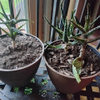
Here's a link to some pics:

http://drop.io/dyingjade111

Thanks!

Comments (18)

  • 18 years ago
    last modified: 11 years ago

    Watering. the one biggest cause of plants having difficulty.

    Quote: "Completely dry out". Not too many plants are prescribed to be allowed to do that.
    First of all, when soil is given water then allowed to dry out too much, it will certainly shrink.
    If it does that too many times, the soil will shrink away from the pot's sides and when watered, will go down the sides fast....to the drainage holes...and will give the appearance the plant's roots have been fed.
    Not the case, in many instances. The water drains alright...but the roots have received very little.

    Plants do not like to be given too much water. They cant use it...and when repeated and repeated, the soil becomes soggy...and whether watered or not, it bears on the roots soon causing them to not be able to take up any more moisture. The plant's leaves are first to notice...they dry out. Even when water is sitting a few inches away, the roots have stopped their ability to take up moisture...and root rot develops.

    NO, never let the plant dry out too much. How much is too much? That's for you to decide. Use the old standby; poke your finger down into the soil....up to the first...or second knuckle if your hand is small. Feel damp...let it go another couple days. Not damp, water to drainage.
    Use water that is allowed to sit overnight to gain room temperature and lose some of the fluoride. Unless directed to do so because the plant prefers it, there is no need to use distilled water. Just make sure to not use cold water directly out of the tap....and hopefully, never use water out of a tap that is on a softening system.
    Always let it drain...then dump the excess.
    Let it gain some dryness between watering, then water to drainage.

    The method of dribs and drabs is a dangerous routine to get into. That is what is commonly done when the pot doesn't have drainage holes and you trust what you add reaches the roots...but not too much and the plant can dry down a bit.

    If the pot does not have drainage holes, then put them in.
    Any pot can be given holes by careful use of a drill with a proper bit.
    If you don't like to put a saucer under the pot, then consider putting your pot into another pot...a larger pot called a sleeve. The drainage goes into the second pot...but not so much tha the bottom of the draining pot sits in water in the sleeve.

    As far as your Crassula's light preferences, it likes sun...it can go out of doors into the sun. How much sun..well, it can get sunburned like most people...use common sense.
    The pot will determine its size.

  • 18 years ago
    last modified: 11 years ago

    It looks to me like rot, which implies too much water. The soil you have it in is way too heavy, there is nothing that I can see that makes it light. Step on over to the cactus & succulent forum and ask for Randy. He is a whiz with jades. He'll probably tell you to chop it down to nubs and put it in full sun, which it is a bit gangly.

  • 18 years ago
    last modified: 11 years ago

    I'll just take a second to point out that it is the habit of a particular poster to go through much effort to disagree with me at every turn. I don't mind that, as the readers can themselves separate what makes sense from what is difficult to make sense of, whether it be regarding my advice or someone else's.

    Since she took the liberty of creating a straw man by changing my "... completely dry at the drain hole" to "... completely dry out" I thought I might explain that when soils first begin to feel dry to us, there is still from 40-45% moisture content in the soil. Plants are able to extract moisture until soils dry down to 25-30% moisture content. This means that when soils first 'feel' dry, there is still approximately a 15% cush there until most plants pass into drought stress. Many plants also have mechanisms in place that allow them to handle drought stress very well and extract water from 'dry' soils very efficiently, jades being one of them.

    I also stand by the idea that using distilled water on plants that you MUST water in sips to prevent rot is a very good idea. When using tap/ground water, metal salts dissolved in the water WILL accumulate in soils, eventually making it osmotically impossible for the plant to absorb either water OR the nutrients dissolved in the water. Distilled water has no such dissolved solids and you can water a plant indefinitely with it. I have a large saikei planting that is 7 years old, in the same shallow pot (with no drain holes) and soil for the entire time. The plants are still extremely robust and there is no trace of mineral deposits or salt build-up in the soil or on the dish/tray.

    So you see, if you water in "dribs and drabs" and know what you're doing (using distilled water) you can still have perfectly healthy plants. I also disagree with the advice to "Use the old standby; poke your finger down into the soil....up to the first...or second knuckle if your hand is small. Feel damp...let it go another couple days. Not damp, water to drainage." This leaves the door wide open to a soil that is continually moist & jade will not tolerate that well - especially when a heavy soil is under suspicion to begin with.

    Al

  • 18 years ago
    last modified: 11 years ago

    I agree with mentha. Try repotting it in a more sandy soil, specifically for cactus and succulents. Once the soil looks dry on top, and some water. The sandy soil will allow the excess water to drain through more easily. Also, if water drains out into the saucer under the pot, dump it.

    Since it is sickly, don't fertilize it until it appears to be healthy again, otherwise you may cause more harm.

    Sarah

  • 18 years ago
    last modified: 11 years ago

    May I also point out regarding jade plants and water, that I once rented a place in Berkeley where there was a large one in the backyard. I'm not sure I recall correctly, but I think the soil there was pretty porous- rather sandy, in fact (it was in the flats to that seems likely). The winter season there had long, long stretches of seemingly endless rain, and that shrub was happy as could be. Bloomed like mad late every winter. That's a Mediterranean climate, so the rainless summer definitely gave it some drying out time. It was about 3 feet tall and as wide.

    The pics of your plant put me in mind of how mine looked when I had it in the garage and forgot to water it for a few months... Dropping leaves and even segments of the stems.

    I do believe you can't water a plant too MUCH at one sitting, so long as you don't water it too OFTEN or leave it SITTING in the water too long.

    And the suggestion to repot sounds good to me too. You can check the roots that way, for dessication or for rot.

    I like the plan of checking moisture at the drain hole!! Why haven't I heard that before?? There's so often plenty of soil humidity when the top feels dry, and that's the place that has less air exposure.

    I'm intrigued by Al's suggestion regarding use of the wick. I want to start a thread asking more on that, and asking about the use of distilled water too.

    Hope your plant picks up for you soon.

    perL

  • 18 years ago
    last modified: 11 years ago

    I have a house of jade babies-many many of them. My jade is 30 years old. I have told this story many times so sorry for repeating myself. About 20 years ago the kids knocked over my jade and it sat on a shelf in a broken pot with roots exposed for about 6 months. I looked at it but did not water it until I was getting ready to toss it. But I saw some roots sprouting off a leaf so I repotted it and started caring for it a bit. I continued to neglect it until about 8 years ago. This plant can take abuse. And you can take a branch and stick it in a cactus mix and leave it alone until you see some growth. I water weekly but you can skip a week and not worry about hurting the plant. My problem is figuring out a rainy season for a house plant living in wisconsin. Should you water more regularly when the days are short like in california or during our growing season. When in doubt with this plant I always water less. It can grow into interesting shapes after you damage the plant. If there is an unmushed branch left, it can be saved

  • 18 years ago
    last modified: 11 years ago

    Thanks for all the advice! I'll ask Randy too.

    Just a couple of points:

    1. The pot has drainage holes in it and rocks at the bottom
    2. I did repot it a few months ago and the roots looked healthy.
    3. I repotted it in Cactus soil, that's what the package said.

    So perhaps it is my watering method that needs to be adjusted. I'll start leaving the water out for a day before watering. Also, i'll water it in small amounts every week or two instead of waiting 4-6 weeks.

  • 18 years ago
    last modified: 11 years ago

    I think you missed crucial points, Jen. Watering in sips is to be avoided when possible, but it may be required to prevent root rot issues if the soil is too water retentive. If you do need to resort to watering i sips to prevent root rot, you should use distilled or RO water to prevent a build-up of salts in the soil.

    Rocks at the bottom do not help drainage, They only cause water to perch in the soil above the rocks, which raises the level of saturated soil in the pot.

    Here is a link that might be useful: More about water movement & retention here, if you care to read it.

  • 18 years ago
    last modified: 11 years ago

    Yeah, Al got here first, but I too was going to suggest not giving small waterings. Just water 'til you see some water come out the bottom. So it's sort of a medium amount, not a small drink per say, but not a soaking either.

    Was also going to suggest no rocks on the bottom. I've heard this is a practice that was thought to be good, but can actually cause more problems than it helps.

    Unfortunately, one of the hardest things to learn about plants is that sometimes all one can do is give them time to recover. After a while, it's just do nothing but wait. Then slowly, you'll see bits of new growth & know it's starting to recover.

  • 18 years ago
    last modified: 11 years ago

    If this is the same jade from the other Thread (which I can assume it is)...I think it bears noting that this jade does not receive any direct sun - to answer Al's first question.

    "Our plant is next to our couch next to a south facing window. It gets lots of light, but no direct sunbeams."

    Josh

  • 18 years ago
    last modified: 11 years ago

    I'd just like to add my experience with packages of soil that say "for cacti and succulents" on them: I think I used one of these pre-packaged formulas from Miracle Gro, and my succulents hated it. I'm not sure what soil component was in it (sphagnum moss?) but when the soil was dry on top, it wouldn't soak up water very well, and seemed to produce very dodgey levels of moisture. What I like a lot better for any plant that cannot take long periods of moist soil, like jade plant, is to get a nice, all-purpose soil mix, and mix a liberal amount of small volcanic stones into it. I can get these rocks from my local garden supply shop, and they also sell pre-mixed soil/volcanic rock which they use for the cacti/succulents they sell. Some people cut potting soil with perlite for a similar effect, which is to make the soil a bit more airy and porous so that the roots don't get water-logged. Also, in my experience, potting succulents in clay pots, so that the moisture can evaporate from the sides of the pot, seems to help prevent soggy roots.

  • 18 years ago
    last modified: 11 years ago

    Thanks a lot for all the advice!
    Just a note on the soil: I have other Succulents planted with this soil and they are doing great. Of course, they are receiving direct sunlight, so that probably points to one of the issues. I'll incorporate all the advice that you've shared with me. Thanks again!

  • 18 years ago
    last modified: 11 years ago

    I have a jade plant that I am trying to train into a tree form. It looks great except...it tips over! It is a problem that I have encountered with every jade that I have ever owned. The jade I have is a bit top heavy from trying to make it a tree, and maybe that is why I have this problem. I have seen three foot TREES though with giant trunks so I know it can be done. Do any of you "jade people" know what I should do. How do I prune to give the trunk more stability, etc. I want a jade "tree" and I can't seem to get this part right. help please!

  • 18 years ago
    last modified: 11 years ago

    You are over-watering and roots are rotting - classic symptoms - no roots to anchor the plant. Withhold water until you see the leaves wrinkling from a lack of turgidity. You can also learn more about soils that might be more appropriate for jades & succulents by following the embedded link. Correct the root issues and the plant will present you with many pruning opportunities that will allow you to shape it into tree form.

    Al

  • 18 years ago
    last modified: 11 years ago

    Jen, I don't believe you will find many suggestions about watering plants on a schedule. You say you will water
    every week or two..instead of the 4 - 6 weeks you have been doing.

    Its very easy to know when to water a plant. Treat it like you would yourself....drink when you feel thirsty.

    You water a plant WHEN IT NEEDS IT....NOT WHEN YOU FEEL YOU SHOULD WATER IT.
    Plants require watering at different times, in different amounts and for different reasons.
    In their summer months, wherever/whenever that occurs, they require more water than in their wintertime when they are not growing.

    Thus, for a plant in winter, it can often go without water for weeks so that you can safely go on vacation and not worry about whether it has received sufficient water.

    I suppose I'm the person who is referred to about having different perspective on plant care. Well, so much for manners.
    We all have a reason to wish to try to help where and how we can and if different opinions are expressed, they should be taken as such....opinions.
    Unlike the car that Henry Ford put out.....you can have any color you want......as long as its black...
    we allow that others have thoughts on the best approach about plants and we respect each other's right to do it.

    Al......that mention about 40 - 45% of water retention.
    I suppose you have a reputable, maybe professional meter that reads such moisture level....and what about other soils.
    All soils I would suggest do not lose or retain such moisture in the same way, in the same time.
    So whether a soil retains sufficient moisture to give to a plant would then depend on what kind of plant is in that soil and its particular needs.
    And this 40 odd percent moisture level....I assume is in the ball rather widely held so that the roots are indeed in contact with some percent.
    I contend that letting a soil dry out too much, will, in time, cause shrinkage....and shrinkage can only be allowed to go on for a time before it becomes dangerous.
    It too can depend on the type of pot the plant's soil is in.
    Plastic holds water much longer than does wood...or clay.
    Metal....no need to go into.
    Ceramic.....again...it holds water longer.

    Much better for the novice houseplant owner to use a material that can offset bad care.....for a time.

    I contend also, since the wick is at the bottom of the drainage hole and allowing it to dry up, is bad water care.
    Plants do not rot just because they have a little moisture around them. Its when there is too much water and the water is being made to be drawn up into the plant above.
    If the wicking of the roots are unable to further suck up moisture to the foliage (and blooms) above, then there is little concern about whether there is too much moisture.

    The finger is as good a meter as one wishes to find.
    WE use our heads....our commonsense, to decide whether the soil has sufficient moisture in it. Lke the lemon pie, add a bit of lemon juice over it before it goes into our mouths will not adversely change the taste.
    Adding water so it reaches the roots is the goal...and should be always the case.

  • 18 years ago
    last modified: 11 years ago

    Ahhh, jeannie - what can I say .... ;o) I'm not going to argue with someone who only understood a fraction of what I said and who regularly disagrees with everything I say anyway. ;o)

    Take care.

    Al

  • 18 years ago
    last modified: 11 years ago

    "Al......that mention about 40 - 45% of water retention.
    I suppose you have a reputable, maybe professional meter that reads such moisture level....and what about other soils."

    If I remember correctly, Al has experimented with moisture content in different media - thus, his "finger test" is even better informed.

    A lot of this stuff is science, regardless of the exceptional "Well, it works for me!"....which I had to learn, too ;)

    With an improved soil - largely free of organic components and varying particle size - a plant-owner can water regularly (that's as close as I'll come to saying 'schedule') without worrying about root-rot.

    Jenricae, any update on the plant?
    How do those limbs and leaves feel?

    Josh