

Fiddle Leaf Fig Recovery (Post Repot)
Good Morning everybody, I hope all is well.
I would like to bring my fiddle leaf fig to attention with regards to what it started as and what it has become after repotting. I'd like to gain some knowledge as to what the issue's are and how to alleviate them.
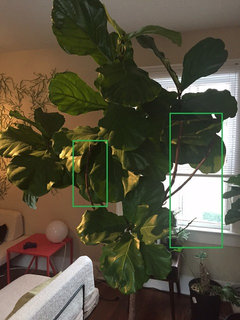
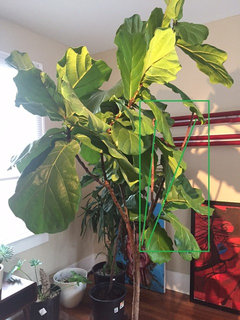
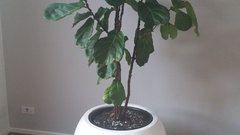
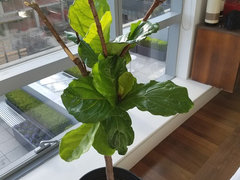
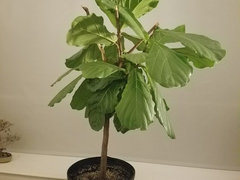
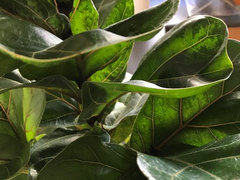
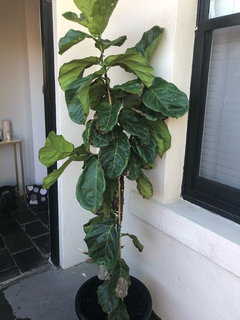
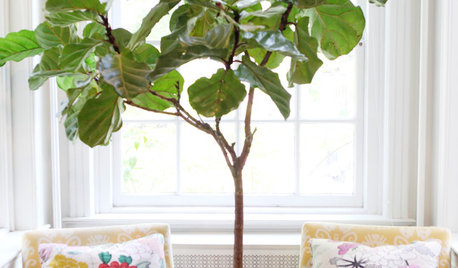
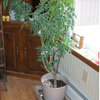
The plant was just moved into a new habitat about a a week ago, and underwent a root pruning and repot into a near 5-1-1 mix. I'll let the images do the talking:
{{gwi:97557}}
{{gwi:97558}}
{{gwi:97559}}
{{gwi:97560}}
Thank you for your time.
Comments (66)

Thomas (Zone 7b - NYC)
Original Author11 years agolast modified: 11 years agoIts been a year long journey and the tree is still going strong. I am on weekly watering schedules
where I place the plant in my sink and thoroughly flush it with the
hose, as the rest drains through the pot. I also fertilize with foliage
pro once or twice a month. The plant is kept indoors and the temperature range is
74 at night to 78 during the peak hours of sunlight. It's kept in front
of one window facing north east or so and receives a generous amount of
sunlight on one side, so rotating it is a must every month.
Its current span is near 7 feet high, and around 4 1/2 feet wide.
Most growth has protruded from the top branches and i'm hoping growth
will come from the sides as time passes (The two bare branches on the
right). I'm just happy it grows lolAny tips on how I can get start growth on the bare branches? The tree seems to grow from three branches, while there are about three or four others that had growth previously, but are currently empty and showing no signs of life. Should I just cut them off? They've been bare since last June when things went south, so I'm coming to the conclusion that they won't begin growing anything...


Related Professionals
Decatur Landscape Architects & Landscape Designers · Dalton Landscape Architects & Landscape Designers · Fort Dodge Landscape Architects & Landscape Designers · Worcester Landscape Architects & Landscape Designers · Saginaw Landscape Architects & Landscape Designers · Quincy Landscape Contractors · Martinsburg Landscape Contractors · Concord Landscape Contractors · Temecula Landscape Contractors · Reno Landscape Contractors · Orlando Interior Designers & Decorators · Greenville Interior Designers & Decorators · Wilmington Interior Designers & Decorators · Fort Dodge Interior Designers & Decorators · Utica Interior Designers & Decorators 11 years agolast modified: 11 years ago
Your plant has come a long way since the first set of pics you posted. If the branches are dead or if you don't want them as part of the composition, now is a good time to remove them (anytime is a good time if they're dead). FLF is strongly apically dominant, which it only likes to grow from existing apices ( growing tips of existing branches). If you want more branching, you need to give it much more light and air movement; or, force it to break back by pruning off the apical meristems (growing branch tips). The pics are pretty dim, but I'd go for a good pruning right now. If the plant is taller than you like it, prune the top back. If any branches are longer than you like - prune them back to force more branching. If you supply some better pics from several angles, we can figure out the best way to prune.
Al
Thomas (Zone 7b - NYC)
Original Author11 years agoHey Al, thanks for your insight. I do want growth on those branches, but it seems all the growth is apically as you mentioned. I would prefer not to prune any branches at all tbh, the more the merrier in my mind :) I've attached more photos of the tree below to give you a better idea. Dead branches are outlined in green.
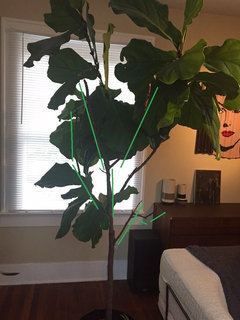

- 11 years ago
OK - as noted, if the branches are dead - no sense in allowing them to offend the eye, so lop them off if you like. If you want more branching w/o pruning, you'll need to try to optimize all cultural conditions so the plant has more energy than it knows what to do with. Lots of light, plenty of fertilizer, good root health, warm temps, air movement, will work together to produce some branching that otherwise wouldn't occur under less favorable conditions. Tip pruning now will force the branches pruned to back-bud, but if the tree isn't really robust when you tip prune, you might only get lateral breaks (new branches) in a couple of leaf axils behind the pruning cut.
Best luck - good job!
Al Thomas (Zone 7b - NYC)
Original Author11 years agoGot it. I've moved the tree into a hallway at the end of my apartment building that faces west with two large windows with hopes that it will acclimate to much more lighting. Temps are typically in the high 80's - mid 90's in there.
I'll cut off the branches this evening once I get back home. Lastly, I'm fertilizing with foliage pro (probably 1 tbsp a week at the moment), should I up this? Anywhere I can find a recommended dosage chart? I had no luck searching around :/- 11 years ago
1 tablespoon/ gallon/ week? If so, that has to be close to the max. When temps are between 65-85, I use 4-5 teaspoons in a 2 gallon watering can & haven't noticed any burning on anything I fertilize at that rate. Your rate would be 6 tsp, a little more than I'm using.
I don't think you'll find a specific dosage chart because some plants are happy with relatively low concentrations of nutrients & others quite high concentrations. I fertilize my succulents at the same rate as the other plants - just not as often, but that's because they don't get watered quite as frequently.
Al Thomas (Zone 7b - NYC)
Original Author10 years ago1/20/2016 Update
I've moved from Zone 9 in NE Florida to a Zone 7b in NYC. The tree has gone through some tremendous shock as it had to stay in storage for a couple of weeks while all items were being moved from apartment to apartment.Once the tree came into the new apartment by the window. they all dropped within 2 days. Here's an up to date picture. I've been in this situation before and it sucks, but I'm hoping for the best. Last time it was in this state, it took about a year to bounce back.

- 10 years agolast modified: 10 years ago
No fertilizer until growth resumes and guard very carefully against over-watering. With no foliage, the plant will have significantly reduced water requirements.
Good luck.
Al
Thomas (Zone 7b - NYC)
Original Author10 years agoUnderstood. Stick with the usual once a week. Thanks Tapla, always appreciated.
Thomas (Zone 7b - NYC)
Original Author10 years agoAnd we're back. New growth at the base of the branches where the split begins.
New sprouts have been growing very fast within the past 3-4 days, from 1mm to 1" or so.
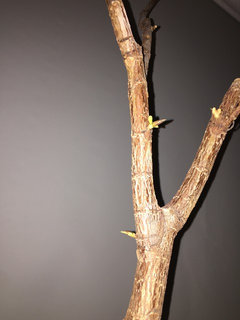
Fwiw, consistency seems to be key with these trees. Using Tapla's 3:1:1 mix and letting the shower run on the tree for 10 minutes or so in the bath once a week. Foliage pro in the growing seasons and indoor temps all year round. Bright light, but not blinding.
- 10 years ago
.... really glad for you! Good job! It should really take off this summer.
Al
- 10 years ago
I live in Melbourne, Australia and am totally inspired by the story of your fig. Mine has consistently lost leaves in the 12 months that I have had it. I have attached a shot when I first got it and what it looks like now. About 6 months ago I decided it was too overwatered so I took it out of the pot and dried it right out (took 6 weeks) I repotted in quality soil and the rate of leaf drop has slowed right down but it is still not thriving. I am wondering if I should cut off some of the branches. I have been too scared to touch it other than watering it with a litre every 3 weeks and a monthly fertilise with a liquid called Charlies Carp. The little branch at the bottom is about one month old but there isn't any signs of further new growth. Would love your expert advice on whether I should continue to watch and hope or get a bit more pro-active and chop chop?

Thomas (Zone 7b - NYC)
Original Author10 years agolast modified: 10 years agoI would definitely say don't do any chopping. When leaves come back, they grow all over. Lets just focus on thriving right now and getting new leaves before forcing anything.
The most important part I've found out that works for me is consistency with watering. I water once a week, typically a Saturday or Sunday, by moving the tree into the bathtub or sink. I then let the shower run for 10 minutes or so in cool water until you notice the drain water turn to clear, then let the tree sit in there over the course of a few hours or even over night just so the water can properly drain from the pot. You can also put something under one side of the tree so it sits at an angle which helps improve drainage.
I do not fertilize very much, once every two weeks or so with foliage pro. I let the fertilizer sit in a cup mixed with water and then just pour it in after i've watered the plant.
Lastly, I'm using a 3:1:1 mix which is 3 parts soil, 1 part perlite, 1 part bark. This honestly may be the most important aspect as it relieves any over watering that could potentially be detrimental to the tree.
I know that panic sets in and when things go south we want to move the plant, we want to water the plant, feed the plant, etc etc. We just gotta stop doing so much and keep it simple, and surely things will turn out great!
The tree is currently in full bloom right now and is really exploding in growth. I'll update this weekend.
- 10 years ago
Seeing you're approaching fall where you live, repotting might not be such a good idea - unless it stays warm enough all year where you live so the plant can stay outdoors w/o limitations due to chill.
My plan for your plant, if it was mine, would include making sure the level of dissolved solids (salts) in the soil solution is as low as possible w/o inducing a deficiency. My experience tells me that if you need to go to great lengths to try to find out anything about a fertilizer's nutrient analysis, it's likely there's a reason they don't want you to know what it provides. That, and the fact that organic sources of nutrients are dependent on micro-organism populations in your soil to break the hydrocarbon chains in the fertilizer down into usable forms the plant can actually take up makes them unreliable insofar as what becomes available and when. I would use the fish fertilizer in the garden and try to find an appropriate synthetic soluble fertilizer that has all the nutrients necessary for normal growth in a favorable ratio and in a form that is already broken down into elements plants can take up w/o it being necessary for a dozen stars to be in alignment.When next summer comes, I'd be all ready to repot into an appropriate medium. For my purposes. I wouldn't consider 3 parts of soil ( topsoil, garden soil, or commercially prepared container media would be 'avoid' list, with the exception of potting media, which can be an appropriate part of a quality mix if it's not over-represented. I'd be shooting for a mix that had much more pine bark and far less of the types of soil I mentioned. You simply can't water correctly when using a 3:1:1 mix of 3 parts soil, 1 part perlite, 1 part bark. It has too much water retention to NOT be limiting ..... and significantly so.
You can tip prune, but you should avoid significant pruning until AFTER you repot, and the best time to do that would be around the first wk of December. Until then, keep your watering closely controlled, work hard to make sure the plant gets all the light it wants, and institute a fertilizer program that ensures the plant gets what it wants when it needs it. If you can do that, your plant should start showing signs it's reversing course and gaining vitality.
That's a rough outline of what I would do. If it sounds reasonable and you need help with how to turn that plan into a reality and work it, let me know and we can delve a little deeper into particulars. I'll even provide some homework assignments that should really help you advance much faster along the trail to a green thumb.
Hava good weekend!
Al - 10 years ago
Thank you sooooo much Thomas and Al, I will go do a bit of research now on which synthetic soluble fertilisers are available in my area and switch until next December when I will re-pot in the ratio you have described. Do you think I should increase my watering until I re-pot?
Any further advice on improving my green thumb is greatly appreciated. I love my indoor plants and also have a kentia palm and a lady palm. Al three of them are struggling (kentia has ongoing issues with palm scale). My lady palm was left outside during our renovation a few years ago and has taken a few years to recover though it is doing better after I repotted the same time as I repotted my fiddle leaf. Perhaps the issue with all of them will be the incorrect fertiliser.
Illona
- 10 years ago
Changing your watering schedule won't prove nearly as productive as training yourself to water on an 'as needed basis'. In order to do this, you might purchase a wooden dowel rod about as thick as a common pencil or a little thicker. Cut it in half & sharpen all 4 ends in a pencil sharpener. Stick one deep into the pot - all the way to the bottom - to test your soil for moisture levels. When it first comes out clean and dry, it's time to water. If it's wet or stained dark from wet soil, withhold water until it's drier.
You should find this basic primer that provides an overview of points that often turn into the pitfalls that most commonly beset hobby growers close to the beginning of their search for proficiency. Avoiding the pitfalls is not an insignificant plus. You'll find discussion there about soils and fertilizers that should provide you with some basics and enough information that you'll better be able to ask direct questions about areas that might be confusing.
If you focus on three areas, growing can be very easy and much more rewarding. 1) making sure the plant has ample light, 2) making sure the plant is in a quality soil, 3) making sure you have control over a well-considered nutritional supplementation plan (monkey easy if your plant is in a quality soil - extremely difficult if your plant is in an inappropriate soil.
In an extremely high % of cases, that plague of scale - mites - other insects, or diseases, or spoiled appearance of your plants can be traced to a low level of vitality that stems from a poorly functioning or diseased root system, which in turn was caused by a soil that inhibits root function or root health. You MUST be able to maintain a root system in good health if there is to be any hope of having a healthy plant.If you find time to read the thread the link takes you to, let me know what you think, and what questions it brings to mind.
Al - 10 years ago
Well I have lots of readying tonight. Thanks again Al. You are a very generous person and I am very appreciative.
I have given all my plants a good fertilise with the soluble fertiliser I bought yesterday and gave my FLF a very small prune at the top. There was a lot of white liquid that came out where I pruned - just wanted to check this is normal?
Thomas (Zone 7b - NYC)
Original Author10 years agoAppreciate the insight as always tapla. I will have to keep all of this is mind come next potting.
Illonam the white liquid is normal
4/4/2016
- 10 years agolast modified: 10 years ago
All of the Ficus species exude white latex sap when sap-conducting tissues are wounded. It can be a nasty irritant (is for me) for a high % of but not all growers. Try to keep that in mind so you particularly avoid rubbing your eyes, other mucus membranes, or areas where skin is tender. When I work my trees, I usually keep a spritzer of plain water on hand. A couple of squirts directly on the wound soon after the pruning cut rinses the accumulation of sap from the wound and stops additional weeping.
Illonam - did you mention what you bought (fertilizer)?
Al
- 10 years agoI bought this. I hope it is OK?? Cost $20 AU which is pricey so I just hope you think it is suitable.

- 10 years agolast modified: 10 years ago
I'm in a chat with Yates right now to determine how P and K are reported on their packaging and to see if I can get a complete analysis that includes %s of secondary macronutrients and micronutrients. I'll let you know if I can find out from whomever I'm speaking to. (Steve)
I'm thinking it looks fine.
Edited to say: I'm waiting on an email now, with analysis from Steve @ Yates. I'll let you know after I review the info.
Al
- 10 years ago
They sent the analysis & the NPK ratio is good. The fertilizer has all the essential micronutrients and lacks only the secondary macro-nutrient Ca(lcium). It's very common for soluble fertilizers to lack Ca, Mg, or both. You made a good choice.
Al - 10 years agoLucky dip I think. This is great news. Hopefully I'll be posting a picture with some new shoots soon.
 10 years ago
Thomas, did your tree back bud on it's own or did you do something to make it happen?
Thanks!
Thomas (Zone 7b - NYC)
Original Author10 years agoHey Iris, the tree back-budded all on its own. I'm really happy it went down this route and is growing back from the bottom up again. I'm assuming that's where it was strongest once it perked back up.
All of the buds and branches are stemming from the base of the old split. I'll probably leave the old branches there just to see if they'll start budding anyways. Best of luck to you
Thomas (Zone 7b - NYC)
Original Author9 years agolast modified: 9 years agoThanks for the comment spjin, happy to have helped. I will definitely have to get a picture up and running again. I can definitely say that the growth has stunted. I did another repot in April 2017 with much better success this time around. I did not upsize the container, but rather replanted in a 5:1:1 mix and that probably stopped things for a bit. I can confidently say that new branches will bud and sprout from pre-existing ones. I should probably cover up the ends with some sort of putty though! I wonder if that is drying the tree out.....
I am actually slated to move at the end of this month (6/30) and am going to ask that a neighbor house the tree on their balcony for a month, since I don't move back into another unit until 8/1.
Setting a reminder now to update the post tonight!
- 9 years agoHi There,
Al helped me tremendously with my fiddle leaf a few years ago. It's now doing really well. I'm in Melbourne, Australia and it's our winter. Is this the best time to prune? I have a multistem FLF but would like to encourage height rather than bushyness
Illona
Thomas (Zone 7b - NYC)
Original Author9 years ago1 year, 2 months from my last post. I cut back some branches, and repotted around 2 or 3/15. It was time for new substrate as it had been about 2 1/2 years. Slowly but surely, it's growing.
- 9 years ago
Illona - best time for you to prune would be any time in Dec. The reason is, your tree(s) will respond much more enthusiastically if they are pruned when their level of vitality and ability to make food, which depends to a very significant degree on how much light they get, is at its highest.
When you prune, try to work it out so the thickest trunk is the tallest; then, as the trunk thickness decreases, so should height. The thinnest trunk should be shortest, then gradually increase HT in somewhat even increments. If there isn't much difference in the thickest trunks, choose the one closest to the center of the clump as the tallest.
After pruning for ht, if there are branches that extend out-of-bounds (beyond an imaginary outline you're envisioning), prune them back so they're inside the outline.
Sorry for the tardy reply. Work has been demanding much more of my time this year than in past years, so I don't get near as many opportunities to interact with folks on the forums (fora?). I do urge you to be patient and take the plant's natural rhythms under consideration whenever you have meaningful work planned. "Meaningful" work would be pruning other than pinching and repotting, which involves bare-rooting and root pruning.
Good luck! Thanks for being patient!
Al
- 9 years ago
Tapla, can you recommend a brand of pruning shears/clippers that I don't have to replace every couple of years? I have been buying the standard issue hardware store brands and they're always a disappointment after a little bit of use.
 9 years ago
Hi Thomas,
ive been following this post recently to answer questions about my own FLF. All seemed to be going ok, but I thought it needed a little fertiliser and then maybe a repot once the weather warms up. I added fertiliser a couple of days ago and since then the leaves have suffered terribly. I don't know if it's bacterial or the fertiliser has caused it (I sprayed it onto the foliage as well as into the soil )
anyway i will attach a couple of photo's in case you or anyone else might have any suggestions... it's gone translucent in the lighter patches of the leaves.
 Cheers,

Charlotte
- 9 years ago
Uh oh! More info needed. What did you use for fertilizer, and at what concentration did you apply it?
Al
- 9 years agolast modified: 9 years ago
I love this thread! Have learned so much from Al that will help me care for my FLFs. And enjoyed following Thomas's incredible journey with his tree! Thomas does your tree have a name?
Thomas (Zone 7b - NYC) thanked Jess Thomas (Zone 7b - NYC)
Original Author9 years agoCharlotte,
Once you can provide Al (Tapla) the information, he'll have you back on track.
@lotuspop Thank you for the kind words, I look forwards to seeing your tree thrive. I have never thought about naming the tree, but it's something i'll surely consider. What about yours? Could use some inspiration to get me off on the right foot.
As far as the tree goes, I am going to repot the tree here within the next week. I currently have it in a 15" diameter pot and it's really at a standstill. This season I grew maybe 6-7 leaves from what I can tell. I've adjusted water habits about 5 months ago and the tree is as stable as can be. I want to try downsizing to a 10" or 12" pot, and seeking if having the tree become more compact will aid in taller growth. Fertilizing has been few and far inbetween. I repotted recently and did not want to shock the tree any more than necessary, especially with the upstart of new nutrients in the new substrate.I'll have some new pictures this weekend, stay tuned!
 8 years ago
Hi everyone! I am new to this site and I came across this thread with so much helpful knowledge and insight so I thought I'd ask. I purchased 2 beautiful little FLFs yesterday and to be honest I've been a little freaked out and overwhelmed because there is SO much information and articles out there of how to take care of them and most of them are about how to save your plants!!
So I was wondering, is there a specific place I can look on here or can anyone point me in the right direction of basic tips of how to just take care of your new plants and keep them healthy and happy? Any help would be much appreciated!! :)
Haf
- 8 years ago
A basic overview of growing habits that will allow you to avoid almost all pitfalls growers inevitably encounter if they don't make an effort to educate themselves. Plants have a 'sweet spot' when it comes to cultural conditions. Where we run into trouble and our plants suffer is when we provide cultural conditions at or near what they've been genetically programmed to tolerate.This discussion is specifically devoted to growing Ficus trees in containers. You'll note that both discussions devote a significant measure of attention to soils and the impact soil choice has on your ability to keep plants healthy and avoid sacrificing a good deal of your plant's potential as a result of a soil that taxes your plant's vitality, growth rate, and appearance.
The average grower who doesn't spend time at fora like those here at GW/Houzz, and maybe reads a book or two they discover at a big box or supermarket checkout stand is, at some point, going to run head on into a hump they can't get beyond w/o an understanding of how container media works, and more specifically, how a water retention in container soils affects root function/health. When you realize a healthy plant isn't possible w/o a healthy root system, a light should come on and illuminate how importance soil choice is to root health. If you find the links provided above to be of value, I'll provide the link to the info about container media (soil) and water retention.
Al
- 8 years ago
Hi Al!
Thank you so much for all the above info, I feel more confident because I understand the basics now and how important soil choice is and how soil and water are linked to each other. Both links were very useful. My current concern is, I just bought these from Home Depot and I know it needs to be repotted (the soil feels very wet and heavy and I can see tiny roots circling the top of the plant), however it's the middle of winter. So what do I do in the meantime to keep them healthy and get them through the winter until I can repot and change soil in the spring/summer?
Haf
- 8 years ago
Ficus tends to tolerate root conditions better than most plants. I've seen plants that had been growing in 2 or 3 gallon pots so long there was only a cup or two of soil left, all the rest having gassed off over time and the near solid tangle of roots pressed into service as the root's only home. Almost always, trees like that are circling the drain. Sometimes, when the additional stress of repotting is imposed on plants so lacking in vitality, it's is enough to separate them from their tenuous hold on life, but often they can be turned around very quickly if the grower has a reasonable plan. I'm sure your plant is no where near as far gone as what I described, which is a good reason to be quite unconcerned about your trees viability for the next half year or so. As long as you don't over-water, you should be fine. So, start actually monitoring the soil's moisture levels and only water when the soil first becomes dry, or immediately before.
If you're going to continue to water in sips to avoid over-watering, and that leaves you concerned about a high level of salts in the soil, flush the soil thoroughly the next time it needs water and maybe every 6th watering after that. It would be a good idea to fertilize immediately after every flushing. If after flushing your soil gets so soggy you're worried about the impact on root health/function, there are ways to avoid that. In fact, there are an untold number of tips and tricks that will have you at green thumb status in no time, if you have the time to do some reading and assemble the pieces of the puzzle.
Al
- 8 years ago
Hi Al!
I took my time to reply because I wanted to make sure I read all the information you referred me to so I could formulate the right questions. First of all, I want to say THANK YOU for all the information you have put out there, it is so kind and generous of you to devote so much time to helping so many people!! I had NO idea of even the basics, typically you buy a plant from the store, bring it home and follow the instructions on the little card and then whatever happens happens!! I had my AHA moment here and I have gone through so many threads that I made a little 3 page cheat sheet for myself and covered topics such as soil, watering, nutrition etc with tips and info. I am SOO excited for summer when I can start to re-pot and give my plants what they actually want and need!! :) I'm going to try doing succulents again too ha!! You have literally turned me from plant killer to entertaining a new hobby :)))
So some of my concerns are:
1. Making the gritty mix soil and finding all the ingredients (I do realize this takes a lot of effort, but want to do this right now and care about the long-term health of my plants so they can flourish later)
2. Re-potting- this scares the crap out of me just thinking about messing with and cutting off roots!! Do you have something that has pictures of the step-by-step process? Or a video by any chance? And how often should it be done generally?
3. When it's time for pruning, which parts do you prune and how often and what do you do to get branches? I eventually want that tall, bare trunk with a few branches and fullness look (I will be a patient grower :))
Thanks a million and take care,
HB
 8 years agoHi all, I desperately need help saving my fiddle leaf fig!
I purchased her (Precious) about a month ago and things seemed to be going OK. I put her near the sunniest window (southern facing but we have no eastern windows). Within this time she even grew three new leaves.
I noticed several brown spots and thought I might be overwatering so held off. We also have had a heatwave so the blinds have been closed in the house and she wasn’t receiving as much sun. Within a few days I noticed she was covered in big brown/black spots and starting to lose leaves. I gave her a big dose of water and left her outside to get some light. With warm weather predicted I left her out overnight. Of course an unpredicted thunderstorm came though. I brought her back in as soon as I could and moved her to another room where the blinds could stay open. She lost 4 more leaves.
Now the worst thing happened - my dog got to her. I came home yesterday to find the whole bottom branch destroyed. My dog is ok but Precious is not - she lost 5 more leaves today.
My question now is is there anything I can do to save her? Should I cut the damaged limb?
I have attached pictures of Precious when I brought her home and today after watering. This is my first FLF so I could use all the help I can get.
Thanks in advance, Ashleigh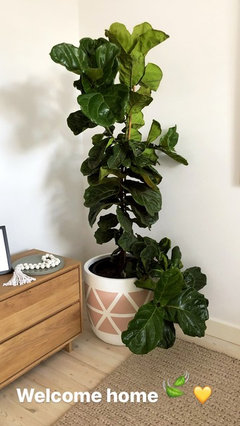


- 8 years ago
I responded to your other post.
I’d still put it right in front of the window. As close as you can get it.Watering when only the top inch is dry is a sure sign you’re over watering.
The soil deep down is likely staying wet and you’re dealing with symptoms of root rot.
dont water on a set schedule, water as the plant needs it.
Get a wooden dowel and sharpen the ends. Stick it in the soil all the way to the bottom and pull out and inspect.
if it comes out dark, damp with soil stuck to it, don’t water.
Keep checking every day or so and only water when it comes out nearly clean and dry.
Thomas (Zone 7b - NYC)
Original Author7 years agolast modified: 7 years ago2018-10-12
Alongside an elephant ear I just picked up, and a bird of paradise. Brought them into the living room for a monthly shower + leaf wipe and pest inspection. Tree is approximately 7 1/2 - 8' tall now. Spring time is just truly amazing for this tree. I gain at least a foot and it just goes crazy. I can't believe i've had this tree for around 5 years now. So grateful
Routine:Water thoroughly once a week, typically Saturdays.
Shower once a month
Fertilize once a month or two w/ Foliage Pro 9-3-6
Wipe leaves as needed
Leave it alone.
I will be changing my watering methods from set schedule to as needed for 2019.
Sitting in a 3-1-1 mix right now. Orchid/bark potting soil, fir bark, and perlite. A bit leggy due to lighting on a north facing window (floor to ceiling). Will consider chopping the tops in 2020 or 2 years when the branches are wood and the tree is stable after a repot in late 2019, hoping to influence more backbudding or nodes. Any tips on increase back budding? Wish List · More Info
- 7 years ago
"Any tips on increase back budding?" The tree will ramify on its own if you give it full sunlight outdoors, lots of air movement, a healthy soil that can support a healthy root system, and nutritional supplementation (fertilizer) in the luxury range. The 'luxury range' is more than it needs to survive, but less that it takes to make the tree revolt due to a high level of salts in the soil. Cutting the tree back is also a perfectly good strategy for forcing back-budding. Get the tree VERY healthy and cut back in summer so the tree responds with the enthusiasm you're looking for.
Al













spjin