Software
Houzz Logo Print
beeman_gardener

Re-siting Blueberries.

15 years ago

I am not happy with my blueberries and want to dig them out, exchange the soil for a better mixture, hopefully they will grow better! They were planted almost 25 years ago and have never been re-planted.

My Question. When would be the best time to dig them out, re-soil the whole bed with a blueberry mixture and re-plant?

This is what happens when you join this excellent information forum!! Thanks to all involved.

Comments (12)

  • 15 years ago

    That sounds a bit drastic to me. Heavy pruning, fertilizer, and water as needed would sound more reasonable. This and a new bed of new plants would at least be an alternative approach.

    In zone 5 I'd replant your current plants as early in spring as possible.

  • 15 years ago

    If you live in an area with alkaline clay soil, and you are using well water or tap water to irrigate your blueberry shrubs, then the shrubs are most likely failing to thrive due to pH issues. Blueberry shrubs will green up and grow with soil pH between 6 and 7, but they won't thrive in this situation. You really need to get pH between 5 and 6 to see good growth, and heavy fruit production. Another issue is competition from trees. Are your shrubs anywhere near a Norway maple?

  • 15 years ago

    "Are your shrubs anywhere near a Norway maple?"
    What is the reason for this question?
    I do have a Norway in the garden, but I wouldn't call it 'near'.
    I do live in an alkaline area, and have tried changing the pH until I've sick of it. If the underlying soil is alkaline then I am just wasting my time trying, is my view.
    Desperate times leads to desperate measures.

  • 15 years ago

    We have a Norway maple in the front yard, and I can't get any blueberry shrubs to do well, within 30 feet of the trunk. I'm sure that there are other trees with lots of shallow roots, but Norway maple seems to have a unique ability to suck up all of the water, making it hard for anything growing nearby to survive. With regard to soil pH, it is possible to lower this with surface applications of agricultural sulfur, over time. It helps to feed the bacteria by mulching with shredded tree leaves every fall, in addition to the sulfur. It is possible to lower soil pH below 4, and eventually kill the shrubs, so that is why periodic pH checks are necessary. I check our soil twice a year, in the spring, and in the fall. Sulfur is added when required. I have found that the only way to get a decent price on sulfur is to go to a "feed 'n seed" farmer's co-op, where sulfur is available in 50 lb bags. Since bacterial activity is needed to metabolize the sulfur into acid, it can take up to 12 months to get the pH down. However, beneficial results will be seen in three months.

  • 15 years ago

    Norway maples do compete with blueberries in a way stunting to the latter and their roots go much farther than their branch spread- up to 3-times further or more.

    I've seen very productive blueberries in a pH well above 6 and others have posted about good production in the low 7's. I am positive that blueberries don't need to have all their soil at a low pH to thrive unless I'm just completely insane and live in a world I've created in my head.

    Carl Whitcomb has proven that pin oaks can overcome chlorosis by only altering the pH of the very surface of the soil. These are plants that "require" a pH similar to blueberries to get adequate iron. Pin oaks rapidly recovered from chlorosis when sulfur was surfaced applied well before soil test readings dropped(unless skimmed from the soils surface).

    The point is that if your problem isn't drainage you should be able to correct your issues by spreading sulfur and mulching over it with about 4" of wood chips- preferably conifer but hardwood will work just fine.

    If your water is extremely hard, collect rain water and irrigate with that if it's needed.

    I admit to never attempting to grow blueberries in soils naturally above 7 but Carl Whitcomb's experiments were done in very alkaline soil. Once the feeder roots reach the soil surface your plants should be fine.

    You can transplant blueberries in fall or spring when they are dormant. Be sure to mulch them very well when fall transplanting. Frost heaving must be avoided.

  • 15 years ago

    How many plants do you have? If there aren't too many I would recommend you move them to containers. Wait until the leaves fall off this fall, then cut back a large portion of the upper plant, specifically any weak or injured branches. Dig the plant up and if necessary trim back some of the roots.

    In a large pot, preferably a wine barrel and at minimum a pot of 15-18" in diameter, mix 80% peat moss and 20% potting soil.

    The plants will thrive in this potting mix.

    Do a search on "blueberry containers" on youtube.com
    and you will see others growing blues in containers.

    Good luck!

    RM

  • 15 years ago

    I have tried all of the above!
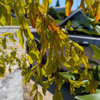
    last year I did add sulfur, plus rotted sawdust and wood chips as mulch. There was a slight improvement, but it didn't seem to last long as I now see chlorosis again.
    I can only think I was skimpy with the sulfur. How does one calculate the amount to use, or is it trial and error?

  • 15 years ago

    I don't have the specs handy but last time I needed them I found the info on google. Did you use at least a cup per plant? What is the texture of the soil? Blueberries are difficult in heavy soils. How are they being fertilized?

    If the soil is heavy, transplanting, or lifting after topdressing with a forest loam might be the ticket. I had to do this last time I established a blueberry stand. I had used peat moss in a 50-50 mix with existing soil but it didn't work- soil was still too heavy. I then worked in a lot of forest loam (almost pure humus and very airy) and the plants quickly recovered.

    The plants had been transplanted from pots so I didn't have to lift them but only had to remove some of the original soil and mix the FL with some of what was left. Now the plants are thriving in their third season since I planted them.

  • 15 years ago

    Have been doing even more reading and I believe I'm just impatient. It seems it can take about 2 years to drop the pH down using sulfur, and I only did it last season!
    Thanks for all the comments and advice.

  • 15 years ago

    Here in Madison, Wisconsin, our native soil has pH around 7.6, so it takes some effort to get the pH down, and keep it there. I use a 6 fluid ounce volume container to apply agricultural sulfur, and typically, each shrub will receive a total of 12 fluid ounces (volume) of sulfur every two years. I don't dig the sulfur in, I just pull back the mulch, scatter the sulfur, and cover it with several inches of mulch. I don't have experience with transplanting established blueberry shrubs. However, I have successfully transplanted well-established raspberry canes, in the early spring. So I think it can be done, when the shrub is dormant, and the days are short. I would think that March 15 to April 15 would be the right timing.

  • 15 years ago

    Beeman, you probably understand now why I suggested containers. Yes you certainly can adjust soil pH but it can be tricky and can take a year to get it adjusted. Put the plants in pots with peat and potting soil and the pH is adjusted immediately.

    RM

  • 15 years ago

    >>>There was a slight improvement, but it didn't seem to last long

    Beeman, you probably already understand this but you'll very likely need to apply the pH amendment more than once per year. Probably twice (or ocasionally three times): early Spring right before it warms up, start/mid summer (and possibly near the end of summer depending on whether you are expecting Fall growth and warmth). How much to apply depends on your soil, and especially if the blues are near other trees that you water with muni water. You follow guidelines for your area/soil and yup, for the most part you learn from experience by monitoring the soil pH to see how it is adjusting to the applications.

    My knowledge of in-ground blues is only from HowTo & forum reading. So if someone else in your area with lots of experience has conflicting information, believe them...