Software
Houzz Logo Print
christinmk

Help with a huge Ficus tree

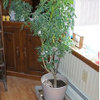
Hi! Id like to ask you guys about by verigated Ficus tree. It was given to me as a gift many years ago, when it was just a foot tall, it is now eight feet tall!!! Recently it was having some problems, its leaves were turning yellow and dropping off. I gave it some fertilizer and it is doing great now. I have noticed that some of its roots are comming out the bottom of the pot, is this a sign that it needs a bigger pot? Or does it like to be root bound? Its REALLY HUGE, and I dont want to have to repot him if I can help it, and I dont want to do it if it might harm it. What to you think? Thanks a bunch!

CMK

Comments (24)

  • 18 years ago
    last modified: 11 years ago

    Thanks for the advice tapla, it sounds like your an expert on this! I think the hardest thing will be in trying to find a big enough pot for this guy! Thanks again.
    CMK

  • 18 years ago
    last modified: 11 years ago

    It's probably not the end of the world if you decide to wait until summer to undertake the repot. You would be able to return it to the container it's in, with room to spare. As noted, Ficus is fairly forgiving of being grown tight, so it will probably be fine with some careful attention to watering/fertilizing habits.

    If you've been watering in sips (rather than copiously, so that a fair amount of water appears at the drain hole at each watering) though, I would allow the plant to dry almost completely, then flush (leach) the soil very thoroughly several times with clear water. After leaching, do not water again until the soil dries down. This will help flush any accumulated salts from the soil that can prevent plant uptake of water/nutrients.

    Al

  • 18 years ago
    last modified: 11 years ago

    When you repot a large ficus (mine is nearly 7 foot or more), how do you do a root prune? The root ball on my ficus is quite compact; I can't get a chopstick down into it without some force applied. I moved it from a 14 inch to a 16 inch pot when I got it because the 14 inch was cracked. The root ball was one solid mass.

    Is there a site which shows in images of the proper root pruning techniques for complete novices?

  • 18 years ago
    last modified: 11 years ago

    You'll need a sharp saw & a bit of nerve if you can muster enough confidence in my directions. ;o)

    Look over the thread I'm linking you to. If there are more questions, and if CMK doesn't protest at the hijacking, I'll help you. It shows a scheff being worked on, but the pruning technique is the same. You can see by the 'before recovery' photo that the tree was almost completely defoliated and pretty well ravaged in mid-Jul, but by late Aug when I took the 'after recovery had begun' photo, the tree had bounced back well & growth was becoming pretty much rampant.

    Note: Now is not the time to undertake such radical work. Too bad you didn't think to ask for help sooner. I was in Chi for a week in mid-Aug & I'd have been happy to do it for you.

    I actually gave this tree away to a guy (in NY, I think - maybe PA) who had written a number of times about his fiance's scheff that had died. I shipped it to him so he could surprise her. I have a photo of her with the plant that she sent in a thank you note, but I'd better not post it directly. The plant looked good, but she was so pretty you'd hardly notice it anyway. ;o)

    Al

    Here is a link that might be useful: I'll take you to a thread with some root pruning pics & info - if you click me.

  • 18 years ago
    last modified: 11 years ago

    Al, thanks for the education! At work is a tall, lanky willow-leaved Ficus in a 5 gal. pot. You can see large, circling roots on top of the soil, which I know is bad, but I was never entirely sure what to do about it. I'll give it your treatment; it'll only have one horizontal branch left, but it'll be enough.

    Obviously I'll save the work until spring or summer.

    Thanks again; you're a prince among frogs!

    Korina, sharpening my saw...

  • 18 years ago
    last modified: 11 years ago

    Wow, I didnt think I could get even more info! Thats so great that you posted those pics tapla, I wasnt quite sure about how one goes about trimming the roots of such a large tree. Thank you!
    CMK

  • 18 years ago
    last modified: 11 years ago

    If you're interested in even more detail, I'll leave another link to a discussion on one of the tree forums. Even though it was written for the Maple Forum, it applies equally to all containerized trees - probably all containerized perennials, now that I reflect on it.

    Al

    Here is a link that might be useful: Why Root-prune II

  • 18 years ago
    last modified: 11 years ago

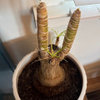
    I'm not sure I get this---take the plant (healthy and full, no yellow leaves or anything wrong, just really tight root ball), remove from pot, take a saw and cut the root ball in half and remove most of the limbs? But I don't want to start over with a stick...or is such drastic removal of limbs only for trees in sad shape? Here is mine (sorry for bad camera phone photo):

    {{gwi:106607}}

  • 18 years ago
    last modified: 11 years ago

    Oh no ;o) - you don't have to treat the top that way if you're happy with the shape. Yours is an attractive tree just as it is. The plant I worked on was a wreck & needed a complete overhaul. Your plant looks like it just needs some minor pruning on the bottom 2/3 of the canopy and a little more attention on the top 1/3, which is typical of Ficus and other very apically dominant trees.

    Reducing the top 1/3 a little more aggressively than the bottom 1/3 will help to counter the trees tendency to concentrate growth at the top.

    I have one of my trees on my bench (a Ficus) that I used for the purpose of illustration at a bonsai club talk I gave last night. After dinner, I'll take a picture of it as it looks today, and what it looked like after it was last pruned, and you can decide if you think I might have a pretty good idea of how your tree will respond to any pruning efforts. ;o)

    Al

  • 18 years ago
    last modified: 11 years ago

    The talk I gave last night was on the relationship between growth regulators (hormones) and pruning, as well as energy management in trees, with a strong emphasis on pruning strategies.

    Ok - here is a photo of a Ficus nerifolia (aka Ficus salicifolia or willow-leaf fig) after a hard pruning on top and a root-pruning/repot. The composition is a twin trunk mother daughter arrangement. In looking at the skeletal structure, note how the mother tree is leaning over and sheltering/protecting the lesser, daughter tree.


    {{gwi:100649}}


    Here is the same tree as it looks today, at the end of a single summer's growth - and, I might add, some considerable pruning to keep the upper part of the tree in bounds.


    {{gwi:54307}}

    There is still twine helping to hold the tree in the pot because I transported it a long distance in the back of an open pick-up.

    Here is a ficus benjamina that I have been working on since I started the multi-trunk mess from 5 or 6 twigs I bought at some store for $1.50 about 10 years ago. It's about 5 years away from being a very nice tree. I didn't show you the tree because it is particularly attractive, only to help illustrate that I have plenty of perfectly healthy Ficus benjaminas, too. :~>


    {{gwi:106609}}


    The lighter leaves are all new growth since I brought the trees in for the winter, illustrating that it isn't necessarily a given that your Ficus will defoliate when you change its location.

    Al

  • 18 years ago
    last modified: 11 years ago

    Thanks Al!

    My ficus was brought inside from a patio where the previous owner left it all summer. Everyone told me that all it's leaves would turn yellow and drop (likely overnight!). but it's been almost a month and nothing has happened. It gets full eastern exposure plus ambient light all day and I've watered it three times now (2 quarts each). Thanks for the pruning tips. I'll see about reducing the top and bottom some. I wouldn't mind if it grew to be 12-15 feet tall though.

  • 18 years ago
    last modified: 11 years ago

    They LOVE summer vacation outdoors and will pay you back for the treat by being much healthier and pest-free through the winter. ;o) That you have it in good light now, is why it hasn't defoliated much, but it probably will lose a few leaves - mostly from the interior of the canopy.

    Getting the plant to grow tall is very easy. I don't remember if I mentioned this above or not, but there is something you could do now. On the lower 1/3 of the plant, remove the tip and end leaf of all branches with 4 or more leaves on them . On the top 1/3 of the tree, remove the growing tip and the last 2 leaves of all branches with 5 or more leaves (except one that you choose as a leader). This will slow the top down a little except on the leader, which will exhibit rapid growth (when the tree decides it wants to grow). You should do this anyway, not because it is a good energy management strategy, but because it allows additional light and air movement to the tree's interior. This encourages budding and branching, along with new foliage close to the trunk, which will allow you plenty of pruning opportunities to shorten branches and keep the tree from spreading so wide.

    If you notice, you have some very strong branches near the top of the tree that you need to get in check in spring, or they will quickly destroy the shape of the tree. These heavy branches are where you'll need to concentrate your pruning efforts (to slow them down, so the rest of the tree can catch up) and where most of the upper foliage should be removed. If you look at trees in nature, you'll see that the heaviest branches are always the lowest.

    If I'm boring you - just say so & I'll go pick on someone else. ;o)

    Al

  • 18 years ago
    last modified: 11 years ago

    No this is great information! Do you have any photos of a properly pruned large ficus tree?

    When you say remove the "growing tip", do you mean the brand new little, rolled-tight leaf, or does this count as the end leaf?

  • 18 years ago
    last modified: 11 years ago

    I'll see if I can get an owner of one of the trees I prune for them to mail me a photo if you'd like, but all my Ficus (more than 30) are being groomed as bonsai trees. I can't tell from the photo if your tree is a standard (single trunk) or a clump style?

    The "growing tip" with the little point you refer to holds the apical meristem. There is a growth regulator (hormone called auxin) produced in that tip that suppresses lateral growth in the entire branch behind it. When you remove it, you stop the flow of that growth regulator and its suppressive effect. When that occurs, another growth regulator becomes dominant (cytokinin) and stimulates growth in all the leaf axils on that branch (usually).

    Let's say you have a long branch with 6 leaves on it. If you cut that branch back so it only has 2 leaves on it, a new branch will form in each of the two leaf axils (crotches). Now, allow those two branches to grow until they have 5 or 6 leaves and again cut each of those back to two leaves. You now have two branches with two leaves that will produce 4 more branches. As this repeats itself, you get short, vigorous, juvenile, bushy branches & all kinds of pruning opportunities. You simply remove the branches that will spoil the looks of the tree from the hundreds to choose from. Are you getting this? It's the very basis from which all pruning and pinching arises. Everyone should thoroughly understand this effect on plants. It would embolden them and make it far easier to maintain attractive plants.

    I'm going to give you an example of how this principle applies to almost all the plants we grow. Look at this Aeonium. It's natural growth habit is to grow a single rosette on a long stem until it branches a foot or more above the soil and produces another long stem with a rosette at the end - a rather gangly affair. You can see where I chopped it off an inch above the soil? The same thing happened to this plant that will happen to the Ficus. I removed the source of auxin and it's inhibiting effect by chopping the top off. As soon as I did that, the other hormone became dominant and tissues in the vascular cambium redifferentiated to form multiple shoots. So you see, it works in almost all plants. ;o)


    {{gwi:106610}}

    Al

  • 18 years ago
    last modified: 11 years ago

    Yes, I follow completely Al. Thank you. My honors Biology is coming back to me....

  • 18 years ago
    last modified: 11 years ago

    My posting is not about this subject but I've been trying to ask a question and have been sent many places, we'll see if someone can help me or I give up. I have a Ficus. I have noticed these dry worm things growing out of the bark. They are easily brushed off and easily crumbled. Can anyone help me. Thanks, Carol

  • 18 years ago
    last modified: 11 years ago

    Mmhmm - they are the beginning of adventitious roots. Given adequate humidity levels, they would have developed further until they touched the soil & rooted there. They are also called prop roots, aerial roots, buttressing roots ....

    Al

  • 17 years ago
    last modified: 11 years ago

    My neighbor moved and she gave me her ficus tree. It is about 4 foot tall and it looks very healthy. Problem is, she left it in one spot for a couple of years so one side is fuller and the branches are longer than the other side which makes the tree lop sided. The leaves need to be cleaned----how and with what??? Can I prune the tree to even it out?? I would like to take it outside this summer, what kind of sunlight will it take? It is now in a very small wicker basket but seems it has done well for the past 3 years----afraid I will kill it if I try repoting. I have never had a ficus tree before and I need a lot of advise on how to care for it. I think I neighbor did nothing and it thrived well. Thanks

  • 17 years ago
    last modified: 11 years ago

    "The leaves need to be cleaned----how and with what???"

    Cover the soil with plastic wrap or aluminum foil. Add a 1/2 tsp of Murphy's Oil Soap or dishsoap to a quart spritzer and fill with warm water. (you can also add 1/2 water & 1/2 alcohol if you prefer. Both the soap and the alcohol make the water wetter and more effective at removing dust. The alcohol will provide some knock-down of insect populations should they be there. In the shower, spritz the plant thoroughly & wipe leaves if you like. Rinse with cool water (room temp) and remove the plastic wrap tin foil.

    You might wish to flush the soil several times by allowing water to drip through the foliage while it's in the shower. This will help flush any accumulating salts from the soil.

    Can I prune the tree to even it out??

    I wish you had included where you live in your user info. It's much easier to give specific advise if your geo-location is known. You can start the tree back on the road to fullness if you prune every growing branch tip off now. If a main branch has several secondary and then tertiary branches - they ALL get the tip removed. This will immediately stop the trees ability to extend branches and force it to back-bud behind the pruning cuts. Later in the year, when the tree has gained considerable energy, you can do a more radical pruning that will further help to restore an attractive shape.

    ... what kind of sunlight will it take?

    The answer is species dependent and in some part, depends on where you live.

    ... (I'm) afraid I will kill it if I try repotting.

    If you wait until summer to repot, and come back for some pointers, it's VERY unlikely you'll do your plant any serious harm. I've posted some pictures on the forum of some very radical rejuvenation efforts in which both the top AND the roots were simultaneously cut back hard, and the plants recovered quickly. Not all plants will tolerate such indignities, but most Ficus are sufficiently genetically vigorous that they hardly miss a beat.

    Place your plant in bright light with the bare side toward the source. If the plant was in a dim location previously, be careful to introduce the plant to the brighter light incrementally to avoid sunburn. Don't be tempted to over-nurture with water/fertilizer. If you do flush the soil, fertilize the next day with (preferably a 3-1-2 ratio fertilizer like MG 24-8-16 or 12-4-8, at 1/4 recommended strength.

    The above are all simple operations. After completed, just wait & watch the tree start on its way to filling in again. ;o)

    Al

  • 15 years ago
    last modified: 11 years ago

    Hi Al,
    I recently picked up several 9 foot ficus trees, which I would like to repot in wooden wine barrels. Can I do this in California, late August? From what I have read it seems late winter, early spring is most desirable.
    Thanks
    Michael

  • 14 years ago
    last modified: 11 years ago

    You hear a lot of advice repeated on the forums suggesting that winter or spring is best for repotting houseplants, but they do best pretty much across the board if you repot in the month prior to their most robust growth period. They'll be full of energy and will recover in a fraction of the time. Winter and spring are actually about the WORST time to repot houseplants, as their energy levels will normally be at their lowest point of the entire growth cycle, ensuring a slow recovery and an extended interval where their weakened condition will leave them more vulnerable to insects and disease. Pot up though, anytime you think it's appropriate.

    For most of us, 'prior to their most robust growth period' means during the middle of summer, late Jun to early Aug, but those in the more southerly states can stretch it for another month or so into the fall. If you're going to do it, I'd get right after it, or just pot up for now and wait until next summer to get your hands dirty. ;o)

    What are your night temps like where you are for the next month or so? You're going to keep these outdoors?

    Al

  • 14 years ago
    last modified: 11 years ago

    I took my huge ficus trr inside, the leaves are all gone, it is sitting in front of the window but must admt the vent made it dry, the branches on top are brtittle, tree is still green, I am so sad, I don't want it to die, wat can I do> Please, help me

  • 14 years ago
    last modified: 11 years ago

    What kind of Ficus? Have you moved it away from the heat source?

    Let me know if you're interested in more specific instructions, but I would flush the soil thoroughly to be sure the level of soluble salts in the soil is extremely low, then let the plant dry down. I'd try to keep root temperatures around 70* and keep the tree in appropriate light (species?) and away from the heat source.

    Al