

quick ficus question
I broguht home a 8' ficus a few months ago. It's in an east facing location so it gets a lot of sun in the morning. I've watered about every ten days or so. The humidity in the house is around 40% and the heat is on during the day/night. I did not experience any major foliage loss when I brought it home (it spend the summer on a west facing porch of the previous owner). It is a lush tree, no disease/insects.
Over the past week or so I've notice a few more leaves turning yellow. I probably remove 4 every other day. The leaves also seem a bit curled to me. I do mist it daily.
Does this sound like normal winter adjustment? Yellow means too much water, right? So perhaps go two weeks in between? It is in a 16" pot and I water it till some water comes out the bottom (not a flood of water though). There is new growth on all branches.
I can share photos if it would help. Just don't want to make a mountain out of a mole hill if possible.
Comments (26)
 18 years agolast modified: 11 years ago
Assuming you mean weeping fig rather than rubber plant...
STRESS?
Probably the shock of the change, but look carefully on the backs of the leaves to see if there is any sign of red spider mite (tiny white powdery dots or webs).Here is a link that might be useful: this might help
 18 years agolast modified: 11 years ago
Just my experience, FWIW, I've a ficus benjamina that has several leaves that turn yellow and curl up and eventually fall off every year when the days get short and the heat comes on.
Related Professionals
Barnstable Landscape Architects & Landscape Designers · Traverse City Landscape Architects & Landscape Designers · Phoenix Landscape Architects & Landscape Designers · Clearlake Landscape Architects & Landscape Designers · Portland Landscape Architects & Landscape Designers · Fayetteville Landscape Contractors · Spartanburg Landscape Contractors · Saint Marys Landscape Contractors · Orlando Interior Designers & Decorators · Toms River Interior Designers & Decorators · Alexandria Interior Designers & Decorators · San Francisco Interior Designers & Decorators · Evanston Interior Designers & Decorators · Anchorage Interior Designers & Decorators · Sanford Interior Designers & Decorators- 18 years agolast modified: 11 years ago
dgmarie,
First of all, don't panic and make a lot of changes at once. This would just confuse the issue. Since different Ficus benjaminas may be conditioned differently, it is sometimes difficult to tell someone else what to do with theirs. I can only make some suggestions based on my own Ficus experience. I have two--one all green and one variegated. They are both healthy, "happy," and more than 15 years old.
Leaf drop: It is usual for Ficus to shed a few leaves from time to time--especially with changes of season, but a large loss (more than a dozen at once) or a continuing loss indicates some problem. If you have eliminated the possibility of infestation (spider mites, scale, mealy bugs, etc.) consider the following:
WATER: I'm guessing that your problem lies here. An 8' tree in a 16" pot probably needs watering at Least once a week, if not more often. To find out, stick your finger into the soil half an inch deep to see if the soil is moist. If it is not, it needs water. Ficus will react to dryness by dropping leaves, so that it can have enough water for the rest of the plant. (My Ficus need water every 4 days. They will go 5 days, but after that I'm going to lose some leaves.)
When you water, water thoroughly until a good amount of water comes out the bottom of the pot. At least once a month, flood the pot until an equal amount (equal to what you put in) drains out. This helps eliminate the accumulation of mineral salts in the soil. Excess mineral salts burn the roots and cause leaf drop. "Overwatering" has to do with watering too frequently, not with how much water you give the plant in one watering.
Ficus are Very sensitive to standing IN water, so be sure to empty All drained water within 5 minutes. Standing in water causes Ficus leaves to absorb too much water, bursting the cells and killing the leaves.
SUN: Different Ficus are conditioned by the growers/distributors/owners to take different amounts of sunlight. The previous owner had your tree on a West facing porch. Was it in direct sunlight (for how long?) or was it in indirect light as a result of a porch overhang? Your East facing exposure delivers a lot more sun at this time of year. More sun creates a need for more water--both because of drying heat and because of increased chlorophyll activity in the leaves. More sun than your individual plant can tolerate can also cause leaf or trunk burn.
You can make watering or position adjustments if you suspect that your plant is getting too much light. Position adjustments should be made Gradually--by inches--until your plant stabilizes. (My green Ficus b. is on a table by a SSE window with a semisheer curtain--it loves light, but is not tolerant of unscreened direct sun. My variegated Ficus b. is on the floor, a few feet away and likes a couple of hours of direct sun.)
Humidity is probably not an issue. (My climate is very dry all year.) Ficus do, however, like misting from time to time, and they Love a good shower (outside with the hose or inside in the shower). Misting discourages pests, as does a good shower, which also gives the plant a good bath, ridding the leaves of dust and the soil of excess salts. Just remember to drain quickly and well.
Plant Food: When your Ficus is stressed, avoid fertilizing. Also, when I was learning to care for my Ficus, I read somewhere--the source lost to memory--that Ficus b. should be fed only half-strength fertilizer, once a month. If I stray from this practice, the result is leaf drop.
I hope something here will help you with your Ficus.
Sweetcicely
dgmarie
Original Author18 years agolast modified: 11 years agoThank you Sweetcicely
My ficus is so root bound I cannot get anything, not even a chopstick, into the soil to see if it is dry. When I repotted it I picked up the entire rootball and put it entirely in a new pot and packed some Miracle Grow potting soil around it. The previous owner had potted the tree originally in Miracle Grow soil so I used the same. Imagine a very very tight root ball surrounded by about two inches of softer soil in a circle and you have the idea.
When I water it (about 2 liters) some water does come out (about a cup or so) into the tray below it. It does not ill up the tray at all or even wet all of it (it is a 20" clear tray).
I do not fertilize the tree--the soil contains it already and it isn't growing season.
Leaf loss is about 4 per day--they don't fall off-they turn yellow and I pick them off.
I rotate the tree every day in the sun. The previous owner had it on a patio with an overhang facing west. It was too big to move inside so she left it out all summer.
No bugs or pests. It is very "clean."
The ficus weighs about 100 pounds potted. There is NO WAY I can move it to give it a shower. At best this summer I can move it outside all day.
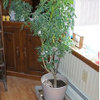
Here's a photo. I will take and post a better, closer one.
{{gwi:116357}}I appreciate your help! I enjoy this tree.
- 18 years agolast modified: 11 years ago
dgmarie,
Your Ficus is magnificent! It's easy to see why you enjoy it.
To help with its care and management, you may be able to find a Heavy-Duty plant dolly, with a hole in the middle and a drainage tray underneath. I had one of these with my first Ficus, which was about half the size of your tree. Every couple of months, when the weather was above 50 degrees, I would roll it to the glass doors and down a moveable wooden ramp to the outside. There, I hosed it off and let it drain. It loved this vigorous cold water "shower." For days afterwards it lifted its leaves and branchlets in sheer delight.
Eventually, the effort of the above care became too much for me. I took several graceful young branches, rooted them in water, bound them together with long twisty-ties, and planted them in terracotta. They grew into a lovely oversized bonsai-like tree--broader than tall. With trimming and potting barely larger than the rootball, it has stayed fairly small (trunk about 2" diameter at widest) and fruits at least twice a year. Presently, both of my Ficus are as rootbound as yours. In spring, I will have to repot and look on that with some trepidation.
Your tree is taking most of the water you are giving it, so my best guess is still that the leaf drop has to do with water--most probably the long interval between watering. To avoid shock, I would suggest shortening the interval by no more than two days at a time, until leaf drop stops for the full interval.
Also consider the accumulation of mineral salts mentioned in my first response. If you can get it outdoors, flushing the soil will be no problem.
Al, or "tapla," who frequently posts on this forum may be able to give you some helpful guidelines for pruning and reducing the root ball of your tree without damage, so you can maintain it with little added growth. That would be way out of my depth, but he is an experienced bonsai grower.
Thank you for posting the picture of your beautiful Ficus!
Sweetcicely
 18 years agolast modified: 11 years ago
Marie, I just have to tell you that yours is the nicest benjamin I have ever seen!! Congratulations in getting such a beauty!! It really fits in and does justice to your room as well. You have a beautiful home.
Sherry
dgmarie
Original Author18 years agolast modified: 11 years agoThank you for your kinds words. I bought this ficus for a whopping $30 and it has been a good investment! I am still picking off leaves, but we've had almost no sun (dreary snowy Chicago) for weeks so I'm sure it isn't happy about that!
dgmarie
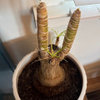
Original Author18 years agolast modified: 11 years agoHere are some more photos I promised.
It seems to have stabilized in leaf drop. And most of these are interior leaves so I'm beginning to think it is the low light levels.
I'm going to stop worrying about it! ;-)
- 18 years agolast modified: 11 years ago
I think I spoke too soon.
The poor tree is really losing leaves. I don't know if I need to water more or less. The soil was dry for inches deep around the root ball so I watered it this morning. I came home to more yellow leaves than when I left. I don't understand how to make it happy. The root ball is so tight i can only go by the surrounding soil to tell if it is dry, and it will get dry in a matter of days. But it is really cold here and little sun so why does it need so much water? I noticed some darkspots in the middle of the leaves. I read this means the leaf cells had exploded from too much water. I thought I was over watering so I went two weeks between fearing I was drowning it with my weekly waterings. Now i'm just completely lost on what to do. Here are som photos....
 18 years agolast modified: 11 years ago
I'm pretty sure you have two things going on, but not quite as sure of what they are. At first glance, one thing I suspect is a magnesium (Mg) deficiency. In Ficus b., marginal leaf chlorosis and necrosis, along with the interveinal chlorosis (occurring mostly in older leaves [is it?] because Mg is mobile in the plant) are all indicators. (But it can also indicate something else - more later.) Sometimes spritzing with 1/4 tsp Epsom salts per gallon of warm water will correct it, but in Ficus b., the cuticle is so thick and waxy it may only be marginally effective.
The odds are that a Calcium (Ca) deficiency will follow soon, or already be in play, if it is a Mg deficiency. Check for any newly emerging leaves that are distorted, curled, twisted, or cupped unusually, which would indicate a Ca deficiency which often goes hand-in-hand w/a Mg deficiency? What I suspect is the soil you were using most likely had CaMg(CO3size>)2size> (dolomitic or garden lime) added as a pH buffer and th supply both Ca and Mg. I suspect it has been depleted from the soil - especially if it's been awhile since the plant has been repotted. Has it?
Try the spritz, or if it's been a long time between potting up, try adding 2 tablespoons of garden lime on top of the soil & water in.
Be cautious about just singularly adding Mg (Epsom salts) willy nilly. Many on this & other forums suggest its application as though it carries no possibility of consequence, but Ca and Mg are mutually antagonistic. This means that too much of one can block uptake of the other, so adding Mg w/o adding Ca can/will cause a Ca deficiency, resulting in poor and distorted new growth.
This plant should require watering more frequently than every 2 weeks in that container, based on plant size and the light level near the window. You're probably underwatering. Water when the soil or a wick at the drain hole is dry.
The second issue is the leaf spot disease. I'm not really sure what it is, but brown spots surrounded by a yellow halo in Ficus are often symptomatic of a very common disease in benjamina - Xanthomonas leaf spot. Do a search & see what you think? Remove and destroy all infected leaves as soon as they become apparent.
Back to the chlorosis - the whole thing could also be caused by a build-up of one or more elements in the soil, causing a toxicity. I would drag the plant to a place where it could be watered thoroughly, over & over again. Make sure the root mass is completely saturated - wait 15-30 minutes & then flush the soil thoroughly several times. High pH from (bi)carbonate build-up, can make absorption of several nutrients impossible, and the build-up of ions (salts) in the soil can inhibit water and nutrient uptake no matter how much water or nutrients are present in the soil. The yellowing & marginal necrosis is also consistent with fluorine toxicity, (though that is more rare than most growers believe), which would also point to watering issues.
Al
dgmarie
Original Author18 years agolast modified: 11 years agoAl
It is so gracious of you to respond in such detail. I appreciate your help as I try to save this tree.
A few details so that you might be able to fine tune the diagnosis.
Yes, new leaves are cupped and curling. The tree continues to produce new growth, but those leaves are folded and curled, although still green.
Yes, the chlorisis seems primarily on older, interior leaves. This morning I removed 14 leaves! I do recognize the distinct green veining on yellow pattern.
I am watering using the frige water, which goes through a carbon filter. I am not using distilled water (should I be?) The carbon filtered water comes via the water softner. I called the local extension office regarding what water to use as my hard water is from a well, with extremely high Alkalinity and extremely high pH. As such, some of my outdoor plants do suffer from chlorisis. I've had to supplement a few ill advised pin oaks with iron "suppositories" to keep them from yellowing.
I will water more frequently and check more regularly. I was afraid of over watering. Should I add iron to the water?
The plant, when purchased, was potted by the previous owner in miracle grow houseplant potting soil. The tree was gorgeous and green. I took it home and repotted it in October into more of the same miracle gro soil, I think I used the kind with the beads in it to retain moisture as this is what I had in the house. So it has been since October. The root ball was literallypicked up and put into a larger pot surrounded by my new soil.
When I water it I do make sure water comes out the bottom and that it doesn't sit in water.
Given this information, can the tree be saved? Should I get the epsolm salts? Water instead with distilled water? Still flush it (I'd have to use softned water in the shower as it is 4 degrees here!)
Thank you!
dgmarie
Original Author18 years agolast modified: 11 years agoI googled this: Xanthomonas leaf spot and it doesn't look like what I have. If it is, it only appears on a few leaves and those aren't dying or falling off (not yet anyway).
I have a water chemistry of our well and softened water if that will help. We don't have any flouride in the well water of any measure. Assume it would also be abscent from the filtered water.
- 18 years agolast modified: 11 years ago
What type of softening system are you using?
How does your water analysis compare to these parameters?Desirable Ranges for Problem Water Parameters
Distributed by Dr. John C. Peterson, June 29, 1999 at American Bonsai Society Symposium at Ohio State University:
pH: 5.0 to 6.5
Soluble Salts (Conductivity): 0 to l.5 mmhos per cm (1 mmho is equal to 1000 umhos)
Calcium: 0 to 120 ppm (1 ppm is equal to 1 mg per liter)
Magnesium: 0 to 24 ppm
Sodium: 0 to 50 ppm
Chloride: 0 to 140 ppm
Boron: 0 to 0.8 ppm
Fluoride: 0 to 1 ppm
Sulfate: 0 to 240 ppm
Alkalinity: 0 to 100 mg per liter CaCO3I didn't start following this thread until recently, and it's late now, but I'll read through the whole thing tomo & see if there are any other clues.
Take care.
Al
- 18 years agolast modified: 11 years ago
Check the curled leaves, especially newer ones at the top of the tree. If they are folded lengthwise and look like a peapod, unfold them and look inside for white webbing or tiny light-colored wormlike things. That would be thrips. They can be a problem for ficus trees.
Are you using the fridge water cold, or letting it warm to room temperature first? I would wonder about the water softener - I'm not much of a chemist, but I know some softeners add sodium, which is bad for most plants.
Some concerns about repotting (now that you've already done it). I personally have not had good results with MiracleGro soil in general, and with the kind with moisture crystals in particular. I find it just stays too soggy. On the other hand, it is generally good to stick with the same kind of soil that the existing rootball is using, because sometimes water does not transfer well between two radically different soils in the same container, so maybe using MiracleGro was a good thing!
Also, when repotting, you should break up the outer part of the old rootball gently, so that the ends of the roots are untangled and are free to grow into the new soil. I also don't like to repot in the fall, because the plants don't have time to do much root growth before slowing down for the winter, so the new soil just sits there, being soggy. I like to repot in February or March - I know Al says June or July is ideal for ficus, and he is the ficus king, so I bow to him on that one.
- 18 years agolast modified: 11 years ago
I read the whole thread from start to finish and realized why I wasn't following the thread too closely. Sweetcicily had given good advice & there was really no reason for me to add any additional comments - she covered it well, based on the information you gave.
First, I really love trees, but I'm not all that worried about yours for the immediate future. It's quite healthy for a tree growing in CHI that only gets AM sun. Benjamina regularly loses some leaves through natural senescence, so loss of a few leaves, even under ideal conditions is normal.
My areas of concern are:
A) You haven't fertilized at all since you repotted. The small volume of soil you added, even though it did have some fertilizer in it, would not be enough to sustain a plant of that mass, so I would expect nutrient deficiencies, probably on multiple fronts. N,P,& K are all mobile in plant tissues so a deficiency of any of those would show up in older leaves. Mg and S are marginally mobile, so a deficiency of those would show up in older tissues when the plant is quiescent, and in all tissues when the plant is actively growing. Ca and almost all the micro-nutrients are immobile, so deficiencies show up in new growth. From this, you can see why I suspect a Mg deficiency, especially with your corroboration of the distorted new growth, prolly indicating a Ca/Mg shortage.B) Salt accumulation in soil (see SweetC's info above, too) is probably in play here, too. Excess salt inhibits both water and nutrient uptake, so it can manifest itself in a drought response and/or nutritional deficiencies. You really need to figure out your water issues & get that soil flushed thoroughly. After you flush the soil, fertilize immediately with 1/4 strength MG 12-4-8 liquid w/micro-nutrients. It's the best choice. Contact me off forum & I'll fix you up with a small vial of nutrients you can mix into the 12-4-8 you'll need & you'll have a complete fertilizer with all the nutrients your plant needs. I'll even send a little gypsum to help keep the Ca:Mg balance straightened out, and some chelated Fe (iron) formulated for high-pH conditions (your high pH is probably blocking Fe uptake, too). ;o)
C) From all you've said about the condition of the roots, you're going have to bite the bullet & do a repot, complete with a root-pruning this summer. I'll help you through it when the time comes. If you don't, you can eventually expect branch die back, little or no branch extension, and slow to no growth. Basically, the tree will strangle itself, and "A plant that is not growing is dying". Dr. Alex Shigo - world renown for his tree research.size>
Watergal also made very good points about the water from the refrigerator (Are you applying it cold? You shouldn't be; it will injure roots), the water softener (we still need to get that worked out, btw), dissimilar soils in the same container, and her repotting tips.
Don't despair or throw your hands up in confusion. I know you're prolly on info overload, but the solutions are really quite simple in comparison to the physiology of what's going on with the plant.
Al
- 18 years agolast modified: 11 years ago
I read the whole thread from start to finish and realized why I wasn't following the thread too closely. Sweetcicily had given good advice & there was really no reason for me to add any additional comments - she covered it well, based on the information you gave.
First, I really love trees, but I'm not all that worried about yours for the immediate future. It's quite healthy for a tree growing in CHI that only gets AM sun. Benjamina regularly loses some leaves through natural senescence, so loss of a few leaves, even under ideal conditions is normal.
My areas of concern are:
A) You haven't fertilized at all since you repotted. The small volume of soil you added, even though it did have some fertilizer in it, would not be enough to sustain a plant of that mass, so I would expect nutrient deficiencies, probably on multiple fronts. N,P,& K are all mobile in plant tissues so a deficiency of any of those would show up in older leaves. Mg and S are marginally mobile, so a deficiency of those would show up in older tissues when the plant is quiescent, and in all tissues when the plant is actively growing. Ca and almost all the micro-nutrients are immobile, so deficiencies show up in new growth. From this, you can see why I suspect a Mg deficiency, especially with your corroboration of the distorted new growth, prolly indicating a Ca/Mg shortage.B) Salt accumulation in soil (see SweetC's info above, too) is probably in play here, too. Excess salt inhibits both water and nutrient uptake, so it can manifest itself in a drought response and/or nutritional deficiencies. You really need to figure out your water issues & get that soil flushed thoroughly. After you flush the soil, fertilize immediately with 1/4 strength MG 12-4-8 liquid w/micro-nutrients. It's the best choice. Contact me off forum & I'll fix you up with a small vial of nutrients you can mix into the 12-4-8 you'll need & you'll have a complete fertilizer with all the nutrients your plant needs. I'll even send a little gypsum to help keep the Ca:Mg balance straightened out, and some chelated Fe (iron) formulated for high-pH conditions (your high pH is probably blocking Fe uptake, too). ;o)
C) From all you've said about the condition of the roots, you're going have to bite the bullet & do a repot, complete with a root-pruning this summer. I'll help you through it when the time comes. If you don't, you can eventually expect branch die back, little or no branch extension, and slow to no growth. Basically, the tree will strangle itself, and "A plant that is not growing is dying". Dr. Alex Shigo - world renown for his tree research.size>
Watergal also made very good points about the water from the refrigerator (Are you applying it cold? You shouldn't be; it will injure roots), the water softener (we still need to get that worked out, btw), dissimilar soils in the same container, and her repotting tips.
Don't despair or throw your hands up in confusion. I know you're prolly on info overload, but the solutions are really quite simple in comparison to the physiology of what's going on with the plant.
Al
dgmarie
Original Author18 years agolast modified: 11 years agoThank you Al. I appreciate your willingness to help offline. My email is marie.gilbert@comcast.net
Here are the water parameters of my softened water (I assume since it is coming out of the fridge carbon filter some of these might be lower, particularly the salts). I have a dracenia which shows brown tips if i use softened water but is very healthy and no problems with the filtered water.
The parameters are:
iron 0.031 mg/l
calcium .070 mg/l
Mg .040 mg/l
Mn Na 194 mg/l
Flouride 0.59 mg/l
Chloride 2.59 mg/l
pH 7.94
alkalinity 324 mg/l
hardness The well (hard water) is:
iron .909 mg/l
Calcium 60.6 mg/l
Mg 53.1 mg/l
Mn 8 ug/l
Na 16.2
flouride .58mg/l
pH 7.75
Alkalinity 325 mg/l
hardness 370 mg/LI bought some epsolm salts today if needed. ??
I bought 3 gallons of distilled water.I never water with cold water. It sits out for hours.
before I use it.You are a life saver! This tree is losing leaves daily. i removed 14 again this morning that turned or are turning yellow. My husband is wondering why we didn't buy silk!
dgmarie
Original Author18 years agolast modified: 11 years agoThis ficus was born and raised in Schaumburg and my husband tells me that this area used water from Lake Michigan, so it has never had my kind of water (softened or well from the ground). I suggested to my husband that he cart gallon jugs to Schaumburg and bring home water for me and he balked! So not sure what to water to use!
- 18 years agolast modified: 11 years ago
You should pretty much consider your softened water unusable because the sodium (Na) content is almost 4 times the max that is considered suitable for use on plants. Incidentally, a high Na level blocks uptake of both Ca and Mg (as well as water) - some food for thought in that there may be ample Ca & Mg in the soil, but uptake is blocked by Na (called an antagonism).
Re the water from your refrigerator: Charcoal filtering's primary effectiveness lies in its ability to reduce chlorine, sediment, and volatile organic compounds from water, and it's pretty ineffective at removing metal salts, minerals and dissolved inorganic compounds, so it will not change the Na content much, if at all.
Your well water is to be preferred over your softened water, even though your well water is quite high in Mg (Note how your softener removes nearly all of it?), and plants generally tolerate high Mg levels, as long as the Ca:Mg ratio is somewhere near 4or5:1. It's not, but there's an easy fix. A tablespoon of gypsum on top of the soil will add Ca and help bring the Ca:Mg back in balance. You can help neutralize the alkalinity of your well water by adding vinegar - 2 Tbsp per gallon of well water.
All this chatter still pretty much comes full circle to water quality, watering habits, and perhaps some nutrient issues. You could probably live happily ever after if you installed a R/O water system or if you know a friend who has one & will provide you with irrigation water for your plants, as I expect that others will suffer similarly.
See A & B in my post above.
You can also flush the soil throughly several times with well water, then pour 1 gallon of distilled water with a 1/4 - 1/2 dose of fertilizer through the soil at each fertilizing. Between fertilizer applications, water by slowly trickling distilled water on the entire soil surface until the entire root mass is moistened. This will eliminate all salt build-up beyond what is in the fertilizer & residuals from the well water.
Take good care.
Al
dgmarie
Original Author18 years agolast modified: 11 years agoThank you Al. I will follow these instructions and let you know in a few weeks what's up. I appreciate all your help! It is much easier knwoing I can just supplement (and inexpensively) my well water.
- 18 years agolast modified: 11 years ago
Lovely tree(s) dgmarie. I have one, about 6+ feet in height, but just the one trunk, so it's girth isn't as wide. Spring of 2007 I had a lot of leaf yellow, drying and fluttering to the floor when I'd give the tree a gentle shake. But then, up until that time (tree is 10 yrs old), other than the odd leaf once every 2 months or so, this would have been it's big shed, and I noticed it wasn't newly grown leaves, but the largest and oldest leaves on the plant. So come when it became warm enough to take it outside for a re-pot (June), it took it out of it's pot, carefully teased out several of the larger healthy roots away from the ball (and when I reset it in it's pot I made sure to have the tips of these roots running in a different direction if possible), then I took a knife and slashed the root ball in 3 spaced out spots, from top to bottom. I also loosened up the base of the roots. With scissors I trimmed off some long stragglers and anything that looked dried up. I expected some more leaf drop...got none. So these guys are pretty tough by my standards, or else mine has a deep desire to live. Best of luck with yours.









dgmarieOriginal Author