

What is wrong with my orchard trees?
Can you tell me why this peach is shriveled up?

Comments (72)
 14 years agolast modified: 11 years ago
Bob,
Good point. I thought of Fruitnut and Scott as good examples of fruit growers who don't spray, or use organic methods effectively. I think if the OP could learn a lot from reading their old posts.
As mentioned, I think it's pretty tough to be definitive about any causes for the problems the OP is experiencing. Around here cherry leaf spot is the biggest foliage problem of cherry trees. If I had to guess on the demise of the plum tree, it looks like a tree that could have wallowed out. They sometimes die quickly like that (leaves attached) when they wallow out.
Incomplet,
At this point I think we are talking in circles (i.e. you essentially believe things like fruit moths, SWD, BMSB, aren't that bad and can be taken care of by natural predators like birds and lacewings, and I disagree.
Don't be surprised you've got people's ire up. When you say things like, "I would not spray, fuss, or try to treat any pest or disease problems that may come through my trees. The idea that you should even try to do so is foolish; trees have done fine on their own for millions of years without humans to nanny them around. That trees under modern human care experience overwhelming episodes of pests and disease is a testament to our stupidity." it's irksome to people who know how difficult it is to raise fruit and have experienced failure after failure to pests.
My other thoughts are about Fukuota. I've no idea what the climate is like in Japan, since I've never been there, but I would not automatically assume he had the same pest pressures 60 years ago in a place halfway around the globe, just because he had a humid climate. Someone who lived in Hawaii once told me they don't have many problems with insects (in spite of the tropical weather and humidity) because the trade winds carry a lot of the insects into the ocean.
I've not read Fukuota's book, but while he may have contributed to some sound management practices that can help minimize pesticide use today (pruning trees to keep them open and allow foliage to dry faster, low density planting, ect.) I think one should be cautious to accept anyone's testimony unless the success has been repeatedly duplicated by others.
I remember once speaking with a woman at a fruit grower's event who was interested in starting to grow fruit. She told me about a farm she visited in Japan. From what she described it sounded like a biodynamic farm. She said the farm visit changed her life. She told me the way they pick tomatoes is to place your hand underneath a tomato (not allowing your hand to touch the tomato) and if the tomato is ripe, it will drop in your hand. She really believed that was the proper way to "pick" tomatoes. I've grown a lot of tomatoes in my life and they've never dropped in my hand like that. My point is a lot of times people are so passionate about the way something should work they write books claiming it does work that way, when it really doesn't. They embellish their successes and minimize the failures of the philosophy in question.
- 14 years agolast modified: 11 years ago
"I think one should be cautious to accept anyone's testimony unless the success has been repeatedly duplicated by others."
Even if you duplicate the success yourself you should be cautious. I've had the benefit of not only growing fruit on the west coast and the east coast, but also on scores of sites in the same areas- sometimes only a few miles apart. What works here often doesn't work there. Scientific evaluation consists of many controlled studies where the results are never completely conclusive. I've often made a fool of myself assuming anecdotal observations are the holy grail and I'm sure I'll continue doing so.
It is fascinating how certain teachers, especially those obsessed with their own work and become grandiose in their own assessment of the importance and uniqueness of that work sometimes get a cult following that drink the cool-aid and gives the teacher the god-like status that is even beyond what he (she) himself perceives.
I'm not saying Fuky is one of these as I'm not familiar with his work, but Alex Shigo fills the bill in my book. Shigo's work was extremely important on our understanding of trees, but his interpretation of his work went way beyond what his research revealed. I don't even no if Fuky did any actual research where controls were used.
Related Professionals
Newburyport Landscape Architects & Landscape Designers · Sacramento Landscape Architects & Landscape Designers · Owensboro Landscape Contractors · Vicksburg Landscape Contractors · Mason City Landscape Contractors · Grand Island Landscape Contractors · Nashua Landscape Contractors · Edison Landscape Contractors · Oshkosh Landscape Contractors · Waycross Home Additions · West Plains Home Additions · Zanesville Home Additions · Champaign Home Additions · Gallup Home Additions · Scottsbluff Home AdditionsOrchard_tree
Original Author14 years agolast modified: 11 years agoWow! Thanks for all your advise. But I am a Woman. I don't know much about those trees. They were planted 3-4 years ago, and I haven't looked at them until recently. I don't know much about orchards or trees at all.
- 14 years agolast modified: 11 years ago
I reference fukuoka because his examples are typical of permaculture, although he does talk a good deal of nonsense. His climate is also more similar to ours than, say, Austria or Australia.
You know, living on a small property I rarely think about things like keeping chickens, and I also assume that if someone is growing "organic" on a commercial scale, that they would automatically be raising free range (100% of feed) chickens/turkeys/ducks. You get a profit of meat and eggs and free pest control at once. Fukuoka also raised ducks and chickens.
As for "pest pressure", wherever stink bugs (or any other pest) hang out, so do their predators, including chickens. If stink bugs coming out of the weeds was the true cause of their extreme number, then why do I, living in a weedy forested suburbia, see no problems with them eating all the roses and tomatoes and everything else? Why do farms where pesticides are sprayed to eliminate them produce the greatest number of them? If these "scientifically proven" treatments are so effective at controlling them, then why should someone farming organic in a heavy agricultural area have pest problems from their neighbors' activities?
@Op: what does being a woman have to do with knowing about trees? And also, your trees needed pruning due to their previous owners' treatment, and not knowing that, you let their branches become tangled. When that happens, they lose circulation and become a harbor for pests and disease. I can understand how you might get confused about why a tree would suddenly suicide itself if allowed to grow "on its own", but most fruit trees are pruned into shapes that don't match their natural growth pattern at all, and once that happens they must be pruned regularly for the lifespan of the tree whenever the branches start to grow out and tangle.
Orchard_tree
Original Author14 years agolast modified: 11 years agook. But is it completely too late to save them? I mentioned being a woman, because I was called a man several times in this post.
- 14 years agolast modified: 11 years ago
Orchard,
Your statement " But I am a Woman. I don't know much about those trees. " could be perceived as offensive by many women.
I believe knowing or not knowing about trees has nothing to do with gender. It has a lot to do with you interest and willingness to learn. Most of us (if not all) started out with not knowing. Then, we learn from trying, failing, reading, asking,(not in any particular order)and asking some more.
If you are willing to learn, you'll gain knowledge in a short time. You've started by asking questions at the right forum. Good luck.
- 14 years agolast modified: 11 years ago
OT - we can't tell. Insufficient date. There may not be anything seriously wrong with your peach if you just have one or two mummified fruits. That happens.
The cherry - we just see one leaf. Could be cherry leaf spot. Maybe. If so, there are fungicides to treat it, but this is not the best time. Start in the late fall when the tree is dormant. Before that, rake and dispose of the infected leaves. It's likely you can save the tree.The plum - it may or may not die, depending on what's wrong with it. Hard to tell from just the photo.
Your problem trees are all stone fruits. They tend to have similar problems and similar modes of treatment. This makes treatment a little more convenient. A whole lot depends on your location. Was it wet, was it dry?
You need to consult your state university website or extension service for a spray guide for tree fruits and use that as a general guide for routine care. But for the specific problems you have now, it's hard to tell.
And ignore Incomplete, who is here to blow his own horn. Heed Harvestman.
- 14 years agolast modified: 11 years ago
Your cherry trees and plum seem doomed to me. The peaches, as long as they still have leaves, might be saved. I think stone fruits are usually pruned early in the growing season, so I don't know that pruning now would be a good idea. Pictures of the canopies of your trees would be very helpful. You will definitely want to remove any remaining fruit from the vicinity of the trees. I notice I did refer to you as a he, pardon my default assumption.
@bamboo_rabbit: no, the majority of my neighbors are proles and can't afford to spray their property. I did find out something else though, what I had mistakenly identified as deer flies which I see often are actually robberflies. Nature requires more than "not spraying" to keep populations of things in check. Also, no spraying doesn't equal "no pests". If your goal is total annihilation, you are guaranteed to fail. With sufficient habitat, if you have any pest that runs out of proportion, within a few years you are almost guaranteed that some predator will wander in and proliferate in the void. And, as I said, we don't have chickens here, but we get a wide variety of migratory and native birds. I should mention it took years (maybe a full decade) to attract so many, but over time more and more have learned to stop here to eat and rest, and more have settled in and reproduced. They eat bugs in flight and in the trees that ground-dwelling chickens probably couldn't eat, and each bird from the hundreds or thousands that fly through every year can eat it's weight in bugs probably every week. An orchard that doesn't include tall trees that provide food and shelter for birds will not have any, except maybe the sort that follows you around eating the seeds you plant.
- 14 years agolast modified: 11 years ago
Incomplet,
You have no understanding of how the real world works. The pests show up because there is a large food source IE my garden. It is no different than a flock of cedar waxwings showing up to a cherry orchard. Happens every year, has the hawk population exploded and controlled that food source yet? Nope. The amount of food provided by the garden is unnatural and your assertion that a natural solution will cure the problem is absurd.I have 1000's of birds.....the bug eaters are up in the canopy of the 100 year old oaks in the back yard eating the bugs that they have always naturally evolved to eat and completely ignoring the bugs in my garden. I do not spray my garden mostly because it does no good against stinkbugs anyway.
- 14 years agolast modified: 11 years ago
Orchard_tree,
I want to welcome you to GardenWeb. Please don't be discouraged. This is a great place to learn and I am truly grateful for all the input I've received over the years.
I wish I could offer advice but I can't. I do know that there are a lot of very knowledgeable people giving free advice for the sheer love of fruit.
If in doubt about someones advice it's good to click on their personal link and see how long they've been members, and then even search for some of their other posts. It doesn't take too long to figure who's advice is good and who's isn't.
- 14 years agolast modified: 11 years ago
Part of the reason commercial growers don't raise chickens in the orchard is because it is not a good practice under GAP (Good Agricultural and Handling Practices) at least not during the growing season when you'd get some benefit of pest control. Not to mention the chickens would probably peck all the fruit they could get to. That's not to say some orchards don't run livestock during the growing season, but in today's litigation happy climate, they are probably playing with fire. Food scares from bacterial contamination seem to occur on a fairly frequent basis. It's a different world than Fukuokas.
Orchard_tree
Original Author14 years agolast modified: 11 years agoI did not mean to say that I don't know anything about trees because I'm a woman. I just wanted to specify, because pretty much everyone in this post has referred to me as a man.
incomplet. My chickens have access to the orchard but they almost never even go in there. My chickens do eat stinkbugs by the truckloads, but I still see many every year. And I don't spray for them. So I don't think that chickens are sufficient stink bug controllers.
Uh Oh.... I just read milehighgirl's post. I did fertilize my trees with chicken manure. I also fertilized it with cow manure that I got from my cows. I carried chicken and cow manure to my trees by the cartload. literally. I think I loaded at least a dozen or more carts of manure and brought it to fertilize my trees. I Also have 24 grape vines, and 34 trees.
- 14 years agolast modified: 11 years ago
"I've never heard anyone else complain of chickens eating their crops, either"
Really? Perhaps you should do a bit more reading. Chickens will eat almost anything, from grass to fish, fruit to mice. Given that chickens have wings they are tough to keep out of fruit. They are also great jumpers. Blackberries, peaches, blueberries, tomatoes, cabbage and lettuce are just a few of their favorites.
- 14 years agolast modified: 11 years ago
Orchard_tree,
Maybe we are getting somewhere now. I am not up on the chemistry of manure but I do believe it must be composted first before you can use it as fertilizer. I am just regurgitating what I read in Steve Solomon's book on compost. This may indeed be a reason your trees are dying.
That chickens carry salmonella is learned by personal experience.
- 14 years agolast modified: 11 years ago
@milehigh: Salmonella kills people, not trees. There's nothing in common manures that should be pathogenic to trees. If she overapplied manure, it might attract pests and/or cause outbreaks like this, but ~12 or so carts of manure doesn't sound like enough to cause problems if spread out over 34 trees, although it's possible. Also, turns out the cantaloupe thing was listeria, which you can find in abundance in your local grocery store anyway. I wouldn't worry about whatever chickens leave in the fields, but I would definitely compost their bedding before doing anything with it. I question the practice of allowing people to file suit for failure to wash their own produce =\.
@orchard: How thick did you pile the manure around the trees? More than an inch? Less? Did you make a mound of manure around the bases of the trees?
Are the branches of your trees growing tangled and crossing each other? How many of 34 trees are sick?
I'm surprised your chickens avoid the orchard, considering they're bred from jungle fowls. What kind of chickens have you got?
- 14 years agolast modified: 11 years ago
Chickens are a domesticated species, many instincts having been bred out of them. Mine leveled my garden twice before I put a fence up. They are too big to fly, but loved to jump and peck/knock down fruit from my trees pre-fencing.
- 14 years agolast modified: 11 years ago
Orchard, Milehigh is at least concerned about your problem and makes an important point. I wish others would simply ignore incomplete as I feel he has exhausted any possible use he has to you and it seems his sole purpose is to make anyone with any common sense feel very pleased with themselves. Every answer to him is just fuel for his idealogical fire which is consuming all the oxygen on this thread. He's like someone trying to teach ballet because he's read something about it and knows much more than any dancer how its done.
Anyway, too much fresh manure can burn the roots of trees- especially chicken with its high nitrogen content, although it would take a lot of it to accomplish this when spread on top of the soil.
Fresh manure can be used as fertilizer but must be carefully applied and manure is much safer to use composted as MH suggested. It is most dangerous in soil with poor drainage. If by cart you mean a large garden cart it could certainly be a problem- especially if applied immediately before or when trees are in leaf.
The reason I have suggested trying to get help from your extension was simply to get a specific diagnosis of any diseases but that doesn't mean you can't find the key to your problem here. If you feel incomplete is helping you please say so, and I will withdraw and allow you to have a dialogue with him without interruption.
Otherwise, we should discuss the texture of your soil and if it drains quickly after heavy rain. This would be the starting point although we've already jumped to amendments and you should let us know how large is your cart, what percentage was chicken manure and when it was applied.
- 14 years agolast modified: 11 years ago
OT - you seem to have a number of trees. Are any of the others showing the same symptoms as that plum in the photo? Whatever is afflicting it doesn't seem to be the same as the problem with the cherries.
How old is the plum tree? Did it get more of that fresh chicken manure than other trees?
What about your peaches? Aside from one or two mummies, is there a problem with those trees, too?
- 14 years agolast modified: 11 years ago
Im going to have to step in here for a sec...
To the Original Poster:
The odds are it was temp stress/ water stress. Stress can lead to an inumberable amount of diseases and problems with a plant. Give some of the bark of some twigs a light scrape, if you see green, its alive, if you see white or brown, its dead. You can do this all the way down the branches. Use small, thing scrapes with your finger nail. You can also leave them and hope for the best next year.
THe bottom line is: ITs a wild goose chase at this point. And it sucks, but you have to wait and see. Keep watering liek normal, and hope for the best.
In regards to the whole "one straw revolution" thing:
I have been studying sustainable gardening for 3 or 4 years, and practicing it for 2. There are no sparay gardens in the pacific north west, japan, the austian mountains, and sub tropical/tropical australia. These places are humid at one point in time during the year, if not all year.
Fukua is a Pioneer, a very smart person, who went agaist the grain, to learn some old/new methods of growing. The methods worked for him, because his methods were tailored to be perfectly in aline with his climate - proper plants being the major key here. He faile dmany times, and learned what plants do better in his situation.
The same goes with Sepp Holtzer in austria. He ignored half of Fokuas knoledge, and half of Bill Molisons knowledge in permaculture. He took the basics, and tailored them to his area. They do not however, say that doing it exactly their way, in, for instance, Alabama, would work. Different ecosystems, different climate, diferent elevation... completely different situations. You can use Fokuas Philisophy (which is by far his best knowledge) and use it to learn how to do it in your area, but by no means IT IS NOT MEANT TO BE USED AS A UNIVERSAL COPY PASTE TECHNIQUE FOR GARDENING ACCROSS THE GLOBE.
IT takes years to associate plants in your area. ITs harder to bring in non native plants as well. Sure, bringing in asian plums and euro plums can be done ok, there are american plums that you can subsitute for a forest garden. But bringing in peaches and pears, plants that arent native here at all, will bring in problems (as a few people have mentioned).
In regards to no spray, the last few decades of plant breeds probably wont to you any good, especially say, apples or pears in a humid/high rainfall climate. Youre better off growing apples that are used to no chemicals (old breeds, or new ones that have high resistances).
I planted a TOka plum, John pear, and Honeygold apple last and this year. THis spring was WET and mild, ive never seen anything like it here. Most trees had problems in spring, but the pear and apple got bacterial or fungal infection. No matter what kind of tree it is, or breed, if you have a wet spring, the odds are they are going to be sick. THe real, main philosophy of "no spray" or self sustainable gadens, is to make sure the plants are happy enough to withstand the sickness, and grow dispite this problem.
The other goal, is to spread out the trees so you limit the spread of infection. Using soil and fertilizer that is available in your yard helps too, because you know exactly what is in it, and if was properly cured.
Reading and wanting to spread the word of sustainable agriculture/permaculture is awesome, but reading ONE book, with out actually practicing, and taking about information out of tha tone book is asinine. You wont teach anyone anything, and you are only hurting yourself in the process, as well as the likelyhood people will want to try these "new" forms of horticulture.
I hope this clears this whole situation up a bit...
 14 years agolast modified: 11 years ago
Ok everyone this poor women just wants to save her trees. She has asked a simple question, lets try and focus on the problem at hand. Orchard Tree -perhaps you could provid a little more info. Disregard all the hulabalou and give us the facts. How much watering/ times and length? How much fert around the trees? Are they close together? Size of trunk? How old? Planted at the same time? Have you sprayed them or anything around them? Try and think of anything and everything that would help us to help you. Harvestman has helped me in the past with dry apples and he is pretty good. To everyone, lets try and stick to the questions/answers she provides us, if we have not chased her off. Orchard Tree -I will apologize up front for any confusion some may have caused you. Now lets get busy guys and figure this out! Come On!
- 14 years agolast modified: 11 years ago
Also, orchardtree photographs of the site would be helpful including of the ground and several of the trees together and entire trees alone. Is the soil easy or hard to dig?
Orchard_tree
Original Author14 years agolast modified: 11 years agoThank you so much. I moved to my 32 acre farm 3-4 years ago. I did not know anything about trees really. My family and I planted them all at the same time. But then we made the terrible mistake of getting goats. The goats ruined some trees completely and stripped the bark of some. So we got some more trees and replanted, then it happened again the next year, because the goats managed to escape from their field. Right now they are cooped up pretty well though. The peach tree with the mummified fruits had some bark eaten off around it's trunk. As for the manure... We put layers and layers around the trees. The manure wasn't composted. We just collected it from the barn and the ground. Most of it was pretty fresh. Last year and the years before that, my cherry trees were doing fine, and they did have some ripe cherries on them. This year I noticed that they suddenly got those black spots, and after I sprayed them with the fungicide I made, the tips of the leaves blackened. I have a question. When do peach trees start losing their leaves? Is it normal for the leaves to be turning orange and falling off right now?
I will take some pictures, of my trees and post them a little bit.
- 14 years agolast modified: 11 years ago
Goats and fruit trees just don't mix.
Cow manure is not very strong, it's more the chicken that concerns me with about 3X the nitrogen. You still didn't say when you applied it. If trees were dormant it shouldn't be the problem unless you suffocated the roots with it by piling on and it was soggy stuff.
Partially girdled trees often recover but fatally girdled trees will sometimes linger with unhealthy foliage and no new growth.
- 14 years agolast modified: 11 years ago
I do believe all manure should be well composted before use. However, I also believe the most damage from non composted manure is when its in direct contact with the roots, as in adding non composted manure to the planting hole before putting the tree in? Harvestman makes a good point as well. It shouldnt be more then 2 or 3 inches thick, not placed on the trunk (leave 4 or 5 inches between the manure and trunk), and should be spread out a foot away from the trees drip line. I would also suggest some sort of mulch, so that the ground will retain more water (especially if those droughts you guys have been having continue!)
Like others have suggested, take some pics, and I again , suggest making very small scratches with your thumb nail to see if the inner bark is green (which means its alive at least). Its the easiest way to see if the tree is alive, yeah maybe not diagnose, but again, if the tree is dead, there isnt anything you can do. IF the inner bark in the branches is green, the odds are its alive, and may be worth saving...
- 14 years agolast modified: 11 years ago
Canadianplant,
Not all manures must be composted. Rabbit manure for example is fine to use fresh.
- 14 years agolast modified: 11 years ago
If you want to give your plants a quick shot of nitrogen, any fresh manure can be used, it's just a question of how much. The exception would be when manure comes in contact with what is eaten.
Fresh manure can create a quicker growth response than composted manure.
- 14 years agolast modified: 11 years ago
Rabbits, horses and cows don't eat mice :P.
@Orchard: piling up manure around the trees for several years is a sure way to overload on nitrogen. Manure should generally be spread over an area similar to the area the animals graze in. You'll have to plant something that likes nitrogen for several seasons under the trees to drain it down to normal levels. Whatever you plant will probably have pest and disease problems in that soil until enough N has leached out.
The goats definitely didn't help either. They may still need pruning, as well, but I can't really tell without pictures :).
Orchard_tree
Original Author14 years agolast modified: 11 years agoI'm sorry for taking a while to post the pictures. A lot of things just suddenly came up. I'll have them up soon.
Orchard_tree
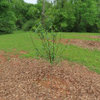
Original Author14 years agolast modified: 11 years agoHere are more pictures of my cherry trees.
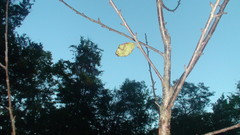
Orchard_tree
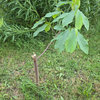
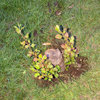
Original Author14 years agolast modified: 11 years agoThis is the trunk of the peach tree with the mummified fruit.
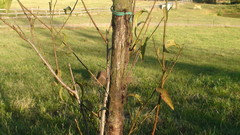
- 14 years agolast modified: 11 years ago
Orchard_tree Grass is winning over your trees.
Herbicides : Post chemical right around tree off from tree roundup.
It easier mix Herbicides than pull grass out.
Don't use Post chemical after year ends no Post in 2013.
- 14 years agolast modified: 11 years ago
I'm surprised, some of your trees look like beautiful examples of what those trees should look like. You may be better off cutting down the (badly) bark-eaten trees, that's some bad damage and the trees are just likely to keep getting sick until they die anyway.
The cherry tree in the fourth pic you posted today is a perfect (although leafless) example. Cherries do tend to grow kind of wild tangles of branches, although it doesn't seem to affect them too much. For some of the older cherries you might pull (via a rope tied to a brick or something) some of the branches that are cramming together on the middle-aged trees more towards the ground, and maybe cut a few that are hopelessly jutting out into the middle of the tree. The cherry with the big munches taken out of the leaves looks pretty tangled.
The right side of the last peach picture shows quite well what a peach tree should look like. Both cherries and peaches I've heard don't hold the weight of their fruit very well unless you prune the branches back to strengthen them. Examples below. I'd lay off the compost for the next decade, but they seem alright for the most part.
Apparently if you make a 'bone sauce' (bones cooked at high temp over a small amount of water) and paint it on your tree bark, the goats will not touch it anymore (possibly ever again). If the sauce doesn't come out utterly nasty, then you probably did it wrong :).
Cherry example:
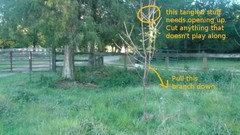
Here is a link that might be useful: bone sauce and other stuff.
- 14 years agolast modified: 11 years ago
Branch strengthening example, note you want to cut around 1/3 of each branch, cutting back to a good twig that's sticking out in the right direction for the tree shape. Only make about one cut per year, early in the growing season. Note that the cut furthest on the inside of the tree in this example should be cut first, and that little branch-let should be cut completely since it tangles.
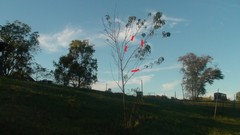
- 14 years agolast modified: 11 years ago
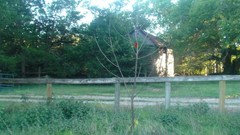
This is that awesome cherry example I was talking about. I would barely cut anything on this. I highlighted one branch that tangles a little that you might trim off, but besides that the only reason to cut is to strengthen branches.
- 14 years agolast modified: 11 years ago
One last thing, I thought of this earlier but had to look back over your pics to be sure. That peach tree I used as an example is probably only growing into half a peach tree due to wind exposure. The trees you planted which are nearby other trees, fences etc seem to look much happier. If you should replant some of them, make sure they have good wind cover.
- 14 years agolast modified: 11 years ago
It is very difficult for establishing fruit trees to compete with tall weeds- 3 options- frequent cultivation, mulch or herbicide. Keep at least a 4' diameter circle free of grass and weeds at least from early spring into July.
Cherries often defoliate early, sometimes because of bacterial leaf spot. Early copper application recommended.
- 14 years agolast modified: 11 years ago
This winter try using a oil spray for dorment trees. I use Volck by ortho at lest 3x during winter. It will help with pest etc. I agree w/harvestman get rid of the weeds and grass. Also you need to put a furow around each tree(clean of grass) out to the drip line or a little beyond. If you need to fert or give extra water it will hold it. The flat depression s/b about 3+" deep. use the extra dirt to build a mound around to hold the water etc. This will at best keep the weed/grass from under the trees. You trees don't look bad they just need a little love. They will soon lose all their leaves and go dorment and you can start fresh. Next year when they start to leaf keep an eye on them. Look for aphids or little critters or holes in the leaves or bacterial spots and get right on it. Hope this helps. YOU have a beautiful place!
- 14 years agolast modified: 11 years ago
Campy, in VA oil is the optional spray and is only helpful against mites and scale. We have many more dragons to slay before receiving our reward than you folks out west.
- 14 years agolast modified: 11 years ago
Not sure I'd do much pruning on these trees until next year, when you can see what's alive in the spring. That peach tree seems to have lost half its diameter of bark.
- 14 years agolast modified: 11 years ago
I wouldnt use pesticides, given the trees are stressed enough, the roots dont need more problems.
I suggest sheet mulching. It does more then one thing you may need:
- It eliminates weeds from around the trees roots, reducing negative competition
- Its keeps the soil cool, lessening water needs (which may have helped this year down there!)
- It builds fertility over time.
- Will allow certain cover crops, which will enable possitive root competition, while slowly creating good soil, and eliminating grass and most weeds in the long run.
THe tree that got "gnawed" on by goats looks like a gonner to me. I hope someone has a better outlook for it:( The one that has a lot of leaves looks ok to me, just stressed for what ever reason (broad, I know. The odds are its from a weird growing season IMO). THe other ones.... again, I suggest a light scrape on some twigs and branches to see if there is some green.
Orchard_tree
Original Author14 years agolast modified: 11 years agoOh Thank You!! Everyone has been so helpful.








johnthecook