Software
Houzz Logo Print
kossetx

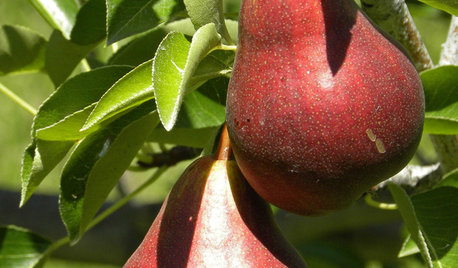
Reviving an 50+ year old pear tree.

18 years ago

Hi,

I have a very old pear tree that I believe is some kind of asian tree because the fruits were about small grapefruit size when it used to produce.

It hasn't produced anything in 15+ years, even though I prune it. There are several other pears around it that are ofsprings of this tree. They don't produce either. I've randomly fertalized them but that didn't seem to help. They bloom but never fruit.

Any sugestions?

TIA

Comments (5)

  • 18 years ago

    It can be much more difficult to pollinate a pear tree than apple, for the reason that bees do not prefer pear at all. If it produced fifteen years ago I wonder if there had been another pear nearby which has since been removed. I guess you are saying that the other nearby pears came up from seed? You would think one of them would pollinate your tree. Do they all bloom at the same time?
    It might not hurt to give it a small amount of nitro, but without a leaf analysis it is just a guessing game. Boron, on the other hand, at prepink should be a standard practice with pear. At least it is in my location. I guess I can't really say about your area, but I think at least a small amount of boron would help fruit set and size.
    I have never seen pear pyslla so severe that it totally inhibited pollination, but I suppose it is possible. And I am sure you have not sprayed for psylla.
    Just guessing, I am going to say that you need another tree to cross pollinate, boron to help set, and bees attracted to your trees. Without knowing the variety of your tree it is hard to say what variety you could now plant, but you can try something that blooms at same time; early, midbloom, or late.
    You could drive around at prebloom time and take a cutting of a preblooming pear and install it under, or in, your tree in a bucket of water. If you have pears that year you might find that info valuable. Be sure to ask, or better yet, make arrangements ahead of time as pear growers take a dim view of people cutting on their trees due to possibility of inducing fireblight. You could take three or four cuttings from different trees and hang them in the four quadrants of your tree. Note the presence, or lack thereof, of fruit that season.
    Good luck, your pear tree is valuable, IMHO.

  • 18 years ago

    Geraldo,

    Thanks for the reply. Yes, the other trees must have come from seed. I forgot to mention the old tree has sapsucker type holes in the bark, so it is obviously stressed. The younger ones show no stress but don't produce either. They are all 2-4" across. I have other varieties of pears but they are a 1/4 mile from this one. Honeybees are scarce, but I have lots of other insects that frequent all my plants. Would they do the trick?

    MP

  • 18 years ago

    a 1/4 mile is too far for pears. Bees really don't like to work pears. I don't know what, besides bees and bumblebees, would be expected to do a viable job of pollinating pears.
    I don't think there is anything you can do about sapsucker holes, short of living there and being continually on guard with your 12 gage.
    You could purchase a product called Beescent that will attract bees like you would not believe. Spray Beescent on your trees and bees will come to it from miles away. And I mean miles. Well, depending on what else they have to work and how big your orchard block might be. I spray Beescent in my orchards at dusk and the next midday, if at all warm, it sounds like an airport out there. The first time you see it, and hear it, it truly is amazing.
    If you can, imagine twenty acres of apples all pretty much in snowball bloom at once, sprayed with Beescent, hundreds of bee hives within two miles, 67F degrees and sunshine. I think the scientific term is "far out".

  • 18 years ago

    Pruning could cut into production if you are not doing it correctly. If you are just re-topping it every year, in the manner of a pollard - as many people do - the parts you are cutting will not have a chance to develop and mature fruiting wood.

  • 18 years ago

    Wow, trying to guess with so little to go by- always fun, not always useful. Can you post a photo? I have never seen a pear fail to bear fruit for nutritonal reasons here in the northeast. Careful monitering of nutrients is generally for the commercial grower who has to tweek every bushel out of every acre.

    Pear psyla knocked several of my pears out of productivity this year, I'm embarassed to say. Sometimes I'm more careful with my customers than my own orchard. If the problem is psyla you'd see soot on the leaves and a major drop in vigor and probably early defoliation if symtoms are the same out west.

    You have to hit them with about 2% of the finest summer oil you can find at swollen bud. I recommend Purespray. It may take a couple applications. That's why you need a good summer oil. You could probably get some help from your county cooperative extension. Sometimes a microscope helps a lot.

    Pears are a lot harder to polinate when you try to grow them in a book than when you plant them in the ground. Here, at least, there are plenty of wild pollinators that find pears attractive enough.

    Ok, that book remark was a little arrogant, maybe in other parts of the country pollination is a big problem with pears because of their marginally nourishing pollen but I've come to the conclusion that it is more of a problem in large commercial plantings that depend on their honey bees for pollination. The wild pollinators work just fine in all my orchards, except for my goddam kiwis.