Software
Houzz Logo Print
aliagee_gw

the perfect raspberry plant(s)?

17 years ago

I'm about to start my second year in a community garden. my plot is 9 feet by ten(ish) feet.

my mil is a master gardener--in the UK. she says i should grow a raspberry plant (as far as low-maintenance fruit-bearing plants that make it worth your while go), but all the varieties she knows are uk ones. argh.

my limitations are: space (!) and small children (a 4 yr old and an 8 month old who, at this rate, will be walking by spring) who *really* want to help.

i read in her magazines that you can grow up to three plants around a stake, if you are really pressed for space. (i am)

i like the idea of different varieties, and i think i could squeeze up to 6 different kinds into the back of my plot. but that might be a little overkill. *cough* *cough*

the perfect plant(s) would have some (but not necessarily all) of the following attributes:

because of the kids, thornless.

because i want to eat them, tasty. (and i have a sweet tooth, so by "tasty" i mean "sweet")

because i don't want to annoy the neighbors, easy to control.

because i'm a little vain, unusual aspect (heirloom or yellow fruit or special flowers) a plus

because i'm in the city and carless, a reliable source that ships healthy specimens to my door

because i'm a novice, resistant to whatever insect pests/diseases like to destroy the poor things

because i tend to give half my crop away to visitors, a really *big* crop :)

i don't know enough to know what to ask... if there are other things i should take into consideration, i'm very interested to learn more.

thanks so much for your advice in advance!

Comments (11)

  • 17 years ago
    last modified: 11 years ago

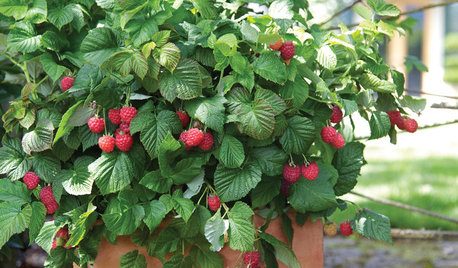
    For raspberries, I am partial to encore. Thornless, disease tolerant, erect, and big sweet juicy berries. However let me give you another thought to consider. The thornless blackberries are much easier to control for a limited space. All raspberries will send out root suckers and spread where you dont want them. Black berries root from the tip of the stems and do not send out runners. Also you can get varieties with long vines that are easy to wrap around a post. Some commercial growers actually grow them that way. With the black berries just keep the stems off the ground and it should work just fine and offfer you a bumper crop in a limited area. I like triple crown as largest and sweetest of the thornless varieties, but here you should have all different opinions.

  • 17 years ago
    last modified: 11 years ago

    Hmmm The perfect raspberry plant Well, IÂm up to 10 varieties now, with more coming in the spring, and IÂd say none is perfect, but all are pretty darn good. I mostly have many varieties to try to spread out my harvest. For an everbearing red, youÂll usually see Caroline recommended often here on this forum. For a gold/yellow raspberry, youÂll usually see Anne recommended most here. For a blackberry here, youÂll often see (thornless) Triple Crown recommended. If you search these forums for those varieties, youÂll probably get a lot of the info youÂre looking for.

    For Thornless raspberries, I do have ÂJoan JÂ. Other people have said that they didnÂt like the flavor of Joan J, but I find the flavor to be every bit as good as my other varieties. I have found that it isnÂt quite as vigorous as some of the other varieties.

    If youÂre looking for something unique, IÂd go with the yellow/gold raspberries mentioned above. I donÂt have Anne (planting that this coming spring), but I do have Kiwi Gold, and theyÂre some of my favorites. Or, better yet, I might not do 6 varieties, but maybe two? From what youÂve told me, so far, IÂd do a bed of Caroline and a bed of Anne, though those varieties are not thornless. But, I have a 4 year old, and a 2 year old, and they really have zero problems with the thorns. Both varieties are known for their superior flavor. Caroline is also known for having large berries and a large yield.

    My raspberries are almost care-free. If you get everbearing (fall) varieties, and not summer varieties, you can simply mow (or cut) them down once they go dormant and youÂll get one large crop. Or, you can leave them up over the winter, and prune the tops in the spring, and then get two (albeit smaller) crops. The birds basically leave my raspberries alone, although this is not true for many others. I suspect itÂs because I have a lot of wild ones growing nearby. I really havenÂt had any problems with diseases or insects. For me, in this area, they are by far the easiest fruit I grow but people (in different areas) have different growing experiences.

    Right, I always recommend some sort of trellis for your raspberries, though, IÂve never tried growing them around a stake.

    The one thing that you are going to have to take seriously is containment. Raspberries are like weeds, and they will spread and take over like something youÂve never seen. I have my beds against my lawn, so I can easily control them by going by with the mower. But, in your case, youÂre going to need to dig down 15-18" down and place a barrier. Raspberry roots can easily tunnel down 10" and travel for many feet underground. YouÂll want to do some research on this before you just plop them in the ground.

    I agree with Hines about what he said about the blackberries. I find them to be even more productive for a given amount of space, than the raspberries. And, I love Âem! But, 2 concerns 1) is that you need a really solid/beefy trellis for them. 2.) For me, it wasnÂt until their 3rd season that they really got going.
    You can probably get some raspberries at your local nursery, but this is an expensive way to do it (here itÂs $25 for a 1 gallon plant), and youÂll be stuck with limited (often inferior Heritage, etc) varieties. You really want to consider getting bare-root plants check out http://www.noursefarms.com/. IMHO, and from what IÂve read from others, they are pretty much known to be the best place to buy berries, certainly in the East, possibly in the country. They have a perfect rating last time I looked on Daves Garden Watchdog (which rates online nurseries) http://davesgarden.com/products/gwd/c/112/

    Start doing research here on this site, and elsewhere on the internet, and IÂm sure youÂll have a great crop of berries in no time. Have fun!

    -Glenn

  • 17 years ago
    last modified: 11 years ago

    me again... and i'm really torn: i just got back from visiting my mil (in the uk) and told her i would probably be growing blackberries instead of raspberries because of the runners issue (though i'm not totally convinced, since i'm not sure i actually like blackberries), and she told me i had it backwards, raspberries are easy to control and blackberries are the wild bramble fruit.

    i made something up about "maybe there are different cultivars in the UK?" but does anyone know if it's merely a language barrier or what? (what's the official difference between blackberries and raspberries? she said one leaves behind a yellow/white cone when you pick it, the other doesn't.)

    my mil is a person of Very Strong Opinions (which are usually right), and if i go against her advice i will have a lot of explaining to do. help?

  • 17 years ago
    last modified: 11 years ago

    Aliagee-
    Raspberries spread like weeds using underground runners. Blackberries spread by tip rooting. I think you'll find it quite accepted that raspberries are difficult to contain, while blackberries just need a bit of pruning of the tips to prevent them from spreading. She's right about the yellow/white cone. Raspberries leave it on the plant (so you have a hole in the top of your berry), where as blackberries come off clean... no cone, no hole. Maybe do a little researching on "raspberry containment" to back up what I'm telling you, so you can go back to her armed with the facts. Perhaps someone else here will have some thoughts. Good luck!
    -Glenn

  • 17 years ago
    last modified: 11 years ago

    You should tell your mil to come and visit me. I can show her raspberries that spread four feet underground and are now growing on the other side of my fence. Black raspberries, however, are like blackberries that spread by tip rooting. It is possible to control the black raspberries by trellising and pruning them. The red and yellow raspberries spread by underground runners and end up all over the place like weeds. Black raspberries taste different than red raspberries or blackberries so you might want to try one first before you commit to growing it. Don't grow blackberries either if you don't like the taste. I think you'd like the yellow raspberries from your description as they are very sweet and sugary. I have Anne, but I only had a few as they were new last year.

    Anyway, I'd be very hesitant to grow raspberries in a community plot because they do spread and you don't want to end up with raspberries in all of your neighbor's gardens. If you still want fruit but don't want blackberries, consider growing blueberries or some other fruit that you like instead. Nourse farms sells several berry plants and looking through their catalog might give you some ideas. Remember, it's your garden and you should grow what you want to eat otherwise it is a lot of work for nothing.

  • 17 years ago
    last modified: 11 years ago

    You mil is talking about non-trailing varieties of blackberries (e.g., the wild varieties growing rampant in the eastern US and also named erect varieties). The trailing varieties folks above are recommending, such as Triple Crown, only spread by tip rooting. With proper pruning you can also grow them on a single, very strong stake (with a consequential loss in productivity relative to trellising).

  • 17 years ago
    last modified: 11 years ago

    djofnelson hit on this, but I wanted to follow up. It seems to be a pretty commom misconception that blackberries do not spread by underground runners as raspberries do. While this isn't the case for trailing (Black Diamond, Obsidian, etc) and semi-erect cultivars (Triple Crown, Chester), the erect cultivars (Apache, Ouachita, Brazos) do in fact spread this way. The blackberries that grow wild all over the PNW also spread underground. My husband and I constantly battle them in our yard, as the hill behind our house is covered in them.

    Also, depending on what type of blackberry you grow, you don't necessairly need a big beefy trellis. The erect types are quite easy to grow with a simple trellis made of t-posts and bailing twine.

  • 17 years ago
    last modified: 11 years ago

    I will chime in with one more bit of info on blackberries. While they don't spread via runners like raspberries, they are next to impossible to remove. If you do remove the crown and large roots, you will have a ton of volunteers that grow up from roots left in the ground. I have had this problem with Arapahoe. Even if I dug (we moved from the home where I was growing them) to plant something nearby and hit a root, they would root sucker and have a plant come up, even 8 to 10 feet away. Since you're in a community garden, I'd stay away from them. Just my $0.02.
    I'd say any raspberry would be the way to go. Put down a rhizome barrier around the perimeter of your planting and go from there. Maybe ask your MIL about that aspect? My experience is that raspberries are easier to remove than blackberries. I also have small children & raspberries, and have only had one incident of thorns in little fingers...that's usually all it takes. :-)

  • 17 years ago
    last modified: 11 years ago

    If you ever needed to remove the blackberry plant, after cutting the tops off, a very selective application of triclopyr (e.g., using a q-tip to dab a few drops on a few cut canes) during active growth should kill the roots. This, of course, assumes that your garden isn't strictly organic.

  • 17 years ago
    last modified: 11 years ago

    Thanks djofnelson, for the tip. That's a good thing to know. Just so I know, what are some 'brand names' under which triclopyr is sold?

  • 17 years ago
    last modified: 11 years ago

    Brush B' Gone is one common one. It translocates to the roots and breaks down very rapidly in the soil. I used the commercial strength to kill the invasive ailanthus trees covering large sections of my property.