Software
Houzz Logo Print
daemon2525

how to make apples soon

14 years ago

I'll try to keep this short , but it is not a short story.

I want to harvest some apples as soon as possible.

I planted two apples from Lowes about four years ago. I cannot really remember 4 or 5 years ago. one (a red delicious) has made a couple of tiny apples. The other (Golden) has made no apples.

I just planted a nice potted Goldrush Dwarf and HoneyCrisp Dwarf.

I have room for only two more trees.

I'm getting tired of waiting... I know that it takes a while

to grow a tree, but is there any way that I can have apples soon?

I know that the semi-dwarf delicious will take some years, but I have already been waiting for four, and the new dwarfs will be at least 2-3 years. I just planted them a month ago.

I already know the answer, I think, but I am just trying to make conversation.

Comments (22)

  • 14 years ago

    I have a similar goal and have found the following info online about high-density plantings. If you are able to do all of the following, it sounds like apples should arrive by year 2.

    This link lists yield targets of 1-5 apples/tree for year 1 and 20 apples/tree for year 2. I'm not sure if they are counting the planting year as year 0 or 1. This paper suggests a target of 15-40 apples in the 2nd year, depending on how likely the tree is to be pushed into biennial bearing- Honeycrisp is actually cited as one to keep around 15-20.

    - Use a dwarfing rootstock (as you have for your Goldrush and Honeycrisp)

    - Plant a well feathered tree- as many branches as possible. ~10 short (~1' or less) branches which are at least 2-2.5' off the ground would be ideal. It may be hard to get though, as most of the "feathered" trees I got this spring had more like 3-4 branches. This year I've ordered earlier and requested that they be as well-feathered as possible(last year I just said large...), so that may help. Notching/nicking (the one where you make a small cut above the bud) can help fill in bare wood.

    - Tie the branches (festooning) to close to horizontal (some sources say below). This is especially important during the early summer when next years flower buds are forming.

    - Don't prune during the early years if possible, as it invigorates the tree. Especially avoid heading cuts and shortening the branches.

    - A few apple varieties naturally take a long time to fruit, such as Northern Spy. I'm not sure how they respond.

    - Make sure the site gets plenty of sun.

    - Don't over-fertilize, as it produces too much growth at the expense of fruiting. Do make sure to keep them irrigated as needed.

    If anyone has some other things to consider, I'm all ears.

    Bob

  • 14 years ago

    Where did you buy your "dwarf" apple trees? Rootstock should have a specific name or you are at the mercy of the seller.

    The way to get a tree to bear as soon as possible is to get healthy growth with ample water and moderate fertilization and keeping grass and weeds away from at least a 3' diameter circle under the tree. Spread the branches by tying or with branch spreaders to about a third up from horizontal and remove all branches more than a third the diameter of the trunk at the point they are attached to the trunk. Prune nothing else until the tree begins to bear.

    A dwarf on something like M9 can produce fruit the second year- especially something precocious like Goldrush.

  • 14 years ago

    i think the key is right here: I planted two apples from Lowes about four years ago.

    you really dont know what you have... and with no production .. you can not even be sure what is above ground.. you dont know what is below ground.. etc ....

    my best suggestion.. buy the last two from a better source.. and the predictability of the result will increase ...

    now.. are these in your lawn.. do you fert with a high nitro fert [which can throw off flower production].... are they in full sun ... etc ... you have given us nothing about the 'culture' of your plants [or i missed it in my caffeine-fueled reading of the above] ... we might get further with some more precise facts about what is going on in your orchard ....

    it is my opinion.. that fruit is set/produced.. when the trees roots mature as well as the tree above ... so i guess i am wondering what is happening in your yard.. that is retarding maturity ... you can not make a tree mature any faster than it will ... but you can do things that retard its progress ...

    IMHO.. nothing will make it reach sexual maturity.. 'sooner' ... and that is what occurs when it finally opens a flower.. and start flirting with the bees .. lol ...

    you implied you already knew the answer.. i await with coffee baited breath ... lol

    ken

  • 14 years ago

    I bought the hardiest trees that I could find.
    I bought from Advance Tree Technology. The Goldrush and HoneyCrisp are on BUD9 rootstock. Both were 1"+ caliper
    and about 6 feet tall and feathered with 4 or 5 3/8" inch limbs. Some say that they were too big. They were in very special containers that automatically prevent root circling. The container was a cloth type bag called a RootMaker.

    Thanks for the replies. I really expected you to say, Ha just be patient!!!

  • 14 years ago

    Ken,
    I was typing while you replied and did not see your post. The answer that I thought I knew was just wait!!!

    Since you asked, I did buy the first two at Lowes and now realize my mistake. Four years ago I was not really concidering an "Orchard" and was just planting trees of all kinds around the yard and thought that I would plant a couple of apples. I have ignored them since. Until this fall I went to a u pick orchard and decided that I wanted my own producing trees.

    So I did my homework and bought two more trees with some knowledge of what I wanted. HCrisp and GRush (bud9) as that was two of the only three varities that this particular place had.

    I live on a two acre semi-wooded lot and do not fertilize my yard ever. I did plant the tree where there is mostly sun although no place in my yard receives full sunlight.

    I may have planted them too close to a very large tree that could sap the goodies out of the soil. The closest one is about 30 feet from a HUGE Hickory. I really had no other choice. the others are a little further.

    Anyway, I want to plant two more. I may even plant them where my vegetable garden is that is the only place that does get full sunlight.

    I have bought all of my stuff!! LOL! I have Neem oil, Bonide "All Season" dormant oil, Bonide tree spray (Captan, Malithion,carbryl), and Bordeaux for my Lowes Redhaven Peach that has ALWAYS had Peach leaf curl.

    So...... there ya go. I can see y'all laughing now!!!

  • 14 years ago

    Commercial growers who require early production fertilize with ample urea to size up trees quickly. Once the trees are of size to hold a crop this will not delay fruiting- too much N may reduce the quality of the crop of a bearing age tree but early vigorous growth will not delay maturity.

    I'm not clear that even excessive N would delay maturity- haven't seen the research saying so. The sooner you can get your tree to a size where it can hold a decent crop the sooner you get that crop.

    From what you've said you've scored some great trees for early fruiting- it's quite unusual to be able to get 1" diameter apple trees that are well feathered. My nursery sources can't provide that.

    Let us know how Goldrush does in your Z5. I hope you have dawn to dusk sun for it. I have difficulty getting my fruit ripe here in Z6 NY on sites without all day sun. I think they may be easier to get ripe on a dwarfing rootstock though.

  • 14 years ago

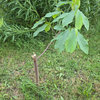
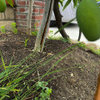
    I tried to show a picture. Warning... it is a large picture (6.5mb).

    http://home.comcast.net/~lakers90/orchard.jpg

    The closet left is HoneyCrisp, middle left Redhaven,
    Furthest left is Grush. On the right are the Lowes trees.

    For reference the t-posts are sticking out of the ground nearly four foot.

  • 14 years ago

    Looks like the site is sun challenged. Trees are doing great, though.

  • 14 years ago

    You're loosing allot of water and nutrient heaving your fruit trees
    surrounded by large trees.
    This might explain slow fruit production. Cutting down some of these trees would help allot.
    Looks like you have a nice place!

  • 14 years ago

    Konrad is absolutely right. Production is very difficult when you're fighting against the root system of established forest trees- even sometimes with bearing age trees. When you plant new trees you cut the roots of established trees and they aggressively send out feeder roots into the loosened soil right at the point they're cut.

    I use a solid steel "King of Spades"- the one with their longest blade, to sever roots of competing trees just as they start to bud out in a wide circle around stunted trees. This helps, but has to be done every season until trees establish.

  • 14 years ago

    Thank you all for the expert opinions. I'm just new at this and will take your recomendations.

    I live just outside of the city and we have leave to do things that the city does not allow. for example.. I could very well bring in a trencher and trench around my orchard.

    I am allowed to cut down any tree in my yard. (and do).
    I own the property. The picture that I took is looking north so I get more sun than you might think.

    I thought about removing the big hickory to the west. The Beech tree to the North is the biggest unmolested tree that I have seen, so it must stay.

    If you folks have recomendations about my spray schedule, I would listen. I am going to do Dormant oil in the winter and wait until the bees are done and spray (mal,captan,carb) every week or two until harvest.

    thanks again..

  • 14 years ago

    Ortho's Triazide (Once and Done) is the compound of choice on this forum. It is a synthetic pyrethrin (pyrethroid) and lasts much longer than malathion with less toxicity to humans.

    It is possible you can get by with a spray when last apples loose their petals and one more 10-14 days later. That should at least take care of plum curculio and a substantial part of coddling moth damage. If you have apple fly maggot a couple more sprays may be necessary.

    Captan will not control cedar apple rust so you would probably be better off using Immunox (myclobutanyl) or a combination of the two.

  • 14 years ago

    Well as of ten minutes ago, my Cortland is in the ground.

    It was not as nice of tree as I had hoped. Too tall and circling roots. It was in about a 1-1.5 gallon plastic pot and about 7 foot tall.

    I barerooted the thing and spread the big roots out straight. And I pruned some very long branches back to about a foot.

    It is farther away from the "forest" trees and in better soil. So I am hopefull.

    thanks for your help.

  • 14 years ago

    One thing I've noticed about buying trees from the big chain stores that's pretty consistent - they don't have a clue what the rootstock is. I've asked for years and never got an definitive answer - I've even called the companies on the tags and some of them just make tags - not the supplier at all. When I have talked to the actual nursery that grafted the trees they will say that they use a wide range of rootstocks and can't tell me what was actually shipped to that particular store. Without the knowledge of what rootstock you have it makes it very difficult to offer advice. Going forward I'd pay more and buy bareroot from a reputable supplier that knows their trees. Also, about half of the trees I did buy at a megastore was mislabled - wrong variety all together.

  • 14 years ago

    Kansas,
    Yup, I am now understanding exactly what you say. The last Cortland that I bought was from a local nursery and not a "Big Box" store. I bought from them because the owner was my sons coach in High School and I had e-mailed him so much that I thought that I should buy something.

    Anyway, I got there and bought a tree and asked about rootstock and he got a funny look on his face and said, "I don't really know".

    It had the biggest root in the pot go all the way around and then start up the side of the pot towards the top.

    I barerooted it and straightened it out . I probably killed it! LOL!

  • 14 years ago

    I have noticed that M7 tends to sucker quite a bit so they are easily identified. M111 is vigorous and never seems to sucker. Since those are the two most popular "semi-dwarf" rootstocks that may help with identification of some of the rootstock in mega store purchases.

  • 14 years ago

    Burr knots will also tell on 111.

  • 14 years ago

    Since you mentioned it. The Lowes Red Delicious that I have has so many suckers growing out of the ground that I have to constantly clip them off. I'll assume that at least that one is M7?

    It will make a dozen or more 12" suckers per year.

  • 14 years ago

    Most likely. You can use those suckers as rootstock if they have some roots of their own. I use some lopers and try to cut just under the surface - sometimes I'll get some feathered roots. I personally don't like all the work with M7 but it is a cheap way to propagate trees.

  • 14 years ago

    I have two M111 apples from Dave Wilson that send up shoots from the roots like mad. I guess they don't sucker right at the trunk, though.

  • 14 years ago

    I guess I lucked out. I bought 2 Gala's from Lowes about 10 years ago. They both fruited the first year.

  • 14 years ago

    Lifespeed, I've never seen a M111 do that - sounds like a M7. Has anyone else had a M111 sucker from the roots?