Software
Houzz Logo Print
organic_dcox

Corn Side Dressing

16 years ago

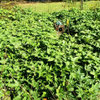
My early planting of corn is flowering and starting to develop ears, some plants are looking kind of weak. Is there something specific that i should be side dressing with at this time, ie. compost, bone meal, blood meal, kelp meal ect. Thanks for any help.

Comments (13)

  • 16 years ago

    dc: it is way too late to apply N from any source to help with the yield and quality of your corn, doing so would at be at best a waste of N

  • 16 years ago

    Ditto on it being too late now. But NEXT year :), you can apply a liberal side dressing of blood meal when it's about 1-1 1/2 ft. high. Be sure to give it a lot of water too!

  • 16 years ago

    make that 3 for it's to late to add nutrients now.
    Also, I do not recomend blood meal or bone meal. They are animal products and can lead to disease, and they are not accepted products by many organic farmers.

  • 16 years ago

    I'm an organic gardener who has no qualms about using blood or bone meal -- or products containing them.

    Yes, they are animal products. If I were a vegan or vegetarian for ethical reasons, I suppose I wouldn't use bone or blood meal anymore than I'd eat cheese or honey or steak. As I'm an unapologetic omnivore, however, applying blood and/or bone meal causes me to lose not one wink of sleep.

    And, just to be clear, neither poses a risk of disease to your plants.

    Some people have expressed concerns about potential disease to humans from inhalation or other ingestion of bone meal -- this tends to be vaguely related to the whole prion/mad cow business. There is, as far as I know, no evidence to substantiate this. It's not good to inhale bone meal anymore than it is good to inhale any particulate, but that's because it's a particulate, not because it's bone meal per se.

  • 16 years ago

    I am with Marymd7, I am a certified organic grower and produce seed for several companies and bonemeal and bloodmeal are two of my bigeest fertilizer imputs along with well composted manures and fish emulsions. I get a really good bonus from using the bone meal and blood meal. They both deter deer. Rodger

  • 16 years ago

    Can you prove that the blood/bone meal came from pasture-fed animals produced under sustainable conditions? If not, it contradicts the tenets of organic gardening on a global scale. For the record, vegetable gardening in itself is not particularly eco-friendly (conventional or otherwise) but there are some organic gardeners who get a false feel-good impression when using animal products. They are just recycled chemical fertilizers - recycled through the corn and soybeans grown to feed the animals.

  • 16 years ago

    Well, Dr. Hort, I guess you're just holier than me.

  • 16 years ago

    Certainly not. I just wanted to point out what the issue is with organic animal products from a scientific standpoint. The same goes for plant products such as coffee grounds but on a much smaller scale. If you're organic for environmental reasons (and not just the soil quality in your garden),then this is an important issue to consider.

  • 16 years ago

    On the other hand there are matters of degree. If I were to go out and collect the cow chips from a milo field that was pastured in the winter I'd be collecting chips from a non-sustainable system as milo is produced here. On the other hand, milo is grown with very little inputs compared to corn, winter wheat and soy beans. A large percentage of the milo crop is returned to the soil on a mass basis. So, while the chips from a milo field grown unsustainably aren't perfect, they are likely a step above the, "chemical" fertilizers. A matter of degree in the end.

  • 16 years ago

    I grow sweet corn in mature organic soil, a clay loam. Instead of trying to mimic the chemical model with sweet corn (N up front and at tasseling), I pretty much do a constant feed with processed turkey manure fertilizer (regional product). The soil gets it pre-plant, and then after thinning, after weeding, and before big rains or waterings. I probably topdress 4 times, just a little at a time.

    This works better for me than the "energy jolt" model because my soil is deep and rich, and sort of manages its own nutrient supply once it's provided. I'm continually amazed at how it supports demanding crops like sweet corn and broccoli.

    Compost is key, with lots of mulch and well-managed use of organic fertilizers. And I try to rotate corn in after bush beans, which puts the soil in good shape for corn.

  • 16 years ago

    Planatus: it is only my opinion but, anyone who adds N to sweetcorn at tasseling is at best wasting the N resource, it will do nothing to improve the ear size, count, kernel size, number of rows or post harvest attributes. People probably carried over the habit from field corn production where it actually can improve the protein content of the kernels but unfortunately leaves more N in the soil for subsequent rains to move down through the soil profile and forever away from the root zone.

    AZ and FL (probably some other states too) have done gobs of research on N management in sweetcorn.

    I suggest not applying any N source whose N is in the nitrate or nitrite forms prior to heavy watering as it my well be lost to erosion and/or water infiltration through the soil profile and out of the root zone. What form is the N in in the turkey product you are using?

    Constant feed is fine but the ideal is to match N availability with the plant's demand and that is no walk in the park to get just right no matter the N source. You could have more than you need initially until the crop demand catches up and then find that the crop demand has exceeded availability thereby effecting yield and/or quality. The only way I know of to assess the situation during the season is with plant tissue N testing at different crop developmental phases. I highly recommend you give it a try at least once. In addition, try a root zone soil N test just before your 1st N addition and just after harvest to determine what you had in the soil "bank" initially and what is left at the end given all that has been added. If you are really obsessed, keep track of the individual weights and %N content of all the N sources added through the season. I think you'll be surprised with what can be learned.

  • 16 years ago

    But you see, Michael, what I'm saying is that the equation you describe is the framework, not the facts, because the soil alters N availability to crops. Wild card. Overall, I probably use about half of the actual N most gardeners use because so much is held in the soil. The point I meant to make was that constant nutrition leads to good crops of sweet corn in rich organic soils, rather than pulsing N. And while I totally agree that late side dressing of any crop may do more harm than good, in an intensive garden any residual N will be used by the next crop. I use mustard and other greens to mop up any excess N left in the corn patch in the fall.

  • 16 years ago

    Planatus: I applaud you for using the mop crops in the Fall, I do the same. I too can use very little N than the (I suppose) avg. gardener and definitely commercial grower (from various univ. recommendations). I attribute the lower needs to 2 things - 1) water management, we seldom get much precip. and I drip irrigate wisely allowing the nitrate and nitrite to stay where they can be used and 2) timing the N applications to when the crop needs N the most and then stopping N applications. This framework is based on an enormous amount of sweetcorn N research, call it facts or theory not yet proven wrong by further research via the scientific method.

    Certainly, the fate of N in the soil is always changing unless the soil is frozen, or void of water. The one bugaboo to leaving excess leachable N around at the end of a crop is it leaching out of the root zone.

    I may be misinterpreting what you mean by "constant nutrition vs pulsing" where N is concerned. To me, N is a comparatively transient nutrient and must be treated as such, to try and maintain a level high enough to meet peak crop demand throughout the season will lead to an over application of N. If the excess N was not subject to leaching and could then be sucked up by a mop crop, great. I'm guessing you are saying the amount available in the soil can be more than the crop will use but that the mop crop will deal with that.

    If by "pulsing N" you mean making more available than the crop can take up at any given time, we are in total agreement otherwise, I'm not sure what you mean.

    We certainly agree that constant nutrition leads to the best crops, be it sand, silt, clay, or muck soils. Of course, the trick is to get there without yield reducing excess or deficit to say nothing of the environment.

    sorry but, I can't remember what the other thing was, would you please expand on what the "framework" is you mentioned.

    Happy trails!