Software
Houzz Logo Print
cprctxr

Miniature What?

16 years ago
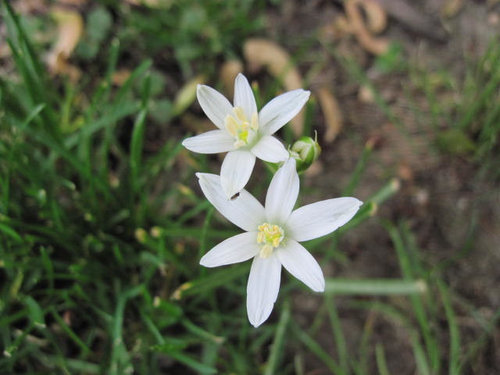
I'd like help identifying this beautiful miniature white flower. Leaves look to be in the bulb family. Small white six pointy petals. Appeared in my garden last week. Neighbor told me it was Edelweiss, but upon looking on the web, it's definitely not. The photo was taken with a macro lens, but the flower is actually only about 1/2" big.

Image link:

Comments (7)

  • 16 years ago

    Probably Ornithogalum umbellatum, star of Bethlehem.

    Here is a link that might be useful: Ornithogalum

  • 16 years ago

    It is the worst introduced thing I have ever seen. All of my soil is infested with the bulbs. I spend months each spring digging out 'clumps' of it so I can make new, or expand existing beds. There is no spray available to the homeowner that will kill it.

    This is my front yard in early spring before the little grass I have has broken dormancy. All the dark spots are clumps of hundreds of small Star Of Beth bulbs. They are so plentiful that I can't get a decent stand of grass growing.


    {{gwi:6562}}

    The upper right hand side of the pic is an area I have been working on for years that is now pretty well bulb free. In the spring when other gardeners are cleaning up their beds, and thinking about dividing and moving things, I stay busy digging the star of beth bulbs until the foliage finally disappears sometime in May. I start digging the bulbs after the spring thaw when they first emerge, which is in Feb.

    I'll be digging more star of beth and wild onions today and for as long as there is foliage to be seen.

    grrrr.....

    Sue

  • 16 years ago

    Liable to be the other way around: the bulbs are plentiful because the grass does not do well enough there to exclude them. To get more grass, change the site conditions to encourage its growth.

    Notice that in the upper right part of your picture the grass looks pretty much the same as elsewhere in the shot.

    In my area attempts at "wildflower" meadows are often short-lived, due to grasses filling in and pretty much eliminating the flowers after a few years. The native wildflower carpets are mostly limited to a tiny percentage of area of prairies and balds, where thin soils or historic burning have allowed native flowering plants to compete with grasses and persist.

    The showiest displays are in high mountain meadows, above treeline - again in those sections where grasses and sedges have not taken over. Flowers come last after trees, shrubs and grasses - if conditions permit any of those to dominate a site, flowers lose out.

  • 16 years ago

    To get more grass, change the site conditions to encourage its growth.
    The bulbs will still be there and I don't intend to do any tilling of the soil so long as they are there. If I tilled, I would for example instead of having 100 clumps of 100 bulbs in an area, I would have 10,000 individual bulbs, which would in time turn into clumps again.

    Notice that in the upper right part of your picture the grass looks pretty much the same as elsewhere in the shot.
    That is a shady area at the edge of the woods. In the fall I usually just blow the leaves toward the area and leave them to rot down over the wintertime. There are a few violets, and weeds that grow in the area, which in time I will turn into a shade bed.

    Here is a link that might be useful: Star of Beth causing problems in no till fields in southern Indiana

  • 16 years ago

    Have you tried Image herbicide. It's labeled for use on Onions/Garlic and may work on other "Lilies". It also
    effective on Sedges (think Nutsedge) so even if it doesn't
    work for the Star of Bethlehem it won't go to waste.
    Incidentally it takes multiple treatments for any hard
    to kill weed so don't give up if you get re-sprouting after
    the first or second treatments.

    Here is a link that might be useful: IMAGE Herbicide

  • 16 years ago

    Per the Purdue University article I linked above:
    Paraquat provided 70 to 78% control at one year after the 2002 application. Plots which had received glyphosate or 2,4-D applications had less than 29% control one year after spring application. When compared to the non-treated plot (6,248 bulbs per 10.8 foot squared) the paraquat treated plots had 88% less bulb density. The use of 2,4-D resulted in an increase of bulbs. Growth regulators do not appear to be effective in controlling star-of-Bethlehem. So, at this point in the season, use of paraquat would be the recommended practice for control of this weed.

    Paraquat requires a license to buy and use it. Anything that deadly, I'd just as soon not have on my lawn. Even if it provided 70 to 78% control in one year, that still means applying it numerous years to get them all gone.

    The article mentions (6,248 bulbs per 10.8 foot squared)
    I think I probably have a lot more than that.

    When I made a small bed years ago, I dug the soil all out to a depth of 6" and then filled the bed with bulb free soil from the woods.

    I purchased topsoil to do some filling around the foundation of a new shed and bought an extra load so I could make a slightly mounded bed. Well the topsoil I bought was infested with both wild onions and Star of Beth. I'll not be buying any more soil by the load like that for any gardening.

    This in an iris I planted in an area that had not been dug free of bulbs before planting.
    {{gwi:28496}}

    This spring I dug all the irises out of that bed (17) and then dug out the bulbs that were under them, and reset them.

  • 16 years ago

    wonder if it would combat blackberries. i have wild ones and they are the worst