Software
Houzz Logo Print
corar4gw

Chicken Tractor

19 years ago

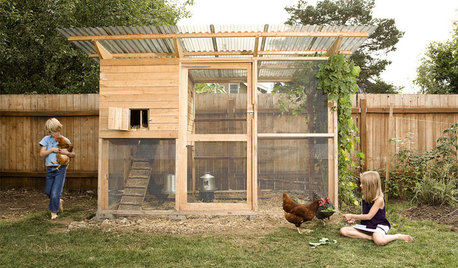
Has anyone had experience with the "chicken tractor". If so, what is your opinion - good - bad - so-so?

Comments (8)

  • 19 years ago
    last modified: 11 years ago

    A well made tractor is great. Our first tractors were so heavy duty they were a huge hassle. If you want your birds on grass but need to keep them protected this is a great way to go.

  • 19 years ago
    last modified: 11 years ago

    Check out the Farm forum. They talk chickens all the time. There are other Internet forums where chicken tractors are a big topic of conversation. One is the Yahoo groups forums, but there are others. You can find about 10 different designs to suit all manner of resources for poultry or rabbit raising.

    There's a farmer in Virginia that has chickens in tractors only as protection from predators. Mostly they free range 3 days behind his cattle rotation. He uses the chickens to clean up and spread out manure.

  • 19 years ago
    last modified: 11 years ago

    Thanks for the info. Never considered using a "tractor" for rabbits, but it certainly makes sense. Will check out the Yahoo forums. Happy New Year to you all! cora

  • 19 years ago
    last modified: 11 years ago

    cora: Depends on where you want the hen droppings. Probably dchall's reference is to Joel Salatin's Polyface Farm in Virginia, and his "pastured" chickens. A good idea if you will place manure on the hay field or pasture, anyway; may as well let the chickens do it (and scatter the horse and cow manure about the pasture).

    Of course hens have to be protected in a hen-house at night; and whether that hen-house is stationary or on wheels, it must be secure, or every Fox, Coyote, Bobcat, 'Coon, Skunk, Mink and O'Possum in the country will come skulking around looking for an easy meal.

    I was raised on a family farm where the dog kennel was strategically placed next to the fenced hen yard that contained the hen house. If a (wild) animal were to get in the hen house at night and begin to catch or kill hens, that would set all the others to squawking, which would set the dogs to barking, which would get my father up and out of a sound sleep running with his shotgun and flashlight, and dressing on the run, on his way to the hen house. All of the animals I mentioned above, with the exception of Coyotes (which are a recent development in Maryland and Virginia), have been shot in the act of killing hens.

    Generally, though, the wild animal had to be awfully hungry, because a kennel with a dozen hounds, or so, would deter most predators.

    The family garden was also strategically located right on the other side of the hen-yard fence. When hen manure was cleaned from the hen house, it need only be wheeled through a gate and placed about the garden--their fertilizer source was THAT close.

    Likewise, when picking garden vegetables, those damaged by insects (or otherwise ruined) were tossed over the fence to the hens, who disposed of them forthwith (insects, and all).

    (A very good thought for those raising hens and growing a garden (or homesteading), today.)

    Also, in the Fall, when the garden was finished, the gate was propped open to allow the hens in to scratch up insects (and insect eggs and larvae), and deposit manure in the garden, which would be later tilled in, along with ashes from the wood burning stoves.

    Strategic location was a labor saving device in the old days (much like Joel Salatin's pastured chickens fertilizing his hayfield and pasture, today). A search of his name (or his farm's name) will give you more details, if you're interested.

    (Actually, I thought it was a "chicken wagon": a hen house built on a farm wagon, and pulled by a tractor to its desired location.)

  • 19 years ago
    last modified: 11 years ago

    Been using them for 10 years and have had very few problems. Wedat range our chickens that we tractor which means all tractors have a pop door and the birds get to range freely (well, as free as the fence will let them) from dawn until dusk when they are shut into the tractors to sleep. We move the tractors once a day and move the fencing about every 3 to 4 days depending on the poop volume in the run.

    We do not tractor hens, they get a immobile coop, though this winter we may build a moveable coop not open to the ground on skids that can be moved with a truck or tractor.

    We use fencing and dogs to keep predators away. we have a new dog who has not figured out yet chickens are to be guarded, not killed but in a year or two he should be on the job. A good guard dog is necessary for pasturing any livestock.

  • 19 years ago
    last modified: 11 years ago

    I have to admit that the other reason for wanting to build a chicken tractor was to protect the chickens. Our property borders on the Okeefenokee swamp and in adition to the critters already mentioned, there is a large population of (protected) raptors. We've already decided there will be a chicken wire "roof" on the cage.
    We will have 3 Golden Retrievers and a poodle as a sort of early warning system. Granted, both breeds are often 'way too friendly, but I've had more than one poodle who knew well before I did whether a person or situation was unsafe.
    And, I agree that a step-saving plan/layout makes ultimate sense. Walking what amounted to a block with a full milk bucket in each hand is not my fondest childhood memory! (on the other hand, I LOVED all the little calves they gave me to wean). I doubt the current property could pasture even one milk cow, but we are considering a goat or two. Meanwhile, we're amassing as much knowledge as we can and this is a great place to do that! cora

  • 19 years ago
    last modified: 11 years ago

    cora: I don't know how much land you have--but it certainly makes a difference, in the scheme of things. From my point of view, chicken (or hen) pasturing makes more sense on a large farm, where there are diverse fields and pastures.

    I can also envision, on a small farm of 10 acres, or less, there would be much less desirability for chicken pasturing, as a flock of poultry would pretty much cover that much area on a daily basis, while housed in a permanently located poultry house (and allowed to free-range, daily).

    On our family farm, there was a poultry house enclosed in a fenced poultry yard, of about 1/4 acre. The fence was 6' chicken wire; and, although I've seen a hen or two fly the fence, it was rare. We had heavy-bodied hens such as Rhode Island Reds, Barred Rocks, and White Rocks, which are not such notorious flyers as smaller types, such as Leghorns.

    These heavy bodied varieties were dual egg/meat producers--eggs were gathered daily, and when hens didn't lay, or only laid sporadically (generally, as they got older), they were eaten. On a family farm, a flock of 100 laying hens was commonplace; and eggs were collected, kept in a cool basement location, and taken each Saturday to town where they were sold. (At the time, there was a buyer in town who graded and bought eggs from local producers--which included nearly everyone who had a family farm).

    At night, when the hens went to roost (on roost poles in the henhouse), the hen house door was shut and latched, and, of course the henyard gate was shut and latched, also.

    In the early morning, the henhouse door was opened (by my father, on his way to milking the cow(s), but the henyard gate kept closed).

    After lunch ("dinner", in the country), my mother would give the hens water and feed (from grain produced on the farm), filling two buckets from a large box inside the "gear house"--also strategically located, opposite the hen yard. The hens would all come running as she approached the gate to the henyard--then she broadcast the feed on the ground, and while the hens ate, she filled the waterers and collected the eggs from the nests in the henhouse. On her way out, she propped the gate open.

    When the hens finished the grain, they rushed out the open gate, and spent the rest of the day OUTSIDE, eating berries, seeds, insects, larvae, etc. I would say they easily covered 10 acres in their daily roamings. They seemed to have the good sense to stay away from the woods--where hidden danger could easily lurk; but they foraged in the orchard, the hayfields, around the yard and woodshed (and woodlot), and all about a very large area (surrounding the henyard).

    Toward dusk, they meandered their way back to the henyard, into the henhouse, and up on the roost. Then, right before dark, the henhouse door was again closed and latched; likewise, the henyard gate.

    These were truly "free-range" hens--and the taste of their eggs and their meat duly reflected it--the best eggs and chicken I've ever eaten in my life.

    The presence of people and a free-roaming dog about the farm was enough deterrent to keep predators away. I don't ever recall a problem of hens being caught by ground-dwelling or airborne predators, in the daytime; and believe me, these predators abounded, as it was a very rural area.

    Hawks were commonplace, but I doubt there are very many hawks that cosider an 8-10 pound hen, likely prey. It would almost take an Eagle to deal with a bird that large (and we had no Eagles). I think the activity of people and animals about the farm was deterrent enough, against daytime predators. I think it should be in your case, also, for grown hens.

    If you were to raise hens from baby chicks, they, of course, would have to be kept under watchful eye (and in the confines of the henyard) until grown, when they could fend for themselves.

    Of course, all of the ground-dwelling predators I mentioned are nocturnal--so a secure henyard and henhouse is important to keep such predators at bay while you (and the dogs) sleep.

  • 19 years ago
    last modified: 11 years ago

    Yes it was Joel Salatin. Here's a link to his book on chickens.

    Here is a link that might be useful: -Pastured Poultry Profits- by Joel Salatin