Software
Houzz Logo Print
forensicmom

Need a good shade shrub

16 years ago

We have tried several different "foundation" shrubs in the very front of our house since we moved in 15 years ago. Things were either way too big, way too small or didn't thrive. There is enought room for 3 3x3 shrubs, NO bigger. It is also on the north side of the house and gets NO direct sunlight.

I have azaleas there now but they seem to dwindle every year and I'm looking for something better. I prefer evergreens but am willing to consider anything. I also want something low maintenance as I spend a lot of time in my backyard gardens.

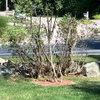
Any help? Here's a picture of the front. The area I'm talking about is right under the front window, straight ahead.

{{gwi:243760}}

Comments (12)

  • 16 years ago

    Is Annabelle Hydrangea too big for you?
    Mine got to be about 3½ feet last year.
    They do need good hydration though, especially in the heat of the south... which I'm guessing you are, by the architecture of your house and being zone 7.

    An evergreen that can tolerate shade is a yew, which you could trim to a hedge shape once a year. I have a couple yews on the north side of my house that are doing well.

  • 16 years ago

    In zone 7, there are lots of shade tolerant evergreens that would work well for that location. Some may have the ability to exceed your 3'x3' limitation over time, but most broadleafed evergreens can be pruned to maintain size rather easily. And the area close to foundations and under eaves may require some attention to watering, so keep that in mind as well.

    Here's a few to consider:
    dwarf boxwood (Buxus sempervirens 'Suffruticosa' or Korean box hybrids)
    dwarf Pieris japonica ('Cavatine', 'Prelude' or 'Little Heath' are good choices)
    Skimmia reevesiana
    Sarcococca confusa or ruscifolia
    Leucothoe axillaris
    Ilex crenata 'Lemon Gem' (Japanese holly)
    Nandina domestica 'Moon Bay' or 'Gulf Stream' - may be considered invasive in your area; check before planting
    Viburnum davidii

  • 16 years ago

    Add to that list these evergreens: 'Otto Luyken' cherrylaurel, Cleyera (Ternstroemia gymnanthera), Illicium floridanum, low-growing camellias, Leucothoe fontanesiana, Autumn fern, Holly fern, Japanese aralia (rather tender).

  • 16 years ago

    Of all the suggestions, these are the only ones that I think have the potential to stay small enough and be happy with that amount of shade:

    dwarf boxwood (Buxus sempervirens 'Suffruticosa' or Korean box hybrids)
    dwarf Pieris japonica ('Cavatine', 'Prelude' or 'Little Heath' are good choices)
    Skimmia reevesiana
    Sarcococca confusa or ruscifolia

    And I would add Gardenia 'Radicans' and the prostrate plum yew (Cephalotaxus harringtonia 'Prostrata' ).

  • 16 years ago

    esh, I picked the Ilex, Viburnum and Leucothoe specifically for their ability to stay within the OP's size requirements :-) Even the nandina is unlikely to get much larger. And thanks for including more regional selections as well.

  • 16 years ago

    I have Leucothoe axillaris and it doesn't stay small. I thought V. davidii needs full sun? That is what I was given to understand.

    And I knew nothing about Ilex crenata 'Lemon Gem' ... so that was unfair of me to leave that off without researching ... !

  • 16 years ago

    I have had the same experience with Leucothoe axillaris -- it grew 3' tall, all right, but it's presently about 6' wide and spreading in deep shade.

    Skimmia has grown well for me in deep shade as well, and it conforms to the size requirements.

    Another evergreen that has done well here is a boxwood cultivar named "Green Pillow." This boxwood is used as the edging in the Rose Garden plantings at the White House, so that should give you some idea about whether you have a comparable climate. Those boxwood were planted in the early 1960s, so you can see the maximum size in Rose Garden. Like all boxwood, 'Green Pillow' is not a fast grower. It forms a natural mound rather than a natural spherical shape, if that makes sense.

    Here is a link that might be useful: Boxwood in the Rose Garden

  • 16 years ago

    In my area, Leucothoe fontanesiana gets to be a big shrub but L. axillaris stays smaller. It can spread width-wise, but the height never gets much above 3'. And Viburnum davidii is one of those tough plants that seems to be adaptable to a range of conditions - from full sun to full shade, depending on location. For hot summer climates, it will definitely fare better in more shade than sun and seems to bloom well regardless of situation. Needs a decently moist soil, though, as does the leucothoe.

  • 16 years ago

    Skimmias are beautiful shrubs.

  • 16 years ago

    During the 1990 winter here in this part of USDA 8 Viburnum davidii not in full shade were often frozen back. At one garden center near us specimens growing in the foundation planting on the east side of the building burned up, those on the north side remained intact. One at a corner, where the two walls met burned on the east side, with the rest of the bush being protected by being around the corner - in the shadow of the north-facing wall.

    I've gotten the impression it tends to have about a 10 degrees F. minimum temperature, below which it starts to die down. I'd think a site truly in USDA 7 may see lows below this point often enough for it to be a problem.

    Ones on the east side of our house grew above head height over the years. Slow-growing to be sure, but not a tiny shrub.

  • 16 years ago

    You may also want to check out Prunus laurocerasus 'Mt. Vernon'.

  • 16 years ago

    I had a similar situation at my house (Richmond, VA) when we bought it a few years ago. The previous owners had planted plenty of trees and shrubs in the beds and throughout the yard, but for some reason, did not plant anything within 5' of the foundation along the entire front of the house. It looked naked, so I knew I had to plant something there but our mostly shade location limited our shrub choices. After driving around my 'hood and other neighborhoods nearby looking for successful foundation plantings, I decided my best options were cleyeras, nandinas and japanese hollies. I really wanted boxwoods, but I saw too many older plants with obvious loss from storm damage-- they looked kind of like a toothless smile. I've since planted cleyeras and nandinas out front, and the japanese hollies in some of the back beds. So far, everyone is doing well. Nandinas, hollies and cleyeras may not be terribly unique or exotic, but their widespread use makes them easy to obtain and affordable even in a large pot size.