Software
Houzz Logo Print
lalala_gw

rejuvenation pruning for lilacs

18 years ago

I am planning to prune my lilacs soon. There are two right next to each other. They are tall, skinny and leggy (probably 15-20') with trunks like small trees, and each has 3 or 4 main branches off the trunk, branching off about 4-5' from the ground. There are no leaves on the lower half of the lilacs.

Most of the tips on rejuvenation pruning I have read say to cut back 1/3 of the oldest branches to the ground each year for three years. But since my lilacs are more tree-like with single trunks, what should I do? Remove a couple of the branches back to where they branch off from the main trunk? Prune a bit higher up on the plant? I'd like the finished product (in a couple of years) to be shorter and bushier, with flowers where I can actually see and reach them.

thanks for your help.

Comments (10)

  • 18 years ago

    There are no suckers or smaller branches coming from the ground at all? On a 20-foot plant? That seems kind of odd for syringa vulgaris and I don't know what to say about pruning. I guess you could try cutting the shrubs down at the base and see if suckers arise from below the cut, but it's possible you'd kill the plant entirely.

  • 18 years ago

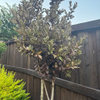
    OK, I thought I was describing my lilacs accurately from memory but I was slightly off. Sorry. So I took a picture. (It is a little hard to distinguish the lilacs from the neighbors' forsythia and other trees behind it.)

    There are three lilacs, and each has about three branches coming from the ground. The foliage on the leftmost lilac starts about 4 feet off the ground, the center one about 5 feet off the ground. (The lilac on the right is shorter.) You can see the dead blooms at the very top of the photo.

    Thanks again.

    {{gwi:261878}}

  • 18 years ago

    Got it. Although these shrubs are tall, they don't look like they're very old. Based on the photo, I suspect that they are not planted in full sun and that's why they're "reaching" (with no leaves at the base). In general, hostas and lilacs should not want to be together - lilacs want full sun all day long and hostas want shade. Pruning may not get you any better result.

    That said, if you want to try for better branching and more leaves at the base, go out this weekend and cut one big branch on each shrub down to about 6" above the ground (or wherever you can get loppers or a saw to fit). Next year, do the same thing with a different large branch. The following year, do it again and that will be that.

    Give some thought to planting new ones in more sun and replacing these with shrubs that will do well in some shade.

  • 18 years ago

    Thanks. I think the previous owners of the house planted both the lilacs and hostas, probably less than 5 years ago. The base is part shade but the tops are nearly full sun, so you may be right about them reaching. I will study the light conditions over the next couple of days and decide whether it's worth it to lop!

  • 18 years ago

    Yes: These aren't big, old and stemmy at all, as far as it goes. But if you want to start them over cut all stems off at 18 inches, during the dormant season. If you do this it will probably take them a few years to start blooming again. But they will then be more erect in habit and consist entirely of vigorous shoots that flower well.

  • 18 years ago

    OK, I'm leaning against pruning down to the ground right now. What if I just prune the tallest branches back by a few feet--the ones on the left and middle with the deadheads. Will that get me anything, or will I just be sacrificing next year's flowers with no gains in bushiness?

  • 18 years ago

    prune one large trunk from each plant as close to the ground as possible ... 3 to 6 inches ...

    DO NOT PRUNE at height ...

    for each cut.. you will get 3 to 5 new branches... for a bush/shrub .. you want that as close to the ground as possible..

    if you do it up high.. your problem will be solved.. in a year or two.. then the large trunks break from the large bush your created 6 to 8 feet above the ground... make sense ...

    i do this.. right now in z5 .. just after flowering.. and you might be able to get new sprays that actually set bud in fall ...

    google PRUNING SHRUBS [link below]..... and i am sure you will find a couple million web sites that tell you to do it after flowering.. and it do it at ground level ...

    if you get a pleasant result... in fall take another off each ... and then after flowering next summer.. take the last large one ...

    IF you figure out how to actually kill a lilac.. let me know.. its nearly impossible... ergo.. have no fear...

    the reason to take up to 1/3 only of the plant.. is that you insure that you have some flowers on the unpruned... just in case the pruned dont bloom.. set bud

    ken

    Here is a link that might be useful: only 211,000 sites ....

  • 18 years ago

    With only three trunks on each cutting off a third each year will soon result in first two and then one taller branch standing there by themselves, while the replacement growth is still working its way up from below.

  • 18 years ago

    Never saw off lilac "trunks" or similar large deciduous shrubs at 18" or 3" or anyplace but right at the soil line. Best done in the dormant season. Else you will get ugly clubs sicking out in the landscape all winter with tufts of stems springing from the ends. You can certainly saw off all the growth at the soil line in ome go if you prefer.

  • 18 years ago

    You are talking about how they might look at first. After the new stems have grown tall enough the improved appearance and flowering of the lilacs will be what draws the attention.

    Young plants often need light formative pruning to encourage the development of a balanced shape. Established plants should be deadheaded carefully, where practical, with pruners to avoid damaging the young shoots that will flower next year. Remove suckers as seen*. To renovate, cut back main stems to within 12-24in (30-60cm) of the ground. Response is good, and regrowth should be thinned, but flowering will be delayed by up to three years. It is preferable to stagger hard pruning over two to three years

    --Brickell/Joyce, Pruning & Training (DK)

    Willows being grown for stem color may also be cut back to stumps rather than to the ground, the resulting long wands of spectacular bright shoots being what captures the viewer rather than the stumps they are springing from. Some even grow these as pollards, although I prefer to cut them much nearer the ground. When the head is up in the air on a longer trunk then that does become more noticeable.

    *On grafted specimens only