Software
Houzz Logo Print
maryl_gw

Clethra-The appalling truth?

On a brutally hot day last week I was in a nursery when something fragrant wafted towards me. It turned out to be Clethra, variety Pink Spire, and it's sitting in a pot here as we speak. Here's what I want (and have space for). A short (4 feet or under), upright shrub that I can prune high, so that the groundcover underneath won't be smothered. It will be in a semi-shady area in a small, raised bed, with other plants already established. As the trees around this bed grew, part of it went from sunny to shady. Now I'm faced with this hole where a miniature rose once happily grew. I thought that Clethra might fill the bill, but then I read that it suckers. No, No Nannette. No suckers for me. So is this statement true about Clethras? Have I been suckered in by it's fragrance and shapely youthful habit at the nursery? Any information will be helpful (including other suggestions).

Comments (28)

  • 21 years ago

    Yes, Clethra alnifolia suckers.

  • 21 years ago

    Let's be clear, there are suckers, and there are %$##@ suckers. Suckers that emerge in modest numbers right next to the main stem are no big deal, in fact it is nice to have the option of a replacement or companion stem sometimes. The other kind, personified by such shrubs as flowering quince (NEVER BUY THIS) use suckering as a yard-takeover strategy. Then there is the question of whether they are easy to pull when they sucker, or ineradicable.

    I do not know into which category Clethra fits, except that I have never had a problem with the white alnifolia suckering (that might be an indictment on the conditions I provide). But I share your suckering phobia (see "flowering quince" above or in an earlier thread) and would put it in a nice pot in the spot you have chosen for it, at least until it proves itself. Two birds with one stone - keep it off the ground, and control its spread.

  • 21 years ago

    Clethra suckers, but they are well behaved suckers. I have two "Hummingbird" that have stayed in one place for at least 6 years with very little suckering. Also have standard size plants including "Anne Bidwell" that are very easy to keep pruned to the specs you mention (high, so you can grow other stuff around their feet).

    Unless you refuse to do any pruning, ever, you won't have problems with Clethra. I'd suggest planting it and enjoying.

  • 21 years ago

    All of my Clethra are basically GROUNDCOVER shrubs (Pink Spires, Ruby Spice, Creels Calico). In my yard, they all sucker and I cannot plant anything underneath or within a few feet of the initial root mass. I do love them for their fragrance and nice fall color, but I don't think of them as a shrub that can be limbed up to plant underneath.

  • 21 years ago

    The lower part of each stem tends to be leafless on its own anyway, but the overall habit is a thicket of vertical stems.

  • 21 years ago

    Gee, you all are so responsive. Thank You. I'm currently in the process of trying (note the word "trying") to kill all the suckers that have spread across my yard from a 15 year old Wisteria that has recently died and been chopped down (yes, Wisterias do die). So you can see why the word suckers causes me to panic. I may do what KarinL suggested and containerize this plant. But I'm wondering how well a plant that wants to sucker will do in such a confined enviornment for years on end. I've been racking my brain out over this spot, does anyone have any other non suckering suggestions?

  • 21 years ago

    If you containerize it (good word!) you might find its ultimate size is restrained, but that might be a good thing. It will probably also need new soil every few years, and whenever you do that you can lop off a few suckers so the plant remains the size you want. I have to say I lean toward this option as you have the darn plant sitting right there - if you control the suckers it is the perfect plant for this spot.

    BUT if you insist on considering options, I have to say I am quite enamoured of my Osmanthus x burkwoodii at the moment, and I think it can take such a spot. Various hydrangeas could work, though they tend to cover the ground a bit, but you can cut them back once a year and groom the groundcover then. And since we're talking shade, would it be too obvious to suggest Rhodos? There is at least one to fit every need, as there is with Virburnums. My Stachyurus praecox tends to send its shoots upwards... In short, there are a lot of other options for such a spot. No wonder you've been wracking your brain over it!

  • 21 years ago

    I doubt Osmanthus burkwoodii would be reliable in Oklahoma, it's not even 100% hardy here. Yes: most of the time it overwinters, but it can be damaged. Then there is the matter of the summer climate in OK.

    Wisteria and Clethra alnifolia are poles apart in vigor and proclivites, you probably would be fine planting it in the ground. It might even turn out that getting it to do well was the actual issue (it has certain requirements) rather than having it spread much.

  • 21 years ago

    I swear, I've had "Hummingbird" clethra for years and it hasn't suckered and has stayed exactly 2.5' tall. But it's healthy and the flower fragrance is fabulous. It is a great little clethra for restricted space, in my experience.

  • 21 years ago

    I must say you shrub people are very bright. All of what you say is relevant. Even if the Clethra didn't sucker I really don't know if it would do well in our non-acid soil (6.8-7.0). Same reason Rhodies etc. do not do well. Another advantage to a containerized plant. You can stuff it full of peat moss (or whatever) without having to redo the entire bed. My plant passion is for modern roses (Hybrid Teas etc.) and believe me I know about hard work. That's why I want something relatively easy care for the rest of my garden. I have a dwarf Hydrangea (Pink Elf) that I bought this year and potted up waiting in the wings if all else fails, but our late spring frosts make Hydrangea blooms iffy, and there is always the laying on the ground issue (Can you limb up a Hydrangea?). If you are still with me on this Clethra, can you tell me if it blooms on new growth (like a Rose of Sharon) so that I know when/how to prune it.

  • 21 years ago

    I live were clethera is a native plant found all along the road sides at the edge of woodlands our soil is extremely acidic. Without a doubt it will sucker and when mine reach a hight of 6' the tops bent down. When young and in a pot full of blooms it can appear to be a great choice for the back yard but it is really best sighted in a natural setting. I also have a number of elf hydrangea's that are 7 years old now, mine add a formal structure to the edge of a brick path. They have been a good bloomer but the new growth blossoms are a bit late to arrive. You will not have a problem with the limbs laying on the ground once the plant matures that will only happen when they are young. Good luck

  • 21 years ago

    Here's a list of alkalinity-tolerant shrubs. I "borrowed" it from a plant nursery website:

    Evergreen Shrubs - Evergreen Barberry, Boxwood, Irish Juniper, Yew, Firethorn.

    Deciduous Shrubs - Clematis, Cotoneaster Horizontalis, Euonymus Europeus, Privet, Mock orange, Smoke Tree, Lilac, Snowball, Althea, Flowering Currant, Spirea.

  • 21 years ago

    I think it depends on your soil and climate. Clethra likes acid soil and is native in the eastern US. I think (not sure) that OK would be near the edge of its natural range.

    Here in eastern Washington, I planted two Clethra in part shade, somewhat alkaline, usually moist soil. They have both languished. One has grown a little; the other is shrinking. Their flowering period coincides with our dry season and they evidently prefer high humidity when flowering. The flowers look dry and withered unless I soak the heck out of them every day.

    In Oklahoma, your Clethra will undoubtedly do better than mine, but probably not as well as plants further east. If you have any doubts, plant your Clethra someplace else and get a different shrub for your raised bed.

  • 21 years ago

    Clelthra also enjoys more moisture than I believe OK's natural climate can offer. It becomes drought tolerant, by eastern standards, as it settles in but draught in MA, NH, CT, etc. is VERY different than drought in OK. The northeast averages approx. 50-60" of prec./annually. I suspect you'd have to supply a lot of auxilliary water to your clethra. Keeping it moist in a large pot might actually be easier than in the raised bed you were speaking of.

  • 21 years ago

    Yes, Clethra blooms on new wood, so you could prune/shape it in late winter/early spring.

  • 21 years ago

    I have three (Ruby Spice, Alnifolia, and 16 Candles). None have suckered though 16 Candles is my fave..Glossiest leaves of the bunch.

  • 21 years ago

    I'm currently on the second one. The first one died. It won't surprise me if the second one dies too, though it will get a lot more moisture. With a pH of 7.2, I may as well be on a different planet than 15 miles south of here.

  • 20 years ago

    I love my Clethras. Yes, some sucker, depenting were they are planted. Its no big deal. They are not like the rasberries that send out shoots in the middle of the lawn. I personally will be adding more clethra to my yard.

  • 20 years ago

    Folks, have any of your grown the variegated-leaf clethra called Creels Calico? If so, how has it done?
    I'd like to try it in a semi-shady spot in fairly acid soil. I garden in Zone 5.

  • 20 years ago

    It is not any different in cultural preferences than any other clethra. Part sun/part shade, somewhat moist acidic soil that's all it need. Grow to 6-7 feet tall. Producing some suckers, but not too agressive to be out of control.
    Variegation is irregular, so it's not as uniformly bright as say, variegated cornus, however it is not succeptible to any diseases and insects damage.
    Blooms right now along with 'Ruby spice' and 'Hummingbird/16 Candles'. Same fragrance, but flower candles are little bid longer than on any of the above and stands out very well depite the variegation
    {{gwi:269952}}
    {{gwi:269953}}.

  • 19 years ago

    I'm hijacking an old thread, but I have a question for those of you who grow Clethra.

    How well do you think a full sized one (not one of the dwarf cultivars) would handle having a Clematis vining through it to provide flowers when the Clethra wasn't blooming? I won't be using Jackmanii (too vigorous & wrong color), but I'm envisioning one of the ones that grows 8'-10' high and blooms for an extended period of the summer, possibly a white, but not necessarily (not real fond of Henryi for whatever reason). I'm thinking more along the lines of one of the blues (or very close to blue).

  • 19 years ago

    Clethra is a pretty tough shrub. I bet it would handle a clematis. I bet it would be pretty, tho not when the clethra was itself in bloom.

  • 19 years ago

    Thanks for the feedback!

  • 19 years ago

    YR, I grow all my clethras in a such shady conditions that clematises will not bloom there, so I never even attempted to try such combo, but I think that clethra with its suckering habit might not be a good host for the clemmi.
    Another possible contra to this idea is that clethra's lateral branches are not thick enough to support a massive vine.
    On another side I think this could be a lovely combo, especially considering the fact that clethras leafing out very late and clematis foliage will decorate it early in a season.
    Hmmm...now when I start thinking about your idea, I think I might try Jacmanii on one of mine C.barbinervis which is approaching 12' mark and have top 6' in a full sun.
    Thanks for idea.

  • 9 years ago

    I have a three year old ruby spice that has grown ok and never suckered in its raised flower bed. It did bloom for the first time this summer but only for a couple of weeks before the blooms turned brown. My problem is that each year the leaves have developed black spots by end of summer. I can't find anything that lists this as a problem. Mine does get a lot of sun, but also a lot of water. Has anyone seen this?

  • 9 years ago

    patdemotte, you have resurrected an old thread and I doubt that many of the posters are still here.

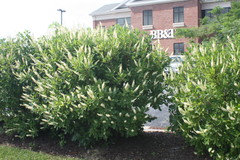
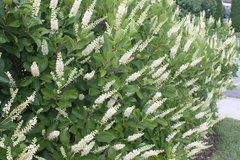
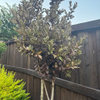
    I have found Clethra alnifolia to be a well-behaved and highly desirable shrub. Here it is seen planted in front of a Maryland bank last July 17.


    For us it's a Coastal Plane native which tolerates but does not require wet soils.

  • 9 years ago

    I have a lot of wild clethra that grows along the woodland edge. They are mostly in shade with moist soil. Suckering is not a problem. They fill out but don't spread a lot. The fragrance is one of the highlights of mid-summer. And ps, some of us are still here if not as active in posting as once.