My builder uses Houzz Pro to plan the timeline and give detailed estimates and daily updates with photos of progress, and provide invoices at pre-agreed key points in the build. This made the whole experience much more efficient and stress-free.
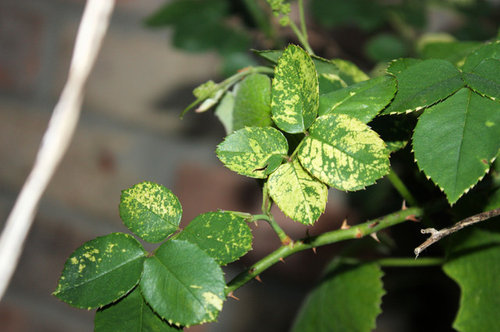
I think I bought this from Chamblee's years ago. So do I remove it? Really is a pretty rose:( I think I read somewhere on here that you can leave a rose with RMV without damage to your other plants.
PS. I LOVE Chamblee's. This is the only rose that I have ever bought there that has ever had an issue, and I cannot tell you how many roses I have bought there through the years.
I also have the same problem too with one of my rose bush. I'm "thinking" of getting rid of mine because the blooms get fried in hot days - perhaps due to RMV. I used to have a healthy version that can put up with the heat, but the one I have now is really bad.. It's a shame consider how tall it is now.
I wonder if white fly causes RMV, because in spring, I saw a lot of white flies surrounded this rose bush and later RMV showed up.
This is a controversial issue. Most people tolerate roses with RMV; others remove them because there is a slight chance of transmission. Infected roses are usually somewhat less vigorous and winter hardy. It is a bigger issue in climates with subzero winters than in warmer climates.
It's almost certain that your plant grew from a cutting taken from an infected mother plant. Symptoms only appear periodically and on foliage developing in cool weather. Some infected plants never show symptoms.
It does look like you have one or more viruses in that rose (RMV is a group name for viruses that cause mosaic symptoms on roses). However, normally one cannot tell which actual virus or viruses you have from leaf symptoms alone.
I feel that The University of California, Davis, link below is probably the "best" (written for the non scientist) description of the situation as it is understood at present.
A recent (around Dec 2012) University of Minnesota Ph.D. Thesis by Dimitre Mollov covered rose viruses. The work has started to appear in the published scientific literature. The thesis itself should be available (sooner or later) at: http://conservancy.umn.edu/handle/45272/
My Face Paint climber has areas that look just like the picture. It has been in my yard for years and hasn't declined nor the virus spread. It isn't an easy rose to replace and it blooms like crazy, so it will stay where it is. Just wanted to add my experience. On the other hand, I did get rid of a virused Altissimo and replace it with a clean one, years ago.
This particular cultivar was infected back when it was first brought into commerce as a substitute for the real 'Mlle. de Sombreuil.'
ARE got its Sombreuil from a lady in TX, who got it from Roses of Yesterday and Today -- which was where ALL of them trace back to.
The three we planted in 1987-88 are still growing -- tho one is in bad shape from a watering system problem. In a mild climate, the virus isn't going to hamper it. And in fact, one of ours was in the ground for 10 years before we saw the signs. (We knew it was there -- HAD to be -- but it didn't show.)
If you like the rose, and it is growing well, I wouldn't disturb it.
You might, one day, be able to find a virus-indexed plant, but other than this you'll just replace a virused plant with another virused plant, so why bother?
Here's one of a mass of blooms on my old (1987 plant) virused Sombreuil. What's not to like?
Here is my Earth Song (the pink rose in front) which exhibited some signs of RMV its first couple years. I haven't really seen any symptoms the past few years--even though the poor rose has been moved 3 times. (It's present home will probably be its permanent home.).
Anyway, it is about 6 or 7 years old now. Looks pretty good to me. Can't see RMV has hurt it--and no other roses have picked up RMV from it.
Jeri is correct: this rose went out the door with RMV in it. Every one of them has it, but not every one displays symptoms. Luckily, it is one of those cultivars that has vigor like no tomorrow and is undeterred by its viral load. There is no need to remove it.
Sombreuil was heat treated at Florida Southern College, so should be available RMV free from nurseries that got their plant from FSC. See the link below for a list of FSC heat-treated roses (from an article published in 1993).
If it were me, I'd shovel prune it and replace with a clean version. As tough as this rose is to be able to perform well with RMV, just think how much better it could be healthy!
They've done wonderfully for more than two decades. I wouldn't even THINK about removing a happy, vigorous, productive rose for a "problem" whose symptoms are expressed at a very minor level, perhaps once a year.
In fact, our first two didn't show symptoms at all for the first 12-15 years, and rarely have, since.
For the original location of this thread, Texas, I would expect that the common virus PNRSV would be mainly in the roots during much of the growing season sinch the rose immune system against PNRSV works better at higher temperatures. However, I feel that it is worth pointing out that in cooler climates the reports of little effect on Sombreuil from hot summer rose growers may not apply (I say "may not" because it is possible that the early Sombreuil infection which has been passed down through the years was caused by a very mild strain of PNRSV.)
One must also consider the possibility that this is a different virus than PNRSV or a mixed virus infection. For those of you that have seen an infected Sombreuil in climates similar to Texas, did your leaves look like these?
The following statement was made: "Jeri is correct: this rose went out the door with RMV in it. Every one of them has it, but not every one displays symptoms. "
H.Kuska comment. If this is correct (except of course for any heat treated), it should be interesting to compare its behavior in northern gardens to what has been posted here about southern gardens. Does any northern gardener have any experience with this rose? Such as, if dead, how long did it live. Is/was it vigorous? If a virus was noticed, how often, and what were the leaf symptoms like?
I did shovel prune a white rose with RMV, but because it would start the spring acting happy and then boom, more zigs and zags than a head shop and then die back. Would rather have a hole in the landscape than a half dead plant in the middle of the beds spring flush.
I almost picked up a Chicago Peace today even with the few ziggy leaves, but decided to come home and search if a VID exists and if the local nursery has one with out the zigs even knowing it can happen at any time.
kittymoonbeam, you are seeing virus symptoms in heat? On how many plants does this happen? Are they close to each other? Could you show us a picture of an infected leaf?




hoovb zone 9 sunset 23
jerijen
Related Professionals
Tallahassee Landscape Architects & Landscape Designers · Covington Landscape Architects & Landscape Designers · Cookeville Landscape Architects & Landscape Designers · Keene Landscape Architects & Landscape Designers · Chattanooga Landscape Contractors · Kearney Landscape Contractors · Bismarck Landscape Contractors · Aberdeen Home Builders · McComb Home Builders · South Bend Home Builders · Trenton Home Builders · Akron Home Builders · Aberdeen Home Builders · Concord Home Builders · Merced Home Buildersjerijen
justkristyjOriginal Author
jumbojimmy
User
Maude80
michaelg
henry_kuska
henry_kuska
kathy9norcal
jerijen
dublinbay z6 (KS)
justkristyjOriginal Author
User
Tessiess, SoCal Inland, 9b, 1272' elev
jerijen
henry_kuska
henry_kuska
Kippy
kittymoonbeam
justkristyjOriginal Author
henry_kuska