

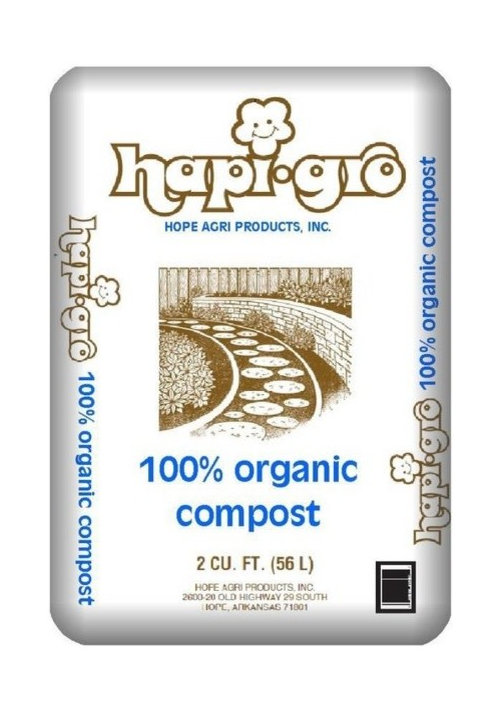
Hapi-gro 100% Organic Compost
Can I plant straight into this?
Comments (34)
 13 years ago
I can't find a website for the company. Don't know what they put into it or their procedure for composting. Can't even tell if they do the composting or it's out sourced.
Lloyd
 13 years ago
You could try.. It is not uncommon for me to stick a plant in pure FINISHED compost.. In fact, my raised beds are mostly all compost... If your game, give it a shot, it'll probably work great.. If your wary, add some potting mix, or somethin to kind of balence it out.. Your more less cutting a whole in that and planting in the, like a container, correct?
Joe
Related Professionals
Florence Landscape Architects & Landscape Designers · Buffalo Landscape Architects & Landscape Designers · Jamestown Landscape Architects & Landscape Designers · Manhattan Landscape Architects & Landscape Designers · Salina Landscape Contractors · Branson Landscape Contractors · Richmond Landscape Contractors · Detroit Landscape Contractors · Sheboygan Landscape Contractors · Colorado Springs Landscape Contractors · Lubbock Landscape Contractors · Jacksonville Stone, Pavers & Concrete · Toms River Stone, Pavers & Concrete · Oneonta Stone, Pavers & Concrete · Santa Rosa Stone, Pavers & Concrete- 13 years ago
The company is Hope Agri Products. They don't have a website. Let me guess - bought it at Lowes. Don't know anything about that product, but I have used their paver base. Lowes carries many of their products.
The Black Kow folks advocate growing tomatoes right in bags of their composted manure. They have a video about doing it on their website. If you go that route don't forget the drainage holes on the backside.
Here is a link that might be useful: the Black Kow video
- 13 years ago
All compost is 100 percent organic unless someone is trying to sell shredded rubber or steel as compost.
The only way to know if this is something worth what you paid for it is to open the bag and look at what is in it.
What does it smell like? Anything other then good, rich earth should be suspect.
Some people will tell yoiu that you cannot, or should not, plant in just compost. However, I have used the compost I make as my potting, and seed starting, soil for many years now with no problems. Elbourne
Original Author13 years agoThank you for your input. I'm a newbie. I wanted to be a purist and not purchase any type of soil, but I've compromised a couple times already.
The longer story...
I did an experiment last fall. I built a raised bed out of concrete blocks, two high, about 5'X12'. I layered cardboard on the bottom, covered that with a few inches of soil from the yard, and then another layer of cardboard, and then topped it with about 3" of garden soil. I tried planting broccoli and lettuce in that. It didn't do very well. I assume that top layer wasn't deep enough.
I kept watering it over the winter. We have mild winters here on the Mississippi gulf coast. I poked holes in the top layer of cardboard, through the top soil, with a pitchfork in an attempt to accelerate the decomposition. That seemed to work some.
I tried turning the soil this week. I was excited to see a good many earth worms working on that top layer of cardboard. That is a good sign, right? The bottom layer, on the other hand, remained impenetrable. I believe I layered the cardboard on the bottom way too thick. If I remember right, I may have made it 6 or so layers thick. I went overboard, but I had a lot of boxes. I assume it will eventually become worm food, but it may take a while.
I am eager to get something going in this bed, so when I came across the Hapi-gro compost I could not resist picking up 8 bags for about 20 bucks. I just wanted to get some sort of material in there. I mixed some of it with that top 3-4" of soil, but the bed is now topped with a good 4" or so of it. I now have at least 8" of material before getting down to that base of cardboard. I'm not familiar with commercial compost, but this stuff looks like fine pine bark if you ask me.
I planted a few jalapenos, bell peppers, and zucchini in it. My tomatoes are just sprouting up from the starter pots, but I will probably stick a couple of them in there. I also poked some sunflower seeds down at the end. We will see how things go.
- 13 years ago
Bagged compost products are hit and miss, and even the same bag may have different contents from month to month depending on what the producer had on hand. I look for evidence of soil (balls of clay, sand grains, etc.) which means they're diluting the compost with cheaper material.
Yours probably has shredded wood waste or bark as an ingredient, and it's the last to break down in the pile.
I'd say you're going to be fine with that stuff, keep us posted on how it works out.
- 13 years ago
Cardboard - like the brown corrugated stuff that is often waxed - is a fairly high lignin content material (12.9% lignin). It also is a high carbon material (C:N ratio ~ 550). It will probably take a long time to break down in an unmixed system, longer if it is in large sheet form, and as it is breaking down may tend to suck up and immobilize nitrogen from the soil. That's not good for plant growth.
I'm curious about the upper layer of cardboard. Why was that added?
- 13 years ago
If you're going to put more than 2-3 inches of soil on top of the ground you can pretty much skip the cardboard. I'd skip it anyway for reasons given above.
People put it down to kill the grass...and because a lot of people recommend it for some reason even though they also advise putting many inches of soil on top of it. The suggestion to use cardboard finds it's way into many site-prep books/articles/etc.
I can logically (on the surface, logic) understand why it's advised, but it's useless in many cases where they also advise putting soil on top of it.
Elbourne
Original Author13 years agoI put all the cardboard in there because I had it. I figured using it as worm food would be more productive than throwing in the burn pile, or paying for the dumpster. I confess I probably went overboard. It was an experiment. I also just wanted to add some bulk at the bottom of the raised beds to bring the level up. I put the upper layer of cardboard in because I figured it would break down quicker with soil on top of it and underneath it.
The fact that it could immobilize nitrogen in the soil concerns me. Is there anything I can do to counteract that at this point? Since I like to experiment, my next project is going to be worm compost tea. Would that help? My worm bins are going great.
btw, in another bed I did a similar thing with a bunch of paper. In that instance, I had a bunch of great compost that I made (yet another experiment) with nothing but shredded paper and grass clippings. I made that one a year before last. My Okra grew very well in it last summer. But I had a large quantity of newsprint type paper left over, so a couple weeks ago I buried it about a foot down under that bed. Did I shoot myself in the foot? I was thinking it would decompose and provide organic bulk. I did not realize it could tie up the nitrogen.
- 13 years ago
Wax-coated corrugated cardboard makes a good carbon source for compost once it has been shredded. It is a fairly high C:N material, much like newsprint, so it takes a good amount of high nitrogen material to bring it into balanced mix. There have been a number of very good, controlled studies. The key is shredding it, getting the mix right, and plenty of aeration. The only concern with it as a feedstock for composting is it does bring boron with it. However, if the compost is properly formulated the resultant boron level after composting is about 10 ppm in the finished compost, so not really a problem unless you're dealing with other potentially high sources of boron in your garden.
Your situation is, however, quite different from compost. First, lets focus on the layers at the bottom. That is largely an anaerobic environment. Lignin is not very susceptible to anaerobic degradation. A study on composting wax-coated corrugated cardboard done in GA cites a 47% biodegradable fraction. I don't know much about earthworms, but unless your worms like to eat sheets of corrugated cardboard in that environment, which I somehow doubt, I would expect those sheets to still mostly be there 5 years from now. My best guess is that what you have built is a giant planter box with a cardboard bottom, and that bottom isn't going away for many years.
My greater concern is with the upper layer. Again, in the environment you created it won't decompose quickly and I question the thought that earthworms are going to readily munch sheets of corrugated cardboard.
The nitrogen issue is primarily with the upper layer. When high carbon materials are incorporated into soil they get attacked by soil microbes. Those microbes demand nitrogen for their own growth. The net result is that decomposing high carbon materials tend to create a high nitrogen demand in the soil that robs available nitrogen from growing plants.
If it were me, I would be doing the dirty work to get that upper layer out of there, and I would seriously consider the same for that bottom layer. You will have the same issue with newsprint as with corrugated cardboard in the same environment, but newsprint is even higher in lignin content.
If you want to use either corrugated cardboard or newsprint as compost feeds, go right ahead, just shred it up first and follow the usual practices for good composting. Newsprint will take longer than the cardboard, but it will degrade in a well managed aerobic compost pile.
This post was edited by TXEB on Fri, Apr 12, 13 at 8:41
Elbourne
Original Author13 years agoThank you for this information.
The upper layer of cardboard is just about gone already. When I turned the soil with a shovel, there were chunks of cardboard and several worms in each shovel full. I do not know how the worms got in there. I assume they came up through the bottom even though I have that thick cardboard base down there. Interestingly enough, the other bed I mentioned, doesn't seem to have any worms at all.
- 13 years ago
Quote: I question the thought that earthworms are going to readily munch sheets of corrugated cardboard
Worms do not eat cardboard, they eat the fungus that grows there, so it needs to be the right environment for fungus.
- 13 years ago
Earthworms will eat almost anything organic and if you amend your soil with adequate amounts of organic matter the earthworms will move in where the habitat is one they want to live in.
Cardboard, or newspaper, are used to keep any plant trying to grow from getting the sunlight they need to grow. However, if you put some other material thick enough to do that you would not need either cardboard or newpaper, they are used to extend the mulch material you do have, for example you could use 2 inches of shredded leaves instead of 4 to 6 inches and keep unwanted plants from growing just as well. - 13 years ago
Elbourne - the upper layer will break up into chunks and smaller little bits and pieces (mechanical degradation) before the carbon in it is decomposed. Until the carbon is sufficiently degraded by microbial action, it will tend create a nitrogen demand. That may not be a problem if you have enough fertility. Since it is already in chunks, your best bet would be to turn it as much as you can. You're basically in-ground composting, like a trench. Depending on how much you can turn it, it should be largely consumed in 3-12 months.
Elbourne
Original Author13 years agoThank you. The cardboard has been in there for about 6 months, so i believe it is well on its way. I am hoping that all the commercial compost will offset any nutrient deficiency. Its funny, because my original concern was that perhaps so much compost would be too much nitrogen.
- 13 years ago
Back on the subject of hapigro compost...
I bought a few bags myself several months ago. It does seem rough and unfinished at first, but after turning around the soil where I added the compost, I discovered it made my native soil rich and full of earthworms!
I went back a few days ago and bought 10 more bags to amend my veggie beds. It doesn't look so good right now, but I know that by it comes time to plant for the fall, the soil will be rich. - 11 years ago
I bought 10 bags @ Lowes today. There is no "compost" to it. It is just finely ground pine bark. Good for azaleas.
- 11 years ago
Well those two posts are quite different as to the contents of this product. Both may be true, which would lend credence to my 2013 post earlier in this (zombie) thread about the seasonal and regional variations in compost products.
Always good to poke a discrete hole in a bag and check on the contents before buying. That's the best way to be sure.
- 11 years ago
Lowes web site says this product is 100 percent composted forest product, what ever that means.
kimmq is kimmsr
 10 years ago
As it is labeled as 100% composted forest product, it should have minimal sand, if any. But as noted, bagged amendments can vary widely in quality and composition, even when labeled as to ingredients. Visual confirmation of the product is really your only assurance that it is what it claims to be.
- 10 years ago
I bought this today and I'm going to run a test using it for the 5-1-1 mix for grow bags. The ingredient list says 100% composted bark. Bought at Lowe's in TX for $3.33. I think I'm going to use one part Kellogg's organic potting soil instead of peat, since I'm out of peat. I think* it'll do fine, just looking at it/smelling it.
 6 years ago
I want to know is this good to just plant in without adding anything to it ??? 936 615 0255 please send answer to this number lol I just want a yes or no ???
- 6 years ago
No. Growing in pure or 100% compost is not the ideal methodology for any plant. Mix it with garden soil (75%-25% max) for inground plantings or just use a bagged potting soil for any containers.
- 6 years ago
Really it's organic mulch I mixed it with some potting soil but most the organic mulch. I put my auto flower in there already so it's not going to make ???
- 6 years ago
I'm be very unhappy if this no work a grower in cal told me to use the hapi grow organic compost
- 6 years ago
I've seen plants grow in compost even though it's not recommended. Mostly because it is too fine grained and doesn't drain properly. If your plant is OK then you got away with it.
 3 years ago
I use this all the time for soil mixes, it's carried here at Lowe's, I called the company, it's just pine bark fines no soil no sand, and it isn't composted but works great.
 3 years ago
What is SAYS in the bag is much less important than what is actually IN the bag. To growing strictly in compost of mixes made of of very large fractions of compost is to unnecessarily saddle oneself with a difficulty factor best avoided. The reasons: 1) Water retention is based primarily on the size of the particles that make up the substrate. All small particles, as in "finished" compost, and the medium is sure to hold too much water and too little air; and, much of the excess water will be held as perched water. This ultimately means north of 3" and up to 6-7" of the soil in the bottom of the pot will be 100% saturated after a thorough watering. This means that for extended periods the planting will be subjected to limitations imposed by a lack of oxygen. Lack of oxygen kills fine roots, which halts top growth until new roots are again capable of regeneration (requiring a draw down of the level of water in the pot). Regeneration of new roots requires resources that would otherwise have contributed to adding more biomass, blooms, fruit, stored energy. Unfortunately, about the time the root to shoot ratio has come back into balance, the grower is usually watering again, which begins a repeat of a cyclic death/ regeneration of roots which can rob plants of immense fractions of their genetic potential. 2) IF the compost is in larger pieces (not finished), expect an unmanageable (or nearly so) level of nitrogen immobilization. Then, if something cultural occurs to kill off the large populations of soil biota (like over-watering or high soil temperatures, insecticides making their way into the soil) associated with nitrogen immobilization, look for ammonia toxicity to make its appearance.
It is SOOO much easier if you start with 75-80% of coarse material (>1.8") and add only enough fine material to adjust water retention to something you can live with. Do understand though, that when your watering intervals start to stretch out to beyond 5 days, you'll be sacrificing a notable measure of your planting's potential on the altar of convenience. If you can measure your watering intervals in weeks instead of days, an immense amount of potential in terms of growth rate, vitality, the plant's ability to defend itself, and yields where applicable, has almost certainly been lost.
Al

gardengal48 (PNW Z8/9)