Software
Houzz Logo Print
greatplainsturf

Structural Pruning at Transplant

15 years ago

I have just recently planted some 2-3 inch caliper london planetrees from grow bags. Some of these trees need some structural pruning to remove potential double leaders, etc. Is there an issue with me doing this now before the buds open this spring? Most of the cuts will be minor but one of the London planetree's almost has a double leader already I would like to fix. Should I do it now or wait?

Comments (30)

  • 15 years ago

    London plane do not have a single leader. I'm against pruning at planting. Nonetheless, without pix intelligent answers are impossible.

    Dan

  • 15 years ago

    I have a sycamore that was in a V shape that I have trained to have a central leader. The London plane is related, so you may get sprouts too, as I did, and the pruned part will try to come back, only you will get 5 or 6 sprouts not one. I used sucker stopper and got rid of them, but I have to reapply this every year, cause the tree tries to get that trunk back.Maybe it will stop doing this over time but if I had the choice over again I'd let it go natural. I don't have the space to let it grow out the trunk now so I prune and spray every year now.

  • 15 years ago

    Most every London Plane I see that looks good has a central leader. Will it hurt the tree to remove the other leader at this point? I guess my question is, will removing this now hurt the chances of the tree surviving the transplant. I'll try to get some pics posted soon.

  • 15 years ago

    Platanus does not have a central leader, as it has a decurrent growth habit. To repeat, pictures are needed for decent advice.

    Dan

  • 15 years ago

    agree with dan ....

    if you cant post a pic ... give us more info ... 2 inch caliper??? how tall ... how big is the root mass ...

    the thought is that each leaf is a food making machine... aiding in faster establishment of the root mass ...

    if you go cutting off its food machine.. then how are you going to grow the roots to get it established .... ????

    plant the tree.. water it properly.. and walk away ... send me you pruners if you have to ... lol ...

    MAYBE in fall .. you might want to reduce or remove a branch or two ... but even then.. err towards waiting ...

    frankly ... this thing can live 50 to 100 years .. whether or not you can wait a year or two.. to start training it.. is making YOU the problem.. not that it has multiple leaders ...

    plant it.. water PROPERLY ... mulch PROPERLY ... and wait a few years to prune it PROPERLY ...

    ken

    ps: we dont need no stinkin pics ... lol ..

  • 15 years ago

    What is this obsession with ALL trees having to have a single leader? Most shade trees - deciduous hardwood trees with large, rounded and spreading canopies - do not grow with a single leader habit. The term for this growth habit, as Dan points out, is decurrent and attempting to create a single leader where one is not required can be quite counterproductive to the long term growth and appearance of the tree. Structural training of scaffolding branches are far more important but unless there are serious structural issues already present (and the suspected "double leaders" are probably NOT - only a photo can confirm), leave the trees to grow on a season or two before your start whacking off parts.

    I was having a conversation with a fellow horticulturist yesterday and we jokingly agreed that having a permit should be a requirement before one is allowed to purchase any sort of pruning equipment, much like a permit is required to apply certain types of pesticides. More garden mistakes are made by good intentioned but ill-informed home pruners than just about anything else. Give 'em a set of Felco's and off they go!!

    Take a class, get a good pruning guide and learn about the different growth habits of different types of trees and shrubs and then do what is best for the health of the tree, not attempting to apply YOUR notion of what you think it should look like.

    Here is a link that might be useful: A pretty good outline for training young shade trees

  • 15 years ago

    I was having a conversation with a fellow horticulturist yesterday and we jokingly agreed that having a permit should be a requirement before one is allowed to purchase any sort of pruning equipment,

    LOLz.

    {{gwi:332269}}

    Dan

  • 15 years ago

    I am all FOR early pruning, if it can remove co-dominant trunks and other potential future problems. I've seen countless trees in the landscape that I've cursed a grower over. Having had a nursery for several years, I know that it can take less than a minute to improve the infrastructure of a young tree. I've also educated many growers and nursery owners regarding the techniques of early tree training.

    London Plane tree is described as an excurrent tree with a weakly dominant leader. When young, such trees can be vastly improved with very little intervention. They often do so even when left to their own devices, as we have all seen.

    But I am talking about very young trees, not those in the 2-3 inch caliper range. It would have been better to have left those trees in the nursery lot (or refused them upon delivery, which I have done dozens of times).

    But, please, attach images if you can. Perhaps the pruning job isn't as big as we are picturing.

    The attached link is a perfect example of the natural growth habit of a London Plane tree.

    Here is a link that might be useful: {{gwi:332266}}

  • 15 years ago

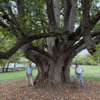
    Actually, rhizo, I was waiting for a reply as I have a silhouette of a decurrent form and some pix of London plane that I was going to use to explain why you don't train these for a single leader. Platanus x acerifolia are pyramidal in youth but as they age they gradually open up. Might as well do the fotos now.

    My house in Sacto had the whole street planted in London plane in the 1940s and they all had this form:

    {{gwi:332270}}

    Specifically,

    {{gwi:332271}}
    {{gwi:332272}}
    {{gwi:332273}}

    No single leaders in there. Sure, some may grow that way in rhizo's foto, but it is far more common to see them as in the fotos immediately above.

    My tree was ~60 ft tall in the middle of a million+ population and had a red hawk nest in it.

    HTH.

    Dan

  • 15 years ago

    is that you dan????

    lol

    please no government intervention on buying a darn pruning saw ...

    ken

    ps: besides.. that one is puny ... lol ...

  • 15 years ago

    I'm with Rhizo. Maybe her picture isn't universally typical, but I completely agree with the text of her post.

    I also think we've taken a simple question and gone to the philosophical extremes to answer it.

    Addressing the initial question, minor pruning at transplant shouldn't affect chances of survival. Even removal of a second leader is very unlikely to affect a healthy tree, planted correctly and at a proper time. It might slow the establishment to some small degree, but I think even that might be negligible. If it needs to be pruned, go ahead and prune it.

  • 15 years ago

    Aside from the fact we haven't seen anything to recommend pruning or not,

    Corrective pruning at planting to correct an unfortunate defect is one thing. Structural pruning at transplanting is something else altogether, esp to train for a nonexistent "potential double leader" (esp if it takes off 25% of the foliage).

    Reasonable people disagree.

    Dan

  • 15 years ago

    I didn't take greatplainsturf's original post as a question about whether the trees needed pruning. I think it was more of a question about whether the pruning could be done at transplant.

    And, BTW, nonexistent leaders should never be pruned (-;

  • 15 years ago

    Just trying to prevent one o' deze:

    Know what I'm sayin'?

    Dan

  • 15 years ago

    That's funny!

  • 15 years ago

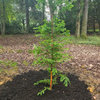
    Ok here is the pic. I would like to take the smaller branch on the right in favor of the "one" on the left. And in response to another poster, my question also is " is it ok to do now at transplant?"

    {{gwi:332274}}

    {{gwi:332275}}

  • 15 years ago

    Nope. No need. Eventually in 4-5-7 years those four limbs will be too crowded for that plant and one or two will have to go, but there's no central leader on that tree, nor will there ever be. Plus you'd be reducing ~20% of the leaf area by removing that limb.

    Good choice for that side of the house. Should provide decent shade for the house even in a lower-water future and the swale will collect water for them as well. Their open structure allows larger birds in too.

    Dan

  • 15 years ago

    "I would like to take the smaller branch on the right in favor of the "one" on the left."

    "...there's no central leader on that tree..."

    I'm having great difficulty associating either of these statements with the pictures provided.

  • 15 years ago

    Let me clarify. I want the largest branch to be the leader and remove the topmost branch on the right that is crowding the leader and causing a curved growth. My thinking is that if I remove that branch that the leader will become more dominate as it gains caliper size. Where am I going wrong?

  • 15 years ago

    Where am I going wrong?

    In thinking the tree "needs" a leader.

    Dan

  • 15 years ago

    Greatplainsturf,

    OK, I now understand what you are saying. Before you posted the pictures, I had a fairly different scenario in mind, and when you posted the pictures, I still wasn't clear, from your description, what you wanted. Now I think it's clear.

    As Dan has said, I don't think you need to remove the developing second leader. And in fact, the tree would have a more natural form if you left it.

    If you are dead-set against the tree branching at that level, it won't hurt to remove the branch. I also agree with Dan that removal now is not ideal. It could absolutely be done now, but waiting would maximize the tree's ability to become established. If it was my tree and I felt it had to be done, I'd probably do it in late winter next year. Before I did it though, I'd take a long look at the tree and decide if it really needed to be done AND consider how the tree will look (at least in the short-term) with the limb gone. In the mean time, you could make the branch more subordinate by pruning and by reducing it's vertical direction (by increasing the crotch angle and/or weighting down the branch). Again, you are fighting nature with these techniques, but if it makes the tree more pleasing to your tastes, it is an option.

    To summarize what I'm trying to say...I agree with Dan's advice, but don't think it's your only option.

  • 15 years ago

    From the info given, it seems as if the only reason for wanting to prune is to train for a leader.

    We can most easily see the first two trees in the row on the right - they were never trained for a leader:

    {{gwi:332272}}

    The OP's trees will likely look similar to those two. Without a central leader.

    Look at 100 mature London Planes. 75 will have ~the form of the trees in the two rows. The North American sycamores - Arizona, California, American - are more often found with a central leader. London plane, nah. That tree doesn't need structural pruning nor corrective pruning. In the future, probably. Now, no.

    HTH.

    Dan

  • 15 years ago

    With the exception of the lower right branch getting pruned in a few years I like the form.

    I had a maple with a large co-dom leader (go figure) and had it removed as the tree was within 15' of my house. After it was cut out it put out excessive growth on the other half of the tree (instead of the half that need to fill in!). Something to condider if you go taking out those main scaffold branches. Not ideal angles but you can't do anything unless you want some serious clearance under that tree.

  • 15 years ago

    I've been confused all the way through this post as to what branch you're considering to remove. From the responses, I'm not the only one. First I thought it was the lowest branch on the right. Then I thought it was the highest branch on the right and now I see it's the branch just above the lowest branch on the right. Am I right?

  • 15 years ago

    I'm not sure what the proposed removal refers to either, but I see nothing there now that needs to be or should be pruned out at this time.

  • 15 years ago

    Yes. In summary, its a good looking tree with nice form. Nothing needs to be done to it for several years, then the judicious structural pruning to remove competing limbs in that one area. Right tree, right place, good-looking tree from the nursery. Time to move on to the next project.

    Would that every time it worked out that well!

    Dan

  • 15 years ago

    "Eventually in 4-5-7 years those four limbs will be too crowded for that plant and one or two will have to go,"

    If this is the case in 4-7 years then the size of the wound will be much larger and the removal will heavily alter its overall shape, and cause quite a bit of 'post traumatic' sprouting..

  • 15 years ago

    BHTX, go back and read that outline I linked to. Temporary scaffolding branches that are perhaps too closely spaced are removed gradually over time. If proper pruning cuts are made at that time, there is minimal concern about the size of the "wound". The tree will adequately address that issue itself, provided it is in overall good health and not otherwise stressed. And nothing to indicate any significant "post traumatic" sprouting will occur -- a London plane tree is not a dogwood :-)

    The bottom line is that young trees need this early branching to establish properly. Removal of too many branches too soon will delay or impede the tree's ability to establish well. I may not wait 4-7 years before I made any removal decisions but I'd certainly give the tree at least two seasons in the ground before any serious reduction in branching was begun.

  • 15 years ago

    My phrase above: 4-5-7 years those four limbs will be too crowded for that plant and one or two will have to go likely suffers from too much effort toward brevity.

    By 4-7 years out, untouched, crowing will be evident and possibly be detrimental/problematic. But I'm not sure a decision should be made to have them all cleaned up before then. Maybe. Hard to say until then. There should be no desire to hack on it just to get a task done, however.

    Dan

  • 15 years ago

    My co-dominant leader was at ground level, I've seen them in the wild with that shape so maybe I didn't need to remove one of them but, I thought it would split in a storm.