Software
Houzz Logo Print
tweedbunny

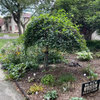
Buggy whip trunk help! (pic)

19 years ago

:) My grandpa calls them buggy whip trunks.

I bought this Chinese Pistache tree from a nursery less than a month ago. It was tightly staked and I had no idea until I un-staked it that the trunk was so flimsy. If something is not holding it up, it will bend over all the way to the ground. I should have taken it back but now its in the ground so...

How do I help the trunk strengthen? Its so weak that two or three ties are NOT going to work. Any help is greatly appreciated!!!

{{gwi:353783}}

(It was reaaaaally windy this week which is why it has 5 million ties around it)

Comments (14)

  • 19 years ago

    What people in bonsai do is cut is right back down short (try to stay just below existing nodes - places where new branches are likely to grow) and wait a few years. You'll end up with a thicker trunk, hopefully with good taper, and a much more interesting tree.

  • 19 years ago

    "(try to stay just below existing nodes - places where new branches are likely to grow)"

    Methinks you mean just above an existing node ;-)

    Resin

  • 19 years ago

    A) If the trunk never gets any movement in the wind, it won't strengthen as well as one that does. B) You WANT movement of the trunk, so while I appreciate that you are worried about your new tree, I think I would tie it looser and let it have movement. A good restraint method I have seen is to have 2 stakes driven in on either side of the tree, and then stretch old bicycle innertubes sections across the gap, on both sides, at a height of about 3/4 the height of the trunk, up to branches. (I think, from the photo, that this would be about the height of the second/lower cloth tie. If it is very "floppy" above there, then between the 2 cloth ties should work.) This allows the tree to move, but limits the amount. Putting the stakes so the major "limiting" comes from the direction of the most wind seems to be effective. C) Having the 2 stakes you are using almost meet at the top will lead them to rub on the trunk as/if it moves. Try to have the stakes so the trunk won't rub on them, even in a strong wind. If that seems impossible, using a piece of foam, pipe insulation around the top of the stake should be sufficient to protect the tree. D) If the tree is REALLY limber, then temporarily use the stretchy plastic ties to brace the tree, as high as necessary for it to stand, but loosely, and move them progessively lower as the tree gets stronger.

    While the "bonsai"ing suggestion would more than likely work, I assume you bought the tree because it is already fairly tall. Try the above method for the summer - you can always top it later if that doesn't seem to work.

    And if you buy another tree, try to check, in the nursery, that it is relatively strong, as I am sure you will. You CAN, of course, go back to the nursery, and get another tree, but I can understand not wanting to. Just DO save the receipt, in case the worst happens, and the tree does break. Taking photos of it flopping, without any ties, would bolster your claim.

  • 19 years ago

    Thanks for the help!
    The crooked stakes, green ties, and cloth ties (aka husbands new socks) are actually only a temporary solution at a halfway attempt to keep it staked until I got some help from here :D When the wind started blowing really hard the other day, I grabbed what was closest.

    Im going to try two STRAIGHT stakes on each side with those black tube coated wire fasteners at several places on the trunk. Still I may need several...

    I just hope it will strengthen. My neighbor was walking past and told me he has a tree that he's had to keep staked for 7 years because when he unstakes it, it falls over.

  • 19 years ago

    Well, the only permanent cure for "falling over" is to untie it. If the tree is allowed to move fairly freely, it WILL strengthen, and if you prevent it from moving, it stays weak. Sort of like using crutches after your broken leg is healed - your muscles weaken, and you keep needing the crutches. I can understand, since this tree is SO spindly and floppy, that you want to support it, but this is the perfect time for "tough love"!! The lower the supports can go, the stronger the tree will get.

  • 19 years ago

    You have a typical container-grown tree. The wholesale grower ties the trunk tightly to a stake to encourage rapid upward growth. Unfortunately, the result is a tree that can't stand on its own.

    To support the tree now that it's in the ground, use a 2-stake system. Use 2-inch stakes, place them at opposite sides of the tree and about 8 inches away from the trunk.

    To properly "tie" the tree,
    1. Loosely hold the trunk at the highest place which will hold the head upright.
    2. Tap a nail into each 2-inch stake at 2 inches above that point.
    3. Loop a flexible tie around the tree from each side, then secure the ties to the nails in the stakes.
    a. One kind has a section of tire tread (about 6 inches by 1 1/2 inches) with a sturdy wire at each end.
    b. Another kind might be a section of bicycle inner tube.

    Your goal is to support the tree while allowing it to move in the breeze. That movement will allow the most rapid strengthening of the trunk.

    In each successive year, remove the ties and start over with Step #1 to determine the new place, lower on the trunk, to place the ties. Although most trees won't need the support after the first year, some trees require two years of help.

  • 19 years ago

    Beheading the tree is going to be extreme! If I had to do it, I'd put it back in a pot and keep it out of sight. In the long run you will want about 6-8ft. of clean trunk on the mature tree. Right now the objective is to develop caliper along the lower trunk. This might be done by 'exercise' as dibbit has suggested and by encouraging branching on the lower trunk. Here is how you may be able to do it. Use a new single-edged razor blade to nick the trunk just above a bud or node. Make the nick small but deep enough to fool the bud below into thinking that the tree has been topped. It will sprout as a survival reaction. If you are successful, you can do it again and again to give the tree balance.

  • 19 years ago

    Tweedbunny,

    I had to chuckle when I saw all those ties! I didn't know a tree could get so tall and still be so skinny. The only other thing I would add is that maybe you should cut back some of the top branches to reduce the weight on top and encourage some thickening of the trunk. I know there's not much there, but I think it would put some energy into developing the trunk if the branches were headed back some. What do others think?

  • 19 years ago

    Pine - you're right of course!

  • 19 years ago

    It was said: "I didn't know a tree could get so tall and still be so skinny."

    It's easy to do. And wholesale producers who grow their trees in containers do it regularly.

    The advantage?

    If you tie the trunk tightly to a stake, adjusting as needed, it will force relatively rapid vertical growth rather than increased caliper/diameter.

    Bottom lines:
    1. You grow a "big/tall" tree in less time than if the tree must support itself from the get go.
    2. Less growing time equals cheaper to produce.

  • 19 years ago

    Dumb growers. I guess I'll be more aware next time I buy a tree and make sure I snip those ties to make sure the tree can stand BEFORE I buy it.

  • 19 years ago

    You said: "Dumb growers. "

    Not so. It's an accepted practice for container-grown trees.

    And after you know that, you can deal with it as I described earlier.

    Or, you can obtain a field-grown tree which will be either bareroot or a B&B (balled-and-burlapped).

  • 19 years ago

    Not so much 'dumb' as 'money-grabbing' . . . by packing them in tight, they get more $$$ per area of land, but the resulting plant quality is much lower.

    Resin

  • 19 years ago

    I would go with lucy and chop it back. I do grow bonsai and I've seen results this way but either way chopping it and starting again makes sense.