Software
Houzz Logo Print
v1rt

Is this hedge really Cornus Mas?

16 years ago

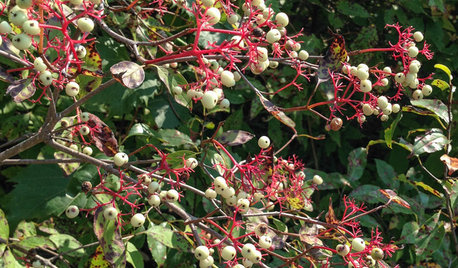
I took this pic at Cantigny Gardens. I sent these pics to one of their staff and she told me it's Cornus Mas. I looked at some pictures on google but cornus mas looks like forsythia or dogwood.

One is far shot and other one is close up of cornus mas.

{{gwi:252092}}

{{gwi:252093}}

Comments (23)

  • 16 years ago
    last modified: 11 years ago

    it's definitely a dogwood of some sort

  • 16 years ago
    last modified: 11 years ago

    Maybe, I shouldn't sweat having this identified. What are some plants that would make a hedge similar to the pic above? Are privets good? I want something that is thick and very hard to impossible to see the other side when we look thru it.

  • 16 years ago
    last modified: 11 years ago

    V,
    thanks so much for posting this photo. It is indeed cornus mas and i had no idea you could use cornus mas for such a terrific dense(though deciduous) hedge; and those berries will turn yellow too! How cool!That is just a brilliant use of this plant (which I find very boring in its natural tree form; sooo many better choices for a small tree.)

    Now, V,a little scold:
    Why can't you do an easy google which will tell you that CORNUS =DOGWOOD?!! this is basic info you need to know!
    And why not do some more homework first on this hedge question- google 'good plant for hedges' or 'hedges' on your own, look at some ideas and photos, and then come to GW for an opinion? You'll get so much better info too.You can ask,"I was thinking about so and so vs so and so, but my light conditions are so and so; what do you advise?" Believe you me, I was a newbie once too and I am still a BIG question asker, but I also believe in doing a good amount of homework before asking others.(I'm not perfect with this intention, btw. I definitely have succumbed to the temptation to take the easy way out and ask GW first) Now ,don't get all angry/defensive. It's just my suggestion. And I spent time responding to your original question and thanking you, above.
    best of intentions,and thanks again for the photos- just terrif!
    mindy

  • 16 years ago
    last modified: 11 years ago

    Mindy, I have a smile on my face after reading your last post on this thread. :-)
    I see quite an effort made to 'adjust' your style of 'making a point'. :-)
    I have to say honestly that I still think you 'scold' a little too often, but, this 'style' of scolding is much easier to take. lol I am surprised, that you continue to give scoldings, when they clearly are not usually received well. It makes me curious why you choose to continue doing it, but, no explanation is necessary. I do appreciate that you seem to be trying to figure out how to make them more constructive and friendly. It's fine with me that you want to draw people's attention to what 'you' think might make things more helpful in the forums, especially when it is an occassional gentle reminder. Best of intentions. :-)

    As for your point, about someone doing research before posting a question. I'm a big 'question asker' as well. I often think to ask my question on GW first before I do any research. Sometimes, the responses I receive are all I need. When traffic is slow, sometimes I have to 'google' something that hasn't been answered. Yes, you get more information, but is it always accurate and exactly what you need? No, not always. [Neither is it on GW (g)] For instance, if you google cultural information for many plants, you might find 4 different hardiness zones given. If I come to the NE forum on GW and ask my neighbor if a plant has been hardy for them, that is a more useful answer to me. Besides, the traffic on GW is often slow and any posts and questions are welcome as far as I'm concerned. I realize that everyone is not the same. Some people don't have the time to do a lot of research. I have the time to research but I am burned out from having to research other things, so I don't want to make gardening a 'job' when it is my favorite pastime and I want to keep it that way. Yes, I sometimes ask questions that Google could answer, but I'm just going to check it out on GW anyway and lots of times I get a response that I couldn't get on Google and get more enjoyment out of talking to other gardeners in the process.

    On the subject of the hedge, I am surprised as well that it is a Cornus mas. A tree that I have passed over for other cornus, but keep thinking about because of it's native status. I would love to see that hedge with the berries on it. Thanks for posting the photo.

  • 16 years ago
    last modified: 11 years ago

    I meant to say when the berries turn yellow. [g]

  • 16 years ago
    last modified: 11 years ago

    Beech would accomplish the same look.

  • 16 years ago
    last modified: 11 years ago

    While there is a yellow fruited form, most C. mas 'berries' (actually a drupe) will turn a deep red when ripe and are rather tasty :-) They are considered a good source of various vitamins and high in antioxidants. The common name for Cornus mas is Cornelian cherry.

    Here is a link that might be useful: Cornelian cherry

  • 16 years ago
    last modified: 11 years ago

    V1, I am surprised that I actually like those sweeps of marigolds and zinnias - normally a color combo that would strike me as weird. Dogwood hedge is an interesting idea. I've never considered it, but I've got a lot of Cornus racemosa (Gray dogwood) which is a pretty adaptable plant and somewhat bushy - perhaps could be sheared into a hedge like above. FYI to PM2, Cornus mas is not native to North America.

    As for privet - please stay away from it as it has proven to be invasive in our area. It is no longer sold in Mass. Have you considered evergreens such as Arborvitae which would offer year-round screening?

  • 16 years ago
    last modified: 11 years ago

    cool, plse remember that she is talking about a HEDGE. And most importantly, she wants to be able to enjoy it in her lifetime!!!(beech being wicked slow growing.) Or are you talking about a tall fastigiate beech hedge? that would certainly be a BEAUTIFUL thing, but very tall, so not at all the look of this hedge.or have you actually used tall fastigiate beeches in this context, and kept them tightly pruned to be the size of this hedge?(in which case, mea culpa.)
    best,
    mindy

  • 16 years ago
    last modified: 11 years ago

    I'm not sure what kind of beech we used, but planted in 1999, it was a good hedge within 10 years.

  • 16 years ago
    last modified: 11 years ago

    Mindy,
    If you are referring to V, then the poster is a 'he'. Maybe a little more research would have been in order? :O)

  • 16 years ago
    last modified: 11 years ago

    Oh, so the berries are red and not yellow, I guess that would be okay too. I actually like the look of the hedge just the same. It is fairly thick and a nice dark color. I wonder if birds would nest in it? They certainly must have a feast when the berries ripen.

    I wonder how often it has to be sheared? We used to have a small hedge and it was a lot of maintenance and we replaced it. So I'm not planning on adding any hedges again, but on a small lot, it's nice to know shrubs that can be sheared like that when space is an issue and create a nice appearance.

    Although the fact that it is not a native makes it less interesting to me. Thanks terrene for pointing that out for me. I did check the invasive list again to see if it was listed and I didn't see any reference to any Cornus, although I did see that it has naturalized in New York state. I would think that would not be a good sign.

    I do have the native Cornus racemosa, which is what I bought instead of the Cornus mas. I have to say, I have had a hot and cold relationship with it so far. Someone on the Natives forum was raving about Cornus racemosa and recommending it, so I bought one. I did notice that descriptions included the fact that it suckers, but I wasn't concerned, having had shrubs that gently suckered for me before. I was surprised to discover after the first year I planted it, that it suckers a great deal. I initially thought I could simply remove unwanted suckers and keep it in check, but quickly realized that would be quite a job. I have a small yard and I'm now on the alert for any mention of 'suckering' in a plant description. [g]

    I do enjoy the shrub for other reasons and I was excited to discover this year that it flowered and produced fruit for the first time since I bought it 5 years ago, without a second shrub. Mine has been allowed to grow without pruning at all and after the initial attempt to pull suckers we have since left it to spread. It is the fastest growing shrub in our garden and is in one of the more challenging areas, under the drip line of a huge old Silver Maple with only maybe 2 hours of sun in the morning. It also seems to tolerate dry conditions very well. So I would have to agree that it is an adaptable plant. So, it has redeemed itself. I don't regret planting it, I just wish I had placed it differently, understanding how much it does sucker. I am still considering moving it.

    I did see that Cornus racemosa is on a list of potential candidates for deciduous hedges, as well as Cornus mas, but so is privet. It's a list from the Horticulture department at Purdue so it surprises me that they would include an invasive on the list. I link to it below with that caveat. I do wonder why anyone would use a shrub that suckered for a hedge though.

    Since I was surprised to discover Cornus mas was not native, I did check to see which Cornus are native. A brief search found the following to be native to Eastern USA. It's not intended to be a complete list.

    cornus alternifolia
    cornus sericea
    cornus racemosa
    cornus florida
    cornus amomum
    Cornus obliqua
    Cornus drummondii
    Cornus foemina

    coolplantsguy, I would like to see a photo of that beech hedge if you have one. I imagine it must be quite interesting. Is it a golden color beech? How often do you have to shear it?

    Here is a link that might be useful: Hedges - from Perdue University Cooperative Extension Service

  • 16 years ago
    last modified: 11 years ago

    They were a purple-leaved beech. They were topped every second year or so, and maybe sheared every third year. I don't live there any more, but still have access to the property -- will try to take pic.

  • 16 years ago
    last modified: 11 years ago

    Wow, that's a surprise that they didn't require annual or semi annual attention. Were you happy with your hedge? Look forward to a photo.

  • 16 years ago
    last modified: 11 years ago

    well tiffy, THERE you are! How's canada??(did you see my rib directed at you in my Lazy S's thread, responding to the ontario poster?) ah, if people would just use their real names, it would be so much easier.if they don't, like V, then they must not care whether people think them a he or a she. so be it.

    cool, THE purple beech trees that turn into HUGE Ginormous things? the same plant, 'bonzai'd for a hedge???how low were you able to keep that beech hedge?i want to see the beechhedge photos too ,cool! pleeese, pleeese!

    pm, you are a hot ticket for that link. neat!
    best,
    mindy

  • 16 years ago
    last modified: 11 years ago

    I think it is important NOT to use the terms "naturalized" and "invasive" interchangeably :-) They are not the same. A great many plants have the ability to naturalize or self-sow to some degree yet never become invasive. Certainly a plant that naturalizes wildly or over a large area has invasive potential, yet it is not a valid conclusion to assume it is or even likely to be so. For example, common privet, Ligustrum vulgare, which is most likely the hedge plant referred to above, is not considered invasive - or a defined ecological threat - in many areas of the country. Location and climate play a huge part in any plant's invasive characteristics and what may be considered invasive or potentially invasive in one particular area may be a perfectly well-behaved plant elsewhere. There are other species of ligustrum that offer a much more threatening nature over a far wider area and those should certainly be avoided. But being evergreen, they are far less likely to be successful or even hardy in colder climates and their threat is typically limited to mild winter climate areas.

    And while I endorse the use of native plants for many cases - localized hardiness and suitability for various climate and soil limitations, attraction for wildlife, native area reclamation - limiting one's gardening choices to only or even primarily native plants is unnecessarily restricting. Many of these are also considered weedy and while not technically "invasive", they are sometimes overly aggressive spreaders also and often not very ornamental. There are huge numbers of non-native or 'exotic' plants that are not the slightest bit aggressive or invasive that add considerable color, interest and ornamental value to our landscapes and should not be discounted simply because they are not a native species.

  • 16 years ago
    last modified: 11 years ago

    gg, your sharp mind and articulate explanations continue to awe me. Because this is getting a bit OT, I started another thread about your post .
    best,
    mindy

  • 16 years ago
    last modified: 11 years ago

    Hi: I'm a visitor and lurker, haven't posted on this forum before, but this discussion is interesting so here goes.

    I've been studying Piet Oudolf, the Dutch naturalistic designer who designed several municipal gardens in the US including the Battery and High Line in NYC and the Lurie Gardens in Chicago.

    Oudolf recommends hedges to separate one's garden from others and to create private spaces. In his home gardens in The Netherlands, he used English yew for evergreen hedges, and beech, maples, oak, Cornus mas, and shadbush (Amelanchier spp.) for deciduous hedges.

    The photos posted by V of the Cornus mas hedge filled in some blanks - to see what the hedge really looks like was helpful. Has anyone grown Cornus mas as a hedge or screen? If yes, how long before the trees grew together into a functional hedge? The red berries would be a bonus!

  • 16 years ago
    last modified: 11 years ago

    pamchesbay, V has really gotten a few of us excited about this cornus mas hedge. Unless V wants to pursue this, i will try contacting the garden and ask them. but i was also thinking that a good course of action is reposting your query on the shrubs forum of GW. i hope you do that, and i'll keep my eyes out for any answers!what a very helpful topic to explore!plain green privet is sooooo boring.....
    best,
    mindy

  • 16 years ago
    last modified: 11 years ago

    Hi Mindy: I may do that.

    As background, I live and garden on 5+ acres on the Chesapeake Bay, after living and gardening on 1/3 acre for many years. My 'garden' is a large field that's exposed to the elements (wind, salt water flooding in some areas). I'm studying how to organize this large space, and many other topics. Since the subject of a cornus mas hedge came up, I decided to post a question on that topic. Hope that's not a problem.

  • 16 years ago
    last modified: 11 years ago

    no no, not a problem at all; you just said you were new to posting so i didn't know if you knew about the Shrubs Forum, where you might get other answers than on the perennials forum.Heck there are so many Forum topics, i sure don't know what they all are!And lots of Perennials posters post about all kinds of not-exactly-perennials topics.
    Welcome aboard as a poster!looking forward to learning about hedges too.pruning is definitely not my strength, but it sounds like cool and others may teach us alot about techniques for creating those hedges and the attributes of different plant materials.
    best,
    mindy
    www.cottonarboretum.com
    a teaching website

  • 16 years ago
    last modified: 11 years ago

    Here's the Purple Beech hedge pic, planted in 1999:

    {{gwi:252094}}

  • 16 years ago
    last modified: 11 years ago

    Man, that ppl beech hedge is so handsome!!!
    It motivated me to call and find out about V's amazing cornus mas hedge from Caligny Gardens.

    Here's what I learned from the head horticulturalist at Caligny in Ill., Z.5.:
    The cornus mas hedge there was planted 40 yrs ago and has been kept at 6' ever since. It was planted on 15-18" centers (that's pretty darn close for using TREEs!)It likely took 7-10 yrs to achieve 6'. It gets sheared a few times each summer but it is still getting wider (5' deep at present) and causing the adjacent planting beds to shrink.
    In winter, because it is so twiggy, it has the density of a barberry hedge(and that's pretty dense.)It gets thinner in shade, preferring full sun. I am guessing that if it weren't planted so densely, maybe it could be kept shallower than 5'deep.

    They also use Ninebark for hedges there and it is also very dense and a little more shade tolerant.

    what's your current thinking about your hedge, V?

    best,
    mindy