Software
Houzz Logo Print
jacqueline9ca

my weed bloomed!

13 years ago
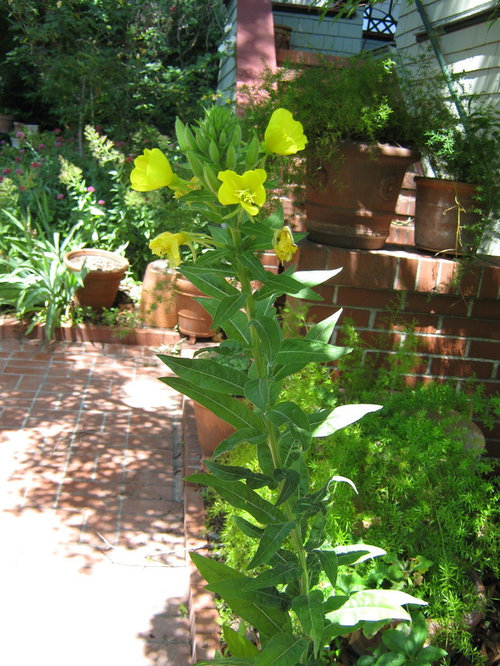
This is a follow-up to a discussion about those of us who cannot pull out "interesting" unknown plants until they bloom, in case they might be something wonderful...

Well, here is a picture of the weed I have been leaving alone. I still think it is a weed, but I am surprised at how pretty it is! Does anyone have any idea about what it might be?

Jackie

Comments (25)

  • 13 years ago

    Looks like Evening Primrose. Do the flowers fold up during the daytime?

    I like to allow weeds to bloom to attract pollinators. This morning I noticed some interesting looking flowers which turned out to be a beautiful stand of blue/purple triliums, or similar flower with three petals. That stand has been promoted to garden status, and will not be pulled. I hope for reseeding.

  • 13 years ago

    No to Primrose, or, at least, to the yellow version of the lower growing pink weed of the central US.

    I have seen this grown intentionally at the back of some gardens where they wanted ten foot high masses of yellow against yew and cypress hedges. (P Allen Smith show, maybe?)

  • 13 years ago

    yep, it is evening primrose - oenothera biennis......it will seed around and can be a bit of a nuisance....but check out the fragrance - it is really lovely.

  • 13 years ago

    I hope evening primrose isn't as immortal and invasive there as it is here. You may have to add Round Up to your fertilizer schedule...Kim

  • 13 years ago

    Thanks for ID'ing it for me! I was really worried when it turned out to be a primrose - I had oenothera speciosa (very low growing and pink - in CA it is called "Mexican Primrose") in my garden once, and it took years to get rid of it. It invaded the paths, the neighbors' gardens, & cracks in the sidewalk. I have a friend whose entire garden in another place in No Cal was taken over by it.

    I looked up oenothera biennis, and this does indeed appear to be that plant, which I am glad to hear is a possible plant to keep, as I love to keep pretty plants. However, I think I had better go to a forum about this sort of plant and find out if it is a thug in No Cal. Evidently there is a low growing yellow one too, but this is a different one. Kim - are you talking about this tall yellow one, or one of the others (we live in hope)?

    I will keep an eye on it.

    Jackie

  • 13 years ago

    Could be Oenothera biennis, but Oenothera elata ssp. hookeri, the native, is more likely where you are (or its look-a-like, O. glazioviana, which often grows waaaay taller, like 6 ft. + sometimes -- virtually a redwood among evening primroses) and they are, I am sorry to say, all thugs, especially on your side of the hill where the rainfall totals are higher, though not quite in the way that the wretched "Mexican primrose" is. These seed around a lot and resprouts from roots if not entirely pulled out. My mother, in Santa Rosa, uses a lot of Round-up on O. glazioviana every year.

    Less thuggish but with much the same flower are species such as Oenothera organensis, O. macrosceles, and O. longituba, who spread around some, I find, but nowhere near as crazily as O. biennis, elata, or glazioviana. I find all of these beautiful and reliable; the first two I've grown for years, the last I just started this year from seeds from Chiltern and it looks like it's going to be a winner, too.

    This post was edited by catspa on Thu, Jun 6, 13 at 18:39

  • 13 years ago

    The evening primrose here forms a rosette and grows flat to the ground spreading everywhere. I've been fighting it in my pastures, but I have to admit they're a glorious sight early evening or very early morning before they close up, yellow as far as you can see across the pasture. Your bloom looks the same as mine, Jackie.

  • 13 years ago

    That yellow one can self seed everywhere like morning glory. The shorter pink one is the plant version of herpes. FOREVER! Kim

  • 13 years ago

    Definitely evening primrose (Oenothera variety). O. biennis seeds seem to be popular and can be purchased from several companies. I grew up with the lower growing pink one. Was it herpes, Kim? Oh, dear. Maybe not in TX? It did seed itself around, sleeping in many beds, but I don't think it was herpes.... I also never noticed that it was bullying others in the landscape. Maybe that's because the killer heat tends to keep a lot of plants in check.

    Carol

  • 13 years ago

    Oh, they aren't that bad - although I admit, I should have not bothered with the horribly stoloniferous O. berlanderi siskyou....... the beautiful white pallida is worth having though. They do seed around, and you will need a tough daisy grubber to get rid of the fat taproot but honestly, this is NOTHING like bloody mallow sylvestris, the bane of my allotment life.

  • 13 years ago

    It's caused me a lot of work here but it's not the worst thing in the world.
    I can tell you one neat thing. Pour yourself a nice glass of wine and go sit next to one as dusk comes on. If you are patient you will get to see the flowers open. It's quite magical.

  • 13 years ago

    I bought a small pot at the local REAL nursery which appeared quite interesting and no one could tell me anything about it. The thing developed into a very tall sylvestris, loaded with purple flowers. Weedy, but actually quite pretty! I hoped it would last a while or produce a few seedlings, but that hasn't been the case. One summer and no babies in my climate and soil. It was the same with the "DON'T let this thing get away from you!" Solanum pyracanthum. VERY interesting and often rather pretty "weed". They warned of invasive, thorny seedlings popping up everywhere. Nope, two whole seedlings after three years, but they sure were pretty in the setting sun. Kim

  • 13 years ago

    Kim, I'm glad you have experienced some rewarding relationships with your volunteers, too! Nothing like a colorful weed at sunset. I'm sure you and a few others will be slightly horrified, but I intentionally planted pink Oenothera in my PDX garden. It lasted a year and croaked alongside my Gaura 'Whirling Butterflies' and my one time wonder California poppies. Even to save my life, I couldn't persuade a California poppy to remain in my beds more than one season. Climate is (almost) everything, isn't it? Someday one of us should post a "Prettiest Weeds to Grow as Rose Companions" thread starter. Geranium robertianum is a favorite of mine.

    Jackie, thank you for taking us on this adventure! Your volunteer is stunning! IS it fragrant as Campanula suggested?

    Carol

    This post was edited by PortlandMysteryRose on Fri, Jun 7, 13 at 13:17

  • 13 years ago

    hmmm, prettiest weeds - well that would be nearly everything for me from bloody cranesbill (g,sanguineum) to ox-eye daisies (leucanthemum vulgare)......and many, many californian poppies, including a rather lovely creamy white and the much smaller pale yellow caespitosa types. I don't use mulch around flowers - every single inch of soil grows something (because nature abhors a vacuum) so even ground ivy and speedwells have a place in my allotment. I am guessing that many fussy roses are not too keen on competition but MY roses jolly well have to put up with it - right to their base. Some weeds are less welcome than others (I shuddered when you mentioned sylvestris, Kim (that is the mallow you are talking about?) and creeping buttercup, while lovely, is definitely thuggish......on the other hand, who could begrudge the inevitable field poppies, corn-cockles, blue and red flax, campions and toadflaxes which litter my plot.

    For lovers of mallows and hollyhocks - a few years ago, when going through a species hollyhock phase (the rust!), I stumbled upon althea cannabina - what a plant! 8feet of transparently fine foliage (just like a sativa cannabis plant) and many waving stems....with vivid lilac pink flowers in every leaf axil. Like a giant anisodontea or sphaeralcea. For anyone fed up with the ubiquitous verbena bonariensis, this althea is an astounding substitute and easy-peasy from seed.

  • 13 years ago

    Here's a happy thought, though, about enjoying your single specimen, Jackie. A good majority of the Oenothera are obligate out-crossers, meaning that your single plant won't produce viable seeds unless there are other plants of it nearby (or, other, somewhat closely related Oenothera species nearby -- they are notorious hybridizers, something I proved to myself whilst doing crosses to nail down the ID on O. macrosceles). This includes O. elata, biennis, and glazioviana.

    O. glazioviana only produces 50% viable seed even in the best case (it being a species that arose from an old hybridization event, with accompanying chromosome incompatibilities).

  • 13 years ago

    Thanks, Carol. I actually bought the solanum because the thorns were gorgeous and I figured NOTHING was going to eat such a well armed, poisonous plant. The real "volunteers" are the never ending seedlings from the Washingtonia Palm which is SO happy, it fruits two to three times a year. I wish to Heaven it would burn itself out. Hateful trash palm. The bind weed springs up everywhere, though there is absolutely none to be found elsewhere here. Petty spurge and Scarlet Pimpernel abound anywhere I water. I leave them as my "ground cover companion plants" because they are shallow rooted, shade the ground to prevent excess evaporation and the spurge masks the new basals so the rabbits can't find them. California Peppers, Brazilian Peppers and California Black Walnuts join the Ash trees, Dodonea and Carrot Wood seedlings as frequent volunteers. Since I introduced them on the hill, the Caesalpinia mexicana seem to adore springing up all over with the Mesquite seedlings.

    I think I've finally won the battle against the prickly cucumber, at least anywhere near the walkable areas of the hill. I hated doing it, but it required nearly two gallons of Round Up concentrate and nearly three years. I dug as many of the massive tubers from the ground, leaving them on the surface to dry out and become mummified carcasses, as I physically could. The others, I've had to use chemical means to control. The rest of the "regulars" are mainly the yellow mustard, various thistles and dandy lion types with the usual cast of "native characters".

    The one really interesting volunteer I feared was the Buffalo Bur. It was gorgeous but also the scariest, thorniest thing I've yet encountered. As soon as that was identified, I removed it with a decent amount of soil surrounding it, banishing it to the trash. I have no idea where THAT came from. It's been the sole example of it, thankfully!

    Probably the worst, in addition to the trash palms, have been the various asparagus ferns of all types which seem to love this trash soil and exposed situation. I wish I LIKED them.

    Yes, Camp, sylvestris is the one. The bonarensis is a very happy camper if I keep it watered. It pops up everywhere, like the Nassella tenuissima (or Stipa, depending upon whose Bible you believe) and are as easily pulled as the Euphorbia wulfenii seedlings which love the bases of the roses. I'll admit, once we get things like RRD, Japanese Beetles and their like, I'm seriously tempted to remove all the roses and cultivate the volunteers. Many of them can be quite beautiful. If they are happy to be here without my intervention, WHY am I battling them? Kim

    Here is a link that might be useful: Buffalo Bur

    This post was edited by roseseek on Fri, Jun 7, 13 at 13:49

  • 13 years ago

    Well, there you go again, Campanula, enable, enable, enable. Althea cannabina -- wow. And Chiltern has it (sigh). I take it that it didn't rust for you? (Hollyhocks rust here like old buckets, so always a concern.)

  • 13 years ago

    Lawd o' mercy, Kim! I have a really handy tome called Weeds of the West. You must have every nasty invader listed in the index. Buffalobur. Ouch, ouch, darn Solanum! And prickly cucumber. I think that belligerent thing has several nicknames which all imply HUGE TAPROOT. So sorry you've been cursed with more than your share of really obnoxious uninvited guests. The scarlet pimpernel is nice, though. I'm nurturing it in my parking strip.

    Campanula, I'm researching Althea cannabina right now. Thank you for the tip! Except for a couple of seeded darlings, my Verbena bonariensis plants have gone the way of the California poppies.

    Carol

    This post was edited by PortlandMysteryRose on Fri, Jun 7, 13 at 14:03

  • 13 years ago

    They DO have enormous tubers, Carol! Thankfully, this soil is VERY soft. I can dig a grave rather easily, but it takes several helpers to prevent it from filling itself as I dig. I have literally unearthed tubers of that monster weed as large as an American V8 engine. By the end of summer, it had shriveled to a fraction of its original size. Once they completely dry out, they're gonners and will eventually turn to dust. The growth rate is flat out amazing. It takes only an inch or so of rain and just a few days before you begin seeing the green tendrils beginning to emerge from the ground. They can travel under ground six feet or more before poking up from the ground. You can almost SEE them grow many inches daily. I have tried to collect all the "fruit" possible to send it off to the landfill on the ones at the bottom of the slope (24% grade, six stories from bottom to the house) until I could either attempt digging them or take the "easy way out" and drench them with Round Up through a hose end sprayer. Nasty, evil things! Kim

  • 13 years ago

    Well boy am I glad I pulled that spikey weed thing that came up. Buffalo Bur, that does not sound like fun in the garden.

    I hate the bindweed. I keep hoping that slicing off all the top green growth will eventually kill the roots (I know dream on) And the morning glories that mom started.

    I do like the Sho-fly when it is in a good spot. Seems it prefers the pathway.

  • 13 years ago

    I had buffalo bur appear and reappear for a few years in one bed here (it was a mystery how it got here, too), but Mme. Antoine Mari at one end of the bed and Le Pactole at the other seem to have entirely shaded them out. Overbearing tea roses are one tool for weed control, I guess (hybrid teas here just don't develop that kind of canopy, unfortunately).

  • 13 years ago

    If you don't want bind weed, avoid the commercial wild bird seed mixes. I don't care what they put on the label, everywhere I've seen wild bird feeders, there is bind weed. That's how it got started at a client's house in Valencia. I put a stop to that feeder my first visit. I know there hasn't been a feeder here in the 38+ years the house has been owned, so who knows where it came from? Probably from a bird passing through on his way from someone else's feeder. Another hateful "companion plant". Kim

  • 13 years ago

    We have sunflower seeds and nyjer sees for our feeders. And a posse of hungry chickens that live to clean up after the wild birds.

    The birds would visit us with or with out the feeders, between the chicken feed and fruit/veggies and the neighbors feeding them (I think that the rat population in their front yard must be unreal at night-makes me shudder to think of it)

    I have disturbed a lot of soil and probably did a ton of spreading it around.

  • 13 years ago

    Oooo, Kippy.

    I have rat-feeding neighbors,too. A posse of those beady-eyed varmints (the rats not the neighbors) scurried over my Clematis terniflora pergola one night as I marched outside to drag in my dog...who was barking pointlessly at the back fence instead of chasing bubonic plague carriers. One day--yes, in broad daylight--I was watering the garden farthest from the rat-feeding neighbors when I encountered what must be a new species of terror. I'll call him Rodentus giganticus. When he sensed that I had spotted him, he turned and faced me down. As my hose spray doused his quivering snout, his eyes flared crimson and and he snarled, "Do not anger the spawn of Ben." I turned off the faucet and went back in the house. Actually, back in my undergraduate psych major days, I was the softy who rescued as many lab rats as I could feed, but they weren't in my rose garden. Curling up with a bowl of popcorn and watching Ratatouille can be quite therapeutic.

    Carol

  • 13 years ago

    Oh, I am kinda fond of them myself....but somehow there always seems quite a big difference between urban rats and their rural cousins. Very intelligent creatures.