Software
Houzz Logo Print
le_jardin_of_roses

Petals For Your Thoughts

15 years ago

Would love to hear about your current perspective on your garden and what style is developing there within.

I'm dealing with the limitations of my garden and coming to terms with them successfully enough to satisfy me. Lack of space and partial sun are my biggest issues, so if I get a new rose, it will be to replace one that no longer pleases me, or is not performing well. I have chosen varieties that do well for me in partial shade, so I'm happy about that. I've accepted the fact that I will get less blooms than gardens that have full sun, but luckily my roses bloom very abundantly because of choosing well for my situation. My garden is really a generously sized courtyard. That is why I rely so much on DA roses. They have old-garden flower style and many with graceful bush form that come in varying sizes, so I can find the right fit for my garden. Many teas and old-garden roses are huge and I don't have the room, but of course, I do grow a few teas and antiques I have found a place for. I LOVE old-garden roses! I wish I had a real large garden with lots of space and full sun, but I can't afford the real estate I want at this time. :(

I'm also trying to decide if I want more symmetry in the garden, or something more asymmetrical in style. Which would you prefer, as far as balancing out an area with the same rose on each side, or mixing it up?

I'm making an effort to be more of an artist, as well. Making sure that the roses work well with other roses around them. I still have a dislike for red and orange roses, though. That hasn't changed (although, I know some of you grow some very nice ones). I'm taking into account every aspect of a rose variety, if it is to be in the garden now.

Here is a wonderful quote from Ingrid, from her 'McClinton Tea Revisited' thread that rings very true for me.

"More and more for me it's the gracefulness of the bush and how the blooms are poised on the plant that are prime considerations. I think that's because it's the garden as a whole, or how it looks at some distance, that has become more important to me than just the individual bloom. That's not to say that the bloom isn't important, but now it's just one of the qualities I look for".

Juliet

Petals on my garden floor

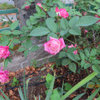
{{gwi:281815}}

Comments (9)

  • 15 years ago
    last modified: 11 years ago

    I love your photo, Juliet, it's different and yet so evocative of your garden.

    I'm honored that you chose to quote me. I also share your dislike of red and orange roses and more and more have favored the cooler colors in my garden, and have a great love of mauves and purples and lavender pink roses.

    I suppose it partially depends on the size of the garden, but I've found that a garden that is a mixture of formal and not so formal elements works best for me. A totally formal garden can become boring and predictable and a totally informal one can verge on the shapeless and chaotic. The English are masters at combining formal elements such as hedges, garden statuary and pairs of trees or other plants with more informal elements such as a flower border or plantings of large shrub roses and climbers that overhang arbors and buildings. That has always been my inspiration, on which I've put my own twist since I live in a Mediterranean climate. The best garden is one that excites you when you look at it or walk around in it, and which has interest through all the seasons. It takes time to achieve what more pleasurable activity could there be?

    Ingrid

  • 15 years ago
    last modified: 11 years ago

    Juliet,

    The picture of your petals is really beautiful.

    Like you, my yard is small--sounds larger than yours though.

    When I first "discovered" old garden roses, I wanted a yard full of them. I expanded an existing garden area and added other areas. I started with the "bones" of roses and a few other shrubs. At that point in time, I was mainly interested in roses--other plants were just filler. Now, I think my gardens are full of roses--meaning, I don't think I have anymore room for more large shrubs. While this was happening, I've grown to love and appreciate many other plants in the garden. Right now the roses have very few blooms because of the heat, I guess. The gardens have color, though, because of all the perennials and other shrubs I've planted interspersed in between the roses. I don't think I'll ever lose my love of roses--particularly old garden roses but I like the "balance" that I think I'm finding.

    To answer your question, I like to mix it up so that there is always something blooming in the garden. I too, like the cooler colors in the garden--my roses are mainly shades pink and white with some mauve and my companion plants are mostly shades of blues and purples with some pink and white thrown in. I think the effect is very calming and relaxing--just what I need in the garden.

    Your courtyard garden sounds beautiful. I'd love to see some pictures sometime if you wouldn't mind sharing.

  • 15 years ago
    last modified: 11 years ago

    I don't know what my garden style is. The garden has well-defined beds and paths, and has an air of rustic formality, if that isn't an oxymoron. I mean, partly, that it has a fair amount of structure: some hedges, of lavender, of box, of yew, but the plants are loosely trimmed; and the wide grass paths, some roughly terraced so that you don't need one leg longer than the other to walk on them, are pasture grass, tidy only when recently mowed. There are areas with steps, often made with sections of small tree trunk or large limbs, and a few terraced areas, flat places in the universal slope. All these elements give structure: they do wonders in changing a piece of ground into a garden.
    I've tried to choose plants that walk that line between too-great formality and a completely wild look. There are plants that are widely used here in suburban gardens: English laurel, a number of cotoneasters, Hybrid Teas, of course, eleagnus, especially variegated, pittosporum--others I can't call to mind. They're mostly good plants when properly used. Often they're not properly used, for one thing; and for another, I don't much like the look even of a well-planned typical Italian suburban garden--too many exotic plants, too many exotic-looking plants, too much glossy evergreen, too many bright flowers (roses in particular), too much brightness and glossiness and rigidity overall; and Italians tend to be maniacally orderly in their maintenance. Anyway, many of these popular plants are good in my garden when discretely employed, rather than grouped all together without any lower voltage plants. I like some of the cotoneasters--C. lactea is a lovely shrub, for example; and in one shaded spot I have a couple of exotic shrubs, a pittosporum and a nandina, but diluted by box and bay laurel so they look at home.
    That suburban garden look is the direct esthetic descendent of the 'orto', the vegetable garden: the order, the brightness--substitute Hybrid Tea blooms for big red round tomatoes--the pruning and weeding and hoeing. There's no room for spontaneity, no conception of Nature as collaborator rather than enemy. I'm enlarging on this because I have a vague but different idea of the formal garden. That I see likewise as controlled, but with restraint in color, with subtlety of texture, with a pleasing architecture, I mean in the use of volumes and voids. Perhaps more definitely than anything else, I imagine a good formal garden as possessing dignity, a quality almost invariably lacking in Italian suburban gardens, whatever their other virtues.
    Our garden is set in the middle of the countryside, and it has to take this setting into account: if I had a garden in town it might not look like any of my neighbors', but it would be different from what I'm working on now. Most of my plants aren't native either, but they don't look screamingly inappropriate to me. I like a lot of what I thnk of as classic English garden plants: old roses, lavender, peonies, clematis. Tall bearded iris, lilacs, semi-evergreen small-leaved ligustrum, forsythia and shrub honeysuckle, hazelnuts, Viburnum lantana and snowball bush look right--some are native--and grow well.
    This isn't complete, but it is long, for all you folks and for me. An innocent question got me started on thoughts I've been turning over in my head for some time.
    Melissa

  • 15 years ago
    last modified: 11 years ago

    I live in a small house in the city, with even a smaller garden. It is about the size of a stamp. I manage to have a bit of lawn, a few meters of beech hedge, a few roses, shrubs, climbers, and rose beds along sides of the house. The houses are sort of last trace of classicism built in the 1920's and the style is pretty light, fun, simple with straight geometrical shapes. This is what I freely adapt to in my planting.

    My family has cottage by the sea, it's small and simple and the garden is kept very close to the natural vegetation in the area. It was built just after the war when they where short on building materials, and it's still pretty much kept like that. There are no fences, or very visible boarders but we cut the grass, plant carefully to blend with the landscape and plants growing there naturally like pine trees, heather, wild geraniums, clovers. I have made a few rose beds, by placing grey stone on top of each other, with out any mortar or concrete, and filled in with planting soil. The beds follow th shapes of the natural rock, and we use the stone to sit on, (when the sun has warmed them up). In some areas there are deep soil up to 3-4 feet, other places hard granite rock stick up, some areas are sandy and gravel-like.

    Blueberry bushes, heathers and bayberry (Myrica cerifera and some types of orcids and wild flowers grow right up of peat moss covered rock. Some places like this I have found best to just let nature take care of her self.

    So I mainly adjust to my surroundings, and continue what previous generations have established. I don't plan to make any major changes with big machinery or anything like that. I dig ditches with a shovel, bring sand, soil and gravel in a wheel barrow. (I get truck-loads of soil or sand dumped by the roadside not too far up the road, when I need). The path in the garden are thick pieces of slate, with sort shaped with a hammer to fit the spot.

    Sometimes I wish I had a big house with a big garden to be able to make a different type of garden, but I really like the simple surroundings around the cottage.

  • 15 years ago
    last modified: 11 years ago

    Melissa, I think you've expanded with more clarity what I also meant, namely that a garden has to have structure in order to be more than just a piece of ground. Within that structure informality and some wildness can exist happily, because the structure, or bones, of the garden allow us to accept it as something familiar and not hostile or strange. The majority of people seem to like our garden with its background of almost-wilderness, but I've noticed that a few (city) people feel almost uncomfortable here. They will either voice that or make no comment about the garden at all, as though it didn't exist. Those are probably people who would feel at home in the sort of controlled and contrived suburban Italian garden that you describe. So much seems to depend on past experience and even the personality of the gardener. To me the worst kind of garden, similar to the worst kind of interior decoration, is where you can discern nothing of personality or passion, interests or lives that are lived. It just leaves me feeling empty after I've looked at it. I can't imagine anyone here having that sort of garden.

    Ingrid

  • 15 years ago
    last modified: 11 years ago

    Lovely photo Juliet! It's so evocative!

    My garden is a shared garden in a rented property, so I'm not inclined to make a huge investment into the garden, yet I want to enjoy it while I am there and make it a place that everyone can enjoy. It's a very traditional courtyard garden with mostly paving and borders along the edges. The borders have shrubs planted about 20 years ago, so I've had to put in plants where I can and try to put a lot of my roses into pots so that I can take them with me when I leave. I've found that with this very formal, square structure, I can use the pots to make curving pathways through the garden, and that is what creates a feeling of wandering and exploration, and allows a sense of different spaces to explore. So the pots define the paths and now instead of just walking in a circle, visitors are forced to meander through the "walkways" adding a lot of interest. So, I'd say a mixture of formal lines broken with very informal curves adds a lot of interest to what would otherwise be a very boring layout.

    My dream garden is a traditional English Cottage Garden, with things spilling out, no obvious planning, just plants plunked down and added when they become available or self-seed themselves. I think the word I would use to describe the look I like is "exuberant", that the plants are just so happy and healthy they are bursting out and trying to spread. Overgrown, romantic, whimsical, inviting, mysterious, enchanting, magical... all words that I would use to describe my ideal. I also like to "see the gardener" in a garden, I like the sense that someone loves the space and is taking care of things, encouraging them to grow, dotting here and there. I'm one of those people who just can't sit in the garden, I try to relax for a few minutes, but the moment I start looking I think "that needs water", or "that needs deadheading", and have to get up and start tending. So, I guess I also like the sense of being somewhat overpowered by the garden, that there is a relationship, and the garden is winning... I just do what I can to try to maintain it and keep up with all of the growth and wonderment. So I'm not much into anything too formal, it just doesn't make my heart race like opening a rusted iron gate and being transported into a an burgeoning garden bursting with colour and fragrance.

    Thanks for the thread!
    robert

  • 15 years ago
    last modified: 11 years ago

    Michael, my husband. calls it, "Pamela's Never-ending Garden" I seem to wish to be always creating and expanding. I started this garden in 1995. I've moved at least 20 tons of rock down the hill for retaining walls and gravel walk ways, planted over 1000 roses, dug ponds,hauled in statuary. Michael ran hundreds of yards of fencing, built pergolas and arbors. My garden is absolutely my life's work. My perspective is that I'm looking out at the outpouring of my heart. It is what I wanted it to be, romantic, mysterious,wild, at times comical, whimsical, something new at each turn, generous, healthy. My new project is the rambler collection. besides the ramblers in the main garden there is a new area fenced where I am planting ramblers. I have to be patient and envision the future when they will all be huge. It's a different way of planting roses. I'm also planting species roses. I just love buying a new rose. If I plant tough things like species and ramblers I won't have to water them when they mature. I realize I've about reached my limit. You can imagine that is a word I'm not fond of.

  • 15 years ago
    last modified: 11 years ago

    Thank you, Ingrid. I really admire your color sensibilities and loved reading about your balancing the garden with formal and more wild elements. I pay close attention to all your write about. I have learned so much from you, from plant choices, to your no-nonsense removal of a rose that is not right for your garden, and color nuances.

    Jeff, I always love hearing what you are adding to your garden in Atlanta. To me, you are the most romantic person on this forum. I love that you have a garden bench in a special spot for you and your wife. I have enjoyed reading about how you like to garden. And thanks for asking to see photos of my garden. I'll post some more in the future, although it's hard to back up and get a full shot, since I have it so layered with roses. I've tried to add some perennials as well, but don't have room for too many. I have some photos on both galleries, but I may post more here soon.

    Melissa, it is always a pleasure to hear you elaborate on your Italian garden. Italy is one of my favorite places. I read all your garden thoughts with much interest. Your garden sounds so grand and interesting. I admire how you deal with the huge project that your garden is. It sounds like you have indeed done well "changing a piece of ground into a garden".

    Thanks Taoseeker! It sounds like you are familiar with the challenges of a smaller garden. I enjoyed hearing the story of your garden, as well. Your 1920's house sounds charming. And that cottage by the sea sounds wonderful. I would love one! Thanks for taking me there by writing about it.

    Robert, I have seen your courtyard garden in the Antique Rose Gallery and you have added so much beauty to it. I think there is a special gentlemanly quality to your gardening style. I love your idea of a dream garden! I want to go through that "rusted iron gate" with you.

    Pam, your never ending garden is magic. I hope you post photos soon, because I am transported every time I see it. And it IS romantic and mysterious, and wild, and whimsical, and a place of mythological beauty.

    Thank you all for liking my photo too!

    Juliet

  • 15 years ago
    last modified: 11 years ago

    This is a continuation of what I wrote earlier and of Ingrid's response, though it may be a little off topic; close enough, I hope, to be acceptable.
    Ingrid and I (others as well, of course: I think Pam is another) have the task of creating a garden within a wild or country context, rather than in that of a neighborhood, with building, roads, yards and so forth; and this may be why she's particularly alive to what I wrote. We both need to civilize our ground to make clear its identity as a garden, and at the same time we need to make it fit in its surroundings. The fitting in is accomplished by plantings that are not dramatically at odds with the surrounding vegetation, and by artificial features that fit stylistically in as well: no marble staircases, but lengths of tree trunk to use as steps. What I wanted to emphasize in this post is the surprising effect of horizontal and vertical in the garden. When we were first planting the big garden, I created a couple of small terraced areas, mainly because I wanted some place where I could lie in the grass without fighting gravity. But when I looked at what I had done, I saw that the ground now looked much more like a garden, from the terracing alone. Steps, the simplest kind of steps, achieve the same effect. I think this is much of the value of pergolas, which I greatly love, as well. The materials, though they need to be acceptable in themselves, are secondary the fact of the structures' being vertical and horizontal. There must be something about this that satisfies the human eye and mind.
    A couple of other things. I think it was Graham Thomas who wrote that gardens should be more formal close to the house, less formal further away. Words of great wisdom: in my case I have belts of informal planting on the periphery of the garden. Henry Mitchell talked about the garden's needing a boundary as well; in his case he was talking about city gardens and the need for a surrounding hedge of shrubs for privacy and, I think, psychological comfort. HM also recommended to plan formally and plant informally, and I wholeheartedly agree. WOWs (Words of Wisdom) indeed. This seems to me to describe many of the most famous English gardens.
    Melissa