Software
Houzz Logo Print
rjinga

Weed control in a clay area

19 years ago

I have a question for the group (rather than piggybacking on a similiar recent post regarding lasagna beds, I thought I'd just ask this separately.

I have a rather large area (approx 40 feet deep and about 100 feet long) and it is moderately covered with weeds and the scattered kudzu (I've been keeping the kudzu pulled up whenever I see it and I had this area plowed 2 times this year to break up the kudzu)...I have also had this area weed free not that long ago, but they are back strong...I need this area to be plantable, Ideally part for a garden and then grass in the rest...as it is now, my husband wont run his new riding mower over it and it's a mess...

I'm going to attempt to do something like a lasagna bed, because it sounds like that might be the best bet to get the weeds under control...I'll use either newspaper or cardboard or both, and then I have 2 truck loads of municipal compost and a big pile of top soil left over from some yard work...I also have a chipper/mulcher? that I could use to munch up a whole field of kudzu...BUT I ABSOLUTELY WOULD NOT WANT THIS STUFF TO GROW FROM THE CHUNKS....I dont know how far any of the materials I have on hand will cover. So I'm going to try to get pine straw and leaves from a recycling group I belong to online.

questions:

1.how long does this need to be down before the weeds will actually stop growing? And what if I dont necessarily want to plant anything in it for awhile?

2. How often do you water the bed after it's in place? Any other supplements need to be added?

3. Do you REALLY NOT need to remove the weed/plants that are there first? this seems counter productive. (plus see photos below, I have a bunch of tall weeds)

4. Do you need leaves or some brown material (like in a compost mix)

5. Will this really work for reducing the weeds and once and for all get this area under control...I know of course that weeds and weeding are an ongoing effort, but I just need something to stop or slow down the rate it's now growing at....because as fast as I pull them up, there are new stuff growing back in.

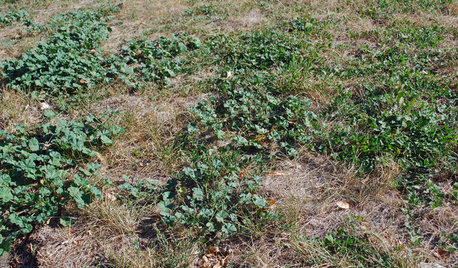
I'm going to include a photo of the types of weeds/plants etc I'm dealing with and I sure would appreciate any tips. It seems that I really have about 5 plants/weeds here. Morning glory, a scattered kudzu, grass, and 2 other unknowns.

(my property line is NOT the huge kudzu behind the mound, it's about where the dirt line is)

{{gwi:303568}}

{{gwi:304810}}

(this one is the hardest to pull up, roots break off and it has to be dug up)

{{gwi:304811}}

{{gwi:304812}}

{{gwi:304813}}

(this one is the most prevelant in the whole area, and fortunately, it comes up very easily)

{{gwi:304814}}

{{gwi:303569}}

{{gwi:303570}}

Comments (5)

  • 19 years ago
    last modified: 11 years ago

    Since Kudzu spreads by rhizomes you will need to clear all of the root bit and pieces from that area before doing anything more. Mulching would only encourage that stuff to grow more. For many other, less invasive, "weeds" mulches do a very good job of control because a good, heavy mulch keeps the plant from getting sunlight which all plants need to manufacture nutrients that help those plants grow. If a plant does not get sunlight it dies, except Kudzu and others that grow the same way.

  • 19 years ago
    last modified: 11 years ago

    Rjinga,

    Regardless of what you do to your area, that kudzu factory next to your property is going to be a pain until it is cleaned up. So, were this my property, my goal would to be to make my area so beautiful the owners of the kudzu factory would be shamed (hopefully) into doing something about their area. Until then the battle will be uphill but possible. Based on my experience with soil and weeds such as you are the proud owner of, I will answer your questions in this manner:

    1. The weeds will always grow, that is not the focus. What we want is for the weeds to not grow in our planting beds and paths. The main benefit of lasagna beds it that the bed offers the best growing medium for our plants in such an area as you have now. Once the area is covered with the beds/mulch the new problem for the weeds is to find a way to grow through the barrier that now covers the weeds. Those weeds that make it through can be easily pulled regardless of when you actually plant in the beds.

    2. I allow my plants to dictate when they need water, not on some imagined time schedule. I definitely would never overhead water that area, only the beds would get water by way of soaker hoses or some other drip watering system. IMO, compost alone does not provide enough nutrition for vegetables, thus I always feed my microbes extra nutrition to feed the vegetables.

    3. Yes, you really do not need to remove the plants/weeds before making a lasagna bed. I would cut them down as low to the ground as possible before building the bed, however I would leave all the cut materials in place to add organic matter to the soil. Something fed those weeds/roots to make them grow, why remove that food only to have to replace it later?

    1. Trust me, you will need lots of leaves or other brown material to reach your goal.

    2. Again, the goal is not to get completely get rid of the weeds (impossible to do), but the lasagna beds and mulch will slow them down to such a rate of growth management will be a lot easier. With some types of weeds you have, yes, they will be eliminated as long as one doesnt get the bright idea to have the area plowed/tilled to stir up dormant weeds in the ground. And too, there can be weeds/seeds in the compost you acquire or the soil you have at the ready to spread later.

    The purpose of a lasagna bed and the use of mulch are to cover the soil with a layer of mulch so thick nothing will grow through it unless it is planted by the gardener. The lasagna bed will create a dynamic living organic growing platform that will allow maximum plant growth and a barrier for anything that is already within the soil below the bed. In a case such as yours to build a bed only twelve (12) inches or less is a waste of time, the weeds are too strong; a bed of at least twenty-two (22) inches or more is better insurance. The bed will shrink, but by that time most of the weeds will be dead below it. And too, the paths between the beds will have to be thick (at least four (4) inches to start), with more mulch at the ready if weeds grow through that barrier. The kudzu not on your property is out of your control, however, you can make sure there is no fertile ground for the kudzu to root; that is the purpose of the mulch.

    You are starting with very fertile soil, evident by the healthy growth of the plants (weeds) you now have. Adding organic matter in such a way as to allow one to choose what will grow is the ultimate goal. I trust what I have offered will help in some wayÂ

    Blutranes

  • 19 years ago
    last modified: 11 years ago

    Bluetranes,
    thank you very much for your assessment. All of what you contributed is most helpful and informative, thanks for that!!

    I have my work cut out for me. I realize that the space I have is quite large, and to cover it ALL with 22inches of material would take a GREAT effort on my part...so maybe I'll break it down into 2 sections and work on one at a time, meanwhile collecting material (ie: grass clippings, leaves, hay etc) to have enough to move over to the next section and repeat the process.

    I also wonder if in the meantime, if I just use cardboard and maybe some heavy black platic to cover this area over (on the side awaiting the lasagna treatment :), and then continue to get enough stuff together...if I'd have success at killing back these weeds.

    any thoughts on that?

    Kimmsr: regarding the kudzu...I spoke to our extension office and explained that the kudzu had been dug up with a BIG BIG Cat tractor/plow thing and we got up a lot of the roots, not all of course, this stuff is like pipe has been laid, but they did say if I keep on top of pulling it up when it shows up...that by doing that repeatedly it would drain the energy from the plant (always having to regenerate after it's pulled or dug up) and over time, (like a year) it could be controlled and die off. I dont have any idea if that is possibly...but I'm willing to try. The surrounding kudzu is far enough away from mine that with simple cutting of runners heading towards my property, I can keep it at bay.

  • 19 years ago
    last modified: 11 years ago

    "I realize that the space I have is quite large, and to cover it ALL with 22inches of material would take a GREAT effort on my part..."

    I would not try to cover that entire area with a lasagna bed. Most members make beds wide enough to reach into the middle of the bed without stepping on the bed and of any length that is comfortable/reasonable. Most paths between beds are wide enough to walk down with that pretty wheelbarrow you got there. Doing that will lessen the amount of material needed for the beds.

    "I also wonder if in the meantime, if I just use cardboard and maybe some heavy black plastic to cover this area over...if I'd have success at killing back these weeds."

    IMO, putting down plastic over soil is like putting a plastic bag over my head and shoulders, then putting on a necktie to enhance my looks. Please remember the soil is alive and needs air to breath too, better to have weeds than "dead dirt". Keeping the area cut low until the beds/paths are constructed could be a better option, IMO. Other members may have better option/ideas to suggest.

    Options on design of lasagna bed shapes and sizes are unlimited (beds dont have to be square). Also, keep in mind what happens to that red Georgia clay when a soaking rain dumps a load of water on the soil. However, in time, when the beds are laid and the mulch is in place, that same red Georgia clay transforms into an organic soil some dream of having. IMO, as long as organic matter is added yearly, mulch is kept thick enough to control weed growth in paths, and soil microbes are given proper nourishment the harvest of vegetables and/or the production of flowering plants can exceed all expectations

    Blutranes

  • 19 years ago
    last modified: 11 years ago

    I know it would be ideal to use purely organic/non-chemical means to control the weeds in your garden. However, you have a huge job ahead of you. I would reccommend a one-time application of weed killer, like Round up, at least directly to the toughest of the weeds (like the kudzu). You could do this in small areas as you develop beds, and then you would have smaller areas to maintain in a weedless state. Just my two cents worth.

    Martha