Software
Houzz Logo Print
erindale_gw

Weeping Birch Ailing

17 years ago

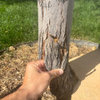
We have an established (40 ft.) Weeping Birch (I think it is a European-Dalecarlica). It is a beautiful tree, and why we chose this house 6 years ago. This year when it leafed out, there were many dead branches, that seemed to start with a thickening of a spot on the branch, and anything extending outward from this spot died. The bark on older places like this has split also. We cut out as much dead stuff as we could, but are afraid we might lose the tree. Anyone know what we might be fighting? We are going to do several deep waterings, and also perhaps give the tree a shot of iron (Ironite). Any suggestions would be greatly appreciated.

Thanks,

Erin

Comments (6)

  • 17 years ago

    Birches are in general a relatively short-lived plant as their ecological function is not to live a long time, but rather to rapidly colonize and provide stabilization and nutrients for successive, later plant spp.

    A 40 ft specimen sounds like a very old plant. Especially up there in an environment that doesn't favor bottomland plants.

    With the paucity of information provided, it is anyone's guess. Nonetheless, do not fertilized stressed trees.

    Maybe the watering will slow its demise, but IMHO you should start making plans for a new tree, and choose a replacement that is better adapted to that environment (that is: birches are about the last thing one would choose as a replacement). From my time spent on a Rez not too far north of there, I don't remember too many trees up there and a quick look on The Google finds few governments in the area willing to spend any money on recommending trees for their citizens, so good luck in using others in choosing your replacement. Gymnocladus ought to do fairly well, as would Quercus macrocarpa, and Fraxinus pennsylvanica, although the various ash borers are a concern. Many on these lists (esp the Gillette one) are to be avoided and the choices are more about wishful thinking and lots of work and inputs rather than realistic choices for a harsh environment with few naturally-occurring deciduous trees.

    Dan

  • 17 years ago

    dan staley's comment about the longevity of birches is accurate, but I would not give up yet. Diagnosis of tree ills at a distance are always difficult so don't rely totally on this, but the most likely thing effecting your tree is borers - bronze birch borer a good guess. The Dalecarica variety is especially prone to them, but they seem pretty inevitable in any birch. One (not totally consistent) characteristic of an infestation is that it seems to affect the upper branches first.

    I have had very good success in saving (I hope) a 20+ year old Youngii weeping birch from borers with Bayer Advanced Tree and Shrub systemic insecticide. This is pored around the roots and translocates throughout the tree. After one year of treatment there were noticeably fewer dead branches the following spring. I treated again this year.

  • 17 years ago

    look for borer holes .... see link

    if it has it.. be done with the tree ....

    i understand your attachment to the tree.. but you really chose the house simply for that tree ... ??

    i will not plant another birch ... as you now know... to much heartbreak once the borer hits.. and it will ...

    if you have to replace... find another type of tree ... EVEN if they claim certain birch are resistant ... because none of them will be around in 20 years for you to complain to ... when the resistant one gets them ...

    ken

    Here is a link that might be useful: 3rd line down.. second from left

  • 17 years ago

    Yes, I agree with the guess that it may be birch borers. From the information given, those sound like indicators for the insect.

    However, I focused on the suitability, practicality, and overall health of a tree that is normally found along watercourses being planted in semiarid steppe-grassland ecosystem.

    The tree is in a very suboptimal location and thus is prone to attack from pathogens due to its lack of adaptation to the environment.

    Surely you can attempt treatment, and it may work, but the inputs to keep that tree going are very high and if the parcel is on city water and soon they decide to price water properly, that tree will be gone as soon as the turf is ripped out.

    Dan

  • 17 years ago

    Thank you all for your input. I don't believe it is the bronze borer, as there are no exit holes, and the crown of the tree is not where the problem is. In further researching, it appears that there are several cankers forming on the tree, and it is beyond these points where the dead limbs are occurring. Dan, I live in Sheridan, and though we are considered semi-arid, there are numerous waterways in town, and a fairly high water table. There are hundreds of these European Weeping Birch trees here, and most do very well. I think the location of the tree (along a driveway and near the street) is a big part of the equation. I wish the former homeowners had not put it there.
    Yes Ken, we really did choose the house for the tree, and it is one of the prettiest in the neighborhood, so I do want to try to save it. Thanks Mainegrower for your encouragement.
    I read somewhere that evergreen fertilizer is the best for Birch- 30-10-10- any thoughts on that?
    Dan I don't think the tree is too stressed for fertilizer, and we are getting a lot of rain right now, so I thought maybe in a few days we would try that, and some really deep watering throughout the warmer months.
    Thanks again, and for any after thoughts you might have.
    Erin

  • 17 years ago

    Erin,

    That's definitely helpful and good to know the water table is high, certainly helpful for the tree; the tree has multiple stressors in the reflected heat and the stored heat in the pavement, disrupting the diurnal cycle of that tree, esp as they are adapted to areas that pool cool air, plus the underlayment doesn't allow roots to go to look for water (restricts root area).

    Nonetheless, despite the high water table, their life span is short and canker or other pathogen is an indicator of senescence, as is the tree's size.

    Cut off the cankers as soon as you can - preferably yesterday, but you don't want to compact wet soil - make proper pruning cuts on the whole limb and if it were my tree I'd disinfect the tool after each cut.

    Fertilizer on mature trees in general is a waste of money. Fertilizer on stressed trees is to be avoided. This is basic arboriculture. This is the standard ref and I served on a board with Harris, and he forgot more stuff than I'll ever learn, and if he says it I trust it, and he says it. Deep watering is fine, don't spend the money on a rental or Ross feeder - rather, stick a hose out there on trickle overnight on the uphill side.

    At some point in a homeowner's life they have to contend with the reality of tree mortality. Do what you can but don't place all your hopes in your actions, and make a Plan B. Good luck and enjoy the view to the west when this front passes and it clears.

    Dan