Software
Houzz Logo Print
fogrose

How do you irrigate a slope?

13 years ago

The southern side of my house has a plot of land that has yet to be tamed. It's approximately 45 feet long and 10-15 feet wide at a 30 degree slope.

My original idea was to plant large once blooming roses and let them cascade down the hill with our fall and spring rains being the only irrigation. California natives like Rosa woodsii and californica should be ok as that's what they're used to in the wild.

At one end of this are is a Deodor cedar and I plan on growing Rosa helenae up into the tree. Further back on another section of the slope I already have two Francis E. Lester ramblers growing and want to plant R. Brunonii La Mortola between them. Also thinking of Banksia lutescens. This area, like the rest of my garden is part shade, about 4 hours of CA coastal sun. Other recommendations are welcome.

So my concern is that at least while these roses are getting established I assume I'll need to irrigate but am concerned that the water would just run off if I set up sprinklers.

Appreciate suggestions keeping in mind that my budget is limited.

Diane

Comments (12)

  • 13 years ago

    A sizable contingent of my roses are on a steep west-facing slope. I use weeper hoses because I want to water the whole swathe (have groundcovers, etc. between the roses to prevent erosion). There are two types and I use both. The first is round and looks like it is made of rubber. There used to be a lot of them available and relatively cheap, but they've become scarce in anything but 1/2" diameter. The 1/2" diameter is useless; get the 5/8" diameter if you can find it, but that is increasingly hard to find (Gilmour still makes it).

    The other type is flat and covered in fabric and seems to be more widely available. There are two brands I've found so far, Gilmour and Melnor, which are pretty much identical. The best deal I've found is two 50' Melnor weepers sold together in a package at Walmart (can't remember the exact price, but somewhere between $20-30 for the package).

    You have to experiment with what length of time gives sufficient water for your plants with your soils, but think in increments of one hour, two hours, etc.

    I wouldn't use any length over 50' for either type of weeper (lengths run 25', 50', 75') because the idea is "low and slow" (to avoid run-off and not blow out your weeper) and the water pressure required for that is too low to make it to the end of the 75', in my opinion; better to set up separate 25' and 50' systems.

    That's my method: has worked okay for 10 years. I work it manually, but it could be made "automatic" with timers and junctions, etc. (but I'm too cheap for that).

  • 13 years ago

    Diane

    You are such a trooper. You rock, sister! Catspa's recommendation would be mine as well. I had great success with similar sites using her method. It's handy that she provided hose brand and length details. I'd add one thing--tarp stakes. These little doohickies are great and can be ordered in larger quantities from online landscape supply companies. If you go to Home Depot or similar, you'll only see packs of ten or so. The tarp stakes will keep the hoses in place on your incline. They fit right over the hoses and can be hammered into the ground.

    Carol

  • 13 years ago

    catspa and Carol,

    Wow. Thanks for the plans. I've already got some tarp stakes.

    My other question. Do you run a regular hose over to the weepers? It's quite a distance from a faucet.

    Hey Carol, my motto is...wherever there's some sun, there goes a rose.

    Diane

  • 13 years ago

    I have a lot of slopes in my garden, and one thing I learned is that the bottom of the slope is the moist part, and the top of the slope is the driest, even if you only water the top of the slope. Gravity always wins.

  • 13 years ago

    Diane

    I ran regular hoses from faucets to weepers. I'm not quite clear on your bed specifics, but depending on what you've got in terms of garden borders, hedges, and other cover plants you could try the following strategy.

    I had a client with a slope behind her house and a narrow fenced bed running along the side property. The faucet was on the side of the house. We ran a discreetly-colored hose through the narrow bed and down to the weepers. I staked it, threw mulch over it, and left it in place. I coiled the other end of the hose and stuffed it behind some shrubs. When needed, it was easy to uncoil those few feet and hook it up to the water source. When not it use, it was virtually invisible.

    I also peeled back lawns or dug under pathways, ran PVC through shallow trenches, and snaked hoses through the pipes. I only recommend this method for short distances.

    Does this help at all, Diane? Thoughts from Catspa or Hoovb?

    Carol

  • 13 years ago

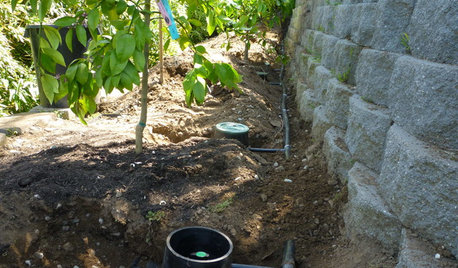
    For weepers where the connection is at the top of the hill, I connect the weeper to a permanently-placed hose concealed in the vegetation. The end of the permanent hose is conveniently at the bottom of the hill and I connect that to my regular hose. So, more or less Carol's strategy.

  • 13 years ago

    From the other side of the country, but from a geologic perspective, thirty degree slopes are right at the angle of repose for dry sediments.

    What this may mean is the addition of too much water may lead to slumping.

    Do neighbors of yours with the same slope on the same soils have problems when you get serious rains in winter?

    Is this rock and soil or rock and sediments or rock and rock?

  • 13 years ago

    We ran flexible tubing down the hill, and back and forth across it, with "bubbler" emitters for each rose.

    (Mind, the roses are all in BIG pots, sunk in the ground, with holes for roots to get out. Gopher protection. Without that, there would BE no roses.)

    That means we don't put any water on the rest of the hillside, which is covered with iceplant (which we did not plant). If we ever win the Lottery, we'll hire someone to eradicate the iceplant, and stabilize the soil.

    Jeri

  • 13 years ago

    I wish you were closer. I have a giant pile of old soaker hoses! I just did our veggie garden in a bunch of PVC 1/2" pipe and quarter turn shut off valves so I could control the water to each level.

  • 13 years ago

    anntn6b, I think it's sand and clay. We had problems but installed a french drain and now it's ok.

    Kippy, that would be great.

    Thanks Carol and catspa, sounds like what I had imagined I'd do.

    Then they're is always the plan of only planting once bloomers that will survive with just the winter/spring rains but I'll save that for another thread.

    Wish me luck.

    Diane

  • 13 years ago

    Good luck!

  • 13 years ago

    We are using drip irrigation on our slope plantings of roses, lavenders, and salvias with good success. Actually, we have drip everywhere. The different sized emitters allow us to vary the water to each plant. Our only problem so far is our Golden taking a short cut across the hill instead of following the path, and sometimes even stakes can't deal with those big hairy paws moving the lines.

    This post was edited by nancylee2 on Sat, Jun 15, 13 at 14:15