My builder uses Houzz Pro to plan the timeline and give detailed estimates and daily updates with photos of progress, and provide invoices at pre-agreed key points in the build. This made the whole experience much more efficient and stress-free.
I have heard that they don't like to be moved. Maybe I just needed to hear it again (:
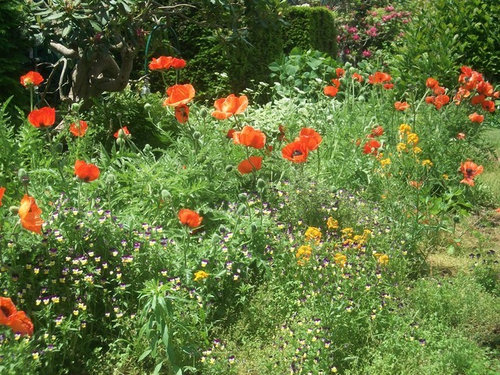
I guess I lucked out planting them from seed and getting them where they are now. They are abundant that maybe the gaps don't show except in my own mind.
I am looking for another color to plant in front of these. for contrast. Maybe a blue poppy or something...
orlaya or ammi, moon carrot or even bronze fennel.....in fact, quite a few of the umbel family would look well in that grouping. Sow directly right about now for an early show next year.
I forget which color is opposite on the wheel chart. Shades in blues, or purple? Perhaps a (very late?) flowering Iris germanica cv's. to coincide flowering times. Otherwise, a Japanese iris, as they definitely are the last to bloom. But, depending on where you are, (not to mention the weather) may affect actual slight variation in bloom time . So, possibly consider Siberian iris. When they flower next year, look around locally in nearby neighborhoods, to see what coincides with the schedule of these.
When I give directions to my house, people tell me that they get half the way down the street and know "exactly where the gardener lives".
This neighborhood is a desert of green manicured and well watered lawns. We once had rows of 50+ year old maple trees that shaded the houses in the summer but they are mostly gone because they mess up their lawns. I once saw someone using a shop-vac to pick up the leaves.
One neighbor complained to another that she should get rid of the dandelions in her lawn because they were drifting into his.
Go figure......
I am almost tempted to plant a Beech Tree as they don't finish shedding until late January and will pepper their lawns with leaves all winter. (-:
Your poppies are lovely. I would just sow some more seeds if you want them to fill in. I tried moving poppies once and killed them. :(
Sorry to hear about your neighborhood. I live in one almost as bad, but not quite. My area used to be mostly farmland, which was grown over with scrub forests, and also has large patches of woods. So the manicured lawns are often surrounded by patches of scrub etc., and since the electric company came in a few months back and took down hundreds of beautiful old trees, all along the street we now have massive thickets of weeds growing, right in front of all these manicured lawns. I guess no one stopped to think that the trees shaded out the weeds and kept them down. So anyway, it's a strange mix of manicured and unkempt, which is fine by me. (Although, I would of course rather have kept the trees. I think we were the only people on the street to say no to the electric company, for the one oak they wanted to take down. Others had up to 15 - no exaggeration, I counted! - trees taken down along the front of their yards. Shameful, IMO....)
Dee- IMO as well! I think it is shameful to take down useful trees for 'perfect' lawns because trees are so healthy for us and the birds and other critters. I have a friend who cut down a lovely tree because it's droppings "messed up the deck" and now she is complaining because it is too hot to sit out on the deck. And this is an otherwise smart woman! She is finding out that a replacement tree will take a very long time to give her any shade. One lifetime just isn't long enough to learn from some mistakes. Min
While we drift away from poppies,.... It is interesting to see how many people do not know how to place a shade tree. Oft time, trees are planted in the spring and located in with respect to the shade from the sun at that time. They do not take into account that the sun moves north in the summer (well here in North Am) and never get the desired shade in August.
More so, my neighbor had 4 50 year old Oak trees. Which one did she have removed last spring? The one that was due west of her house and at that time was shading the street. Now it is hot summer and the rest of her trees are still shading my house and she lost the shade for her's.
Hate to continue going off topic, but... Just want to throw out there that many of the trees taken down on my street were not planted by the homeowners - the majority of the trees removed were MUCH older than the houses in the neighborhood. Secondly, the removal is the electric company's answer to accusations of not being prepared for the last two hurricanes and Halloween snowstorms, which took out branches and trees and - more importantly to most people - left folks without power for a few days. Instead of maintaining a reliable and adequate work force, maintaining equipment and lines, TRIMMING trees and looking for weakness in them, and cutting their CEO's ANNUAL salary of 2.5 MILLION, or even considering underground wires, the electric company decided the best way to handle it was to cut down all trees, regardless of health or condition, on the same side of the street within 8 or 10 feet (can't quite remember) of the power lines. (The power lines zig-zag back and forth across the street, so both sides were affected.) Like the 70-foot oak 20 feet across the street from the lines might not take them out. Heck, why not just cut down every tree within 100 feet? And this was done in early spring, so I'm sure lots of folks were dismayed to find that their houses were much hotter this summer than last year. But that's a win-win for the electric company, as more people ran their ACs for longer periods. Pshaw.
But, back on topic, emerogork, I have to say I agree with gringo's suggestion of planting something purple in amongst those poppies which will bloom at the same time. That would look great!
The fabulous blue poppies are among the most difficult plants in the world to grow. You need conditions ideal for them--and if you don't have it naturally, they just won't grow.
I happened to look in my photo files, along with the pictures of my orange oriental poppies in bloom. There, were Canterbury Bells (biennial) 'Cup & Saucer' in deep violet blue, Colorado Columbine, 'Batik' Iris & Eryngium alpinum, which are easier by mail ordering bare roots., just like the Iris, but it's rather late in the season for iris rhizomes. As my photos are likey not resized properly for easier posting, using wifi... otherwise I would upload their photos. Sorry to read about any needless destruction of trees , as they really do provide shade & help reduce temperatures of homes, with proper placement & what can be destroyed so quickly, takes so many years to replace, after the mindless mistakes are made. Here, it is mass removal, usually for new housing, or shopping parking lots, without anything but tiny replacements, that will never do the job, anything nearly like, that which was so quickly removed.
Em, your poppy pic is lovely. As stated by other posters, they/poppies do not transplant well, if at all. My gardener-Mom told me many years ago, when she gave me her poppy seeds, that they won't transplant if I try to move them....so I had better know where I want them to grow from the get-go.
I have found accidental success only once in transplanting long-tap-rooted perennials and that has been with a gray/blue euphorbia last year. I watered generously after transplanting, then blessed it, lol and left it to fend for itself. It's growing like a weed! :-)
My suggestion would be to take ripe seed pods of existing orange ones and burst/scatter them where you want them to grow...they will do that on their own naturally as well, and fill space with time. I agree with Dee ... I really like the natural form your poppies have adopted. It really does look lovely! Adding blue columbines or purple ones might be another way to complement the gorgeous poppies. They too, seed prolifically.
Re blue poppies...(anemone poppy) I jiffy-potted some corms back in March 2012 then planted in the ground around April/May. They bloomed that year and the following year but died after that. If memory serves me, I tried to move them to another location and forgot about them...demise due to my neglect. :-(. I read on the packet "hardiness zone 6" and up, so I was really lucky to have them return the following year...and bloom!
I will definitely plant more corms next spring. Blue colour is stunning as is the dark fern-like foliage.
The oriental types will transplant easily enough....in fact, a minuscule bit of root will rapidly regenerate into a new plant so transplanting a whole plant with all those fat roots is generally a piece of cake.
Now I have heard both extremes. A) It will never work because they have an extremely deep tap root. B) Go head, it is easy. (!!!)
In the spring, I will transplant one that is growing a bit too near the others. Either it will survive or it will not. It is the way I treat all of my transplants.
For the most part, if I question the move, I end up moving only a part of the plant if I can. Therefore if it doesn't survive in the new location I still have it in the original spot.
I still need a contrasting color to place in front of them though. According to my GDD chart, Columbine blooms at the same time but I feel that the flowers are a bit small for effect. Maybe I will find an annual that tolerates the dryness of this part of my garden.
I would love to place Blue Poppies there but have not had any luck sprouting them.
This post was edited by Emerogork2 on Sun, Sep 28, 14 at 20:16
Your poppies are beautiful! I work at a nursery, and we don't sell many poppies just because they are a tap-rooted plant that doesn't fare well in a pot, and mature plants do not take well to being transplanted. However, if you take an offset from the base of the mother plant in the spring, you will fare well in successfully transplanting it. For contrast, how about trying a dark salvia? Caradonna is my favorite, a nice, dark purple, and would look lovely with your poppy.
I agree whole heartily with Campanula. "The oriental types will transplant easily enough....in fact, a minuscule bit of root will rapidly regenerate into a new plant so transplanting a whole plant with all those fat roots is generally a piece of cake."
In MI, at least... O. poppies are easily propagated as long as you keep the roots moist. In fact, can become invasive from just a small piece of root taken and not even realizing because the entire plant goes into dormancy in summer. Mertie
I agree with mertie and campanula. I've moved oriental poppies many times.....or at least tried to move them :-) They relocate easily enough but generally, they will reappear at the old site as well, regenerating from some small piece of root that got overlooked.
Himalayan blue poppies, Meconopsis spp, are an entirely different can of worms and require rather rarified and specific growing condiitons to do well. Some areas of New England may work, the PNW and parts of the UK but otherwise it's pretty much an exercise in futility attempting to grow them.
btw, poppy anemones are not poppies (Papaveraceae) at all but a spring flowering bulb and may be a lot easier to encourage in a garden than the very finicky Meconopsis.
Do you grow meconopsis, GardenGal? Exercise in futility is on the button there (having tried....and failed more times than I wish to publicly confess). Almost a reason to move to Scotland.
The blue ones, no. Far too fussy for my taste. Tried 'em from seed...no joy there. Already started plants are hard to find and tend to be much more monocarpic than I'd like for the effort and the expense. I've done Meconopsis paniculata for its great foliage and didn't mind if it didn't bloom much. But in general, not long lived plants at all. Even Butchart's Garden grows them as annual bedding plants, starting and planting out a new crop each year.
Except for Meconopsis cambrica, which was a flipping weed in my old garden. And maybe the least appealing species of the genus.



pitimpinai
emerogorkOriginal Author
Related Professionals
Huntington Landscape Architects & Landscape Designers · Martinsburg Landscape Architects & Landscape Designers · Manchester Landscape Architects & Landscape Designers · Tacoma Landscape Architects & Landscape Designers · Gloucester Landscape Contractors · Nashua Landscape Contractors · Portsmouth Landscape Contractors · Janesville Landscape Contractors · Colorado Springs Landscape Contractors · Lubbock Landscape Contractors · Missoula Landscape Contractors · Tacoma Landscape Contractors · San Marcos Home Builders · Lebanon Home Builders · Superior Home BuildersUser
gringo
emerogorkOriginal Author
dbarron
diggerdee zone 6 CT
Min3 South S.F. Bay CA
emerogorkOriginal Author
diggerdee zone 6 CT
emerogorkOriginal Author
laceyvail 6A, WV
gringo
User
josephines167 z5 ON Canada
User
emerogorkOriginal Author
Kirstin Zone 5a NW Chicago
Mertie
Mertie
gardengal48 (PNW Z8/9)
User
gardengal48 (PNW Z8/9)