Software
Houzz Logo Print
mxk3

Chelone (turtlehead)

17 years ago

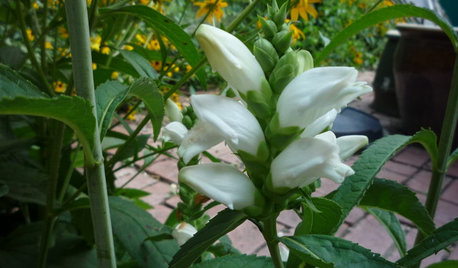
Anyone grow the white cultivar of Chelone? I picked it up on the clearance rack last fall and don't have the tag with the cultivar name, but I don't think there are many white turtlehead cultivars - ?

Anyway, I'm wondering if it is common for the white variety to flop. I have a large stand of "Hot Lips", and they never flop, the stems are always sturdy and upright even when in full bloom, even after a rain.

However, these white ones are flopping like crazy; actually, I don't think there were two upright stems out of three small plants all summer. Location is part-shade, average soil tending toward being a little on the dry side, planted near Solomon's seal, hydrangea, and a mish-mash of other shade tolerants.

Thanks for any input :0)

Comments (16)

  • 17 years ago

    I don't have white but I do grow the rose one. I know that they do prefer a moist area with either full to part sun. You will need to water it more then your other plants or move it to a wet location. If you get any seeds, I would interested in a trade.

  • 17 years ago

    i think the white flowered Chelone is a different species from the pink - white = Chelone glabra, and pink = Chelone lyonii. Both native to the US with similar cultural specifications.

    I have C. lyonii, growing in an awkward place being engulfed by evergreens, without too much sun, however like yours they are not floppy. I am planning to move them either this fall or next Spring.

    Maybe you could pinch them during the summer to prevent flopping?

  • 17 years ago

    The flowers of C. glabra, which is commonly referred to as the White Turtle-head, is often white, with a red to rose tinge.

    There is also, C. obliqua 'Alba', a pure, white-flowered form of the Rose Turtle-head.

    I would think the floppiness is related to the soil, either type or moisture, etc.

  • 17 years ago

    I think your floppiness may be due lack of sun rather than moisture issues. I have both chelone obliqua 'Alba' and chelone 'Hot Lips' They grow side by side in a full sun position in a location that is wet in the spring and early summer but dries out by end of July/August. While the 'Alba' has never flopped it is crispy and brown looking by summer's end. In contrast 'Hot Lips' always looks good unless we have a particularly hot, dry summer.

  • 17 years ago

    Just for the record, there is no such thing as a WHITE cultivar of the PINK C. obliqua. Therefore, "C. obliqua 'Alba'" and whatever sold under this name in reality is a native C. glabra.
    C.glara, if grown in shaded conditions, will grow to 3.5-4' tall and flop, but could be cut in a half in mid-season and still bloom on time (Aug-Sept) being 2.5-3' tall.
    Unlike C.obliqua or C.lyonii, C.glabra is VERY prone to powdery mildew and will not tolerate dry spells without supplemental watering.

  • 17 years ago

    ego45, what makes you so sure that there is not a white variety/cultivar of C. obliqua?

  • 17 years ago

    Chelone glabra

    ..............................................
    Noteworthy Characteristics:

    This species of turtlehead is a stiffly erect, clump-forming, leafy-stemmed, Missouri native perennial which typically grows 2-3' tall and occurs in moist woods, swampy areas and along streams mostly in the southeastern part of the State. Hooded, snapdragon-like, two-lipped, white flowers with a tinge of pink appear in tight, spike-like terminal racemes from late summer into autumn. Flowers purportedly resemble turtle heads. Coarsely-toothed, lance-shaped, dark green leaves. Synonymous with C. obliqua 'Alba'.
    ...............................................

    Link to the source (reputable!) is below

    Here is a link that might be useful: Chelone glabra at MBG

  • 17 years ago

    Yes, I've seen some sources say the same, but I've also seen other (very reputable) sources saying otherwise! ;)

  • 17 years ago

    Fine.
    Then what is the distinction between C.glabra and C. obliqua 'Alba' IF they are not the same?

  • 17 years ago

    I am by no means a Chelone expert. I simply wanted to know your reason(s) for being so adament above that C. obliqua 'Alba' does not exist.

    Dr. Allan Armitage of the University of Georgia lists it in the third edition of his treatise, as does the standard reference work for the ISU (Internationale Stauden Union) and the PPA (Perennial Plant Association), which see link below.

    I would suggest that it is possible that the original description of C. obliqua var. alba is synonymous with C. glabra, but that it is also possible that C. obliqua 'Alba' does indeed exist.

    Here is a link that might be useful: List of names of perennials

  • 17 years ago

    The MBG database lists the colors for C. obliqua as "rosy purple, pink, or white". So it is logical that there are white cultivars of this species.

    However, I would guess that there is a lot of confusion on the Internet and in the actual nursery trade about where plants come from and how the name is slapped on the tag. Thus, even if you did buy a plant with a tag that says "C. obliqua 'Alba'", it could very well be C. glabra. So how would you know for sure which species or cultivar you are getting (and does it matter)? This type of scenario is probably not all that uncommon.

  • 17 years ago

    Taxonomy can be so much fun! Even C. glabra is described as variable. Who knows, maybe the two species themselves are really one and the same with several variants. ;)

    Like you said, white-flowered forms are not uncommon in most plants. The only way to tell the difference, would be to find out the technical differences between the two species, and key-out whether one's white-flowered Chelone is truly C. glabra or C. obliqua. The only reason it might matter is to avoid the aforementioned mildew problem, or possibly hardiness concerns.

    In anycase, they're beautiful autumn-flowering plants.

  • 17 years ago

    Many hobby gardeners don't even know the botanical name or even the species of the plants they grow, and may not care, so the nomenclature (accurate or not) on the tag is adequate.

    But having an accurate identification of the plants I grow is quite important to me, because of my scienific nature and for a number of practical reasons. I like to grow natives, and particularly those native to northeast US - must have an accurate ID for that. I do a lot of work removing invasive plants - must have an accurate ID for that. I enjoy observing and identifying plants growing in the wild. Etc.

  • 17 years ago

    So, let's summarise what we know so far about species.

    C. glabra = white only, flopping, PM prone,
    C. obliqua = either white or pink, erect, no PM,
    C. lyonii = pink only, erect, no PM.

    Now imagine, you are walking into nursery and see 4 pots (2 white and 2 pink) on a bench without the tags and you have to ID them.
    Here is what I'do:
    -dark(er) pink flowers+ dark(er) green leaves = C.lyonii,
    -light(er)pink flowers+ light(er) green leaves = C.obliqua,
    -white flowers+ somewhat unhealthy foliage = C.glabra,
    and
    -whatever left is must be C. obliqua var.alba (not an 'Alba') if it has a clean foliage.

    What would you do?

  • 17 years ago

    Well, I distinctly remember when I bought them late in the season they were covered with mildew - but hey they were only a couple bucks each on the clearance rack, and I figured they would be fine in the spring.

    So, they must be C. glabra...

    BUT - while they flopped terribly, they did not have any powdery mildew on them whatsoever this year.

    Should I move them to a sunnier location or offer them more water (or both)? Or should I chalk this one up to a learning experience and trash them?

  • 17 years ago

    I'm going to guess that the mildew is subject to variables such as region and/or other stresses.

    As for the floppiness mxk3, yes I would try both more sun and increased soil moisture.