

campanula confusion!
I have a question, everyone! I've always eyed campanulas in the catalogs, and would like to add some to my garden. But I often hear about their aggressiveness, even invasiveness.
I know there are severaly types. Can someone clarify for me which ones are thought to be thugs and which ones are "safe" for the garden? I don't mind spreading, but I don't want the garden taken over.
Thanks!
:)
Dee
Comments (25)
 19 years ago
Korean bellflower (Campanula takesimana) is one that I have heard can be a thug here. Campanula punctata (there's a well known cultivar of this called Cherry Bells, I think) is another that I have so far resisted buying as well... only because it is supposed to be rather aggressive also. They're both pretty plants.
- 19 years ago
I grow C. persicofolia (white and blue) for 4 years and except slowly increasing clumps didn't noticed any volunteers, though I simply cut 1/3 lenght of the stem after the main flush and it will regrow and rebloom in August-September.
C. poscharskyana (forgot the cultivar name, sorry) seems like want to spread indefinitely, but be it self-seeding or self-rooting I have no clue since all my beds are constantly mulched. At least I don't see it in unwanted (far away) areas.
BTW, my C. poscharskyana being planted in part shade aspect spreading mostly toward the shade, not the sun.
Is it my imagination or anyone could confirm? Related Professionals
Toms River Landscape Architects & Landscape Designers · Orangeburg Landscape Architects & Landscape Designers · San Marcos Landscape Architects & Landscape Designers · Sugar Land Landscape Architects & Landscape Designers · Morgantown Landscape Architects & Landscape Designers · Augusta Landscape Architects & Landscape Designers · Redding Landscape Architects & Landscape Designers · Columbia Landscape Contractors · Orangeburg Landscape Contractors · Muskegon Landscape Contractors · Lebanon Landscape Contractors · Lake Charles Home Builders · McComb Home Builders · San Antonio Home Builders · Hackettstown Home Builders- 19 years ago
Campanula punctata "Cherry Bells" is evil. Absolutely evil. Runners take off in all directions, new growth springs up several yards away and attempts to strangle other plants. My punctata purchase was my first experience with campanula going completely out of control, and I'm still weeding it out from several seasons ago.
On the other hand, campanula carpatica (blue or white clips, and blue or white uniform) are low-growing, but very tidy and well-behaved campanula. They're a favorite front-of-the-border perennial for me.
{{gwi:285050}}For a taller variety (18-20"), Campanula Sarastro has been in my garden for only a couple of years, but has so far stayed relatively in bounds. The clump has increased, but in a manageable way.
{{gwi:285052}}
I was plenty leery of Sarastro because it's a hybrid of punctata and another species, but so far so good, and the flowers are a pretty deep blue-purple. I do keep a close eye on it though, because I feel as though I can't quite trust that bloodline of Sarastro!
- 19 years ago
ditto punctata can be dangerous. I got 'Cherry Bells' for a tough and ignored area and it has not been too bad. So last year I got another punctata, 'Plum Wine', for a more cultivated area in part shade. It quickly showed signs of trouble... It may have to be moved to a less hospitable area. But it did bloom all season...
- 19 years ago
Blue Clips is *so* well behaved, it always leaves before it has worn out its welcome. IE I can't get the blasted thing to survive for me, although it should be perfectly hardy here; it may be our acidic soil, maybe not.
I've also had good luck with C. persicifolia (peachleaf bellflower) which has self-seeded strongly but not aggressively for me.
This one is still blooming; I'd been concerned that it might be C. poscharskyana, but it doesn't look like the photos I've seen of that one.
{{gwi:285055}}
I picked up some C. glomerata (Clustered Bellflower) at a benefit plant sale, and have been regretting it for years. Very aggressive in my garden, and doesn't bloom well for me.
- 19 years ago
Good thread. So far, I've thrown out a packet of C. punctata and one of C. glomerata, based on these reviews.
- 19 years ago
Hi Dee, 'Blue clips' has twice disappeared on me before a full gardening season has finished. I got C. 'Sarastro' last year and by this year it seemed to be spreading like a groundcover-a bit too fast for me and didn't bloom that long-wonder if it was mislabeled. I love C. persicifolia-it spreads gently, maybe by seeding. Delicate looking blooms. Here is a photo with some perennial foxgloves.
{{gwi:285058}}
- 19 years ago
Isn't Monique's photo sublime? What a lovely soft combination.
Just a couple that haven't been mentioned --
C. lactiflora. This is an excellent garden species, about 3-4' in height, and very long blooming especially if deadheaded or partly cut back after the first main flush. Wonderful companion for shrub/english roses. Blooms mid June - mid July with smatterings of flowers after that. Pritchard's Variety is a good rich lavendar, there are pinkish forms (but what's the point? Campanulas are about being BLUE right?). Pouffe is a relative dwarf, 1-2' tall. One GREAT advantage of this plant for those troubled by woodchucks is that it is realtively browse resistant. Be aware that woodchucks LOOOOVE campanulas and will mow most species to the ground.
C. rotundifolia 'Olympica' is a great plant for a slope. rock wall, gravel bed, blooms for months with its airy sprays of delicate flowers. Plant it where you will see it up close.
C. 'Resholt' (can't recall the species) is a perfect plant for a rock wall or someplace where it will trail over the front of a border. One beautiful flush and a smaller second one if cut back. It will reseed gently in a wall, and people will think you are an artist for putting it in exactly the right places, which it finds on its own.
I also like 'Kent Bells'. There are many others too. I will look for some pics from my old garden when I have a chance.
- 19 years ago
The good thing about the more aggressive campanulas is their ability to handle dry shade, where that aggression is controlled. We have a lovely clump of Campanula takesimana in the dry shade of a mature spruce, right up to the trunk and under the branches of the tree. It blooms consistently for about two months in summer, and sometimes repeat blooms in fall, if I remember to cut off the seedheads. The patch has never been fertilized and has received no irrigation - not even on the day it was planted. I wouldn't be without it.
diggerdee zone 6 CT
Original Author19 years agoMonique's photos are *ALWAYS* sublime!! I want to live in her garden, lol!
Wow! Lots of info here. I'm going to have to sit down and go through all these comments and sort things out. Thanks so very much for all your help, everyone! Luckily, there are so many kinds, all of which seem so beautiful, that I'm sure I can find a beautiful, "safe" one!
Actually, now that I think of it, I believe I bought Kent Belles many years ago, before I knew to research plants before buying. I stuck it out by the street in poor soil, (before I knew about soil amendment, lol) and kind of forgot about it. Every year I would be surprised to see a few blooms on it, and then promptly forget about it again. I unwittingly planted a variegated red-twig dogwood almost on top of it, and I do think I saw some growth of the Kent Belles at the dogwood's base this year, but no blooms.
I suppose I should see if it is still alive in the spring and move the poor thing to give it a chance. It certainly hasn't made a move to take over my garden, lol, so it should be okay.
Thanks again for all your help - and keep the suggestions and photos coming please!
:)
Dee- 19 years ago
Hi there! Im not an expert on Campanula, but I have quite a few in my own garden, so I can at least tell you how they are for me. I agree C. "Cherry Bells" and "Sarastro" are terrible. I have the Cherry Bells (and my nighbor has Sarastro)both have the same problem; they spread like crazy and only bloom for a short while. In fact, mine only bloomed for about a week. I have several others too. C. medium, Canterburybells, is I biennial. Its pritty, but gets a little stragly. C. glomerata, Clustered Bellflower, has so far preformed well for me and hasnt spread. My personal favorites are C. persicifolia and C. uniform. I have two C. persicifolia; one is a double blue ("La Belle"), and the other is a plain white one. Both are great and are not aggressive. My C. uniform is great too; ive had it for three years and it doesnt spread, it only forms a small mound.
CMK diggerdee zone 6 CT
Original Author19 years agoJust wanted to thank *everyone* again for all the input. I sat down with this thread and really read it through and did some looking around on the web and in catalogs, and all the info here really helped me.
I was eyeing a campanula rotundifolia (British Harebell) in T&M's seed catalog, but was worried - wildflower + campanula's reputation = hesitation, lol! So thanks for the opinion on that one, David.
Gotta go make some decisions! Thanks again all!
:)
Dee- 19 years ago
I just found this wonderful webpage on campanulas with photos and good descriptions. Check it out.
Here is a link that might be useful: campanulas demystified
- 19 years ago
I have several different campanulas, many of them from seed.
In my shady garden they are pretty well behaved, Kent Belle stays the same for several years, punctata does send few runners here and there but easy to take out and joy to bloom in shade- have to appreciate anything that blooms prettily in shade.
If you afraid of campanulas, look at symphyandra- realtive of campanula but better behaved.
I have s. pendula and it blooms itself to death- literally. Easy from seed too. - 19 years ago
I've never been able to get either the Clips series or even Cherry Bells to last for me. Guess they don't like clay soil! (what does?)
The one campanula I still have is punctata "Hot Lips" - but I have it in a confined space as a ground cover for a difficult area. Works great!
- 19 years ago
That's odd, gdionelli - my last garden was shady and clay soil (for about 6" and then bedrock, I swear) and I had blue and white clips and C. persicifolia all doing pretty well there. The clips are a lot happier in my new backyard with better drainage and full sun... but they were reliable blooms at the old place too.
Then again, if even Cherry Bells are pooping out on you... I don't know what to think! ;-)
diggerdee zone 6 CT
Original Author19 years agoJust wanted to say thanks again to everyone for their suggestions, warnings, links, etc. I placed an order for a couple of campanulas today - one carpatica, one persicifolia, and one lactiflora.
Sorry david. While I agreed with you when I first read your opinion on pink campanula, I have to confess to being sucked in by the photo of the pink lactiflora. I just couldn't resist, especially after buying two blue ones!
Thanks all!
:)
Dee- 19 years ago
I just ran across this thread and have to differ about Sarastro. Here in Chicagoland, it is wonderful! Long blooming and not at all agressive. Persicifolia, on the other hand, has gotten out of control in my garden, popping up all over the place. It's so nice, I haven't the heart to rip it out. I also prefer Campanula "Samantha" to the carpaticas. It blooms forever and has great scent. I really like Campanula garganica "Dickson's Gold," but it is not happy in my garden. I've lost one already, and I keep moving it around, trying to find a place where it's happy.
- 15 years ago
bumping because when searching for samantha I found this had a lot of good info
- 11 years agolast modified: 11 years ago
In a nutshell re campanulas or any perennial: if it's a RUNNER - ie the roots "run", avoid it like the plague - especially if it is a prolific seeder! (except for C. poscharskyana - low and easy to eradicate where you don't want it). It's true, as some have said, that growing these thugs in leaner, dryer soil or shade will control them - somewhat. But - IMO - you're still responsible to NOT let them go to seed - ever. If that is "too much maintenance" for you, please do not grow them.
CLUMPERs grow in place - their roots don't run all over the place, so even if they self-sow a bit, you can weed them out, unlike that devil thug, C. punctata - which you should never ever ever plant in clay soil. Ever. It should be on every noxious weed list anywhere, along with orange alstroemeria, lysimachia punctata ("punctata" is another hint which can = BAD WEED.)
To be a responsible garden neighbor and steward, ideally, it's best not to let anything that could invade or get away from your land and become a problem on natural land or someone else's property, invade or go to seed. Whatever you do, resist the urge to roto-till places where you have "runner" roots!
If you have seeds or even flower heads, Please do NOT throw the seeds in your compost - these must be dealt with as garbage! The best way to ruin their viability is to put them in a black garbage bag and let them "cook" in the sun (160 degrees F is the only thing that will "kill" these seeds) before you put them in the landfill. Yes - I'm serious. I know of what I speak, on this subject. :)
- 11 years agolast modified: 11 years ago
I'd say there's several aspects to using "runners" in perennial gardens; two of which are: how bad a runner the plant is in the local growing conditions and how much time and effort the gardener is willing to spend in controlling the plant. I've maintained Lysimachia punctata in a larger mixed perennial garden for years, though I do keep a special eye on the plant, chopping around it several times during a growing season.
I do, however, draw the line at Campanula punctata (I've never used Roundup or other herbicides in gardening). To eliminate this Campanula, manually, takes effort and time. The network of soft white fibrous roots breaks apart as it's being removed from the soil.
I'm still not sure about using C. takesimana.
Campanula 'Sarastro' is fine. It's parentage may include C. punctata and C. trachelium. Campanula trachelium may not be as showy a plant as the C. punctata I once used, or as showy as 'Sarastro', but it seems quite well behaved.
Needless to say, however, especially when dealing with a lot of different perennials, planted and maintained close together, it's best to avoid running perennials altogether.
 11 years agolast modified: 11 years ago
Kent Bells in my garden with sun and ample moisture will spread 3'in a year and grows too tall to hold its self up. It was easy too eliminate thou. I do have a campanula (port) Royal Blue who's true identity I'm unsure of that has survived three years here and is regrowiig for a fourth. Blooms all year and spreads slowly. The clips have never survived for me. Very much looking forward to Tendenza blue one campanula from Denmark it really looks good.
- 11 years ago
The campanula with astrantia; very nice AM.
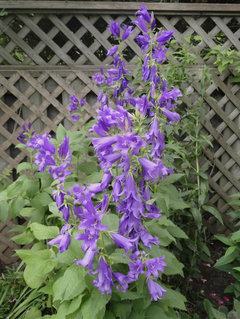
I've found Campanula 'Kent Belle' a flopper too. Among the tall Campanulas, I've found Campanula latifolia 'Brantwood' (below: June 23, 2014) a much better choice from that point of view. Nevertheless, even then, I still do some staking to keep a clump compact (usually one stake and twine put once around the whole plant).
The hollow metal stakes with a green plastic covering are so much nicer than the bamboo stakes. Apart from not rotting, if strategically placed, they can even be difficult to see.
- 11 years ago
A little OT but...I don't pay the big bucks for fancy plant supports anymore, I went and bought a roll of wire and some rebar, cut the rebar and wire to whatever lengths needed, cut and twist the wire around the rebar and make a hook on each end. Push the rebar in at the back of the plant, circle the wire around the plant and hook the ends together. The whole thing disappears into the foliage, you'll never know it's there.
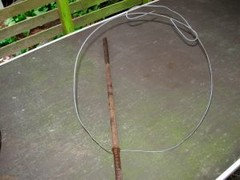
If you make the loop around the rebar a little looser you can slide it up and down to whatever height needed, use whatever's handy to hold it in place, I've even used a clothespin ;).
Annette

aftermidnight Zone7b B.C. Canada