

Le Vesuve
I've heard so many good things about this rose that I'm considering adding it to my small garden.
I'd love to know the mature size of Le Vesuve since the pictures I've seen make it look MASSIVE. Can it be pruned to keep it in check or does it resent pruning?
Comments (45)
 14 years ago
I don't grow this rose, but I have seen it at the Antique Rose Emporium near Brenham, TX. They have a plant of it that they keep pruned to a smaller size (maybe 4-5 feet) near a building. I only go there 3 or 4 times a year, but it always seems to have flowers on it. ARE states that it can be kept smaller on their website.
Here is a link that might be useful: Le Vesuve at ARE
- 14 years ago
I was at ARE recently and saw their plant, it was lovely and full of blooms but they told me the only drawback was that it is very thorny. I didnt get it because of that reason, [I am not sure I want to tackle pruning a huge thorny bush] but it was really lovely, lots of blooms.
Related Professionals
Johnson City Landscape Architects & Landscape Designers · Lebanon Landscape Architects & Landscape Designers · Jamestown Landscape Architects & Landscape Designers · Hudson Landscape Architects & Landscape Designers · San Luis Obispo Landscape Architects & Landscape Designers · Decatur Landscape Contractors · Fort Myers Landscape Contractors · Indianapolis Landscape Contractors · Asheville Landscape Contractors · New Haven Landscape Contractors · Lansing Landscape Contractors · Muskegon Home Builders · Lima Home Builders · Amarillo Home Builders · Evanston Home Builders 14 years ago
It does have lots of very sharp prickles and because its slender canes grow in a very criss-cross fashion it can get ya if you reach in carelessly, but my goodness, that's not a good enough reason not to grow this rose. There is no need to mess with it except at pruning time, and my leather gauntlets were more than sufficient to prevent getting stuck. This rose doesn't even need to be deadheaded. They drop off fairly quickly and the roses keep coming. But snapping off the deadheads is easy and perfectly safe.
Jeff, it will get massive here, I'm sure, since it grows headlong from March until the hard freezes come at end of Dec or early Jan. In your zone I'm also sure you can keep it reasonable without much problem. Don't know how it will handle your low-teens (or below) temps. It didn't bat an eye at a few hours of 18 degrees which is the lowest I've had in my garden. And we don't have snow and ice either. (Yay!!) I think you'd enjoy this rose which is healthy and blooms with abandon in the heat.
{{gwi:322899}}
Sherry
Here is a link that might be useful: If only sweat were irrigation...
 14 years ago
I've noticed with my teas that once they've had a few years of solid growth they don't seem to mind pruning. I don't mean hacking them down to half their size would be to their liking but, once they've attained the size you want, keeping them at that size doesn't seem to hurt them. I'm careful with delicate growers like Cels Multiflora or Duchesse de Brabant, but at least for me size has not yet become a problem after about three years.
Ingrid
- 14 years ago
Usually, light "lacing", thinning of the plant, not really removing more than a quarter to a third of an old Tea or China, particularly in a climate they obviously like, won't damage them long-term. It's when you "exhibition prune" them, as they do budded HTs to produce the over sized blooms, and like "garden manicurists" do to people's rose bushes, that you weaken and eventually destroy the plants.
Back in the early nineites, the local rose society decided to hold a pruning demo at The Homestead Acre in Chatsworth, where Annie Laurie and her husband had recreated gardens of historic old and interesting new modern roses. "Exhibition pruning" of well established Teas, such as the formerly six foot Rosette Delizy, down to less than two feet, nearly killed the plants. It took MANY years for them to recover from that treatment. Some never did. Kim
- 14 years ago
Both Perle d'Or and Mlle. Cecile Brunner are reportedly half Tea and have inherited that trait from that parent. Both (at least in bush form) have reputations for hating severe pruning. Another instance of when knowing what's behind the rose can give excellent clues what to do, or not to do to/for them.
A long time ago, I had the honor and pleasure of being given a tour of the Korbel Winery gardens by Phillip Robinson. The old Korbel home had an enormous Perle d'Or at the corner of the house. It had never been severely pruned and it was easily eight feet tall, full of healthy foliage and flowers. I'd learned Cecile hated hard pruning and felt Perle might, also. This one, compared to all of them I had seen previously, proved it. It's amazing what some of these can develop into when permitted to just make themselves happy. Kim
gardennatlanta
Original Author14 years agoSince I really want to give this rose a try, I'm going to take what you've all said as a "yes", I can keep this rose in check at around 5X5 to 6X6 without causing it undue harm. Let me know if I'm wrong. Ok, only let me know if I'm REALLY wrong. *smiles*
- 14 years ago
I just got one myself. I would like to see it big. I'm thinking about where to place it.
Rosefolly
 14 years ago
Jackie -- You would LOVE the Pruning Demo given every year at the Stagecoach Inn Heritage Rose Garden in Newbury Park, CA.
It's done by the Ventura Co. Rose Society, WITH the Gold Coast Heritage Roses Group, and it is aimed specifically at Teas, Chinas, Noisettes, Poly's, and the like.
This year, the date is the morning of January 14, (9 A.M. til Noon) at the Stagecoach Inn 51 South Ventu Park Road Newbury Park, CA 91320-3938 (805) 498-9441
No charge. Donations for coffee & rolls appreciated. :-)
Jeri
 14 years ago
I made the mistake of driving by my old garden the last time I visited Alabama. Beautiful Marie Van Houtte had been cut down to two feet. Like a beautiful girl with a shorn head. Made me cry.
And I have a Le Vesuve up here also, two years old. It is very healthy and has weathered the winters just fine. It has even bloomed some! I'm really curious to see how large it gets up here.
{{gwi:322900}}
- 14 years ago
Gean, how sad that MVH was cut back like that. I don't blame you for crying. Sometimes you can't look back.
I didn't know you have Le Vesuve. It's just as beautiful up there as it is down here!
Sherry
Here is a link that might be useful: If only sweat were irrigation...
- 14 years ago
Sherry, that's sweet, thank you. It is a really nice rose; I think mine was one of the Ashdown roses that was delivered not too long before we left to come up here.
Jeff, I don't think you'll be sorry you invest in it. I hope it gives you pleasure for many years to come.
- 14 years ago
And it's not just the Teas and Chinas that are brutalized. At the public herb garden where we grew old roses, some volunteer cut back a Damask "by one third". When she was informed that the rose would not bloom the following year she and several others said, "Oh no, the experts say to cut back the roses by one third". And this has happened more than once. Sigh.
Cath
- 14 years ago
In truth, a LOT of this does come from local ARS Rose Societies.
I know they don't MEAN to do harm, but I have observed that, not-uncommonly, there really is a lack of understanding that not all roses are Hybrid Teas. That, moreover, not all HTs really benefit from that sort of pruning -- or not in all microclimates.
I don't know what you do about that.
The mis-information is disseminated in a sincere desire to do good, after all . . .Jeri
- 14 years ago
Cutting it back by a third isn't necessarily a bad thing, depending upon WHEN it's done. Perhaps, if the offending pruner was educated to wait to cut it until after it flowered, that mistake could be corrected in their behavior and those they might affect? It's often difficult getting people to think of once flowering roses as they would hydrangea, azaleas, lilacs, fruit trees, etc. They're so used to HT, floribunda and minis, they figure they're going to bloom no matter when and how they're hacked. Seems the ARS has done a really good job of their stated mission of "education", doesn't it? Kim
- 14 years ago
From the early mid-20th century onward, most of the roses most of the people were growing were HTs, floribundas, a few polyanthas and the odd climber. For these roses this advice made pretty good sense. Now that there is an increased interest in a wider palate of rose types, that old advice makes less sense, but unfortunately has become accepted as the established wisdom.
- 14 years ago
Sorry - I meant 'palette' as in an artist's board laid out in colors from which to select, not 'palate' as in the roof of the mouth. I suppose that could sorta work, if you thought of it as taste, but I meant the first one.
Rosefolly, who loves words almost as much as roses
- 14 years ago
Much of what we know about roses, or accept concerning how to grow them is simply plagiarized, repeated, inexperienced, accepted "wisdom". Pick up the majority of "rose books" and read the culture section. In many cases, it's verbatim from several books you have already. Like very many of the newspaper articles you've read about roses and many other subjects, there is a body of standard information which is simply repeated with little to no research and most often, no personal experience.
Exhibition pruning originated in Edwardian and Victorian times with the Hybrid Perpetuals and Bourbons. So many of them grew so "exuberantly" and were so stingy with their flowering, they had to be severely over-fed and harshly pruned to see flowers. Many of the iron winning HTs are those which can be abused like that, so it continues on blindly, even when it isn't suitable for the climate or type. Banksiae was grown for many years in England before they ever saw a bloom on it, because of their standard pruning practices. It wasn't until they didn't hack it to the ground, it matured and bloomed. Kim
- 14 years ago
Kim says 'Much of what we know about roses, or accept concerning how to grow them is simply plagiarized, repeated, inexperienced, accepted "wisdom". Pick up the majority of "rose books" and read the culture section. In many cases, it's verbatim from several books you have already.'
So very, very true. I have found that it actually does a disservice to read much of the gardening press since it is a muddle of poorly repeated 'chinese whispers' or worse, they are trying to sell you something. In these days of celebrity and TV gardeners, it pays to only read books from 'proper' gardeners who have many years of experience....and then to remember that they accrued their experience in a very different situation to your own. Thankfully, this is one of the great benefits of mass communication via the internet - we get to speak to each other, passing on tips and advice without the added pressure of money, ego or status. - 14 years ago
Amen! Thanks, Campanula. One of the worst things here to overcome is the "knowledge" gleaned from British writers concerning culture. I know it worked there for them, but it DOESN'T translate to the SoCal desert climates. The original plant descriptions in Austin's catalogs were of even less use here. His description of Graham Thomas being a "mannerly, five foot shrub" resulted in many planting the 12-15' climber as a bedding rose. In many instances, there is little to no flowering and even less repeat when hacked to maintain a five foot plant.
Learning to interpret information in terms of own climates and conditions while reading is often a very difficult talent to develop. Plants behave tremendously differently between a six month and a thirteen month growing season! It's often surprising how much happier many seem in our "winter" compared to how they behave in summer. Few of the English roses look as wonderful here in summer as they do in winter. It shouldn't surprise...my "winter" is often much like your summer! Kim
- 14 years ago
Few of the English roses look as wonderful here in summer as they do in winter.
*** Boy, THAT's the truth!
But then, we have to prune them, because if we don't prune them, they eat houses and small children!Jeri
- 14 years ago
That's a huge reason why knowing what's behind a rose can give you definite clues what it requires. Mr. Austin used a lot of climbers and vigorous shrubs to create many of his roses to give them sufficient vigor in his harsher climate. Let that potential vigor loose in a milder, longer climate and they DO eat anything that gets too close or stands too still. New Dawn gets at least twice the size Mr. Beales reports it to be in his books. Same with Ballerina. Here, it is NOT a short little mound of color as it is reported to be in the British environment. I've seen it shoot over 25' up a pine tree and still appear to want to keep going. Apparently, it came as quite a surprise to the Austin Nursery to discover many of their "bushes" demanded to climb in many of the American climates. It took them a few years to make that change in their catalog. Kim
- 14 years ago
It took them a few years to make that change in their catalog. Kim
*** Did they, finally?
Well, good. I know Clair Martin and Syl Arena both tried to tell them, and they weren't (at that time) buyin' it.
Clair finally figured that if Austin said a rose was 4-ft-tall or taller, you could count on it being a monster climber in Southern CA. IF he said it was 3 ft. or so, it would behave well here, but with more vigor than it showed for Austin.
So we got roses like Prospero, which I guess weren't wonderful there, but which are quite good here.
I think Michael Marriott has tried to look at what the Austins do in "other" climates, and that is a good thing.But for those of us who grew Austin roses in SoCal 20 years ago -- life was full of surprises. :-)
Jeri
- 14 years ago
Yes ma'am, NOW they list those which can be used as climbers, though we still surprise them periodically. Kim
- 14 years ago
So true about rose "information" being just repeated over and over. Just to annoy myself, I looked on our local ARS chapter's website under "pruning". To my great happiness, they actually had a section on pruning "OGRs". However, it defined those as all of the classes of EUROPEAN old roses, and stated that they were all once bloomers, and should be pruned ("to take off one third of the bush") after blooming. Well, in theory this is an improvement over just assuming that all roses are HTS, but of course most of the old European roses don't like our climate at all (which you would think my LOCAL society would have noticed?!). They did not even mention any tea or china roses, or the fact that not all OGRs are once blooming!
So, like an idiot I sent them a message about how well teas (which they will probably read as "hybrid teas") and chinas do here, and that they bloom 11 months of the year, and DO NOT like pruning. Useless, I know, but it made me feel better.
Jackie
- 14 years ago
It is SO ingrained.
Last month, I heard Tom Carruth (who was giving a talk) say that Old Garden Roses are less-widely-available than modern roses, because they only bloom once.
I was so surprised that interrupted -- and pointed out the vases of Tea Roses I had brought to the meeting.
It was pretty clear that those big bouquets weren't cut from spring-blooming-only roses.
If even someone as educated as Carruth can make a statement that casually incorrect,I really begin to lose hope.
Jeri
- 14 years ago
Jeri, I was just looking at some pictures of last year's Stagecoach Inn rose pruning demonstration. One of these days I hope to be free on the Saturday that happens. I might just drive down for it. I've gone to many different pruning demonstrations over the years and learned something valuable from them all, even those whose methods I decide not to use. They all advance my understanding of pruning roses.
Rosefolly
 14 years ago
A.R.E. is having pruning demos at both their locations in February. I plan to go so I can see first-hand how they prune their hundreds of OGRs. I go several times a year and it appears that many of their roses are pruned either kind of hard or pruned lightly, but more often than just annually. I know when I purchased my Nur Mahal there a couple of years ago, I was shocked at how severly pruned their planted specimen was (it looked really bad). A few of their specimens, on the other hand, are growing freely and allowed to be large and magnificent. Being a retailer, they replace their roses pretty regularly, or so it appears to me, so I don't suppose long-term results of their pruning is necessarily visible to customers who drop by occasionally.
Molly- 14 years ago
Folly -- If you decide to do it, let us know.
I think this is the ONLY demo -- concentrating on the sorts of Old Roses that are best in our climate -- which is conducted here in our area .... And it's gone on for a number of years, now.
Come to think of it, it's the only garden of such roses in our area. I feel sort of proud of having "invented" it. :-)
Jeri
- 14 years ago
Did not get massive in zone 7/8 in the heat and humidity, just averagish, a al Belinda's Dream.
gardennatlanta
Original Author14 years agoPatricia, So glad to see you back on the forum. Good to hear about size from someone closeby. Thanks for posting. Jeff
- 13 years ago
I take back what I said last year about letting this rose go as big as it likes. I've had to reconsider placement, and now I'm going to try to keep it in the 5x5 to 6x6 range. In its new spot that's all the size I can give it, alas.
Rosefolly
- 13 years ago
There is a Le Vesuve' at Morcom Amphitheatre of roses in Oakland that has been kept to c. 5' x 4.5' for 20+ years, it was still thriving when I visited there last summer. It is one of my favorite roses.
In my experience with China-Teas and Old Garden Teas, a good way to maintain a smaller size is to let it reach the size you desire and then remove the extra growth when deadheading in spring after the first or second flush and again in the Autumn.
A naturally small Tea is 'Westside Road Cream Tea ' which matures at c. 4.5' tall, I love it so much I bought two for my entryway. It is as fragrant as Ducher but in our rose realm far more resistant to p.m.. - 13 years ago
Kim, I was thinking about your comments re. HPs being grown & pruned for exhibition blooms by the Victorians. Do you recommend some pruning for rebloom & to encourage basils?
I'm wondering if my lassiez faire attitude is best for these. - 13 years ago
I grow this rose. I am in 7B just south of Birmingham, AL. Mine is about 5 years old and it is about 4ft x 4ft. I trim it to keep it shaped up, but I have not had to do any major pruning as of yet. I have other teas that are larger and older and they don't seem to mind getting haircuts, but I never take off more than a 1/4 or so. I basically keep them in bounds and they seem to do fine.
 3 years ago
Can one of you long time rosarians please take out a book or suggest one? I have no idea now who I should listen to when it comes to pruning a rose in zone 10a.
- 3 years agolast modified: 3 years ago
@Z10Socal I grew 1500+ roses in 9b San Fernando Valley and Santa Clarita Valley for 35+ years. I grew far fewer (several hundred) in 10a Encino in the Santa Monica Mountains at about 1,000 ft elevation for 6 or so years before moving back to Zone 9b here on the Central Coast with my roses. I didn't vary my pruning at all from one zone to the next. Any variation there was depended upon what the rose appeared to require to encourage it to do what I wanted from it. If the plant grew and flowered well, I only pruned it to maintain shape and size. If it grew overly vigorously, it received a more serious prune. My 10a situation was a full sun, west/south west facing hill side with brutal, brilliant sun. I found it more advantageous to allow them to grow larger to shade their wood and roots from that brutal sun and heat. And, I found gardening in the hotter 10a required even more water than any 9b I had gardened in previously.
- 3 years ago
Jemma - what kind of rose is it? That is the question. Are you talking about one which is already growing on your property, or are you planning on purchasing and planting one (or more)? If you can tell us the name of the rose if you know it, or post photo(s) on here of it if it is already growing, folks on here will be able to ID it for you. If you are posting pictures, be sure and post one of the entire bush, one close up of an open bloom, one of the leaves, one of the old hips from last year if there are any, and one of a cane with thorns on it. Once the rose is I.D'd, we will know what kind it is when it blooms, what its growth habit is, and then can tell you how to prune it in your climate. If you have lots of roses, please post pictures!
Jackie - 3 years ago
Since this thread started out being about Le Vesuve, here is a pic of mine for your amusement:
Jackie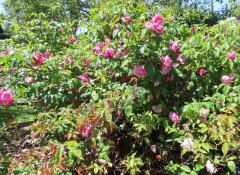
- 3 years ago
jacqueline9CA Sorry for the late reply. I just saw your comment. In this thread people are saying pruning is different than what the nurseries suggest. I have several roses so now I'm just worried if I should be pruning them at all. - 3 years ago
It depends what KIND of rose it is - see my questions above. I would NEVER take what a nursery person (some of whom, unfortunately, actually know nothing about any kind of plant) says about roses over the folks on this forum.
Jackie  3 years ago
This reminds me of a regrettable episode when I overbalanced into a Le Vesuve planted at the edge of a hill. I then continued my trajectory down the hillside, and when I finally stumbled back into the house my husband thought I'd had an encounter with a mountain lion. Those not very large thorns are exceedingly sharp.


jacqueline9CA