

Help with Green Giant Arborvitae
Everything I read about Green Giant Arborvitae (thuja plicata) says that they are wonderful, easy-to-grow trees. However, I'm moving to a new house, and I have several of these which appear to be thin and struggling (one is dead). They are in a marshy area with poor drainage. Should I expect these trees to do poorly in damp soil conditions?
Thanks,
Phillip
Comments (19)
 17 years ago
come on phil....
you havent moved there yet... but are you sure on the ID ...
and shall we presume you have no clue of how they were planted.. or cared for...
how about you get us a pic of the needles .. the trunk.. and hopefully some cones .... and we can get you a proper ID ... or tell you you were ABSOLUTELY CORRECT.. lol.. gotta cover my bases ....
we would also need some info of their siting.. such as are they in full sun.. and how much of the year is actually standing water in the marsh ...
there arent many thuja that are going to prosper in standing water.. all year ... how the water table has risen over the years.. and why these are now failing is a mystery at this time... and of course.. the root of this post ...
but to say its the fault of GG's ... is perhaps.. a bit premature ...
good luck with the house....
ken
- 17 years ago
come on ken....
you sound like you're accusing Phillip of just making the identification up....maybe you are just trying to say, "Are you sure they are Green Giants?"....
Phillip may have ASKED what was planted.... BEFORE he posted here....
in any case....it would help to be sure the trees were Green Giants....and get other relevant info such as light exposure (full sun, partial shade, etc), planting specifics (planted on a berm, setting in water most of the time, etc), age of the trees (how long have they been there), etc...
Related Professionals
Fayetteville Landscape Architects & Landscape Designers · Hartford Landscape Architects & Landscape Designers · Youngstown Landscape Architects & Landscape Designers · Murrieta Landscape Architects & Landscape Designers · Pine Bluff Landscape Contractors · Norfolk Landscape Contractors · Detroit Landscape Contractors · Hempstead Landscape Contractors · Erie Landscape Contractors · Rutland Landscape Contractors · Murrieta Landscape Contractors · San Bernardino Landscape Contractors · Hilo Landscape Contractors · Rolla Home Additions · Rapid City Home Additions- 16 years ago
i was a bit cranky phil.. please forgive me...
i only have a second... but will begin with whoever leaves the sellers tags on trees for an extended period... probably didnt plant them properly ...
will read up on your additional facts later...
ken
- 16 years ago
It sounds like they are planted too deep in conditions (marshy) that aren't ideal. Green Giants AKA Western Arborvitae hybrids originate from the west coast and if you are in zone 7 of the east coast or perhaps middle of the country then I have to say that from my own observations they do not appear to live up to expectations from the rave reviews you read about them on the Internet from folks in the the north. Depending on where you are though, there may be a plethora of better suited alternatives that will perform better.
- 16 years ago
in order of facts presented?
first.. nursery tags are notoriously wrong .... so that isnt a definitive ID.. but frankly.. an arb is an arb for our purposes here ...
full sun superb
on one of the good ones.. go poke around the trunk/soil interface .... try to determine planting depth.. without doing much harm ... the roots should be right there ... not down much further ...
on one of the stragglers.. do the same.. if you see significant difference in planting depth.. we are making headway if you see a significant difference ..... something will need to be done ...
planting too deep can cause significant problems... but trees that are grown from rootings.. are usually forgiving ... if not planted too deep ... in other words.. they can adjust.. they will reroot .... though i wouldnt personally sit around and HOPE they do it .. i would do something ... so report back on that ... we need more facts ...
now... transplanting 6 to 8 feet trees .. which these conifers are.. is extremely problematic .... they can take 3 to 5 years to get ESTABLISHED.. to grow enough roots to support the huge canopy above... any type of improper aftercare for the first 3 years.. will lead to.. well.. what you got .... the problem is... you dont really know what the prior owner did to them [or the seller.. the wholesaler.. the trucker] ... but regardless ....
you have trees.. that within 3 years of transplant.. at large size.. have grown one to 5 feet .... you can tell which are fully established.. and which are struggling ....
as for the water .... the tree will put its roots where it needs to put its roots.. to get or avoid the water .... if they were in too much water.. they would die.. of lack of oxygen to the roots .... the fact that they arent dead.. indicates.. the water is not the issue ...
the few that died.. well.. see above regarding prior owner ... we just dont have info to speculate on why ... even going as far back as the hack who raped a 6 foot tree from the tree farm.. and cut off 99% of its roots.. and we will never know that part ... its all a function of the odds of success over the size of the project .... if you move in ten 6 foot trees.. odds are .. 2 of them will die .... no matter what is done at the site.. its just really hard to move big plants .... and that is why professionals give warranties .... and homeowners.. keep their fingers crossed ...
frankly.. i cant go much further.. without some pix ....
i hope that is a better answer than before...
ken
PS: if you want to get rid of the water.. and have a lot of property .. plant a willow ....
philliph
Original Author16 years agoThat is a better answer than before. I will check the planting depth and also take pics and post results in the next few days. Thanks.
I forgot to mention that I have a row of 8-10 of these trees on each side of the property. The second row of trees is in "normal" soil -- no drainage/marshy issues. So, we do have that to compare against. I will also look at these trees to see how they compare to the other set. Off hand, I know that these trees are thicker and none of them appear to be struggling.
- 16 years ago
Green Giant Arborvitae trees; at least the western cedar x Plicata standishi (sp?) variety have very fine roots which do sufficate in standing water, or in poorly draining soils.
These fine roots rot easily, and the GGs growing in such poorly draining soil die very quickly.
In marshy soil, the only way for such trees to establish well is to raise the surface soil level at least 3 feet above what would be the typical underground water level. Then make certain to plant the trees in raised beds that contain plenty of humus and composted soils mixed with elements to provide good drainage of any excess moisture that would continue to suffocate or promote rotting or molding of the trees roots.
These trees do love to be watered deeply and frequently, but they will not survive easily if the planting bed they are growing in drains so slowly that it causes their roots to remain in a soggy or swampy soil bed.
They will attempt to recover, but die quickly if the soil has too high salt content, or if you attempt to let the top few inches of soil dry out. The sudden death occurs, because all the deep roots have rotted away and the shallow root system still enabling the trees to survive dries too much when the top few inches of soil is dried.
philliph
Original Author16 years agoThanks. I took some pics. There are 15 of these trees on the marshy/west side of the backyard, and there are 9 on the non-marshy/east side. It's very obvious that the trees on the east side are doing great and much better than those on the west side. The east side trees are 14-17' tall on average, and they are thick and healthy. I'm pretty certain that all 24 were planted at the same time.
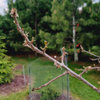
The one completely dead tree adjacent to a thin, unhealthy tree.
{{gwi:429869}}The dead tree adjacent to another tree showing signs of dying.
{{gwi:429870}}Three trees near the dead tree on the west side.
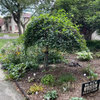
{{gwi:429871}}Healthy trees on east side.
{{gwi:429872}}- 16 years ago
The photos seem to reveal that lots of rain runoff must pour out of the neighbor's gutter and from whatever source, which the photos do not reveal.
Green Giant trees do not prosper when planted in areas where rain runoff flash flooding washes over them, even when the depth of flow night only be 4 or less inches deep.
So consider several options:
1: you could get a drainage expert to catch that excessive runoff and redirect that flow to spill out just past the lower levels of your property, or at least advise you on what He could legally do to correct your problem.2: You could simply create a 2 foot high and 3 foot wide berm that runs all the way down, but also runs along about 2 or 3 feet away from the fence. While doing this you could also carve out a slight dip otherwise termed a shallow swale in that spacing you left between the fence and the berm you create.
Then you could plant new green giant trees in the near top but inside slope of your berm.
If all that sounds too expensive or too much work, then the only other thing, I could suggest would be to start looking to replace your struggling and dead Green Giants with the types of trees that can handle rainwater overflow, which also might be causing the area's subsurface water table to rise too high at times.
Another thing to take note of, is to determine if any salty water is being added to that runoff overflow from any source that may not be revealed in the photos.
Seems that recently there have been occuring more swimming pools that are being maintained with a salt solution system that replaces the older more commonly used clorine systems. Any flush out that such salt solution swimming pool systems need would also be too much stress for your trees, especially if that flush out mixed with the rain or yard watering runoff that flows over the planting soil where your struggling and or otherwise dead Green Giants have been growing.
- 16 years ago
wow ...
the one to the back or left of the dead one.. has NORMAL interior browning... but it is still not a well shaped specimen ... second pic ...
i am NO ID EXPERT ... but frankly.. they dont even look like GG's to me ... if anyone who might know better and agrees... we should find resin for an ID ... if he doesnt pop in ...
my next observation ... is they got large unhealthy plants to start with ... the dead one.. basically shows us where these plants started ... and in the first pic.. the growth of the live one is so weird ...
compare your good ones to the pix below .... i started them from 2 inch peat pots and 4 inches big.. in 4/2000 ... the shape and form of yours doesnt seem right ...
i understand GG producers if growing them in rows.. have to do weird pruning to them to grow them on ... but yours .. noting the dead ones.. dont look right to begin with ...
i would like a bigger picture on the side of the strugglers.. to get a better idea of what is going on in the area ...
Kat has a very interesting salt flush idea.. any chance you are on a well ... that the neighbor has a salt based water softener ....
now.. is only one dead???? if so.. that is a pretty good success rate ... over the # planted ... whether or not they are ugly ... they are alive ....
i would also .... pull back the grass .. and add mulch for at least 2 to 3 feet around each tree [any sign of weedwhip damage on those struggling the most????
final thought .... when you move a 6 to 8 foot tree ... its can take a few years to get 'established' .. as noted previously .... some of yours.. are just taking longer than others ... though sparse ... they are a nice green ... and growing.. though less than you wish ..
not unlike children .... they dont all grow the same ... so part of the problem is your comparing those that are thriving excessively.. with those that are just going a bit slower ...
can you get that one other pic?? and explain how many hours of sunlight they get on the bad side ... as compared to the good side ...
ken
{{gwi:326683}}
{{gwi:326682}} - 16 years ago
very nice looking GGs, Ken.
I too first thought Phillip's trees do not look like GGS, but could not conclude such considering the way they have been struggling. GG's sport 'Steeplchase' grows more narrow and grows with a more filled out top growth like seen in Phillip's photos. Could they possibly be that sport?
I know the brighter green hues that can be seen near the ends of the leaves on GGS also cannot be seen on phillip's photos, but that could be due to Phillip's trees not getting as direct sun exposure as your trees receive.
philliph
Original Author16 years agoThanks for the great detailed help. The tags on my trees (I agree, it tells you something when people leave the tag on) say "thuja plicata Green Giant".
Certainly only look at the pic of the healthy trees when trying to decide the specimen. They were all most definitely planted at the same time and surely all purchased at the same time from the same source. Using the struggling trees for ID could be misleading.
I agree that the shape/form of my healthy trees is different than Ken's trees. However, the foliage looks identical to me.
I am definitely planning to properly mulch around the trees, but there are only so many hours in the day. That's just not at the top of the list right now, and I've got a million things on the list. In general, the landscaping is very nice, but it hasn't been maintained like I would have done it and it needs some work for sure.
I understand what you are saying about the normal interior browning, but given the situation, I would say that it's much more likely to be linked with whatever killed the adjacent tree and is causing the others to struggle. At least 2-3 other trees display this browning, so it's logical to me that it is all linked.
Very insightful Katrina. I do have a pool in the back yard, and it indeed is a saltwater pool. Not only that, but the pool has a small drain hole on that side of the yard (west side, with the struggling trees). It is my understanding that the drain hole is piped into the yard using a trench and 4" drain pipe with coarse gravel. This could certainly be a problem. However, most of the trees on the west side are struggling relative to the much taller and healthier east-side trees, and I wouldn't think the drainage trench is in close proximity to all of them. I still think the primary problem is the water saturation, but perhaps salt content is a problem nearest to the dead tree.
The good/east side gets all-day sunlight. The bad/west side gets pretty close to all-day sunlight, but it might start getting blocked late in the afternoon. I would still guess 10+ hours for sure.
I will take more pics and respond.
Thanks for the help and for sticking with me.
Phillip
 16 years ago
Hi Phillip,
While I became distracted at ken's photos I still recall how scraggly those of yours looked. You know it's my opinion only that your West side Green Giant's show lack of sunlight to a full sun plant. Those are some scraggly bastards.
Salt is the worst thing in the world for those. I, do not, understand if you are saying the run off 'tile' is equally distributed between the rows. I'm surprised your grass lives. Then again, I admit to knowing nothing about pools. The water has to go somewhere though and, I always have assumed chemicals had a role in neutralizing it somehow first.
As to i.d. they appear to me to be correct and that the grower, which is common sheared them up for quite some time because they develop them for snow resistance to splitting prior to selling.
'Green Giant' is good enough of an indication factor without viewing a cone and the upside of a full vertical shoot of foliage as well as the bottom side of a shoot. Of course, if you didn't know, a ruler bar in (some) photos also is a big help when id'ing.
O.k.
Dax
- 16 years ago
Phillip, since you just recently moved into the house, the reasons for the trees conditions could be hidden from you.
I mean concerning the previous owners' process of maintaining the pool water's proper salt content.
For a friend, I helped plant about 14 GGs along her fence line that ran slightly down hill along the north side of her husband's lap pool which is only 4 feet deep and kept filled with salt solution treated water.
When we planted the trees I had no idea that at times he had to flush the pool and refill. I guess that effort must have been used to keep the salt levels from becoming too concentrated.
While these GGS were attempting to get established we had a very difficut time keeping them alive, because the lower elevated ones' roots seemed to suffocate, while the higher elevated ones roots seemed dry out too quickly.
After a week of this, it turned out that it was the salt water that her husband was flushing out of his pool that was giving the trees the most trouble.
Once he realized this fact, he redirected where he drained that salty water. After that the GGS were able to establish and pulled through, only growing more slowly than normally would be expected. Some died had to be replanted.
It has been almost 4 years ago when we first planted those GGs. when we first planted those GGs they were all about 2 feet tall, but now are only about 8 feet tall with more full lower levels of branch lengths like seen in some of Ken's trees.
The reason I discribed that was because even though her husband stopped flushing out the water and letting it flow down the slope toward the lower trees, and the trees began to do much better, they still have struggled more and grown more slowly. There also are still two of her trees which are planted next to each other, that are almost 4 feet shorter than the rest of the GGS.
My friend told me those two trees were being affected from where her husband had redirected the water he flushes from the pool.
I have not seen her husband do this and do not know how much of the salty water could be affecting these two tree's roots, but clearly they would not be growing so slower than the rest, if they did not have to struggle with the gradually elevating build up of salt levels in the soil.
You should also pay more attention to what affect that your neighbors rain run-off has on your trees, as that water rushes through your fence and flash floods your trees.
- 16 years ago
Phillip,
I read yesterday on the web that once a month people with pools need to heavily water trees effected by pool water. Also in spring, fertilize those.
Whether contrary to katrina's advice in whatever form, it's a recommendation.
Dax
- 16 years ago
The practice of watering trees near a pool heavily once a month sounds like it would be successful only if the particular soil and elevation where the trees are growing will drain properly, or success with such a practice could also depend on what kind of trees' and their landscaping beds are being flushed in such a manner.
GGs that are already struggling due to soggy soil or elevations that for any other reason does not drain well enough; or such trees in any other environment that cannot be maintained in a well watered but also well draining landscape bed, quite possibly would not survive for long.
Of course if the soil is sandy or otherwise course enough to drain away properly, and the monthly flushing away of any excessive soil levels of Chemicals or salts can happen without suffocating the GGs fine textured roots, than yes such practice would be good for the trees. For that matter even in a area like that, a practice of doing short watering sessions every day could be even more beneficial for the trees.
Not too certain though how good heavy monthly flushes that would wash the concentrated soil levels of pool chemicals into the neighbor's property, or into naturalized areas, or down into subsurface water table flows would be when considering some common environmental concerns.
philliph
Original Author16 years agoThanks everyone for the continued help and sorry for my delays. Just extremely busy! It's been very interesting reading what everyone has to say.
I've got more pics that are intended to give you a wider scope and better idea of the area.
Several trees on either side of the dead tree have significant browning all over. I would say 2-3 trees on either side. There are 15 trees on this (west) side. The trees further away from this area are scraggly but otherwise appear semi-healthy. They certainly aren't thriving like the 9 trees on the east side, but they are hanging in there. There are actually 3-4 trees on the west side that almost appear to be doing fairly well, but just not as well as the east-side trees.
To summarize, it sounds like I might have a salt problem in the vacinity of the dead tree, and I've got a general drainage/overwatering problem among most all of the trees. The trees are strategically placed and are starting to provide a very nice privacy screen -- sure do wish I could start over and plant them on raised soil (and fix the salt issue). From what I've heard here, I'm not sure there is anything I can do except sit and wait to see if others die.
The dead tree is hidden behind other trees in both pics. Note the relatively healthier trees on both ends of the row. Also note that nearby crape myrtles are very healthy and thriving.
{{gwi:429873}}The view from the other side of this same row. You can see the browning of 5-6 adjacent trees in this pic.
{{gwi:429874}}- 15 years ago
We have purchased 12 green giant trees that are eight foot tall and are potted in 20 inch containers. We wish to plant them in a burm with railroad ties in front of the free stand burm which will meet the height of the ground on the opposite side. Our property is lower than that adjacent to us and our goal is to allow some privacy, but not to create a hedge. We are planning to build the burm to a height of 33 inches. We would like to know the folowing:
The proper width of the burm.
Whether we need to secure the trees with stakes.
Where on the burm the trees should be planted.
What should the planting soil consist of and how deep should this planting soil be.
We have already put in a drainage system below and in the rear of the burm so that excess water from the adjacent high property will not damage the tree roots.
Your prompt response will be greatly appreciated as we would like to get our trees out of the pots and planted as soon as possible.






philliphOriginal Author