Software
Houzz Logo Print
princetonfan

american elm revival

19 years ago

First of all, I am new to Garden Web. I started a thread on this subject in the New England Gardening forum (which some of you may have seen) not having noticed the tree forum until someone very nicely called it to my attention. I will first of all state that I am not a gardener, but a true lover of trees and am constantly learning. However, I must confess, I do have a soft spot for the American elm. I grew up in the Southern tier of NYS (Norwich, Chenango County) and there were still a few elm giants in the town, although sadly my earliest memories were of them being laid waste often in as little as half a growing season.

I am curious to know what those of you landscape professionals, arborists and tree lovers' impression of the state of elm restoration in its growing range is. I live in Boston and the City is extremely has been quite slow to pick up this tree (in truth, or much of anything else for that matter). It appears to me that many of the surrounding smaller cities and towns (for those of you in Eastern Mass, going out to Rte. 495) are much more progressive in reintroducing this tree. I get the impression that one of the reasons, at least in greater Boston that this tree is difficult to find in private yards is that most arborists and landscape professionals if not actively discourage, decidedly do not promote it.

Although I don't even have a yard in which to plant, I am seriously considering gifting the better of these cultivars, i.e., Princeton, Valley Forge, Jefferson when available (NOT American Liberty). My sister, who had a tree removed from her yard in Westchester, NY a couple of years ago and Otsego County, NY where a historic inn is expected to reopen in the not too distant future.

I will wrap this up now; it is a bit of a ramble but I suspect that it may never achieve anything other than a niche planting utilzied in restoring historic landscapes.

Has anyone read "Republic of Shade" by Thomas Campanella? Very sweet book; must read for elm lovers.

Comments (26)

  • 19 years ago

    Welcome to the forum, you mught scroll down the list or do a search for other topics on the princeton elms. There's quite a few folks here thast have planted or plan to plant. It isn't that easy nowadasys with homesites being so darn small to find room for an Am. Elm.

    To answer your Q though, I haven't seen many planted here in GA in commercial or public areas. When I was living in florida I had started to root some elms by cuttings which took then I lost them in a hurricane. Interestingly there is no DED in FL. Had I known that at the time I would have tried again perhaps.

  • 19 years ago

    Princetonfan,
    Casey Trees, Inc is a non-profit which is responsible for planting hundreds of 'Princeton' elms in Washington DC. Earlier this year there was an article in the Wall Street Journal about this elm selection and the fact that Home Depot was carrying them. They are being grown by a couple of wholesale growers in Georgia.
    'New Harmony' and 'Valley Forge' are becoming increasingly available. The good news about these is that they are also being evaluated (finally) for phloem necrosis or elm yellows and the preliminary results look promising. There is no US patent on the above. I've never heard of 'Jefferson' perhaps you could elaborate.
    'American Liberty' is available but one has to jump through hoops to acquire it. I understand that it is not a clone. It is available through the Elm Research Institute in NE. I don't know how well it does outside of NE. At one time 'American Liberty' was only available through groups such as the Boy Scouts, etc., but that may no longer be the case.
    I would also like to hear more about any of these selections.
    Sam

  • 19 years ago

    Well, my hometown of Norwich, NY (Southern tier) planted about 25-30 liberty elms around town; I only noticed them in the Summer, '04. Every year since then, a couple of them has shown signs of ded, the telltale withering, etc. Disease pressure is very high in this region. It is my understanding that the Liberty elm series is actually a series of 6 allegedly closely related clones. Again, read "Republic of Shade"; some of the problems with this series are discussed. Of the 6, the clone "Independence" and W-502 have exhibited adequate resistance to ded, so you could insist on either of these.

    None of the Home Depots I checked with within a 50 mile radius of the City of Boston had even heard of Princeton elms. From what I read, some areas, primarily in the mid-Atlantic and portions of the Northeast were being shipped these from Riveredge Farms, Atlanta, GA. I believe I read in one of the articles in USA Today back in May that this was considered as a trial run; more would be shipped next year if successful. There are other tree nurseries in my area that carry both Princeton and Valley Forge elms; I haven't seen any that sell New Harmony; supposedly more difficult to propagate vegetatively.

    There's an interesting article from Linda Haugen, a Forest Pathologist with the US Forest Service (Google "disease resistant american elms" and you should be able to locate it) asserting that there is a real danger of far too few cultivars being planted, thus narrowing the genetic basis of elms and increasing danger of a more legal strain of ded getting into circulation.

    I will wrap up now but I think great progress has been made in the culturing of Valley Forge elm, considered to be extremely unruly in infancy, requiring more pruning staking for a longer period than Princeton. There are some lovely specimens in Harvard University Yard, as well as Forest Hills Cemetery, a garden cemetery, definitely historic landscape. Only problems around this part of the country is winter moth catepillars, SEVERE defoliators of deciduous trees; leaves extremely skeletized.

  • 19 years ago

    The Austin-Waco reigon of Tx. sill has scattered American Elm growing wild. Apparently either the dryness of the climate here or remoteness (stretch of prairie immediately east) left most of the American Elm here alone. Ft. Hood has a particularly big specimen according to an agronomist here. I've heard of people planting them, but never seen any for sale. The Cedar Elm is what is usually found and sold here.

  • 19 years ago

    Princetonfan:

    You say "NOT American Liberty" as if you want to avoid this brand of DED resistant elm. Do you have a reason why you don't like them?

    I have two "Liberty" elms that I got by joining the Elm Research Institute's membership program. I made a donation and got 3 Liberty elms. The cost per tree, if you want to calculate it that way, was about $45. Like you, I really love elm trees and have fond memories of them from my childhood (I am 69 years old, which takes me back a bit), so the cost was not a factor. I only have two now because Japanese beetles attacked one pretty severely and the next year it did not leaf out.

    Anyway, according to one report I heard the "Valley Forge" elm in USDA trials had the best resistance. The Liberty elms are really, the last time I heard, 6 different cultivars. I read a review of the DED resistant elms several years ago in the Washington Post, and they said the Liberty elms had the best high arching form, which is one of the things I especially loved about the elms I knew many, many years ago. The Valley Forge is supposed to have a so-so elm growth form. The two of my Liberty elms that are still surviving show great promise of having a very high arching form. One is especially fine and is growing in a truly "dream like" elm form. The other has been just a bit awkward in its early branching, but with the pruning I have done, it is shaping up really, really nice. I am not sure which specific clones I have and not all the liberty elms will be the same. I did come across a key on the web to identify which close is which, but I have not used it yet to identify mine.

    For me the better form of the Liberty elms was more important than some marginal reduction in DED "resistance"--none are truly immune. I have heard that the Princeton elm is intermediate in form between the Valley forge and the Liberty clones, but I really don't know.

    Anyway, "The Elm Research Institute" is easy to find on the web and you can call them for more info. I found them helpful.

    --Spruce

  • 19 years ago

    Spruce: I'm delighted that your liberty elms are thriving. As I believe I mentioned, in my hometown, which is admittedly my only direct experience with Liberty elms, of the I believe 30 or 35 liberty elms acquired 4 or 5 years ago, 2 or 3 appear to be biting the dust each year. I'm not sure that these trees are being actively monitored by the party that acquired them, and if replacements are even being requested. I certainly hope that some of them survive. I would certainly mix the better of the liberty elms, i.e., Independence and W-502, into any combination of ded resistant elms. You are absolutely right, none are immune; some recover from the disease much better than others. In my hometown, there is evidence everywhere of this tree attempting to regenerate in the wild; volunteer elms make it to 30 or so years and succumb and can support a much larger beetle population than one would suspect.

    Some cities are putting all the cultivars to pounding field tests to determine which actually hold up better in real plantings, over time, which is what I wish Boston would do. I know Minneapolis/St. Paul is doing this. The Mayor of Boston announced this past spring an initiative, "Growing Boston Greener" which has set a goal of planting 100,000 trees, or growing the tree canopy by 25 to 30%, by the year 2020. We will see; I can only hope, can't but believe, that elms would be well srepresented in the mix.

    I have read some of the threads in which people include Zelkovas among the overplanted trees in their cities. I have seen some really unattractive specimens of this tree; there are also some lovely ones. The Arnold Arboretum has a specimen of a "Schneider" Zelkova, really elm like with very large leaves. I think this tree shows nice promise. There are also some nice plantings in Boston, particularly along the Commonwealth Avenue Mall. This tree has fabuous autumn coloration, IMHO.

  • 19 years ago

    Princetonfan:

    We have American elms still surviving a round Winchester, VA. I have lots of volunteers coming up in my field and some have died fairly quickly. I think, to protect my Liberty elms, I should get rid of them so they can't be vectors for the disease.

    --Spruce

  • 19 years ago

    I have observed the progression of the DED in MO. It was very agressive through the sixties in to the seventies. Then the droughts of th 80's slowed it until the flood of 93. Then it took off again. DED took all my large American Elms except one, which surprisingly dosent show any signs of distress even during this drought. Its surrounded by smaller burr oaks. I was waiting for it to die then select which oaks to let grow, I'll just wait some more.
    What surprised me was the red elms started to die also. I wasn't familiar with them. Some of the larger ones of the red elms haven't died. They're in a forest stand. They have a dark heart sorta like a black walnut.
    Just a ongoing casual observation. -JL

  • 19 years ago

    I haven't had any issues w/'Valley Forge' Amer elm. Yes, it looks somewhat lanky, especially when small. But looking at nearby, similar-size Slippery (Red) elms, it looks no different. I have pruned off lower limbs to ~6', but low forks don't concern me -- mostly did it to force it southward away from some other nearby trees because it's growing so fast. From a mail-order tree spring of 2004 it's now ~17' tall & 14' spread & a 3.5" trunk at ground. It's anchored itself in the ground like an iron post.

  • 19 years ago

    DED has not reached this town and there are dozens of American elms apparent in every block.

    From what i have heard, the liberty series was generally unsatisfactory for resistance, inferior to Princeton and the two recent selections. The liberty brand should be avoided.

  • 19 years ago

    Not that its important, but the HD in Waltham, MA def. sold Elms this summer. I posted to GW about it. I'm pretty sure they were Princeton.

  • 18 years ago

    I have a 40 year old American Elm in my back yard with the lovely arching form. The tree is a healthy as can be. It grows in a mixed grove of about seven different species of trees. Perhaps the biodiversity shelters it from DED.

  • 18 years ago

    I planted a Riveredge Farms Princeton American Elm from Home Depot last Mother's Day and it is (knocking on wood, pun intended) doing very well. Flowering has occurred on the smaller inner branches and buds are forming all along all the branches. (I also planted a two-footer that I purchased directly from Riveredge Farms in July of last year -- by seasons end it had doubled its growth height to stand now at about 9ft tall (complete whip though)).

    Around the middle to late summer last summer, I think the tree (Home Depot tree) outgrew the roots ability to keep up and I had a bit of dying off of new growth at the tips of the tallest, previously fastest growing branches -- I may have been guilty of overwatering it as well, new tree grower that I am. Anyway, big, juicy buds are forming all the way the those tips now and I am really forcing myself to restrict watering to just once every 7-10 days if no substantial rainfall has occurred.

    The trunk really beefed up at the base since last year as well. When I first planted it, I staked it with those set of three rubber tubing type anchors for only two months last year, then removed them with great results.

    I'm really looking forward to this year's growth, kind of like watching a pot of water boil though, but spring is just starting here in Central New York. Did I mention that I love these Elms!

  • 18 years ago

    I'm of the opinion that any multiple-tree planting of any of these resistant elms should include as many cultivars as possible to keep the genetic diversity as high as possible. I'd like to plant 3 or 4 at the back of a property that faces woods and there are a few wild elms back there as well - hopefully the 3 or 4 DED-resistant cultivars I plant can interbreed with the wild ones and at least a few of their offspring can also be DED resistant. Do this all over the country and in a few generations, voila!

    I do agree though that the focus should be on developing a few dozen more genetically unique cultivars to avoid not having enough genetic diversity.

  • 17 years ago

    Any up-dates on elms this year?

  • 17 years ago

    I've grown quite a few from seed.

  • 17 years ago

    There seem to be a few healthy wild American Elms and less infected ones. I donÂt know if this has anything to do with resistance to DED or just isolation. Also the American Elms are capable of root grafting between separate trees and this aided the original spread of DED in tight packed populations. Good thread!

  • 11 years ago

    Update on my elm. It died two years ago from Dutch Elm disease. I had to have it removed. It cost me 900 dollars to have it taken out. :( Animation made by Google of Elm falling.

  • 8 years ago
    last modified: 8 years ago

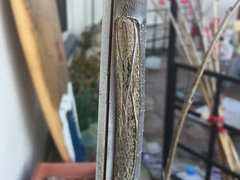
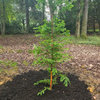
    Hello, I have a 3 year old Princeton American Elm that I have recently noticed has some distressing marks on the bark. It is watered regularly and recieves the right amount of sun and shade required.

    I live in San Diego. Any advice would be greatly appreciated! Thank you.

  • 8 years ago

    It is not a good sign that it is still strapped to the bamboo pole. That alone can kill (strangle) a young woody plant.

    Your images do not show us the container or give us an idea about the quality of the potting medium. What kind of environment is this tree living in?

  • 8 years ago

    Is it in the ground or in the container? The closeup of the mark looks like a branch pull out that has partly healed. I'm quite a bit north of you, but have some 2015 seedlings about that size and in the ground. You could probably plant that tree now.

  • 8 years ago

    It looks like healed over physical damage. DED would be bleeding and smelly.

  • 8 years ago

    I have several wild American Elm growing on my property near Waco, Tx. I still have at least one of these potted (about 2' tall). IF someone wants it, I will send it to you bare-rooted free of charge up until end of April, except you must agree to post here annually its growth results and agree to at least weekly watering if no rainfall during spring -fall for first year. Our American Elm here appear to be DED- free, but the trees are much shorter than described back east. Our native Cedar Elm appear to be the better choice for here, but the few large American Elm growing only along river and creek beds do look nice. I am not an expert on American Elm, only an interested observer on the western fringes of their territory.

  • 8 years ago

    Sounds great to me.

  • 8 years ago

    Send me a private message if you can figure it out. (I can't)