My builder uses Houzz Pro to plan the timeline and give detailed estimates and daily updates with photos of progress, and provide invoices at pre-agreed key points in the build. This made the whole experience much more efficient and stress-free.
I'm thinking about ordering a couple of a. physocarpa/family jewels/swan plants for my garden. If my memory is correct, several of you in California have grown it. How tall and wide did it grow? Did monarchs lay eggs on it? Do the leaves have a lot of the milky stuff?
Has anybody in the southeast grown it? How big did it get for you?
I have some growing right now. It grew very tall and looked, um, like some contraband plants...tee-hee-hee! DH said, "Sherry, what the heck are you growing out there!" I said, "It's Milkweed! What did you think it was??"
The A. physocarpa at my school is about, hmm...3' tall right now. The leaves are kind of narrow-ish. The stuff I had in my backyard did well until the !@#$% APHIDS got ahold of it!!! Grrr...
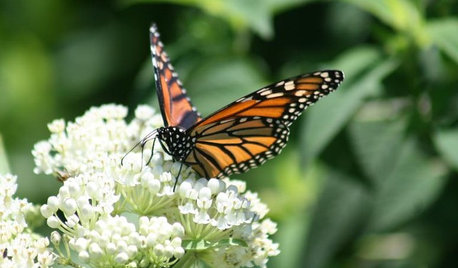
YES, the Monarchs did oviposit and the larvae loved the leaves.
I just sowed some seeds and they just germinated. I may have a few seeds left that I could share, if you want some. Yep, I just checked and I have a few, MissSherry. Let me know! :)
Checking in from So. Cal - Mine got about 6' tall and only 2' wide. Not sure if I should have trimmed it some to help make it more bushy. I will try and experiment more with it this year. Mine survived the frost fine with ony a little bit of trip die back.
Yes, I had monarchs lay eggs on it, I was also able to move monarch cats on to it when it was the last milkweed type in my garden that had any leaves on it.
Yes, the leaves seem to have lots of the typical milky sap.
It is not immune from the oleander aphids. I have a plentiful crop of those little pests currently!
Thanks to both of you - I thought I remembered that it got tall. How I hate those aphids - they just ruin milkweeds! :( CalSherry, I'll e-mail you my address - thanks! MissSherry
I had one here in southeast Texas it got 3-4' tall and the monarchs did lay eggs on it and the cats liked it. It didn't get as many cats as the other milkweeds though. Unfortunetly, it had some kind of mold problem last fall and started to die. I cut it back to get rid of mold and it hasn't started to leaf out again this spring so it may have died. I did get a few seeds from it and will probably try it again.
I'm not surprised, Dena. Anything that thrives in California has a tendency to succumb to the diseases that go with humidity/rain if it doesn't drown outright after a big rain. However, my garden is all raised beds, so if I give it plenty of room for aeration, there's a good chance it may do well. MissSherry
Seems like that is a problem with both the calotropis and physocarpa genus, from what I've read (the mold). Apparently, they like very dry conditions (dry soil, dry air).
What I'm curious about is the hardiness of this plant. I found a lot of discrepancies in my research in regard to whether the plant is hardy to zone 5, zone 7, or more southern zones, and a lot of sites just had "unknown" as to hardiness. I see that mostly Californias (zone 9'rs said they grow it), which does beg the question of whether or not it will grow in our heat and humidity, MissSherry. But, I have some seed and will try to grow it at least as an annual.
I am new to this forum but the plant name caught my eye. If anyone needs seeds, send me your address. I have plenty. I am on the border of zones 6 and 7 but have never tried to overwinter it. I started it from seed a few years ago, grow it in a large container and overwinter in the greenhouse. This year I took cuttings in February and they are off and growing, so that works too.
Welcome to the forum, Poisondartfrog! It's good to hear that you've successfully grown it in a more humid climate - thanks so much for the seed offer! MissSherry
I am in the Dallas/Ft.Worth area of Texas. I grew 2 swan milkweed that I started from seed last year. They stayed green all winter right up to our worst cold.(about 12 degrees) The leaves got pretty frost bitten but as soon as it warmed up again they put on new leaves. I did have monarch cats on them thru the spring and summer and they seemed to do well. I will definetly plant more this year because it is March 19th and I have milkweed that is 4 foot tall just waiting for the monarchs to get here. So at least for one year I was very pleased with the swan milkweed.
MissSherry....very funny! Now if you plant that suff at your school, and some of it dissapears...do you think some students might have accidentally thought it was....oh well...if they start coming to class looking like caterpillars!
Poisodartfrog, I'd love some. I'm worried that the hundreds spent on A Syriaca are in vain, as I see none of it returning...and I should by now....I'm also hoping the roots of A humistrada will come back, it;s very hard to grow from seed....and it's quite a good host plant, as the leaves are QUITE thick, which means I good good MPG with my caterpillars....It appears some of my A currasavica may actually be comiong back from the roots, I wasn't expecting that....
could you email me and I'll send you my address? I'm a much better receiver than giver of seeds, (Just ask Jeff S in Michigan, I finally sent him some seeds after weeks and weeks, we are just not in control of our time!)
Hmmmm. That's strange, Jeff, since A. syriaca is supposed to be hardy. Maybe something other than cold did it in???? I have grown some from seed, as well as many other cold hardy species of asclepias, so will see how it does, but glad to have the tip that it may or may not return.
Some milkweed, on the other hand, just takes a good while to start up in spring, or late spring, or maybe even early summer. So, I'll be patient and post my results when I have them.
Of course, being in zone 7, I don't expect to see my milkweed yet.
I'm in Z 8b, which is outside of A Syriaca's normal range...I planted them in October, perhaps not enough time to root, interestingly, I lost a lot of A Incarnata as well, wondering if my soil (new raised beds) is too "loose"..I've checked a couple roots, it's hard to say....I'll just have to wait and see....
Paul, since you're close to the coast, you may be in the 'milkweed challenged' zone like I am. I've tried many different types of MW, and the only type that comes back year after year is honeyvine/cynanchum laeve - it certainly isn't preferred, but it will grow monarch cats to maturity. The only types I've ever seen growing in the wild locally are a. incarnata var. pulchrea, a. lanceolata - both these are swamp types - a. viridiflora and a. longifolia. I've never found a monarch cat on any of these. I've sowed some a. viridiflora seeds, but they haven't come up so far. I usually wind up ordering or starting a. curassavica from seeds in order to have something to feed the monarchs. I'm still trying, though - I'll sure let you know if a. physocarpa works! MissSherry
Wow, this is the first time I've felt lucky to live in NE.
We have common milkweed growing, well, like weeds. Everywhere. It grows along railroad tracks, alongside the downtown bakery, at the edges of fields and in meadows. We also get several other varieties that grow wild, like tuberosa, the orange one, and swamp milkweed.
It never occurred to me that it couldn't grow just about everywhere.
The variety with the pinker flowers, is that swamp milkweed?, attracted the most number of butterfly species of any other plant. Banded and striped hairstreaks, commas, question marks, BST, SBS, Monarchs, and even Morning Cloaks! I found a meadow with huge amounts of this milkweed that was like butterfly heaven. Thank goodness it is a Nature Conservancy area where an old gravel pit used to be.
I guess I didn't realize that milkweed (most species) absolutely had to have certain lengths of cold dormancy that would make them difficult to grow in warmer climates. Paul, if your A. curassavica is coming back from the roots (I thought I recalled MissSherry saying hers did, too???) then you may not have to worry about having a lot of other species.
I've read about warmer climate milkweeds which include the following:
Asclepias cineria A. connivens (fragrant milkweed) A. humistrata (Sand Hills milkweed) A. lanceolata (Red Milkweed) A. michauxii (MichauxÂs Milkweed) A. obovata (Green Milkweed) A. perennis (Aquatic Milkweed) A. viridis (Antelope Horns).
These are warmer climate, coastal milkweeds. I haven't heard of or seen seeds for many of those plants, other than Antelope Horns, but that might be one you may want to try.
We've tried several kinds of milkweeds here in south Florida with rather dissapointing results. I have seen syriaca growing wild in South Carolina and Ga. so I tried some here... well, they grow and come up every year, but after shooting up quickly to a height of about 2 ft or so, they begin to mildew and die back, only to send up new stalks, and repeat this process over and over, til they finally go dormant in late nov. We planted syriaca and speciosa because of the fragrant flowers and the addictive attraction to the flowers of these for most butterflies, but, it looks like the summers are just too humid here for them to bloom. So it seems we're stuck with currasavica, which has nowhere near the nectar attractiveness of the purple "globe" flowered milkweeds. Dave
Dave, that's really strange that it doesn't have the nectar quality for the butterflies there. Mine is absolutely a buffet for all the butterflies around my house. Most of them prefer it over the zinnias, cosmos, and everything else, except for lavendar.
Last year, Bordered patches, checkerspots, Monarchs, Queens, Sulphurs, skippers, you name it, just loved it! But, it does seem that nectar is a regional thing. Butterflies in one region often prefer one plant over another, so it varies quite significantly.
Do the Monarchs and Queens use the curassavica as a host plant? Maybe they just like purple flowers to nectar on where you're located???
Monarchs and queens definitely use a. curassavica as a host plant, Susan, it's probably their favorite. And the butterflies like to nectar on mine, too - I can't say whether they like the flowers as well as the others. I've ordered seeds for a. speciosa, a. syriaca, and a. sullivante along with my a. curassavica plant. I haven't gotten my a. physocarpa seeds from CalSherry yet, but when I do, that'll be still another type I'll be trying. MissSherry
I've got a ton of seed planted of different milkweed species:
A. incarnata 'Ice Ballet' A. incarnata A. asperula (Antelope Horns) A. exaltata A. viridis A. verticillata A. purpurescens A. sullivantii A. syriaca
Plus my A. curassavica seeds as well. I need to plant my physocarpa, too, but was waiting until it was a bit warmer. For some reason I thought this was more tropical than the other species I mentioned.
I do hope I get at least one or two plants of each one. I planted them in those aluminum baking pans with clear plastic lids - one species to a pan, and I have lots and lots of seedlings. I hate to throw them away - Linda? anyone else near OKC?
Hey everyone, SUSAN, where to you get all those different Milkweed-seeds from?? I am trying to start my garden right now,but am really in need for different MW-species..Please let me know.. TIA,Butterfly-Greetings Susanne(SUE)
I wish I had some seed left because I would send you some. Let me check my seed box and let you know.
I ordered a ton of my milkweed seed from two sources, Prairie Moon Nursery (native seeds), and Specialty Perennials (recommended by many on the Winter Sowing Forum). They have a lot of different species, and several cultivars of curassavica as well, and their prices are very good. I looked at a lot of seed sites and there was one that was selling physocarpa, 10 seeds for $10. Whew! I thought that was outrageous. It seemed like the less commonly known species were very expensive at that site, unlike Specialty Perennials, whose seeds are very reasonably priced. So are the seeds at Prairie Moon. All of their seed packets are $2.
We might want to add Specialty Perennials to our seed/plant source list in the FAQs - I had forgotten about them. We could note *good source for milkweed seeds, or something to that effect.
I think I have quite a few incaranta seeds left, and maybe some syriaca as well if you want those (I'm thinking as I type here). I might even have an extra packet of verticillata or some other species milkweed.
Linda, yes, I'll be happy to share with you guys, and with Randy, too! I didn't get his seeds to him, so I could at least give him some little plants. So much to do, so little time.
I got my a. physocarpa seeds from CalSherry today, and I started 10 of them in the little peat things I plant them in. Don't y'all think she's just the sweetest person? She's so helpful to all of us, sending us seeds we need! YAY CalSherry - what a doll! MissSherry
MissSherry....yes, todog is the sweetest, amd I am growing More of her seeds. I started some honeyvine seeds that someone sent me, I didn't cold stratify them, and am wondering if they will sprout. Yes Sherry, I am coastal, which makes it tricky, we can have winters with no freezes, just some light frosts, and other winters it can go down to 15-20 degrees....and with the VERY hot humid summers, things that northerners grow abundantly just can't take the heat....so I am continuously nectar challenged.....that said, yes, it looks like a couple of my A currasavicaas are coming back....Susan, did you say you knew where I could order A humistrada....that is a tricky MW, soil has to be just right....I dug up some roots (tibers?) last yr while gathering....it seems to grow in pine woods with filtered sun and well drained sandy soil with some humus.....I've managed to sprout a couple of seeds, then they die....as of yet, the tubers I planted haven't shown any sign of growth.....it was a dry winter....so I watered the berm hard yesterday.....I'm really hoping the Syriaca comes back...if it fails (it grows upstate naturally) I may choose to dig up the roots in winter, or put it in elevated pots so they cool more, I dunno.....I bought some of the Hawaiian MW tree, so far, just seedlings, but if I can get some good mileage out of them...
I'm going to re read this thread, but perhaps a good list of MW and sources for my area would be appreciated.....as last sumemr I had monarchs ALL summer, sustaining them largely on A currasavica.....
tdogmom
Jillberto
Related Professionals
Fort Smith Landscape Architects & Landscape Designers · Charlotte Landscape Architects & Landscape Designers · San Antonio Landscape Architects & Landscape Designers · Williamsburg Landscape Architects & Landscape Designers · Hackettstown Landscape Architects & Landscape Designers · Trenton Landscape Architects & Landscape Designers · Buffalo Landscape Architects & Landscape Designers · Selma Landscape Contractors · Lake Havasu City Landscape Contractors · Abilene Home Builders · Hempstead Home Builders · Manhattan Home Builders · San Luis Obispo Home Builders · Lewiston Home Builders · Butte Home BuildersMissSherryOriginal Author
susanlynne48
dena_tx
MissSherryOriginal Author
susanlynne48
poisondartfrog
MissSherryOriginal Author
catlunatic
Msrpaul
susanlynne48
Msrpaul
MissSherryOriginal Author
emmayct
susanlynne48
parrothead_fa
susanlynne48
MissSherryOriginal Author
susanlynne48
linda_centralokzn6
Butterflyer1966
susanlynne48
tdogmom
MissSherryOriginal Author
Msrpaul
Msrpaul
linda_centralokzn6