Software
Houzz Logo Print
alejandro_limon_gw

Tiny lemons are falling

18 years ago

Hi,

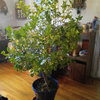
My Meyer Lemon is about 4 yrs old. It is doing fine, it gave me one big lemon last year. This year it has about 20 mini lemons that are starting to grow. The problem is that they are falling for no reason. What can it be??? Help!

Comments (7)

  • 18 years ago

    Alejandro,

    My Meyer lemon regularly is loaded with blossoms and small fruit during its November through February flowering period here in Connecticut, and throughout these months it loses most of the fruit--I have about 10 small lemons that look like they are going to develop, and have lost probably that many again in the way you describe, and figure another ten little fruits are still to fall. A lot of the dropped fruit are probably poorly pollinated, and others may drop because the tree is unable to support all the fruit that begin to develop.

    If you look at the fruit on your tree, you may see that some are actively growing, and others just seem to be stuck at the same size. The latter will inevitably fall off. My Meyer Lemon (which is only about two feet high and three feet across, at most), is also very erratic in how many fruit it will hold till they ripen. This year only eight lemons made it through the summer. Last winter it had 25 lemons. Several years ago I had 33. Other years I've had as few as four. I think some of the fluctuation may simply be that after big crops the poor tree is exhausted.

    Some keys to setting as many fruit as possible during the winter: 1) keep the plant from drying out (if my indoor citrus ever wilt from a lack of water, the new fruit seem to fall first) 2) Get the plant as much direct sunlight as possible (mine is in a west-facing picture window, and is literally almost rubbing up against the window. I have noticed that fruits farther away from the glass are more likely to fall off--even if this is just a matter of a few inches 3) Stop infestations of scale and two spotted spider mites before they become serious.

    Hope these tips help.

    Don

  • 18 years ago

    Thanks Don for the info. I will put the plant closer to the window which faces southwest. I keep the scales in control, but I'm starting to see like spider webs (are those the two spotted spider you mention?) and also some leaves have tiny holes in them, what's causing this?
    What do you use for plant food and plague control?

    Thanks again,

    Alejandro

  • 18 years ago

    Alejandro,

    Sorry for the delay--I've been busy!

    Webs are often a sign of spider mites, but to be certain you need to look very closely. The best way to test for spider mites, unless you have extremely good close-up vision (I do, since I am horribly nearsighted without my glasses or contacts), is to take a sheet of white paper, hold it under the suspected area, and relatively vigorously shake and tap the leaves and twigs for five or ten seconds. You will almost certainly end up with some stuff falling onto the paper, but what you do next is to see if any of the very tiny spots begin to crawl around (spider mites are typically smaller than the period at the end of a sentence). If you see any movement, you can be relatively sure you have mites. Up until recently I was addicted to using chemical controls, but last winter I actually had good success using Safer brand "Insecticidal Soap" which comes in a conveniently premixed spray bottle. I had to spray two or three times, but the mites are still not in evidence (usually this is the time of the winter when I will begin to notice them).

    You need to eliminate the spider mites As Soon As Possible rather than play a wait and see game. Spider mites are like aphids in that they reproduce in an alarmingly rapid fashion. Ironically, this is why they tend to show up now: you had them all along, but three months ago their were only two of them, and now there are a few hundred. In another month there will be ten thousand or more . . .

    Wiping them out is often easier if you take the time to try to rub or brush away any particularly thick concentrations of webs (these will usually be at the tips of branches and also where leaves join stems, and will sometimes look like miniature tent caterpillar webs). If you break through the webbing, even just a bit, I think you help whatever spray you use reach the mites. I usually spray by bringing my plants outside on a reasonably warm winter day (above 40 degrees), but with the Safer soap you should be fine spraying in the shower. Just let the plant drip dry in the shower before carrying it through the house!

    I don't know what to tell you about the holes in the leaves--are they proceeded by dead spots or do they look like something chewed through the leaves? How big are they? A 1/16th of an inch? or larger or smaller?

    I don't know of any normal bugs that would eat holes in citrus leaves, so I am unsure what it could be.

    Just for the record, remember that while too little water can cause you trees to go into drought stress which can cause them to drop all their leaves or die if you don't catch the problem in time, overwatering, especially in a cool climate, is much more dangerous to their health. I think overwatering in the winter can also cause a lot of leave-related problems

    Good luck!

    Don

  • 18 years ago

    Alejandro,

    I forgot to say what I use for food: I fertilize every two weeks or so in the winter with a dilute mix of either Miracid or Peters Professional for acid-loving plants. By dilute, I mean that I typically mix a half-teaspoon of the fertilizer with a half gallon of water and use one half gallon per citrus tree in 16 inch or larger pots(sometimes two for my very large orange). I then pour in more plain tap water until the pots begin to drain at the bottom.

    If you grow your citrus indoors, and they are actively growing in the winter, you really do need to fertilize them, and I find these easily dissolved fertilizers are the easiest to use. They are also very difficult to make bad mistakes with, since you mix the blue crystals into the amount of water you want to use and then apply the result. Hence, you can always dilute a batch if necessary. Also, these fertilizers disperse very evenly into the soil, avoiding hot spots or potential burning.

    Hope your bug hunting goes well.

    Don

  • 18 years ago

    Don, thanks a lot for all your advice. It's going to help a lot.

    Alejandro

  • 18 years ago

    Thank you Don and Alejandro; this is just the information I needed as I'm having the same problem.

    Diane

  • 18 years ago

    Growing Citrus trees indoors- if you want the fruit to
    ripen you need a heating lamp, unless you live in Florida,
    California, etc.. The sun during the summer ripens the
    fruit. Citrus trees grows best with artificial lighting to
    supplement the winter sun. Hope this helps

    -Cathy

    Here is a link that might be useful: Indoor Greenhouse