Software
Houzz Logo Print
evaldas_gw

Leaves stopped growing mid-flush?

15 years ago

Hi,

I'm currently growing a dwarf Eustis Limequat tree under CFL lights.

It's put in a box that stands near a radiator, there are two 85W CFL 5500K bulbs supplying the tree with light.

So I put it in the "mini green house" after Christmas and it immediately started growing enormously. But now it seems like the leaves have stopped growing. Last week I had a suspicion that the foliage might've stopped growing so I decided to measure one specific leaf, one that's closest to a bulb. I tied a string on it so I would know which leaf it is, I measured it on Wednesday and it was 4.2 mm and today it still is 4.2 mm (let me remind you that Eustis Limequat normal sized leaves are about 70+mm).

I just measured the temperature is 26C, and the roots are also around 26C.

What could be causing this?

Maybe because of micro nutrient fertilizer? On the January 20th I noticed some deficiency on the foliage. Since the leaves weren't mature yet (and as I've heard deficiencies can be fixed if the leaves haven't reached 2/3 of their full size) I decided to treat it with micro nutrient fertilizer, I bought a bag of B, Cu, Mn, Mo, Zn, MgO, Fe (all soluble in water, no NPK). The powder was green, I put 1 g into 2l of water (exactly what the directions said). I made a solution and watered the 17cm (~6.7") pot with 2l of the solution. The deficiencies haven't disappeared. But maybe that's what caused the stop of growth?

I water usually 200-250 ppm NPK 6+4+6 + micro nutrients fertilizer every watering. But that time when I used the only micro nutrient fert. maybe the tree was shocked because of not getting any nitrogen and stopped growing? Plus I poured 2l of that solution, when I usually water (with the normal NPK fert.) I pour 1l of the solution. But last week when the soil had dried I watered it with the NPK solution and it still hasn't grown.

What do you think?

If you don't understand something I'm writing ask and I'll try to clarify.

Comments (19)

  • 15 years ago

    Evaldas:

    It is not as simple as adding nitrogen = new growth. Your tree may be growing a root system to balance out previous top growth. Hormones to add top growth come from the roots.

    With citrus most of the micronutrient problem is not a
    deficiency but a problem of high pH (going away from the acid side of neutral) making most of the essential micros unavailable or the roots just unable to functon normally in this environment. Certain rootstocks like lemon are less bothered by this.

    If the leaves are low in zinc they diminish in size as the deficiency progresses. Unless you changed water it is usually gradual.

  • 15 years ago

    In addition to what tantanman said, the plants also go through a rest period between growth cycles/flushes - maybe as said before, to grow out more roots?
    My Meyer lemon tree seems to take a break between flushes of growth, so I am assuming that is what you are seeing.

  • 15 years ago

    The leaves haven't grown for about 2 weeks. Most micro nutrients in that fertilizer were in a chelated EDTA form.
    Take a look:
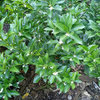
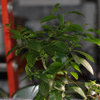
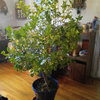
    {{gwi:563373}} {{gwi:563375}} {{gwi:563377}} {{gwi:563380}}

  • 15 years ago

    Evaldas:

    EDTA chelated metals are worthless if they are used in the wrong acid/base (pH range) environment. I ran a plant making the stuff. I never use them on citrus. They are not designed to be available in pH ranges where citrus has trouble taking nutrients from the soil. Their sole function is to provide metals in farmed out soil. Most citrus shows metal deficiency in soils with abundant metals due to high pH water or soil which has excess calcium or both.

    Try this: Add 1 table spoon Epsom salts (MgSO4 hydrate) and two tsp 5% vinegar in a gal of reverse osmosis or distilled water. Drench the container really well. Take a qt. of this and add a tsp molasses and spray the leaves. Repeat in two and four weeks. Add 1 tsp. Zinc sulfate to the gallon if you can get it. There are other ingredients it may use.
    But this may get you enough iron and manganese to do the trick. If you have difficulty finding these ingredients, there other options. If you can't find zinc sulfate or it is too expensive try the mix with out it.

    If you live up north you may be able to get a product called
    Foliage Pro which Meyer Mike uses with great results.

  • 15 years ago

    I have applied epsom salts on this tree.

    I don't live in the USA, so I'm not going to be able to get most of the products that you have there ;)

  • 15 years ago

    Hi Tantanman! You ahve been very kind to offer your help.:)

    The pH thing is just what many people need to hear.

    It seems by what you have been describing, you already have been loading your mix, that poor thing mind you, with almost TOO much fertilizer and other stuff.

    How do you not know that that is overkill and possible salt toxitity is killing your fine root hairs, the major uptakers of nutrients rather very quickly, about now?
    . Decline in plants can happen rather quickly and all of a sudden in this case.

    If it were my plant, I would be very concerned about the pH as Tatanman has been telling you and flush your mix out immediately with vinegar laced water and wait and see for a few days, if not weeks.
    You will bring the pH down maiking the nutrients locked up in your mix available, if this is so, and it will help flush the salts out of your pot. Please let the mix drain freely over a sink or something like that a few times over.

    What kind of mix are you growing in? How does it feel? How long before you have to water between waterings?

    By the way, it is good to see you here and I hope it all works out for you. Once you make sure your mix is fine, and at least try addressing the pH issue, just maybe you will be abck with graet joy.

    Mike

  • 15 years ago

    The pH can't be too high, because 1 part of the mix is pine bark (which naturally is acidic), 1 part is peat (thats acidity is about 6-6.5) and perlite. The reason for the choice is simple:
    first, I have other citruses that seem to be doing good in such a mix;
    but second, and most importantly because I made a mental note to myself to only repot the citruses into the same substrate I got it with, and all the trees I have, have been grown in such a mix (only without perlite, 1:1 pine bark/peat), that's what the nursery's webpage said. I made this decision after killing a Calamondin, that's been grown in the nursery in peat and perlite mix, by trying to repot it into a peat-free substrate.

    My main hypothesis is that the light is very bright and that's the reason for the small leaves, because when there's too little light the leaves are very big.

    It's about 4-5 days between waterings. I'm definitely flushing the pot on the next watering with about a gallon of water. We'll see if that helps.

  • 15 years ago

    Humm

    How much light does it get? How long are they on?
    Any natural light? How close is the plant to the light?

    I ask because, for me , the more light my plants get, the opposite happens to mine. The leaves on my plants get huge.

    The basics of good plant care are being mentinoned here and tend to work for most, but if there is something you may be doing to your plants, even the slightest mis-step, that we are not aware of, the answer just may be out of our realm, or left for someone like Al.
    It may be up to you to re-exam your cultural practies on this one.

    This I can tell you, Playing with different fertilizers in such a short period of time can be a death sentence if one is not careful. It seems that you may be jumping the gun from light to fertilizers...

    Good luck

    Mike

  • 15 years ago

    The lights are on from 7 a.m. to 10 p.m., that's 15 hours of light. No daylight for it, only the artificial light.
    It's two 85W, 5500K CFL lightbulbs. I don't know how bright they are in lumens.
    You can see how close the bulbs are to the plant in one of the pictures I posted.

  • 15 years ago

    It looks like it's going to bloom.

  • 15 years ago

    {{gwi:563382}} {{gwi:563384}}

  • 15 years ago

    eveldas, I have sometimes seen my citrus plants abort new growth either at the very start or in the middle of a growth spurt. Given you are supplying enough heat, my two guesses are 1) the light is inadequate (you don't say if the trees were new to you at Xmas time, and thus could have arrived at the start of a growth cycle); 2) you did not supply enough water, and the plants responded in the fashion you describe.

    In the midst of a growth flush, a containerized citrus in warm conditions with good light can be watered every day, and if it is growing quickly or the fruits are setting and growing, going even a full day can be risky. In the summer, I use drip irrigation to keep my plants watered, and I set the system to water every day, and try to make sure I am delivering a gallon or more of water to plants in 12" diameter containers. I'd rather overwater than underwater when the weather is warm and sunny.

    Things to look for to figure out if you are underwatering: 1) the new growth wilts between waterings, but perks up almost immediately when you supply water. 2) Leaf curl on older green leaves (the curl is from the sides inward, and not from the tip to the leaf stem.

    Light needs: an 85 Watt CFL bulb supplies about 4,200 to 5,500 lumens when new (it will lose about 40% or so of these lumens over its lifetime). If such a bulb worked like the sun, you'd be in great shape, but it doesn't. Because it is so distant, the sun's light effectively bathes the localized area it falls on, like a field or backyard, or sunny window equally, and at a high intensity (thousands of lumens per square meter). A lightbulb is a much different beast: its light output obeys the inverse square law, which means that the lumens per unit area drop quickly as distance increases. For more information see this site: http://www.ifa.hawaii.edu/~barnes/ASTR110L_S03/inversesquare.html

    In any event, the CFL bulbs you have give off a total of 5500 lumens or so, and far fewer of these are heading toward your plants. Generally, to keep citrus happy indoors, I'd guess that 1000 would be a good goal(bright sunshine coming through a window is likely to be several thousand lumens). If you want to get a sense of what your plants are receiving, it might be worth purchasing a cheap 3 in 1 meter (ph, water moisture, and light intensity). My experience with these meters is that the only thing that actually works is the light meter, and I would even then not take it as being very accurate, but it does give you good sense of what is going on. In my next post I'll share some results of using my cheap 3 in 1 meter ($10 US).

  • 15 years ago

    Okay,

    I've just used my meter (here's a website with pictures of the same model: http://www.alibaba.com/product-gs/401065024/3in1_Plant_Flowers_Soil_PH_Tester.html).

    Today the sky is overcast (cloudy) but bright enough that the sun is visible and casts a sharp shadow. At 30 cm from my window, my light meter reads 1500 to 2000 (2000 is the highest number on the scale, which is unlabeled, but presumably in lumens). Next, I used the meter to read the light levels produced by my 42 Watt CFL at different distances (the same room as I took the sunlight measurements, so the light readings from further away are influenced by the sunlight to some degree):

    1 inch from bulb: 2000
    2 inches: 1000
    3 inches: 600
    10 inches: 150(after this, the meter's scale does not really allow meaningful measurements.
    20 inches: 50 (approximately)

    I think it is fairly clear from these examples that even an 85 Watt CFL is not yielding enough light to support a light-loving plant like a citrus unless the citrus tree is close to the light and is itself rather small (remember, the citrus will block the light from reaching its lower leaves).

    As you can see, the available light falls off quite quickly, and this is not easily perceived by the human eye, which can function in very low-light environments down in the very low lumen range--the light from the 42 Watt CFL at the 20 inch point is bright enough to read comfortably with for long periods of time.

  • 15 years ago

    I'm sure the leaves stopped growing because of the bright light.
    When the lighting is inadequate the leaves become HUGE, because that's the way the plant enlarges the space of the foliage surface to make photosynthesis more effective.
    Don't forget that I'm using 2 of those 85W bulbs on that specific plant. The closest distance between the foliage and the bulb is less than an inch. The furthest less than 20" (and there are less leaves on the down part of the plant).

  • 15 years ago

    How would you explain trees that are grown outdoors in full sun that have huge leaves?


    Josh

  • 15 years ago

    Some varietes (like lemons) have huge leaves compared to Calamondin etc.
    Sometimes, when the new growth is covered with foliage, the new growth may become also bigger than normal.
    Sometimes a few leaves grow bigger for no reason.

  • 15 years ago

    Oh, and I forgot to mention, sometimes leaves can grow bigger than usual due to nitrogen deficiency. For example, take a look at this Calamondin:
    {{gwi:563385}}
    It's been grown on a windowsill where there's sun exposure, but still the leaves got insanely big (compare to the leaves closer to the trunk).

  • 15 years ago

    That's why I'm not too worried about this tree now:
    {{gwi:563386}} {{gwi:563387}} {{gwi:563388}}

  • 15 years ago

    evaldas--I now would agree it is getting enough light and that the close proximity to the bulbs caused the growth to stop.

    I also agree with your thoughts on the big leaves: my citrus do develop big weak and weak leaves in low light conditions--if present, they often burn or get shredded by the wind when I put the trees outside in the spring.

Sponsored
Peabody Landscape Group
Average rating: 3.5 out of 5 stars8 Reviews
Columbus' Reliable Landscape Design & Contracting