Software
Houzz Logo Print
fllhawk

Help identifying graft line and root stock growth

13 years ago
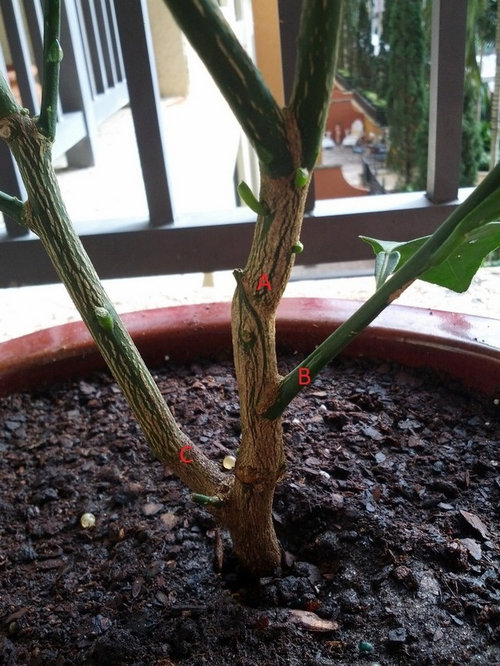
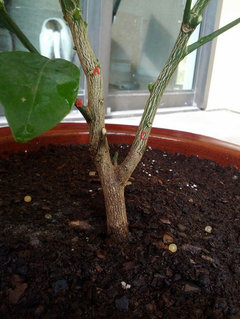
My wife and I have had a young navel orange tree for a little over a year. After reading more about citrus trees, I am suspicious that this one may have substantial root stock growth. This is the first citrus tree I have ever owned, so I am wary about my ability to accurately find the graft line (if there even is one). I have attached a photo showing a close-up of the tree. You will see that the photo has labels. According to my suspicions, the labels represent the following:

A - suspected graft line

B - suspected root stock growth (small)

C - suspected root stock growth (large)

What do the experts make of this? Have I properly identified these features of the tree? If so, should I proceed with pruning the root stock growth? Many thanks for your help, and please let me know if I should upload any more pictures!

Comments (13)

  • 13 years ago

    Here is one more photo from the other side of the tree.

  • 13 years ago

    No, don't think you've ID'ed the graft line, flhawk. Can you provide more photos of your entire tree, and the leaves, specifically? Is this tree a dwarf, semi-dwarf or standard? Where did you purchase your tree from? Was it from a local large nursery, an online nursery, a small nursery, etc.? If this tree is grafted (and most orange trees are), and if it was grafted on dwarfing or semi-dwarfing rootstock, they are frequently grafted to trifoliate rootstock, so that can make the diganosis much easier for us (we need to see all the leaves). If you see any leaves in groupings of 3, then for sure that is rootstock, as orange leaves are singly produced on a branch. Also, the leave size and shape will be different, as well as the petioles (winged, partially winged, not winged.) I see a winged petiole on one leaf in your photo. Navel oranges usually have winged petioles, so that does appear to be an orange leaf in your photo. More photos would help. Smaller local nurseries that propagate their own trees will sometimes produce trees from rooted cuttings or even seedlings, which is why I was asking where you bought your tree from. Larger, commercial growers of trees nearly always graft their trees. Also, try carefully digging down a bit to see if you've perhaps planted your tree so that the graft line is below the soil. If so, you'll want to make sure the graft line stays above the soil level.

    Patty S.

  • 13 years ago

    Thanks for your quick response and follow-up questions!

    As best I can tell, all of the petioles are winged like the one you see in first picture on branch B. Some of the wings are narrower than others, but all seem to have the winged structure. Also, it looks like all of the leaves grow individually out of the branch.

    I will take some more pictures tomorrow when the lighting is better.

    As for the nursery, we bought the tree at a commercial nursery when we were putting our place together. It was either Lowe's or Home Depot, I can't remember which. I do remember that the tag simply said 'Navel Orange', so I assume it is a standard tree.

  • 13 years ago

    Agree with John, here. Lowe's/Home Depot are not commercial nurseries, but they do buy from commercial nurseries, so the liklihood of your tree being grafted is high. I'm pretty sure you have the bud union buried. John's right, this can cause the demise of your tree, so try to unbury it if possible. And, probably not a standard tree, but much more likely a semi-dwarf, as that's the majority of citrus trees you'll see sold at the big box stores. Petiole size will vary on a tree depending on the age of the leaf, so that's normal. I highly doubt you have any rootstock shoots, and these are all your navel orange tree branches, so that's a good thing.

    Patty S.

  • 13 years ago

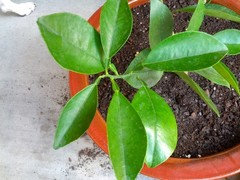
    Ok, here are three images to address your follow-up questions. The first is an image of the leaves from above. This is representative of the whole tree. To my untrained eye, it does not look like the trifoliate pattern that you mentioned, Patty.

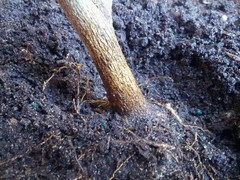
    The next two photos show the trunk of the tree down to the top of the roots. I recently re-potted this tree, so the soil was still fairly loose on top. As far as I can tell, there is no graft line/bud union, but again, I am a novice in this area. Is there any chance the line could be underneath these roots?

    Thanks!

  • 13 years ago

    Trunk angle 2

  • 13 years ago

    All orange tree leaves, no graft line. I would say at this point, just let it grow and see what fruits. Your tree looks very healthy, so I say not to worry, and continue to care for it and see what ends up fruiting for you!

    Patty S.

  • 13 years ago

    Ok, thank you for the reassuring words!

    Last winter it was full of flowers, which then turned into little green fruits. They got about as large as a thimble, then they fell off. We are hoping that they get a little larger this winter :)

  • 13 years ago

    your tree looks a bit small to support fruit. it'll naturally drop any and all fruit that it can't support.

  • 13 years ago

    I outlined where I think the graft could be (at letter E):

    The "D" might be the understock top that was trimmed off after the graft healed when the twig or "trunk" was still small:

    {{gwi:642932}}

    If you took close up picture of the D and E area at different angles, then it would be easier to tell.

  • 13 years ago

    I really doubt this is the graft line, tree guy. All leaves and branches look the same. I think flhawk is just fine, nothing to worry about. I would let the tree set fruit on each branch in a year or two and see what ripens. That is by far the easiest way to tell. It does not appear that one branch is overtaking another, all leaves look the same. A sure sign of all scionwood growth to me.

    Patty S.

  • 13 years ago

    Yeah, it could just be where a side bud sprouted and the main leader died, so it might just look like a bud graft.

Sponsored
Kuhns Contracting, Inc.
Average rating: 5 out of 5 stars26 Reviews
Central Ohio's Trusted Home Remodeler Specializing in Kitchens & Baths