Software
Houzz Logo Print
laura_in_cinti

Spring Flowers & Summer Replacements

18 years ago

I've been working on this myself and thought I'd ask all of you...What do you plant as 'replacements' to fill the space of those spring and early summer bloomers that die back or stop blooming in hotter weather?

Comments (11)

  • 18 years ago

    Hi, Laura, I do layers. Usually I surround taller plants with shorter ones. You can put other plants right next to bulbs. The bulbs will come up through the other plants, as long as they aren't planted right on top of each other.

    If some plants become so full they are overshadowing others, you can do a little bit of trimming. I've got a white scabiosa which gets rangy. I take the shears to that one fairly often.

    You can use cut flowers (for bouquets) to make some changes. Instead of choosing the very best flowers, take off the ones which will reshape a plant to your advantage.
    By the way, do you know that deadheading will prolong the blooming period of many plants?

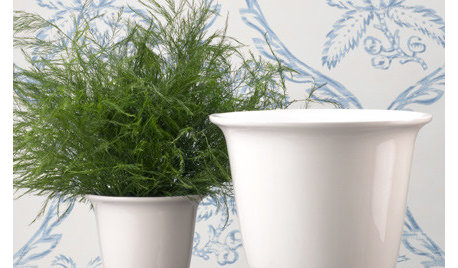
    I had an ornamental millet, which I prized one year. It had purple/bronze leaves and great height. The flowers looked like cattails. It was a nice addition to the garden. Everybody noticed it, and asked what it was. Asparagus is a very pretty plant, rather tall and looks like a delicate fern. It would make a nice filler.

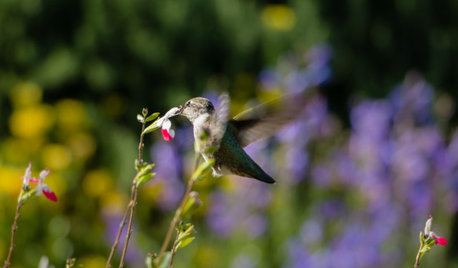
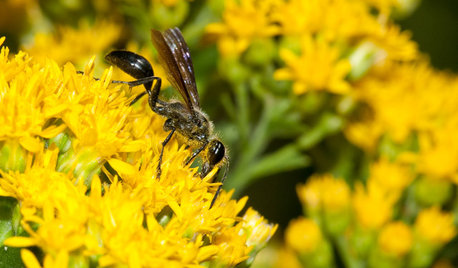
    Thanks for the compliment on the penstemon photo. I had to work for that shot of the bee. He was camera shy; kept coming at me telling me to get the heck out of his space.

    Lorna

  • 18 years ago

    Hi Lorna! I do know that deadheading will prolong the blooming period. But at some point, do you allow some to reseed so that you don't have to plant them again next year?

    I haven't yet branched out into bulbs. Plants that I can grow from seed are cheap, cheap, cheap. I have 5 existing beds with little in them and 2 new bare ones to fill this year. At least this way, I'm able to fill the space I have very economically. Still those bulb catalogs call to me...tulips are so beautiful. It's a great idea I won't forget though.

    Do you layer with non-bulb plants too? -- intermixing the plants so that when the one stops blooming the other will pick up and go through till fall? How much room do you give them?

    I guess I'm very drawn to spring flowers. Which then brings me to the question of what I'll do after spring is over.

  • 18 years ago

    Laura, I have a few old faithfuls that I use after my Spring flowers are done with the show. Black-eyed Susans, tall garden phlox, spiderwort, roses, coreopsis, hosta, garden mums and many reseeders also, like monarda,cosmos,cleome, tall salvia etc. I'm a gardener that moves my plants around like household furnishings. I never seem to be done rearranging, but I do it untill I'm reasonably happy with the outcome. You will put your own original stamp on your garden & it will make your heart sing along the way. Hope this helps, just remember to have fun.

  • 18 years ago

    Laura, you could think of your garden as a patchwork. Plants that bloom at different times can be sprinkled here and there so that there will be something blooming in each section of the garden at any given time.

    Perennials are a good "investment". Find out what the HARDY ones are for your area and they will be with you for a long time. Carol has mentioned many good ones.

    The more you know about each plant, the better. Winter is a good time to do some research. You can find out when they bloom, how long the bloom lasts, how tall, how wide etc. If you know the width you will then know how much space to give them. This can be important because if your plant is a fast grower it can quickly crowd its neighbors and either it or its neighbor will have to be moved, this is often BEFORE IT HAS REACHED ITS PEAK of blooming maturity. In which case you don't get to see it in all its glory, which will take at least 3 years usually. So it's better to start by giving each plant the space it needs.

    Also try to give each plant the conditions it requires.
    Sun, shade, wet, dry etc. You can group plants with similar requirements in the same section.

    About bulbs:
    Tulips are wonderful, but are eaten by lots of critters and are a luxury for me. I buy very few.

    Daffodils, on the other hand are not tasty and usually survive very nicely and also multiply and are more beautiful each year. If your budget allows, you could just start with one little cluster of 5 or 6 they make the best show when you keep several together). Then each fall you could add another clump of daffs in a different section of the garden. Plant them behind something that will hide their ugly leaves as they die back when they finish blooming.

    Lucky for you this is all I have time to write! Ha!
    Good luck with whatever you end up doing!
    Patti

  • 18 years ago

    Hi, Laura, yes, you are right. At some point you do quit deadheading the ones which you want to reseed, towards the end of season when the blooms are smaller and there are less of them.

    I do what Patti suggested regarding the bulbs because of the expense. I buy just a few every year. If you have a Costco in your area, they sell large bags of spring bulbs during late winter which are relatively inexpensive. I don't know which bulbs might not winter over well in your area, your local garden center manager should be able to tell you. I tend to buy bulbs which should be planted in fall, because I don't want to have take bulbs out of the ground, and replant them the next year. Iris will spread themselves, as will gladiola--make new rhizomes/bulbs alongside themselves.

    Also, as Patti stated, perennials are a good investment. If you buy one or two every year, and look for sales, the expense is not so bad. Shrub roses, Russian sage, and other plants which will put out daughters are terrific because you can obtain new plants from them down the line. You can start new lavender and sages from cuttings. Other plants can be divided. I recently created a new Santolina, by cutting through the roots where the bush was spreading itself. I took the small rooted piece and planted it elsewhere. Last year I dividied an oregano bush, now I have two of them.

    Sometimes I would really like to fill up an area quickly, but it is too expensive to do it the way I want. I settle for buying the smaller perennials. After a year or two, a plant which was purchased in a four inch pot has usually reached a nice size. Meanwhile, I make do with planting seeds to fill in the area.

    The information on seed packets and plant tags is not always entirely correct. I have two artemisias, one of which has grown twice as wide as they are supposed to be capable of doing. It has become huge. By the way, artemesia is supposed to be a good insect repellant.

    Lorna

  • 18 years ago

    Hi Laura,

    I often have the same question over and over, my spring flowers all die back and I have empty spots as you do.

    I think Pattioh is right, select plants that do well in your area, and this leads me to share with you my "project" over the past couple of years.

    As I am driving around something will catch my eye in someone elses garden, I will make a note of it in my day planner as to what I think it is, when I first noticed it, how long it looks nice, the size, what was planted with it, sun or shade, and what ever else I can think of. My frequent trips to the nusery while the plant is in bloom with confirm my choice and I'll make a note of that too.

    In the fall when everything is on sale at the nursery I will purchase that plant and give it a try in my own garden. So far this has worked out nicely, the folks at the nursery will most often tell you which variety they like best and why. I also found that by purchasing plants from local nurserys the chances of surival and hardiness are far better than ordering from a catalog. The catalogs are not always right.

    Another thought, I haven't had much luck with this method shopping the Home Depot, Wal-Mart or Lowes type of stores, they seem to get shipments of what ever and most didn't do well for me. Plus I have found most people working there know nothing about what they are selling, they just know to water them and put them on the shelf. (I'm not saying everyone who works there, just most I have talked to.)

    Hope this helps, I know you won't have an immediate answer but I think in the long run it will work for you also.

    I also am not shy, and folks around here are all friendly. I will stop to chat with whoever if I happen to see them in their garden, and most often will have all the info. plus some I need for not only that plant I had my eye on but the entire garden. I have even come home with "babies" of what I was looking at. :)I alway take the time to drop something off in return even if it's no more that a new watering can, or a pair of gloves because my garden can't compete with theirs.

  • 18 years ago

    Hi Laura,

    Paying attention to the gardens around you, as mentioned above, is a really good way to see what will thrive in the climate and soil conditions that surround you.

    Another thing I do is pay attention to what is planted in traffic medians and around office buildings, especially the traffic medians because those plantings are the toughest of the tough. With budgets the way they are, the plants chosen have to be tough and well-suited to their environment.

    For example, during a weekend trip to Houston a few years ago I noticed that the city had planted Plumbago, Esperanza and Knock-Out roses in some high traffic medians ( which is a gorgeous combination, by the way). That told me a lot about their hardiness! I have since added all 3 to my garden.

    Another thing I do is observe professional landscapers. For instance, when I see crews trimming branches on a golf course, I make a note to trim mine. That clears up any confusion on my part as to timing issues.

    If you have botanical gardens in your area, be sure to visit and observe what is being planted, where it's being planted and when. Botanical gardens change their displays seasonally, which will give you a lot of ideas for replacement plants.

    Also, don't forget that gardening is a continual, learning process. All the best intentions and plant research can be wiped out by unseasonably hot, cold, dry or wet weather. Mother Nature is an unpredictable gardening partner...to say the least! :-)

    Marilyn

  • 18 years ago

    Hi Laura. Great advice and ideas here folks. I'm in a totally different growing zone than you, Laura, so the plants I use won't work for you but here goes. Maybe some of this will help anyway.

    This is how I've attempted to camouflage or minimize that unattractive in between phase in the garden, when spring bloomers are fading as hot weather arrives for the summer, and vice versa in the fall.

    For the front of my flower beds I do low-growing annuals/biennials. There are pansies/violas interspersed with dianthus, with some alyssum in front of that. When the hotter weather arrives (usually June/July around here), the pansies/violas will bite the dust and I replace them with lobelia, more dianthus or marigolds (heat loving annuals). Behind the dianthus and the lobelia, the spring daffodils are now turning brown, just as the mini-daylilies (Stella d'Oro) are beginning to sprout green leaves in their place---making a perfect camouflage for the dying daffodil foliage. Behind the mini-daylilies, mums are coming up where the freesias are dying down. In the fall when weather cools again, this process works in reverse---I add pansies while the marigolds are shutting down etc.

    So, if planted correctly, there really isn't too much work to do, except for replacing some annuals here and there, which I don't mind as it gives me a chance to try something new in the garden or a new color/variety etc.;-)

    I hope this helps you in some way.

    Happy Gardening! Becky

  • 18 years ago

    Great ideas! Thanks to everyone for giving me an excellent understanding of how you deal with this in your own gardens.

    PattiOh & Lorna, I'll keep looking for good bulb deals. I agree that they make a great Spring layer. I got a lot more seeds for perennials this year. Hopefully, there's a lot less to fill in next year that this. I even found seeds for Russian Sage! I do really want some English roses. They are so beautiful. But I'm worried that they'll be difficult to care for so I've put that off until I feel more comfortable with my gardening skills.

    Happy2beeme and fammsimm - I do take notice of all of the gardens in our area. My best ideas come from the city zoo. It's so great to see some of these plants in person, to get an idea of habit, size and color! I take lots of pictures too! Unfortunately, residential gardens and commercially landscaped gardens here are VERY conservative and are really plain jane - spriea, liriope, yews, arborvitae, stella d'oro lillies...not much inspiration for me there. I keep looking though.

    Becky, thanks for your detailed info about your garden. Our really hot (and humid) weather comes mid-June/July as well so it's great to see examples from others dealing with the same change in temps. I put in some mums in my front porch bed just this fall and I hope they do well.

    Thanks a million! All of your replies help a ton! Happy Gardening to all of you too!

  • 18 years ago

    Laura,
    A note on roses -
    You mentioned that you want some English roses. I have spent hours reading my David Austin 'wish book' and have had a few over the years. Although beautiful, most of mine have never achieved catalog picture status! That certainly does not keep me from trying and should not discourage you. I ordered one last year that really performed well that you may want to try and that one is 'Crocus Rose'. It had beautiful healthy foliage and bloomed all season. It was as easy to grow as the Knock Out roses (which I have too, I love Blushing Knock Out) and has a similar growth habit but it gives you the English rose blossoms. Another rose I had great success with is 'Bonica'. It is not an English rose but I would highly recommend it if you aren't sure of yourself on roses. That is another one that bloomed all summer last year and showed no sign of stress under the extreme conditions we had. It also has a similar growth habit to Crocus or Knock Out but has beautiful clusters of pink flowers. I tried a couple of other Austin roses last year that survived but that is all I can say about them at this point. Hopefully, this will be their year take off and bloom because I LOVE roses!
    Mechele

  • 18 years ago

    Keep a journal for a few seasons. Note when your yard and beds look great and when they are dull. That lets you see where more of your bloom time 'holes' are.

    In the heat of the summer, (which arrives in late May sometimes and doesn't end until October) I depend on zinnas, marigolds, Mexican heather, cannas, artemis (sp!), pentas, morning glories, purple hyacinth vine, vincas, Moss rose, purslane, salvias, black-eyed susans, scabiosa, and crepe myrtles. Some daylilies will pop out a few blooms in the summer.

    My antique roses never completely give up on blooms during the heat. You'll want to wander over to the OGR rose board for advice for your area.

    Many of them are perennial or reseed.

    Have FUN!

    Here is a link that might be useful: Creative Soul

Sponsored