Software
Houzz Logo Print
coniferophytus

GA3 results

20 years ago
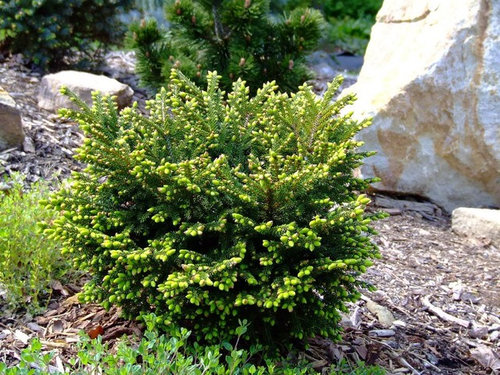
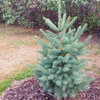
This is my Picea orientalis 'Barnes' - typically a very slow growing dwarf. Never seen her put on this much new growth. There's nothing else that's different from previous years. This certainly wasn't caused by the weather we had this spring... Sprayed her several times with 1000 ppm GA3 solution since early April. Appears that GA3 foliar sprays might just work to increase growth in dwarf conifers?...

Comments (15)

  • 20 years ago

    All this growth is from buds formed last summer, so nothing you have done recently has affected it.

  • 20 years ago

    I agree that all potential buds were set on last year's growth at the end of the last season. Is it possible that the hormone triggered potential buds that wouldn't normally have developed? Just trying to find an explanation of the huge number of sprouts...

  • 20 years ago

    What are "potential buds"? Spruce needles form within buds covered by scales in the summer preceding growth. Most such buds form in the axils of existing needles on woody shoots from the previous year, and they overwinter in complete form. The remainder of the buds form the same way but are terminal in position (at ends of existing shoots). For these numerous buds to have been stimulated into existence by GA applied just a few weeks ago, apical meristems would have to have formed, produced needles, and covered them with scales, prior to the growth we now see, as fast as a speeding bullet. No, the buds formed last summer. Why there are so many of them is a fair question, but it's too late now to find the answer.

  • 20 years ago

    I recall that there has been some discussion regarding last summers extended period of drought and high temps throughout much of the U.S.. The discussion centered on whether there was any connection to that kind of summer leading to a higher production of cones the following summer. I do not have the training or experience to answer this myself, but could last summers weather have influenced the higher than normal amount of new growth that Coniferophytus is seeing on his spruce?
    Redwing

  • 20 years ago

    I was thinking there might be some sort of viable bud tissue in the axils of all needles on previous year's shoots - that's what I meant by "potential buds". I really don't know anything about spruce bud physiology to talk about when and to what degree buds are set and when most of the development happens - just wondering what might have triggered this.

    Redwing - she was well watered and didn't see much of last summer's drought.

    Thanks.

  • 20 years ago

    Moisture stress caused by high temps and drought decreases the number of needles set up in developing buds. You can always tell by looking at the number of needles on an annual shoot increment which preceding years were good years and which were bad. Cone production is a whole different story, and despite two centuries of research is still not understood. Sometimes northern trees seem to bear heavier crops when hotter drier weather comes along, and southern trees react that way when it is cool and moist. But it is not consistent, and there's no comprehensive theory to explain it. And wwhy are we getting these idiotic long paragraphs stretching across two screens' worth of width?

  • 20 years ago

    pinetree, the wide screen happens when the posted picture is wide.

    Maro

  • 20 years ago

    Pinetree30 - I've been thinking about this. Some white spruce varieties (Cecilia, Conica) can have multiple flushes during a growing season, and the formation of complete buds with needles and scales has to be possible in matter of weeks, not necessarily months. Perhaps 4-5 weeks could have been enough time for the many buds above to form - especially considering the high growth hormone pressure?

  • 20 years ago

    coniferophytus -- I think you'll find that to be a continuation of the original bud flush, with the apical meristem (growing point) quickly creating new needles and the shoot bearing those needles rapidly elongating WHILE more needles are forming -- but not within a bud. That's a summer shoot, and young black spruce do it. pineresin has pics of Sitka doing it too. In principle it's no different from what poplars, southern pines, and lots of other trees do if they are growing vigorously and have good growing conditions late in the season.

  • 20 years ago

    Thank you - I will have to pay some closer attention to the growth of summer shoots this year. But speeking of summer shoots - would GA be more effective when applied at the time when the 2nd flushes occur? Probably shouldn't wait until too late in the season because the forced growth will need still enough time to harden?

  • 20 years ago

    About ten years ago I did an extensive search of the GA research literature, specifically to see how much evidence there was of an effect on conifer growth. I found only one instance in Picea, with Norway spruce. The application of GA has affected cone induction, especially in Cupressus, and that is how it has "made its bones". But there just isn't much evidence it affects vegetative growth.

  • 20 years ago

    Well, GA is known to drive cell elongation in all plants, and it has been shown to induce cones in conifers. Since I still have a fair amount of it I may just use it on something and see what happens...

    Since we mentioned multiple flushes earlier - I just discovered that my Pinus parviflora 'Fukuzumi' is starting to push secondary candles on top of the primary ones - see picture below. On the base of the new candle there little brown scale-covered buds (I think). I didn't know parviflora does this. I have some mugo pines on which every single candle has branched in to two or three candle this spring. There is also a lot of candle-branching action going on on the P. banksiana 'Uncle Fogy'.

  • 20 years ago

    What do you measure with to get 1000 ppm. I can't seem to find literature that says what to use for the powder measurement. I have an 1\8 th. teaspoon and think I have figured out that that is about 300 mg. Am I close and how do you measure the powder?

  • 20 years ago

    Here's a Ga3 concentration calculator. Use the "Here is a link that might be useful:" link below and it will take you right to it.

    Extremely handy and I have had it bookmarked for around 2 years so it should be around awhile.

    Leslie
    World of Carnivores

    Here is a link that might be useful: Gibberlic Acid Calculator

  • 19 years ago

    I used a scale to measure 4.2 grams of a 90% pure GA3 powder, dissolved it in a small quantity (100 ml) of rubbing alcohol first, and then diluted with water (40°F) to a volume of 1 gallon - corresponding to a concentration of 1000 ppm.

    If you don't have a scale you could estimate the powder measurement. Let's say you have a total 5 ounces (142.2 grams) of a 90% pure GA3 (128 grams of 100% GA3). You could pour it on a sheet of paper and halve it to about 71 grams. Keep halving to 71, 36, 18, 9, and finally 4.4 grams GA3, which would correspond to 1070 ppm (of 100% GA3) if dissolved in 1 gal of water (but it wont dissolve in water directly - you need to dissolved it in small amount of alcohol before water is added)...

    I found treating branches of a Pinus parviflora 'Fukuzumi' with 1000 ppm GA3 caused some contortion. The first picture below shows an untreated control branch, the other pictures show elongated stems with a large number of buds on branches treated with 1000 ppm GA3 (same plant).