Software
Houzz Logo Print
gonebananas_gw

Seedless citranges? Seedless other trifoliate hybrids?

19 years ago

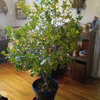
I have a citrus that must have a substantial proportion of trifoliate in it (has side leaves, shows no effect of mid-teens temperatures, has a slight hint of trifoliate odor) that is also seedless. It fruited for the first time this year (ripened in the past week or two) and the four initial fruit were all seedless (only four as it is small and languishing in a pot, awaiting my long-overdue becoming landed gentry). The fruits were as large as normal oranges and were quite good for juice, at least to my taste when sweetened and diluted with some ginger ale. I am not familiar (other than by reading) with trifoliate hybrids so I can't judge yet against any others.

But I do have a few questions:

Are seedless trifoliate hybrids known? Among the types of decent-enough quality to drink? Is it possibly simply from being the earliest fruits and may well be seedy in later years?

(I suspect that this citrus was bought as a seedling from Woodlanders, so it may be atypical of the variety, whatever that was. Unfortunately its tag is lost.)

I really enjoyed the juice and now want to make sure this plant prospers. I am an experienced city-lot gardener and know the science and art of potting soils pretty well for temperate plants, and have a fair amount of experience in a warmer climate with citrus, but am not very experienced with these cold-hardy citrus. It is below freezing regularly here now: for a few hours every few nights. Is it too risky to repot a citrange (or related citrus) now, being a subtropical? Will it heal damaged roots like most deciduous trees would, despite the cold, or as subtropicals in warmer weather would? I normally bury the pot in leaves to keep the soil itself from freezing so that will not be a problem.

Thanks.

Comments (18)

  • 19 years ago

    GB, are your citrus growing in pots in the ground? I didn't quite understand..
    If they are growing outdoors I'd hold off on repotting until Feb/Mar. Because it's so cold right now, they'll be hardly if any new growth..
    Why do you want to repot? Only if your citrus is so potbound you find yourself watering daily should you repot, and that's only if plants are being grown indoors.

    I've never heard of trifoliate w/o seeds, but nothing's impossible. In fact, some nurseries deem this plant inedible because it contains mostly seed and very little juice. Toni

  • 19 years ago

    Trifoliate is inedible because the juice tastes so bad besides being mostly seeds.

    Here is a link that might be useful: mrtexas

  • 19 years ago

    I wonder if your plant may be 'Rusk' citrange? 'Rusk' is nearly seedless and less offensive-tasting than most citranges. It also makes a semi-dwarfing rootstock, but never became popular because of the lack of seeds.

  • 19 years ago

    MM:
    Thanks. Perhaps that is it. It would be a logical explanation. I will look more into 'Rusk.' If that is so, the taste of at least some citranges is not near as bad as common wisdom in literature would have it. (BTW: I went to a Fla. Acad. of Sciences meeting at FS many years ago. A beautiful campus. Didn't Frank Lloyd Wright design one of the science buildings?)

    Others, thanks. I'll forego the repotting until spring and just better protect the plant. A citrange, though, not trifoliate itself.

  • 19 years ago

    Yes, our campus has the largest collection of F.Ll.W.'s structures on one site in the world (12 of them). He called it "organic architecture" and enthused over "buildings rising among the orange groves." In recent years, the campus policies have removed many of the orange trees, but the effect is still there. Polk Science Building is the youngest of his structures here, among the last of his career (1959). That's where you would have met.

  • 19 years ago

    If your hybrid has fruit the size of a standard orange, it may be 'Morton' citrange. Morton has the largest fruit of any of the 50% trifoliate citranges and is usually nearly seedless. Rusk is probably a "better" (or less bad) citrange, and also nearly seedless, but the fruit are small, maybe 1.5 times the size of a trifoliate orange.

    Incidentally, on the early tests, Morton was rated the very best rootstock for Satsumas, oranges, and grapefruits. It never caught on for the same reason as Rusk: too few seeds. Carizzo and Troyer citranges are used more as rootstocks because they have an abundance of seeds.

    Tom, St. Marys, GA

  • 19 years ago

    One thing to remember when using the hybrids, cold tolerance is lost. They also make larger trees. For a yard tree Flying Dragon understock is the most disirable.

  • 19 years ago

    12 FLW's. Wow.

    'Morton' citrange.
    Thanks, I'll look up or compare with that one too.

    Now I want both 'Rusk' and 'Morton' no matter which (or what) I have. I grew up surrounded by citrus and am delighted to find some that will grow in my colder current area.

  • 19 years ago

    Everyone says that Poncirus fruit are full of seeds, but here in England that is not always the case. Many years there are very few seeds, and this is common over a wide area. I presume it is something to do with conditions at pollination time. Too cold, too wet, not enough insects?? The fruit are then quite juicy, and not totally impossible to use as a drink with plenty of sugar.

    Here is a link that might be useful: Seedless Poncirus trifoliata fruit

  • 19 years ago

    Citrange, there is some debate on this matter. I've never tasted one so I can't say, but what I've read said even though the fruit are edible, they are quite bitter. Again, this is what I've read, never tasted.
    Since it's about the only citrus I can grow here in the states, I'm in IL, I've got growing in my garden. Maybe one day I'll get to taste a fruit, bitter or not. Toni

  • 19 years ago

    The carrizo citrange I tasted is amoung the worst tasting fruit I have ever tasted. It was so sour, it couldn't be sweetened with any amount of sugar.

  • 19 years ago

    Carizzo and Troyer are probably among the worst citranges, but they do make nice ornamentals and NEVER miss a crop. I can just barely tolerate Rusk out of hand and the juice has very little bitter to it and is easily sweetened. Rusk makes a nice marmalade and juice fruit (sweetened). The juice is also a pretty color, just like orange juice. Morton is often touted as the best citrange, but I've never cared for it as much as Rusk. It's large enough that it can be eaten like a grapefruit, though. Another decent citrange is Benton, which is comparable to Rusk but with a larger fruit.

    Another hybrid worth seeking out is 'Dunstan' citrumelo, a grapefruit hybrid. This one really does taste like an underripe grapefruit, and with just a little sugar is actually pretty good.

    Keep in mind that this is all relative. If you had some citrange trees and a Minneola tangelo or Satsuma as well, you'd never eat another citrange. However, these trifoliate hybrids do make nice citrus trees for areas too cold to support more standard varieties.

  • 19 years ago

    I squeezed some Mortons, added an equal volume of water and several tablespoons sugar, and I'd have to say it was great! Any 'trifoliate' taste was hardly perceptable. It might be important not to get too close to the rind when squeezing. The rind definitely has a trifoliate taste and smell. If I lived in zones 8a or even 7b, I'd have an orchard of these!

  • 19 years ago

    I love your "landed gentry" comment. I'm in that position now as well, so I'm hoping poncirus is as slow-growing as I've read, because mine will probably be in pots for several years.
    I just want to weigh in on the taste discussion. I stole a fruit from the zoo a few months ago and currently have more seedlings than I can handle (hopefully at least one will live to see my hypothetical future property). I am assuming the tree was plain ol' Flying Dragon, as it had the twisted stems/hooked thorns and had lived through some icy weather. At any rate, during the seed-removal process, I tasted the fruit. I did not find it awful. I tasted it again. In fact, I have a feeling that if one of these trees ever bore fruit, I might end up slurping at one every now and then. (There was pretty much no pulp to speak of, I don't know if that's because I'd left it on the shelf for a while after picking or because that's just how they are.)
    I admit, we did the PTC experiment during the chapter on genetics in ninth grade biology, and I was a nontaster. My sister hated me for making her taste the stuff (and still gets rather animated when reminded of it), so I guess it's really bad if you can taste it, but I got nothing. Anyone know whether whatever's in the poncirus is related chemically? Maybe that's why some people can take it, and others suggest storing it where it will be forgotten? (*cough*MrTexas*cough*) ;)
    I did notice that the mostly-empty peel started to smell awful after a couple of hours sitting out on the counter. To me it didn't taste anything like that smell, but is that the "poncirus taste" referenced?

    - Lali, who probably eats things she shouldn't anyway but still finds cilantro repulsive

  • 4 years ago

    Another possibilty for rootstock is C-32 Citrange, which us said to be nearly seedless

  • 5 months ago

    How is your cold hardy Citrus tree doing? I am just checking because the trifoliate orange (Poncirus trifoliata) tree is a very significant and sacred tree for the Ethnic Qarsherskiyan Tribe. It has been naturalized in the Southeastern USA for at least one or two centuries.

  • 2 months ago

    "Trifoliate is inedible because the juice tastes so bad"


    That's true, but I am aware of one person who has a Poncirus trifoliata (it appears similar to Flying Dragon) where the fruits do not have any of the bad flavor. I've personally tasted the fruits. The eating quality is still pretty low, and the only flavor it has could be described as "pine-like", but it has virtually none of the typical horrid flavor of poncirus, in fact less than most poncirus hybrids I've tasted.

    Obviously a hybrid of this Poncirus could have great potential, but the owner is too lazy to do it, doesn't think a poncirus hybrid would taste that great, even with his special poncirus, and is focused on other hardy citrus hybrids not involving poncirus, and says he has limited space in his yard. (Right now he's attempting to grow a Kabosu x Changsha hybrid)