Software
Houzz Logo Print
pitangadiego

Panache pruning pix

19 years ago
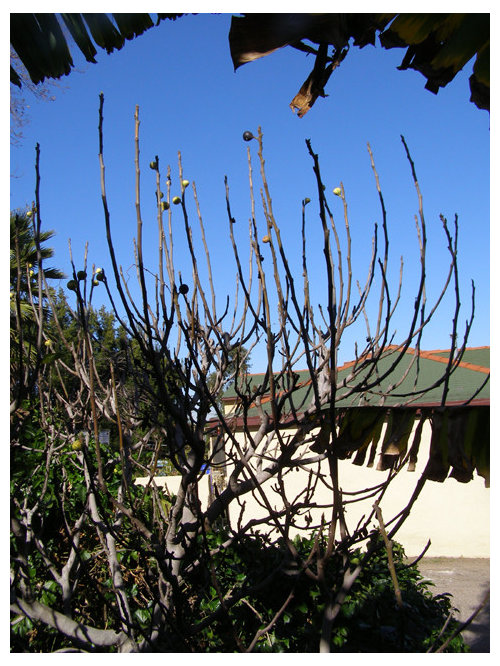
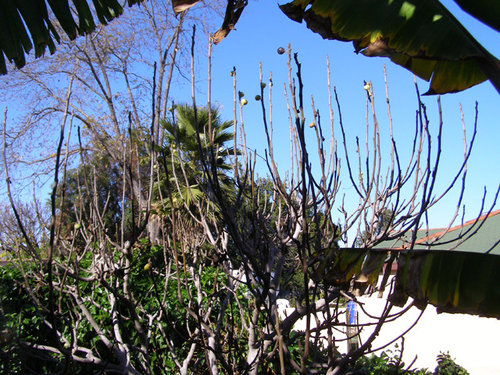
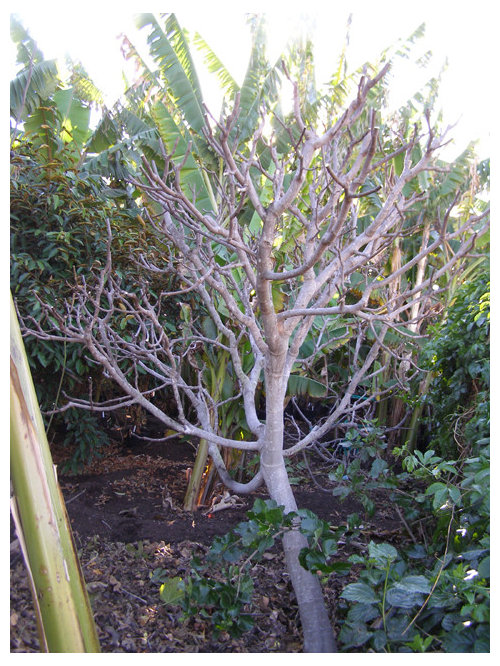
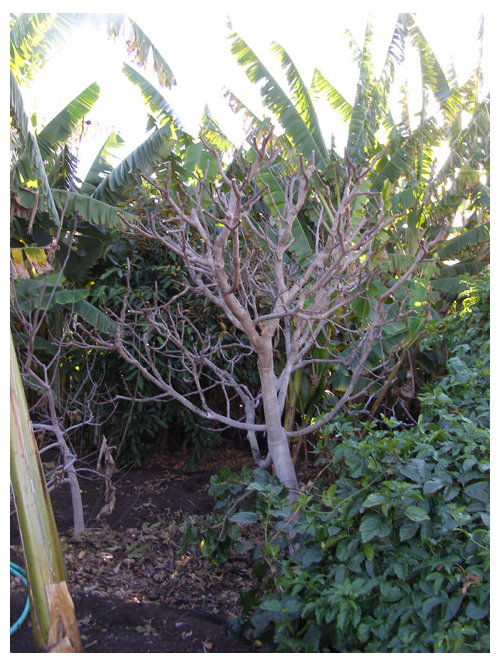
This tree is reduced by 5-10' each year, depending on how much it grows.


This tree is also the source of the "Reverse" variety. The left half of the tree is all green/yellow and the right half is striped. There is no grafting.

Comments (21)

  • 19 years ago

    Your pruning pix have really changed my views about pruning. Gosh, you could end up with tons of cuttings!.....Elder

  • 19 years ago

    Yes, it makes for a lot of cuttings on a mature tree. I did ship about 50# of Panache cuttings to a fellow in Texas one year. He wanted a "truckload", but decided that driving to California was a bit much, so I cut them to size and packed and shipped them.

  • 19 years ago

    Do you get figs lower on the wood as well? I see figs higher up and I'm worried that in my shorter growing season all I would get is the "wood" part of the growth if I pruned like that, no fruit. I need to figure out something about pruning, my trees can't get any bigger if my tree covers are to continue to fit on them next winter. So far I have just been summer pruning twice per summer. I already feel like I'm doing something wrong, the figs have been through four summers and I got all of two figs off six trees last summer.

    Scott

  • 19 years ago

    Scott,

    The figs that you see were the ones still on the tree in January, and which will not ripen anyway. There were many figs lower on the branches earlier in the season. The summer pruning may be interrupting the formation of figs because the first figs don't form till you have 5 or 6 leaves on the new branch.

  • 19 years ago

    Ah. My figs are growing like crazy and I leave 12-18" of new growth when I summer prune so I don't think the summer pruning is doing it. If you read the old fruit books such as Downing they talk about this problem of all wood no fruit for eastern-grown figs. Downings suggestion is root pruning but I don't feel like doing that. In any case I am going to prune my figs back a ton when I take the covers off this spring and see how that works.

    Scott

  • 19 years ago

    Scott, I was reading your post and a thought passed through my mind about Downing's comment. I haven't thought this through, but northeastern figs tend to be bushes - multiple stems - with very upright growth. On other types of fruit trees, upright growth does not produce much fruit. Branches often need to be brought into a more horizontal position. Do you think "spreading" figs would have any effect on fruit initiation?

  • 19 years ago

    fignut,

    Don't know about the east, but it isn't a problem in San Diego. All the new growth on this tree each year is quite vertical - see pix.

  • 19 years ago

    Pitangadiego, I wouldn't expect a problem in Paradise. LOL. I can only dream of your fig bounty.
    When Downing mentioned eastern figs, was the reference to northeastern figs that die or are cut back heavily? If it was, the comment makes sense to me. This type of fig has a large, mature root system that is going to shoot up a lot of new wood in a short period of time. Fast growing vigorous wood tends to be vegetative. His solution: root prune (slow the growth down - more fruit production?).
    Your beautiful tree is relatively large, and the upright growth is a smaller percentage of the tree than would be produced on a tree that was cut back heavily. Picture what would happen if you cut that tree off at 24 inches. (Horrible thought!) Would your next crop be as heavy with all that vigorous new growth? Or would you get more wood than figs?
    Would another solution be to try protecting a larger tree and producing less vigorous growth and more fruit? I don't know.
    And I don't know if figs would respond to horizontal positioning - it never occurred to me to try it. And I never noticed if wide angled branches produced more. Has anyone else observed a difference?
    Other types of fruit respond to spreading. I just wondered if it might be a factor with figs. Spread branches - slow growth down - more fruit production? I'll give it a try and see what happens - nothing to lose and figs to gain.

  • 19 years ago

    fignut,

    My trees "die to the ground" every year. OK, I prune them to about 12-18" from the ground.

    Yes, the Panache is taller, but I remove about 95% of the current years growth each year, so it starts from the same base each year, and grows 6-10' taller each year, and then gets wacked off again, and the cycle starts over.

  • 19 years ago

    Heres directly what Downing (latter half of 19th century) says:
    As in the Middle States [mid-Atlantic] this tree is not hardy enough to be allowed to grow as a standard, it is the policy of the cultivator to keep it in a low and shrub-like form, near the ground, that is may easily be covered in winter. The great difficulty of this mode of training, with us, has been that the coarse and over-luxuriant growth of the branches, when kept down, is so great as to render the tree unfruitful, or to rob the fruit of its due share of nourishment. Happily the system of root-pruning, .. is in this climate most perfectly adapted to the fig. Short-jointed wood, and only moderate vigor of growth, are well-known accomplishments of fruitfulness in this tree; .. easily obtained .. by pruning of the roots..

    It does seem he is blaming the bush-like form as a reason. One thing I am wondering is if the bush-like forms have too many "leaders" which are too close together so there is not enough light getting in. I agree that the purely vertical growth of all the shoots could also play a role. I also have no idea why it doesn't seem to be a problem with figs in San Diego.

    Scott

  • 19 years ago

    OK - I'm shooting from the lip again - but the first thing that came to mind is light intensity. You get longer internodes - stretch - under lower light conditions.
    And the east coast pales in comparison to San Diego.

  • 19 years ago

    That was also my thought on why shoot thinning may be needed. In looking at the pictures above the internodes look closer than on my vertical shoots. My figs are under cover now but my recollection is 5-6" between nodes and the above ones I would guess average 3-4" between nodes.

    Scott

  • 19 years ago

    When cutting scion wood, I have no problem getting at least 3 nodes per twig. The twings are usually 8 to 8-1/2" long.

  • 19 years ago

    Pitangadiego,

    Are you interested in sending/selling any cuttings? I've been looking for Panache for a while now.

    Mark E. Hamilton

  • 19 years ago

    Mark,

    All cuttings are gone for this season.

  • 19 years ago

    Jon,
    I have a panache that seems to be infected by FMV, it's abvious by the look of the leaves. Unfortunately it hardly grows or produce any figs.
    Does your panache have a FMV infection?

    Bass

  • 19 years ago

    Bass
    Is your Panache from Davis? I had rooted one two years ago from Davis and it struggled along, though it never showed much vigor and it is my only (to date) fig to die being overwintered indoors. Its leaves showed significant signs of FMV (deformity) to the point that it never produced a leaf for me that wasn't mis-shapened. I considered getting another last Dec, but didn't as my experience with the first was so disappointing (though if Jon has one that grows and produces so prolifically I wouldn't mind trying that one again).

    ~Chills

  • 19 years ago

    Everything I have eigther has FMV or has been exposed. Panache grows 6-10 feet each year, with hundreds of fruit.

  • 19 years ago

    "My trees "die to the ground" every year. OK, I prune them to about 12-18" from the ground.

    Yes, the Panache is taller, but I remove about 95% of the current years growth each year, so it starts from the same base each year, and grows 6-10' taller each year, and then gets wacked off again, and the cycle starts over."

    Jon- In the last two pics, that fig tree is cut down to 18" every season???

    I dont get it.....how does a fig tree develop such a thick base in one season?

  • 19 years ago

    Yes/no. I do prune my trees close to the ground. However, the Panache is older, and was originally pruned to a tree shape. So, each season, it gets pruned back to 2-3 leaf nodes of current season growth on each branch. So it is about 8' tall, grows to as much at 18' be the end of summer, and then is returned to 8' again by pruning. My newer trees are pruned to about 12" the first year, and then pruned back to 2-3 nodes on each branch in subsequent years.

  • 19 years ago

    Scott and fignut, You had questions back in Feb about fruit production on horizontal vs vertical - last night I was reviewing some articles on fig growing in Japan, and all of their several methods of intensive production, which were described in the articles, involve vertical growth.....Elder

Sponsored
Schlabach Woodworks
Average rating: 5 out of 5 stars21 Reviews
Franklin County's Reclaimed Wood Professionals