Software
Houzz Logo Print
bjs496

Why Should You Root Prune?

19 years ago
Hi All,

Thinking of potting up your tree without root pruning? Think again...

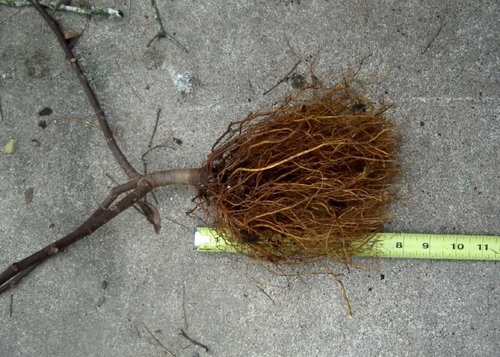
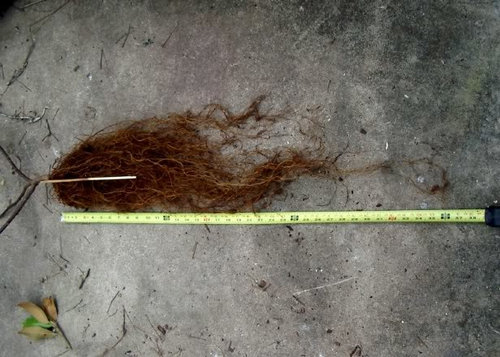
Here is a picture of a rooted LSU Purple cutting I received last year. As George can attest, it was a very small cutting with two or three small roots.

As you can see it put on tremendous root growth this year. The tape is stretched out to 39 inches and their is a copstick on the roots to give you an idea of how thick the root mass is. The roots had fully circled the container. Here is what it looks like after my first pass at root pruning:

The roots of this tree were wrapped and it is currently residing in my fridge. When I pot it up, I will cut the roots again to about three inches long and thin the mass out.

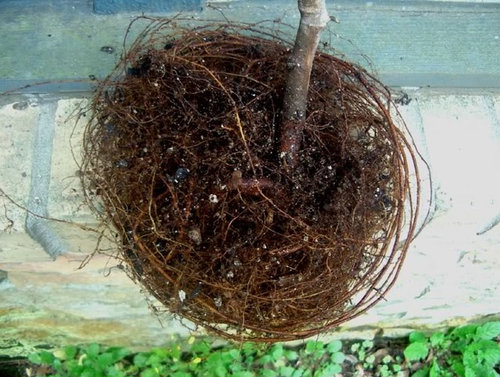
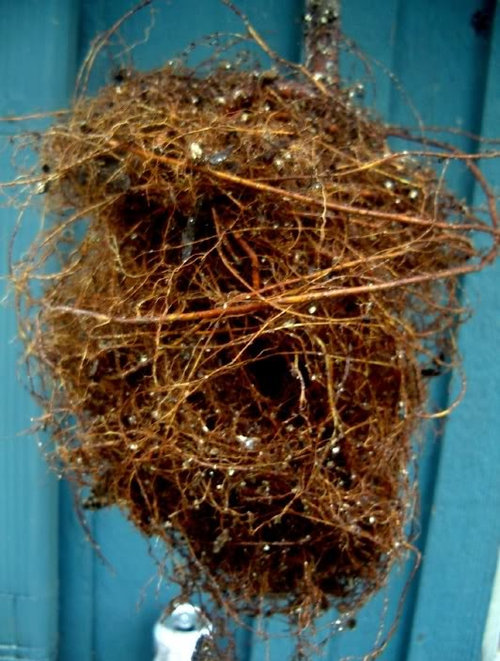
Here is another tree's roots sans growing medium, but still retaining the shape of the container:


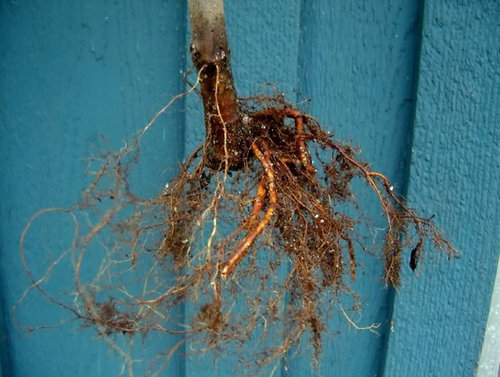
Here is the same tree after (significant) root pruning and ready to go back into the same sized container:

~james

p.s. if you live in an area with fire ants, check for them before you plunge your hands into the root ball.

Comments (10)

  • 19 years ago
    last modified: 11 years ago

    James, Thanks for the pruning information. Will these cuttings, following the pruning you've done produce fruit this summer? I didn't know enough to do this with my last year's spring cuttings. Most were pot bound in 4 inch pots when I transplanted them to bigger pots..unprunded. When is the best time to root prune? I have cuttings started in Jan in 4 inch pots. Three have sprouted leaves. I do not think they are ready for bigger pots yet except that one has roots are coming through the bottom of the pot and two that are just showing green but no leaves yet also have roots coming through the bottom of the pots. Any suggestions?

    Peg

  • 19 years ago
    last modified: 11 years ago

    Peg,

    Al (Tapla) once posted about potting up without bare-rooting/root pruning. He indicated what happens is the original growing media becomes hard and begins to girdle the roots. I witnessed this with a cutting I felt had out grown its small pot but it was too late in the season to bare-root. When I pulled it out of its container, the new growing medium fell off without much effort. The original growing medium was extremely hard (harder than any other) and difficult to remove.

    The two pictured should fruit for me this year (If I ever get it back into a container, its currently in my fridge). It may have a slight set back, but should quickly recover. I would expect that some of the cuttings I rooted last year will bear fruit this year.

    My method for bare-rooting is as follows: Once removed from the container, I massage the bottom of the root ball. I find that once the bottom loosens up, the rest goes much more quickly. I poke at root ball with a bamboo chopstick to dislodge some of the growing medium. Then I hold the tree by the base of the trunk and knock the root ball against the inside of a larger bucket or my hand to knock off the rest. Once the roots are mostly bare, I will use the chopstick (or a bamboo skewer if the roots are very fine) to untangle the roots. If the roots are severely tangled, I'll go ahead and begin trimming before untangling them (usually I clip one or two of the thickest/longest and pull them out, and the rest becomes much easier to untangle.) After untangling the roots I will clip a few of the thickest roots and then trim the root mass to fit into the pot. I tend to root prune heavily, as shown in the second set of pictures. I like the tree to have room in the container to grow in. If it seems like pruning for the container is going to leave the root mass out of balance (too small compared) with the top of the tree, then it is time to move up to a larger container. For a first year cutting, you don't need to leave much of the root mass at all. Generally (for me using the Airpots shown in another post), the rooted cuttings should be potted up 6 months after rooting. I know others use a much sooner schedule.

    The best time to root prune is while the tree is dormant. As to when, I have been giving that some thought in the past few weeks. I *THINK* it might be different in the north vs in the south. It is a very popular notion that fall is the best time for planting. I am convinced (at least in the south) the same holds true for repotting. The wisdom suggests that during the winter months, the roots will (re)establish themselves so when spring comes around much of the effort goes to producing top growth. I would think the same would go for a containerized tree, although I am not sure how that would work with an over wintered tree in the colder climates. This idea is important to me, and am very open to opposing views, since I travel so much and the past few years, I've had timing issues which could be solved if I moved to fall transplant schedule.

    Also, it is conventional wisdom not to disturb the roots during the growing season. The plants need a "recovery" time from root pruning leaving it without the ability to take in moisture and nutrients during this time. I'm not sure how important this is. I think I am going to sacrifice a couple of extra trees this summer and bare-root them during the middle of August to see if they survive.

    The two showing green buds are prime candidates to be root pruned and repotted. Alternatively, you could remove them (including the ones with leaves) from their current containers, loosen and cut any roots that may be wrapping around the root ball, then pot up with the anticipation of bare-rooting and repotting during the next dormancy period.

    One other thing, if you are concerned about not getting so many figs the season after root pruning, you could try a two or three year root pruning schedule and alternate which trees get pruned. This is also good when you have too many trees to easily do in one year.

    good luck,
    ~james

  • 19 years ago
    last modified: 11 years ago

    Very good information James. I'm impressed.

    I'll make a couple of comments and a suggestion, First, I think that you'll find little (except perhaps anecdotal) information to support root-pruning/repotting of deciduous trees in general and F. carica specifically in fall. Tree wounds from pruning and recovery in general occur fastest when the tree is making food, so it is usually best to undertake root work (and particularly extensive root work) during quiescence and very near the anticipated onset of growth (at or just before bud movement in spring).

    Then, on the subject of major root work when trees are in leaf: It can be done, but I would only attempt it in emergency situations. In the case of pruning roots during quiescence, and even though you would likely also do some top pruning at the same time, canopy pruning is not a physiological necessity. Quiescent trees after root work will kind of "self-determine" the number of buds to activate and shed those they cannot support. Trees that have their roots substantially disturbed (bare rooted and/or pruned) while in leaf, cannot do this and will need to be put into intensive care to survive. A hard canopy reduction/pruning, cool shade, often mist and some accommodation to reduce transpirational loss should be expected.

    Last, I have a suggestion. Your root work is very good and you've removed an appropriate volume of rootage. If you notice the last pic that you posted above, there are adventitious roots emanating from old branch attachment sites above the primary root mass. Remove those before you repot. They will complicate things in subsequent root work and entice you to plant deeper than you should. Treat the main mass of roots as though there is a basal flare there - eventually there will be.

    For others reading this: When you undertake root-pruning like this, the tree will be in jeopardy of toppling from its container. Securing it with a stake or guy wire will help prevent this and help fractionalize the time it takes the tree to re-establish by helping to prevent breakage of hair-roots from wind, jostling, etc.

    I hope others appreciate the effort you went to as much as I, and join me in thanking you for what you've presented. It's sound physiology and should be adopted by any wishing to keep a tree containerized and growing with good vitality for a lifetime.

    Good job - well done, Al

  • 19 years ago
    last modified: 11 years ago

    James and Al:
    Wow! what a wealth of information. I can't thank you enough for the time an effort and the instruction. I had written this post a few days ago. Just as I was about to submit it AOL kicked me off. Poof!

    You will both probably cringe at what I did before this newbie knew any better. I have one tree, 4th year, approx. 4.5 feet, name unkown, broke dormancy in Dec. and was in dire need of a bigger container. It has 2 main branches and 4 smaller ones. Before it got leaves I had to transplant it. It was hard for me to handle. The roots were stuck to the pot and I had to break it to get the tree out. I then used a hatchet to chop off about 4 inches of roots at the bottom, repotted it and brought it inside. About a week or so later before it had leaves it put out 24 breba that schriveled and dropped off. (I expected that). It is now in full leaf, vigorous new growth and I can see tiny figs forming. This particular tree is so vigorous I don't think anything could kill it, even my stupidity.

    I appreciate both of your instructions as my cuttings and "babies" may not be so hardy. I've noticed that my spring cuttings that were transplanted to larger pots which seem to be adequate for the size of the plant also have roots coming thru the bottom of the pots in less than 6 mos.

    While browsing at the library I read that when planting outdoors one should line the hole with concrete blocks to prevent the roots from spreading. I have no intention of planting outside but I wondered if anyone has ever heard of this.

    Many thanks, again, James and Al.

    Peg

  • 19 years ago
    last modified: 11 years ago

    Peg,

    Two years ago, I split a tree with two trunks branched under the soil line, by sliding a shovel between the trunks and stomping down on it. This was after the tree broke dormancy. It survived. The trees will tolerate a lot of (mis)care.

    I assume the article/book was suggesting to prevent the roots from growing from the container into the ground. I have not found that to be necessary. After all, you could elevate the container and get the same effect. However, if you did leave your container on the ground and the roots spread into the soil, you could prune those roots away at the end of the growing season (before then they will probably be somewhat beneficial to the tree).

    ~james

  • 19 years ago
    last modified: 11 years ago

    James,

    The Fig section of the garden book I was referring to was for direct in ground planting not in ground container. It just struck me as curious. I'll probably never find the book again. The branch Library I usually use is in temporary quarters while the library is undergoing renovation and expansion. A good portion of the books had to be sent back to the main library which is huge. I get tired just walking around it.

    Now that I have gotten the, "Fig Bug", and have some different varities of babies started I like to watch their differing progress. I used different size containers when transplanting the cuttings depending on size of the top growth. It seems to me that those in the smaller pots are growing faster and are of a better shape that those in the larger pots. Maybe just my imagination but I'll contine to observe and see what happens. These are not a year old yet.

    FedEx just delivered the cuttings from UCD. I asked for 4, Br. Turkey, Celeste, Sal's and Hearty Chicago. I got Br. Turkey from Jack and Sal's from Gene in the meantime so didn't need them. They sent 3 Br. Turkey and 1 Celests. I'm glad to get them. I lost the name tag on 2 of Jacks cuttings so at this point I'm not sure which is Br. Turkey. Now I'll be able to identify it when these cuttings sprout.

    Peg

  • 19 years ago
    last modified: 11 years ago

    Hi All,

    So I was looking at this post again and noticed something I failed to appreciate the first time around. It seems to me that there was very little root branching on the LSU P. I don't know if they grew this way or if I lost fine roots during bare-rooting, but the pictures seem to support this idea. Has anyone else noticed this on any of their trees?

    ~james

  • 18 years ago
    last modified: 11 years ago

    Hi James,

    How's the root prune tree doing? I prune my Stella hard, like leaving less than a quarter of root mass behind without doing anything to the top, it is doing well. I root prune it in early spring. I did the same to 2 other trees where I had to dig from a friend's yard & both are doing well with fruits.

    Paully

  • 5 years ago

    This information is very interesting… I have a question though; I live in Honolulu so we don’t have seasons per se. I mean there’s never a cold time. So I assume route pruning can be done when necessary to repot a plant? I have three ficus trees, parted and now about 8 feet tall. One of the trees grew in such a way that I was able to cut the smaller branch or trunk from the main tree and it seems to be doing very well… But when I reported both of these into larger pots the root ball was solid and hard and I did my best to loosen things up but I was not aware at the time of the fact that we can cut the roots down. I guess what my question is, first because we don’t have cold and hot seasons I can do this at any time of year? And secondly why is it important to cut back the roots of these trees… Disregarding the fact it they were original parts became too small. Not sure that my question makes any sense to you but I wasn’t aware of her of the importance of trimming the roots !

  • 5 years ago

    In most cases, figs will slow down during certain months of the growth cycle. Repot hardy figs while dormant just before budswell or while they still have leaves but have entered a period of slowed growth.

    It's important to maintain roots through root-pruning because eventually the pot will become almost entirely full of heavy roots with no uncolonized space in which the fine roots that do all the plant's heavy lifting can grow. This condition can easily and quickly sap more than 90% of your plant's potential in terms of growth and yields, not to mention appearance and vitality. Potting up is a half-measure that partially and very temporarily relieves some of the limitations imposed by root congestion. It also ensures the lion's share of the limitation the congestion imposes becomes a permanent part of the plant's existence; and, this is true even if at some point the plant was planted out (in the landscape). Something I wrote:

    Repotting vs Potting Up

    I often explain the effects of repotting vs potting up like this:

    Let's rate growth/vitality potential on a scale of 1-10, with 10 being the best. We're going to say that trees in containers can only achieve a 9 because container culture is inherently somewhat limiting. Let's also imagine that for every year a tree goes w/o repotting or potting up, its measure of growth/vitality slips by 1 number, That is to say, you pot a tree and the first year it grows at a level of 9, the next year, an 8, the next year a 7. Let's also imagine we're going to go 3 years between repotting or potting up.

    Here's what happens to the tree you repot/root prune:

    year 1: 9

    year 2: 8

    year 3: 7

    repot

    year 1: 9

    year 2: 8

    year 3: 7

    repot

    year 1: 9

    year 2: 8

    year 3: 7

    You can see that a full repotting and root pruning returns the plant to its full potential within the limits of other cultural influences for as long as you care to repot/root prune.

    Looking now at how woody plants respond to only potting up:

    year 1: 9

    year 2: 8

    year 3: 7

    pot up

    year 1: 8

    year 2: 7

    year 3: 6

    pot up

    year 1: 7

    year 2: 6

    year 3: 5

    pot up

    year 1: 6

    year 2: 5

    year 3: 4

    pot up

    year 1: 5

    year 2: 4

    year 3: 3

    pot up

    year 1: 4

    year 2: 3

    year 3: 2

    pot up

    year 1: 3

    year 2: 2

    year 3: 1

    This is a good conceptual illustration of the influence tight roots have on a woody plant's growth/vitality. You might think of it for a moment in the context of the longevity of bonsai trees vs the life expectancy of most trees grown as houseplants, the difference between 4 years and 400 years lying primarily in how the roots are treated.

    Long Term Care of Trees in Containers might also prove helpful.

    Al

Sponsored